Variable-Speed Pool Pump
ProductOverview
A pool pump is the circulation heart of any residential or commercial swimming pool system. Modern variable-speed pumps replace older fixed-speed AC motors with permanent magnet brushless motors driven by electronic variable-frequency drives (VFDs), achieving 30–70% energy savings while maintaining water clarity and chemical balance.
A typical pool pump operates 6–12 hours daily, drawing 30–150 gallons per minute (GPM) from the pool skimmer and main drain, passing water through the filter for particle removal, then returning heated and treated water back to the pool. The pump must overcome the pressure drop across the filter (~10–30 psi), heater (~5 psi), and plumbing runs (~5–10 psi), totaling 20–50 psi operating head.
Pump Architecture
The Pump Wet End & Impeller comprises a two-stage centrifugal assembly: water enters through the inlet, accelerates across the first First-Stage Impeller (3–4 inch diameter), decelerates in the Diffuser Vane Ring (converting velocity to pressure), re-accelerates through the second Second-Stage Impeller (2–3 inch diameter), and exits at discharge port.
Two-stage design is essential: a single impeller maxes out around 40 psi at 3450 RPM. Two stages in series generate 80+ psi, necessary to overcome filter backpressure and heater/equipment resistance simultaneously. Flow is continuous, no intake valve, so the pump must run even at low speed, though at reduced GPM.
The Permanent Magnet Brushless Motor is a permanent magnet electronically commutated (BLDC) design, not a traditional induction AC motor. The Stator Winding Assembly contains copper windings; the Permanent Magnet Rotor is a neodymium ring. The VFD electronically switches current timing (commutation) to the stator coils in sync with rotor position, eliminating mechanical commutator brushes and enabling variable speed via frequency modulation.
Efficiency & Speed Curves
Fixed-speed AC pumps run continuously at 3450 RPM (60 Hz), delivering full flow and pressure regardless of actual demand. If the pool is clear or heater is off, 80% of the motor's power is wasted as excess flow and friction heat.
Variable-speed pumps adjust RPM proportionally to demand:
- Low speed (600–1000 RPM): 20–30 GPM, 3–5 psi output, minimal power (0.3–0.5 kW), ideal for filtration overnight.
- Medium speed (1400–2100 RPM): 70–100 GPM, 20–30 psi, moderate power (2–4 kW), typical daytime circulation.
- High speed (2800–3450 RPM): 130–150 GPM, 50–60 psi, full power (5–7 kW), heating or heavy-duty cleaning.
A speed curve is programmed into the Variable-Frequency Drive (VFD) (VFD): as filter pressure rises (indicating saturation), the VFD automatically increases pump RPM to maintain minimum flow. Conversely, if pressure drops (clean filter), RPM decreases. This pressure-matching algorithm uses feedback from a Motor Current Sensor or dedicated pressure transducer.
Energy Impact: A typical residential pool (25×13×5 ft) circulating 75 GPM requires ~3–4 kWh/day at fixed speed. Variable-speed operation at average 40% speed reduces consumption to 1.5–2 kWh/day, a 50% annual savings ($300/year at $0.12/kWh).
Drive Electronics
The Variable-Frequency Drive (VFD) module accepts 240V single-phase AC input (standard pool breaker), internally converting it to high-voltage DC (300–400V), then using IGBT Power Module transistors to synthesize variable 0–240V three-phase output.
Key stages:
- Bridge Rectifier: Converts 240V AC to ~300V DC.
- Boost Capacitor: Stores energy, smoothing DC bus for inverter operation.
- IGBT Inverter: Synthesizes three-phase AC at variable frequency (0–60 Hz = 0–3450 RPM).
- Control PCB: Microcontroller managing ramp rates, overload protection, and feedback loops.
A Motor Current Sensor (Hall-effect or shunt) monitors motor current in real-time. If current spikes (e.g., impeller cavitation), the VFD reduces frequency to protect the motor. Soft-start ramps frequency gradually over 10–30 seconds, avoiding mechanical shock that inrush current would cause.
Protection features:
- Thermal Overload: Cuts frequency if case temperature exceeds 65 °C.
- Dry-Run Protection: Detects loss of suction (negative pressure), halting pump before cavitation damages impeller.
- Phase Loss: Detects single-phase loss in 3-phase input, shutting down (optional on single-phase models).
Wet-End Materials
The Pump Body Casting (front and rear halves) is cast iron or reinforced plastic, rated 100+ psi. Internal surfaces contacting pool water are acid-resistant (chlorinated water, pH 7–7.8, demands corrosion-resistant alloys). The Front Pump Body and Rear Pump Body are bolted together with a Pump Housing Gasket elastomeric seal between them.
Suction Inlet Flange and Discharge Outlet Flange are threaded NPT (National Pipe Thread) or flanged couplings. A Strainer Basket Bowl (clear plastic bowl visible on pump top) contains the Basket Screen strainer, trapping hair and leaves before they reach the impeller.
The Drive Shaft is stainless steel (316 grade for chemical resistance), rotating at 600–3450 RPM. Bearings are sealed ball-type (Shaft Mechanical Seal Assembly), preventing water from migrating into the motor cavity. A mechanical shaft seal (cartridge) on the motor-side of the impeller (dual-seal design) is critical, a failed seal allows pool water into motor windings, causing failure.
Installation & Piping
Pumps are mounted on vibration-isolating feet (Vibration Isolation Foot) to reduce operational noise transmission to deck/building structure. The Pump Mount & Isolation base plate is bolted to concrete pad or equipment pad.
Suction-side plumbing (skimmer/main drain to pump inlet) must be airtight, any air leak causes cavitation (bubble formation in the impeller), reducing pressure and damaging the impeller over time. Suction lines are typically 2–3 inch PVC or vinyl, sloped downward to pool, with minimal bends.
Discharge-side plumbing (pump outlet to filter inlet) tolerates some pressure but should minimize long runs to reduce energy loss. Typical discharge is 2 inch PVC to filter, then 2 inch return to pool.
Maintenance
Weekly: Empty Basket Screen (remove visible debris). Check for air leaks (hissing sound at suction line).
Monthly: Inspect pump housing for water seepage at shaft seal. If weeping, seal service required soon.
Annually: Replace strainer basket if it becomes brittle. Inspect impeller for cavitation damage (pitting). Check motor cooling fan (if present) for debris blockage.
Every 3–5 Years: Replace shaft seal cartridge if leaking worsens. Drain pump and heater for winterization in freeze climates.
Variants
Single-Speed AC (Legacy): Traditional 1–3 HP induction motor, fixed 3450 RPM, 60–80% efficiency. No VFD needed, lower upfront cost (~$600), but 50–70% higher operating cost. Increasingly phased out by code in US pools (see energy regulations).
High-Head Pump: 3–5 stage impellers for elevated pools, waterfall features, or long plumbing runs; 80–100+ psi capability, higher noise.
Submersible/In-Pit: Motor and pump combined in sealed housing, submerged in water; used for infinity pools and landscape installations.
Dual-Pump Systems: Two smaller pumps (1.5 HP each) plumbed in parallel, offering redundancy and flexibility in hybrid pool/spa configurations.
Variable-Speed Pool Pump parts and their functions
7 top-level parts · 62 parts in total · full bill of materials below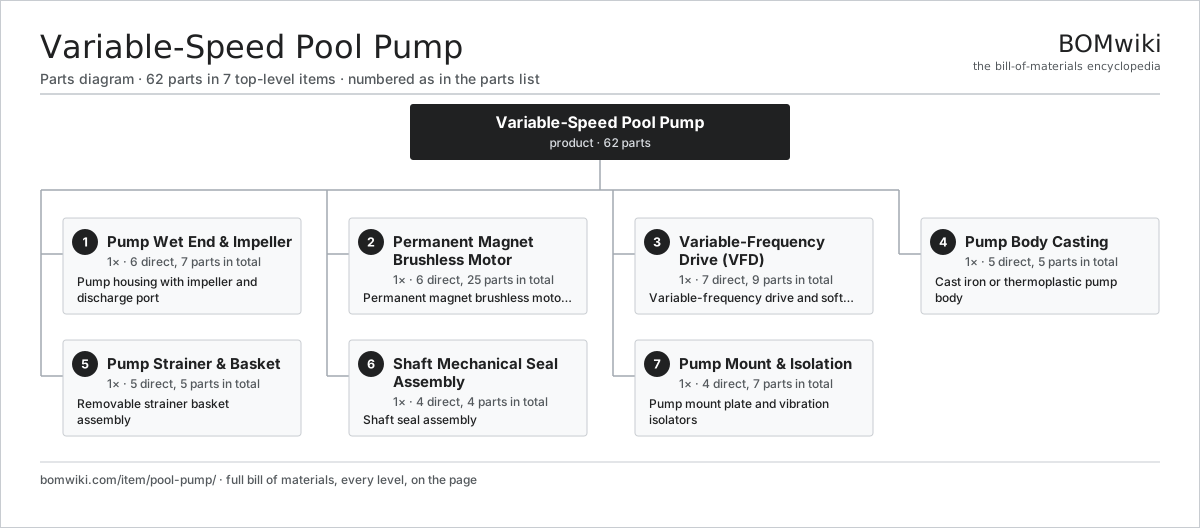
| # | Part | Qty | What it does |
|---|---|---|---|
| 1 | Pump Wet End & Impeller 6 parts | 1× | Pump housing with impeller and discharge port |
| 2 | Permanent Magnet Brushless Motor 6 parts | 1× | Permanent magnet brushless motor 1–3 HP |
| 3 | Variable-Frequency Drive (VFD) 7 parts | 1× | Variable-frequency drive and soft starter |
| 4 | Pump Body Casting 5 parts | 1× | Cast iron or thermoplastic pump body |
| 5 | Pump Strainer & Basket 5 parts | 1× | Removable strainer basket assembly |
| 6 | Shaft Mechanical Seal Assembly 4 parts | 1× | Shaft seal assembly |
| 7 | Pump Mount & Isolation 4 parts | 1× | Pump mount plate and vibration isolators |
3D model
No 3D model yet. Have a CAD file of this? Add a 3D model. STL renders right on this page; STEP, FreeCAD, and OpenSCAD sources are welcome too (openly licensed, like all 3D models on BOMwiki).
Build & assembly graph
expand / collapse · shared sub-assemblies converge · links to related products · est. labourTap an assembly to expand/collapse · tap a part to open it · use “Open page” for any node · drag to pan, scroll to zoom.
Bill of materials for Variable-Speed Pool Pump
7 top-level lines · 48 rows shown · 62 parts total · indented to 3 levels| # | Item / sub-assembly | Part no. | Qty/assy | Ext. qty | Parts | Type |
|---|---|---|---|---|---|---|
| 1 | Pump Wet End & Impeller 6 parts | pool-pump-wet-end | 1× | 1 | 7 | assembly |
| 1.1 | First-Stage Impeller | pool-pump-impeller-stage-1 | 1× | 1 | · | part |
| 1.2 | Second-Stage Impeller | pool-pump-impeller-stage-2 | 1× | 1 | · | part |
| 1.3 | Diffuser Vane Ring | pool-pump-diffuser | 1× | 1 | · | part |
| 1.4 | Suction Inlet Flange | pool-pump-intake-port | 1× | 1 | · | part |
| 1.5 | Discharge Outlet Flange | pool-pump-outlet-port | 1× | 1 | · | part |
| 1.6 | Ball Bearing | ball-bearing | 2× | 2 | · | part |
| 2 | Permanent Magnet Brushless Motor 6 parts | pool-pump-motor | 1× | 1 | 25 | assembly |
| 2.1 | Stator Winding Assembly | pool-pump-stator | 1× | 1 | · | part |
| 2.2 | Permanent Magnet Rotor | pool-pump-rotor-magnet | 1× | 1 | · | part |
| 2.3 | Rotor Assembly 4 parts | rotor-assembly | 1× | 1 | 19 | assembly |
| 2.3.1 | Rotor Shaft | rotor-shaft | 1× | 1 | · | part |
| 2.3.2 | Rotor Core | rotor-core | 1× | 1 | · | part |
| 2.3.3 | Neodymium Magnet | neodymium-magnet | 16× | 16 | · | part |
| 2.3.4 | Ball Bearing | ball-bearing | 1× | 1 | · | part |
| 2.4 | Drive Shaft | pool-pump-shaft | 1× | 1 | · | part |
| 2.5 | Oil Seal | oil-seal | 2× | 2 | · | part |
| 2.6 | Coil Spring | coil-spring | 1× | 1 | · | part |
| 3 | Variable-Frequency Drive (VFD) 7 parts | pool-pump-drive-electronics | 1× | 1 | 9 | assembly |
| 3.1 | IGBT Power Inverter Module | pool-pump-vfd-module | 1× | 1 | · | part |
| 3.2 | VFD Control PCB | pool-pump-control-pcb | 1× | 1 | · | part |
| 3.3 | IGBT Power Module | igbt-module | 2× | 2 | · | part |
| 3.4 | DC Bus Capacitor | pool-pump-boost-capacitor | 1× | 1 | · | part |
| 3.5 | Microcontroller | mcu | 1× | 1 | · | part |
| 3.6 | Motor Current Sensor | pool-pump-current-sensor | 1× | 1 | · | part |
| 3.7 | Connector | connector | 2× | 2 | · | part |
| 4 | Pump Body Casting 5 parts | pool-pump-housing | 1× | 1 | 5 | assembly |
| 4.1 | Front Pump Body | pool-pump-body-front | 1× | 1 | · | part |
| 4.2 | Rear Pump Body | pool-pump-body-rear | 1× | 1 | · | part |
| 4.3 | Pump Housing Gasket | pool-pump-housing-gasket | 1× | 1 | · | part |
| 4.4 | Fastener Set | fastener-set | 1× | 1 | · | part |
| 4.5 | Drain Plug | pool-pump-drain-plug | 1× | 1 | · | part |
| 5 | Pump Strainer & Basket 5 parts | pool-pump-basket | 1× | 1 | 5 | assembly |
| 5.1 | Strainer Basket Bowl | pool-pump-basket-housing | 1× | 1 | · | part |
| 5.2 | Basket Screen | pool-pump-basket-element | 1× | 1 | · | part |
| 5.3 | Basket Cover Lid | pool-pump-basket-lid | 1× | 1 | · | part |
| 5.4 | O-Ring Set | oring-set | 1× | 1 | · | part |
| 5.5 | Pump Basket Isolation Valve | pool-pump-ball-valve | 1× | 1 | · | part |
| 6 | Shaft Mechanical Seal Assembly 4 parts | pool-pump-mechanical-seal | 1× | 1 | 4 | assembly |
| 6.1 | Seal Cartridge Assembly | pool-pump-seal-cartridge | 1× | 1 | · | part |
| 6.2 | Seal Shaft Sleeve | pool-pump-seal-bushing | 1× | 1 | · | part |
| 6.3 | Oil Seal | oil-seal | 1× | 1 | · | part |
| 6.4 | Seal Flush Connection | pool-pump-flush-port | 1× | 1 | · | part |
| 7 | Pump Mount & Isolation 4 parts | pool-pump-mounting | 1× | 1 | 7 | assembly |
| 7.1 | Mounting Base Plate | pool-pump-base-plate | 1× | 1 | · | part |
| 7.2 | Vibration Isolation Foot | pool-pump-isolation-feet | 4× | 4 | · | part |
| 7.3 | Electrical Conduit Entry | pool-pump-conduit-fitting | 1× | 1 | · | part |
| 7.4 | Fastener Set | fastener-set | 1× | 1 | · | part |
Something wrong in this list? Report a problem with this BOM.
Related products
same domain, ranked by shared parts Water Booster Pump
151 parts · shares 10 with this page
Water Booster Pump
151 parts · shares 10 with this page
 Shallow-Well Jet Pump
49 parts · shares 9 with this page
Shallow-Well Jet Pump
49 parts · shares 9 with this page
 Heat-Pump Water Heater
152 parts · shares 9 with this page
Heat-Pump Water Heater
152 parts · shares 9 with this page
 Greywater Recycling Unit
77 parts · shares 9 with this page
Greywater Recycling Unit
77 parts · shares 9 with this page
 HDPE Pipe Butt-Fusion Machine
110 parts · shares 8 with this page
Sewage/Effluent Pump
47 parts · shares 8 with this page
HDPE Pipe Butt-Fusion Machine
110 parts · shares 8 with this page
Sewage/Effluent Pump
47 parts · shares 8 with this page
Sourcing: possible vendors
Browse the supplier directory → Prices, MOQ, and lead times are algorithmic estimates, not quotes, and not claims about these companies. Company mappings are curated by keyword; est. price band $20–$3k. How estimates work| Vendor | HQ | Specialty | MOQ | Lead time |
|---|---|---|---|---|
|
🇺🇸Kohler
kohler.com ↗
|
Kohler, US | Plumbing fixtures | 1,000 units | 6–12 wks |
|
🇯🇵TOTO
toto.com ↗
|
Kitakyushu, JP | Sanitaryware | 1,000 units | 6–12 wks |
|
🇯🇵LIXIL
lixil.com ↗
|
Tokyo, JP | Plumbing (Grohe, American Std) | 1,000 units | 6–12 wks |
|
🇺🇸Moen
moen.com ↗
|
North Olmsted, US | Faucets & fixtures | 1,000 units | 6–12 wks |
|
🇨🇭Geberit
geberit.com ↗
|
Rapperswil, CH | Sanitary systems | 1,000 units | 6–12 wks |
1,156-word article