Pool Sand Filter
ProductOverview
A sand filter is a passive pressure-vessel containing graded silica sand media that traps suspended particles as pool water flows downward through the bed. It is the most common residential pool filter due to low initial cost ($300–800), simple operation, and proven 50+ year track record. Sand filters require periodic backwashing (reversing flow to clean media) every 4–8 weeks, but the sand itself lasts 3–5 years before degradation.
Unlike cartridge filters (higher surface area, frequent element replacement) or diatomaceous earth (DE) filters (superior clarity but hazardous powder disposal), sand filters balance cost, performance, and maintenance for typical residential 20–40 GPM circulation.
Tank & Pressure Vessel Design
The Pressure Vessel Tank is a cylindrical fiberglass-reinforced plastic (FRP) or concrete vessel, 20–24 inches diameter, rated 50–100 psi working pressure. The tank is constructed in two halves (top and bottom) bolted together with a pool-sand-filter-tank-gasket elastomeric seal. The Tank Top Collar Ring at the top distributes the lateral manifold weight.
Inside, the Drain Sump Chamber is a sloped or conical chamber at the base, converging flow to a single outlet port connected to the Six-Position Multiport Valve control valve. The Tank Top Cover Plate (bolted or hinged) provides access for media replacement.
The tank must withstand internal pressure created by incoming pump flow (30–100 psi typical) and backwash flow. A relief valve (usually integral to multiport) prevents over-pressure.
Sand Media Grading
The Silica Sand Filtration Media assembly is a three-stage graded bed:
- Top Layer (Coarse): 0.8–1.0 mm silica sand (~25 kg) traps large debris and serves as rapid settling zone.
- Middle Layer (Medium): 0.4–0.6 mm silica sand (~150 kg) is the primary filtration layer, capturing 10–20 µm particles.
- Bottom Layer (Fine): 0.25–0.4 mm silica sand (~75 kg) final-polishing layer.
- Support Base: 3–4 mm pea gravel (~25 kg) prevents fine sand from escaping through Lateral Distribution Manifold.
The grading is intentional: coarse on top allows rapid water throughput without channeling (preferential flow path); fine at bottom captures smallest particles. Over time, backwashing mixes layers slightly, and fine sand settles, repacking should be done every 3–5 years by replacing the top 10–20 kg of "fines."
Filtration Mechanism & Flow Rates
During normal filter mode, water enters the Tank Top Collar Ring inlet, distributes across the sand bed, and percolates downward. Particles larger than ~20 µm are mechanically trapped in the sand matrix by three mechanisms:
- Mechanical straining: Particles larger than sand pore size.
- Interception: Particles deflected by sand grains, colliding and sticking.
- Flocculation: Dosed chemical polymers clump fine particles, increasing effective size.
Typical filtration rate is 12–18 GPM/ft² of sand surface. A 600 mm (24 inch) diameter tank has ~0.28 m² (3 ft²) surface, so ideal flow is 36–54 GPM. Many residential pools operate 30–75 GPM, trading some water clarity for convenience (shorter circulation time).
As the sand clogs with debris, pressure differential increases: clean sand = 5–10 psi, saturated sand = 20–25 psi. A Differential Pressure Switch (setpoint 20 psi differential) or Pressure Gauge Assembly alerts the operator: "backwash now."
Backwashing Process
When pressure differential reaches 20–25 psi, the Six-Position Multiport Valve valve is rotated to backwash mode. This reverses flow direction, water enters from below through the drain sump, flows upward through the sand bed at high velocity (40–60 psi), fluidizing the sand and dislodging trapped sediment.
Backwash sequence (typical 5–8 minutes):
- Backwash mode (2–3 min): Pump runs at full speed, water flows upward. Dirty water and sand grains tumble. Outlet is directed to waste/drain.
- Rinse mode (1–2 min): Multiport switched to rinse, water flows downward again (resettling media) but output still goes to waste, carrying remaining fine sediment.
- Filter mode: Return multiport to normal filter, circulation resumes.
Result: Sand is re-packed, fines are removed, and filter pressure drops back to 5–8 psi. The pool has lost 30–100 gallons of treated water during backwash, this water must be replaced from the hose before circulation resumes.
Multiport Control Valve
The Six-Position Multiport Valve is a 6-position selector valve with an internal rotor containing port passages:
- Filter: Normal operation, downward flow.
- Backwash: Reverse upward flow, waste outlet.
- Rinse: Downward flow, waste outlet, settles sand.
- Closed: Isolates filter completely (emergency).
- Waste: Downward flow, direct to waste (bypasses filtration, used for lowering pool level).
- Recirculate: Downward flow, returns to pool without filtration (if needed for quick circulation without cleaning).
The valve is manually operated (lever handle) or motorized (Multiport Actuator Motor, 24V AC actuator) enabling automated backwash on timer or pressure signal.
Pressure Monitoring
The Pressure Gauge Assembly (0–100 psi analog dial) displays absolute tank inlet pressure. A differential gauge (optional, 0–50 psi) shows the difference between inlet and outlet, more directly indicating sand saturation.
A Differential Pressure Switch is a setpoint switch that closes at, e.g., 20 psi differential, triggering an alarm light or buzzer. Some systems use an electronic Pressure Sensor feeding 4–20 mA signal to a pool controller (Pool Automation Controller) for automated backwash.
Maintenance & Replacement
Weekly: Check pressure gauge (should be 5–10 psi on clean filter). Empty pump strainer basket.
Every 4–8 weeks: Backwash when differential pressure reaches 20 psi.
Annually: Deep-clean sand bed with chlorine shock to dissolve algae biofilm.
Every 3–5 years: Replace sand media entirely (200–300 kg load per filter).
Winterization (cold climates): Drain filter completely via Main Tank Drain Valve, remove multiport handle, cover tank opening to prevent ice intrusion.
Sand Quality & Settling
Pool-grade silica sand is washed and graded to remove fines and clay before packaging. When sand is first installed, turbidity (cloudiness) may occur during the first 24–48 hours as fines settle. This resolves without action, running circulation for 2–3 cycles typically clears the water.
Over years, sand degrades via:
- Physical breakage: Hydraulic forces during backwash cause sand grains to fracture.
- Biological growth: Algae and biofilm colonize grain surfaces, reducing effective pore size.
- Salt crystallization: In chlorinated water, mineral deposits on grain surfaces.
Degradation is indicated by:
- Pressure differential reaching 20 psi faster (every 2–3 weeks instead of 4–8).
- Water clarity not improving after backwash.
- Visible clumping in the sand bed.
At this point, sand should be replaced. Some operators refresh by removing and replacing the top 25% (coarse layer) only, a partial solution extending media life 1–2 years.
Variants & Alternative Media
Cartridge Filter: Pleated polyester element (20–50 m² surface area), 5–10 micron nominal. Requires element replacement every 1–2 years ($80–150) instead of sand replacement. No backwashing, element is chemically cleaned annually. Higher initial cost ($500), lower long-term media cost.
Diatomaceous Earth (DE): Fossilized algae powder (30–50 µm, superior clarity). Requires grid or cartridge and DE powder dosing. Disposal of used DE powder is hazardous; not recommended in most jurisdictions today.
Zeolite or Glass Media: Alternative to sand, claims 2–3x longer life. Higher initial cost, minimal adoption in residential sector.
High-Rate Sand (Anthracite): Softer coal-based medium, lower density than silica, slightly better water clarity at cost of faster media degradation.
Pool Sand Filter parts and their functions
7 top-level parts · 40 parts in total · full bill of materials below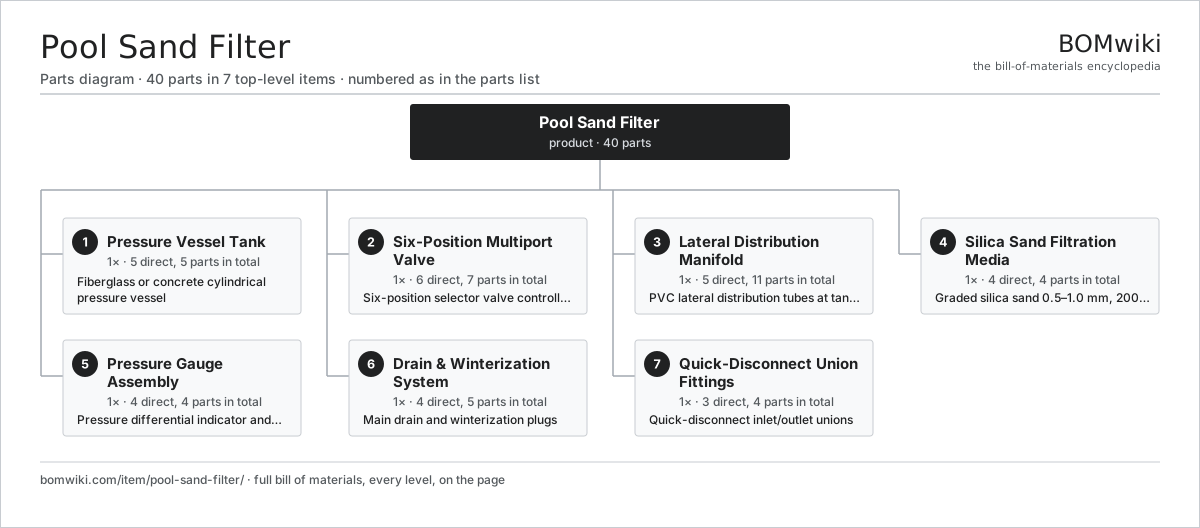
| # | Part | Qty | What it does |
|---|---|---|---|
| 1 | Pressure Vessel Tank 5 parts | 1× | Fiberglass or concrete cylindrical pressure vessel |
| 2 | Six-Position Multiport Valve 6 parts | 1× | Six-position selector valve controlling filtration modes |
| 3 | Lateral Distribution Manifold 5 parts | 1× | PVC lateral distribution tubes at tank base |
| 4 | Silica Sand Filtration Media 4 parts | 1× | Graded silica sand 0.5–1.0 mm, 200+ kg load |
| 5 | Pressure Gauge Assembly 4 parts | 1× | Pressure differential indicator and gauge |
| 6 | Drain & Winterization System 4 parts | 1× | Main drain and winterization plugs |
| 7 | Quick-Disconnect Union Fittings 3 parts | 1× | Quick-disconnect inlet/outlet unions |
3D model
No 3D model yet. Have a CAD file of this? Add a 3D model. STL renders right on this page; STEP, FreeCAD, and OpenSCAD sources are welcome too (openly licensed, like all 3D models on BOMwiki).
Build & assembly graph
expand / collapse · shared sub-assemblies converge · links to related products · est. labourTap an assembly to expand/collapse · tap a part to open it · use “Open page” for any node · drag to pan, scroll to zoom.
Bill of materials for Pool Sand Filter
7 top-level lines · 38 rows shown · 40 parts total · indented to 3 levels| # | Item / sub-assembly | Part no. | Qty/assy | Ext. qty | Parts | Type |
|---|---|---|---|---|---|---|
| 1 | Pressure Vessel Tank 5 parts | pool-sand-filter-tank | 1× | 1 | 5 | assembly |
| 1.1 | Fiberglass Tank Shell | pool-sand-filter-fiberglass-body | 1× | 1 | · | part |
| 1.2 | Tank Top Collar Ring | pool-sand-filter-tank-collar | 1× | 1 | · | part |
| 1.3 | Drain Sump Chamber | pool-sand-filter-drain-sump | 1× | 1 | · | part |
| 1.4 | Tank Top Cover Plate | pool-sand-filter-top-plate | 1× | 1 | · | part |
| 1.5 | Fastener Set | fastener-set | 1× | 1 | · | part |
| 2 | Six-Position Multiport Valve 6 parts | pool-sand-filter-multiport | 1× | 1 | 7 | assembly |
| 2.1 | Multiport Valve Body | pool-sand-filter-valve-body | 1× | 1 | · | part |
| 2.2 | Valve Rotor Assembly | pool-sand-filter-valve-rotor | 1× | 1 | · | part |
| 2.3 | Valve Elastomeric Seat | pool-sand-filter-valve-seat | 1× | 1 | · | part |
| 2.4 | Manual Valve Handle | pool-sand-filter-manual-handle | 1× | 1 | · | part |
| 2.5 | Multiport Actuator Motor | pool-sand-filter-valve-motor | 1× | 1 | · | part |
| 2.6 | Connector | connector | 2× | 2 | · | part |
| 3 | Lateral Distribution Manifold 5 parts | pool-sand-filter-laterals | 1× | 1 | 11 | assembly |
| 3.1 | Lateral Main Riser | pool-sand-filter-lateral-main | 1× | 1 | · | part |
| 3.2 | Lateral Arm Assembly | pool-sand-filter-lateral-arms | 6× | 6 | · | part |
| 3.3 | Slotted Lateral Tubing | pool-sand-filter-lateral-slots | 1× | 1 | · | part |
| 3.4 | Lateral Arm End Caps | pool-sand-filter-lateral-plugs | 1× | 1 | · | part |
| 3.5 | Ball Bearing | ball-bearing | 2× | 2 | · | part |
| 4 | Silica Sand Filtration Media 4 parts | pool-sand-filter-sand-media | 1× | 1 | 4 | assembly |
| 4.1 | Coarse Silica Sand | pool-sand-filter-sand-coarse | 1× | 1 | · | part |
| 4.2 | Medium Silica Sand | pool-sand-filter-sand-medium | 1× | 1 | · | part |
| 4.3 | Fine Silica Sand | pool-sand-filter-sand-fine | 1× | 1 | · | part |
| 4.4 | Support Gravel Base | pool-sand-filter-gravel-support | 1× | 1 | · | part |
| 5 | Pressure Gauge Assembly 4 parts | pool-sand-filter-gauge | 1× | 1 | 4 | assembly |
| 5.1 | Inlet Pressure Gauge | pool-sand-filter-pressure-gauge | 1× | 1 | · | part |
| 5.2 | Differential Pressure Switch | pool-sand-filter-pressure-switch | 1× | 1 | · | part |
| 5.3 | Pressure Sensor | pressure-sensor | 1× | 1 | · | part |
| 5.4 | Gauge Isolation Manifold | pool-sand-filter-gauge-port | 1× | 1 | · | part |
| 6 | Drain & Winterization System 4 parts | pool-sand-filter-drain | 1× | 1 | 5 | assembly |
| 6.1 | Main Tank Drain Valve | pool-sand-filter-drain-cock | 1× | 1 | · | part |
| 6.2 | Threaded Drain Plug | pool-sand-filter-drain-plugs | 2× | 2 | · | part |
| 6.3 | Air Relief Valve | pool-sand-filter-air-relief | 1× | 1 | · | part |
| 6.4 | Connector | connector | 1× | 1 | · | part |
| 7 | Quick-Disconnect Union Fittings 3 parts | pool-sand-filter-unions | 1× | 1 | 4 | assembly |
| 7.1 | Inlet Quick-Disconnect Union | pool-sand-filter-inlet-union | 1× | 1 | · | part |
| 7.2 | Outlet Quick-Disconnect Union | pool-sand-filter-outlet-union | 1× | 1 | · | part |
| 7.3 | Connector | connector | 2× | 2 | · | part |
Something wrong in this list? Report a problem with this BOM.
Related products
same domain, ranked by shared parts Greywater Recycling Unit
77 parts · shares 3 with this page
Greywater Recycling Unit
77 parts · shares 3 with this page
 HDPE Pipe Butt-Fusion Machine
110 parts · shares 3 with this page
HDPE Pipe Butt-Fusion Machine
110 parts · shares 3 with this page
 Heat-Pump Water Heater
152 parts · shares 3 with this page
Heat-Pump Water Heater
152 parts · shares 3 with this page
 Shallow-Well Jet Pump
49 parts · shares 3 with this page
Shallow-Well Jet Pump
49 parts · shares 3 with this page
 Water Booster Pump
151 parts · shares 3 with this page
Water Booster Pump
151 parts · shares 3 with this page
 Hot Tub
60 parts · shares 2 with this page
Hot Tub
60 parts · shares 2 with this page
Sourcing: possible vendors
Browse the supplier directory → Prices, MOQ, and lead times are algorithmic estimates, not quotes, and not claims about these companies. Company mappings are curated by keyword; est. price band $20–$3k. How estimates work| Vendor | HQ | Specialty | MOQ | Lead time |
|---|---|---|---|---|
|
🇺🇸Kohler
kohler.com ↗
|
Kohler, US | Plumbing fixtures | 1,000 units | 6–12 wks |
|
🇯🇵TOTO
toto.com ↗
|
Kitakyushu, JP | Sanitaryware | 1,000 units | 6–12 wks |
|
🇯🇵LIXIL
lixil.com ↗
|
Tokyo, JP | Plumbing (Grohe, American Std) | 1,000 units | 6–12 wks |
|
🇺🇸Moen
moen.com ↗
|
North Olmsted, US | Faucets & fixtures | 1,000 units | 6–12 wks |
|
🇨🇭Geberit
geberit.com ↗
|
Rapperswil, CH | Sanitary systems | 1,000 units | 6–12 wks |
1,236-word article