Porch Swing
ProductOverview
The porch swing is a suspended bench providing comfortable seating for relaxation and social gathering. Unlike fixed chairs, the swinging motion, a gentle oscillation of 2–4 feet per cycle, uses stored gravitational potential energy and momentum to create a rhythmic, meditative experience. The suspension from overhead beams or joists keeps weight off the deck, making swings suitable for porches, gazebos, and pavilions without structural modification.
Structure & Materials
The Bench Frame is traditionally constructed from softwood, eastern white pine, cedar, or spruce, chosen for weather resistance and workability. High-end models use hardwoods such as teak or ipe for greater durability and density. The frame uses mortise-and-tenon joinery, where wooden pegs and glue, rather than metal fasteners, hold the structure together. This avoids hidden corrosion pathways and maintains aesthetic cohesion.
The Seat Slats, typically 1" × 4" planks, are spaced 1⁄2 inch apart for water drainage and air circulation, reducing rot. The Backrest Frame is angled 95–105° from vertical to support the natural curve of the lumbar spine during extended sitting.
The Armrests provide lateral support and a resting surface for arms. Early designs were plain wood; modern versions add Armrest Padding, closed-cell foam or dense polyethylene, wrapped in solution-dyed acrylic fabric rated for UV exposure.
Suspension System
The Suspension System uses Chain Link in either Grade 30 (decorative, light-duty) or Grade 70 (high-strength) steel. Two chains, 6–8 feet long, hang from the frame's front and rear, maintaining horizontal geometry as the swing rocks. Eyebolt anchors pass through the wooden frame and accept the chain's S-hook attachments.
Modern suspensions sometimes integrate Coil Spring dampers to absorb impact at swing terminus, reducing wear on chains and frame. The dampers also attenuate the audible chain rattle common in traditional setups.
Ceiling Installation
The Ceiling Hangers must anchor securely into structural joists, not drywall or decorative beams. Lag Bolt, typically 3/8" galvanized bolts 4–6 inches long, are screwed directly into joist wood. A single joist can typically support 400–600 lbs; larger swings should use two adjacent joists with Hanger Eye assemblies anchored independently.
Mounting Plate, steel plates bearing the eyebolt, distribute clamping force across the joist surface, preventing the eyebolt from pulling through grain. A typical installation places hangers 4–6 feet apart, with chain length adjusted so the swing seat sits 4–8 feet above deck surface.
Motion & Dynamics
A person pushing off can generate a 2–3 foot arc in the first swing cycle. Without external input, the pendulum's period (time for a complete back-and-forth oscillation) depends on chain length: approximately 2.0 seconds for an 8-foot chain. Occupants naturally fall into this rhythm without active effort once the swing begins.
The rated load capacity accounts for dynamic amplification, impact forces when landing in the swing, plus fatigue margin. Grade 70 chain at 3/16" diameter breaks at approximately 2,800 lbf; a 600-lb rated load provides a 4.6:1 safety factor against catastrophic failure.
Maintenance & Longevity
Wooden swings exposed to weather, sun, rain, freeze-thaw cycles, suffer accelerated wear. Cedar and softwood finishes fail within 2–3 years without recoating. Hardwoods like ipe resist weathering naturally but require initial sealing. Annual inspection of chain for rust and wooden frame for cracks is essential; rusted chain should be replaced before structural failure.
Loose joints, creaking when occupied, indicate failed glue lines. Joints can be re-glued and clamped, but if wood is severely splintered, frame replacement is safer than repair. The Chain Link is the most consumable component, typically lasting 7–12 years before surface rust necessitates replacement.
Softwood frames last 5–8 years with annual finish renewal; hardwood or synthetic-material frames approach 20+ years. Swings in covered pavilions outperform exposed porches by 5–10 years.
Porch Swing parts and their functions
4 top-level parts · 56 parts in total · full bill of materials below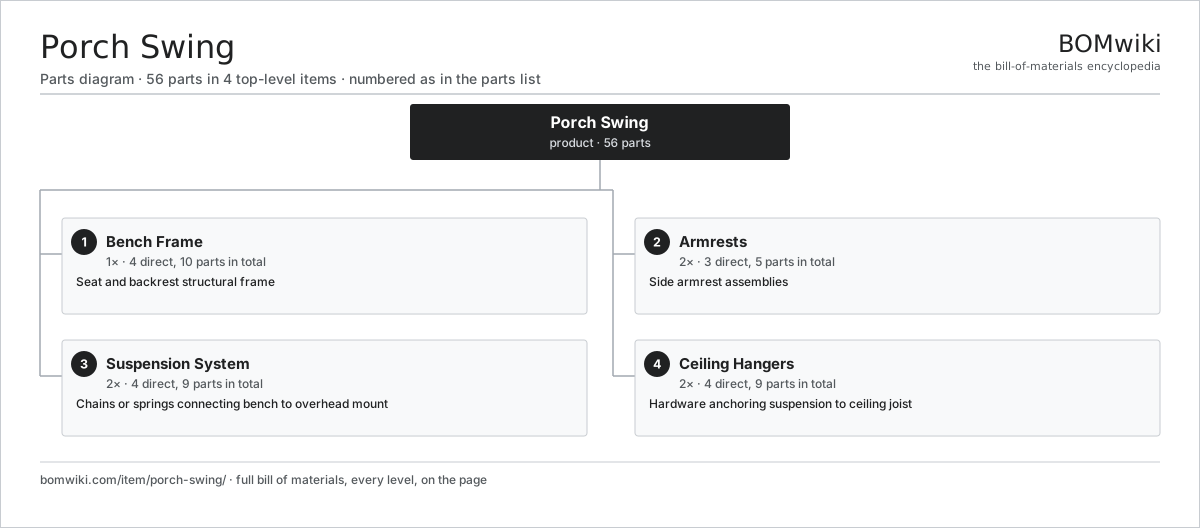
| # | Part | Qty | What it does |
|---|---|---|---|
| 1 | Bench Frame 4 parts | 1× | Seat and backrest structural frame |
| 2 | Armrests 3 parts | 2× | Side armrest assemblies |
| 3 | Suspension System 4 parts | 2× | Chains or springs connecting bench to overhead mount |
| 4 | Ceiling Hangers 4 parts | 2× | Hardware anchoring suspension to ceiling joist |
3D model
No 3D model yet. Have a CAD file of this? Add a 3D model. STL renders right on this page; STEP, FreeCAD, and OpenSCAD sources are welcome too (openly licensed, like all 3D models on BOMwiki).
Build & assembly graph
expand / collapse · shared sub-assemblies converge · links to related products · est. labourTap an assembly to expand/collapse · tap a part to open it · use “Open page” for any node · drag to pan, scroll to zoom.
Bill of materials for Porch Swing
4 top-level lines · 19 rows shown · 56 parts total · indented to 3 levels| # | Item / sub-assembly | Part no. | Qty/assy | Ext. qty | Parts | Type |
|---|---|---|---|---|---|---|
| 1 | Bench Frame 4 parts | porch-swing-bench-frame | 1× | 1 | 10 | assembly |
| 1.1 | Seat Slats | porch-swing-seat-slats | 5× | 5 | · | part |
| 1.2 | Backrest Frame | porch-swing-backrest-frame | 1× | 1 | · | part |
| 1.3 | Side Rails | porch-swing-side-rails | 2× | 2 | · | part |
| 1.4 | Fastener Set | fastener-set | 2× | 2 | · | part |
| 2 | Armrests 3 parts | porch-swing-armrests | 2× | 2 | 5 | assembly |
| 2.1 | Armrest Base | porch-swing-armrest-base | 2× | 4 | · | part |
| 2.2 | Armrest Padding | porch-swing-armrest-padding | 2× | 4 | · | part |
| 2.3 | Fastener Set | fastener-set | 1× | 2 | · | part |
| 3 | Suspension System 4 parts | porch-swing-suspension-system | 2× | 2 | 9 | assembly |
| 3.1 | Chain Link | porch-swing-chain-link | 2× | 4 | · | part |
| 3.2 | Eyebolt | porch-swing-eyebolt | 4× | 8 | · | part |
| 3.3 | Coil Spring | coil-spring | 2× | 4 | · | part |
| 3.4 | Fastener Set | fastener-set | 1× | 2 | · | part |
| 4 | Ceiling Hangers 4 parts | porch-swing-hangers | 2× | 2 | 9 | assembly |
| 4.1 | Lag Bolt | porch-swing-lag-bolt | 4× | 8 | · | part |
| 4.2 | Hanger Eye | porch-swing-hanger-eye | 2× | 4 | · | part |
| 4.3 | Mounting Plate | porch-swing-mounting-plate | 2× | 4 | · | part |
| 4.4 | Fastener Set | fastener-set | 1× | 2 | · | part |
Something wrong in this list? Report a problem with this BOM.
Related products
same domain, ranked by shared parts Baby Crib
107 parts · shares 1 with this page
Baby Crib
107 parts · shares 1 with this page
 Baby High Chair
45 parts · shares 1 with this page
Baby High Chair
45 parts · shares 1 with this page
 Barber Chair
59 parts · shares 1 with this page
Cantilever Patio Umbrella
34 parts · shares 1 with this page
Cinema Recliner Seating
61 parts · shares 1 with this page
Barber Chair
59 parts · shares 1 with this page
Cantilever Patio Umbrella
34 parts · shares 1 with this page
Cinema Recliner Seating
61 parts · shares 1 with this page
 Drafting Table
55 parts · shares 1 with this page
Drafting Table
55 parts · shares 1 with this page
Sourcing: possible vendors
Browse the supplier directory → Prices, MOQ, and lead times are algorithmic estimates, not quotes, and not claims about these companies. Company mappings are curated by keyword; est. price band $50–$3k. How estimates work| Vendor | HQ | Specialty | MOQ | Lead time |
|---|---|---|---|---|
| steelcase.com ↗ | Grand Rapids, US | Office furniture | 200 units | 6–12 wks |
| millerknoll.com ↗ | Zeeland, US | Furniture (Herman Miller) | 200 units | 6–12 wks |
|
🇺🇸Haworth
haworth.com ↗
|
Holland, US | Office furniture | 200 units | 6–12 wks |
|
🇺🇸HNI
hnicorp.com ↗
|
Muscatine, US | Furniture & hearth | 200 units | 6–12 wks |
| ikea.com ↗ | Älmhult, SE | Furniture manufacturing | 200 units | 6–12 wks |
662-word article