Portable Camping Toilet
ProductOverview
A portable camping toilet is a self-contained, sealed sanitation system designed for basecamp use in remote locations where pit toilets or municipal sewage are unavailable. It combines a fresh-water flush reservoir with a sealed waste tank, enabling hygienic human waste containment without groundwater contamination or odor generation. Most systems weigh 25–35 pounds and fold compactly, making them suitable for RV camping, expedition basecamps, and temporary remote settlements.
The design bridges the gap between simple pit toilets (which are rapid but unsanitary) and full RV black-tank plumbing. A portable camping toilet provides familiar toilet seating, manual flush mechanics, and sealed waste storage, reducing disease transmission and environmental impact. Waste is contained until field emptying at designated waste facilities, preventing nutrient leaching and pathogen spread to groundwater.
How it Works
The Flush Tank Assembly assembly holds 2–3 gallons of fresh water. Filling is straightforward: the tank cap (with integral air vent) unscrews from the top, and water is poured in from a bucket or gravity source. Most users fill at base camp in the morning, allowing a single tank to support 2–4 uses (depending on flush behavior).
Flushing is manual via Bellows Pump: a hand-operated bellows mechanism draws water from the fresh tank through an intake strainer and expels it under pressure into the Seat & Base Assembly and bowl. A Check Valve in the discharge line prevents siphon-back of waste into clean water, critical for hygiene. Each pump stroke displaces ~0.5 liters; typical use requires 2–3 strokes (1–1.5 liters) per use for complete waste clearance. After use, the Seat Lid closes, trapping odors.
Waste gravity-flows through a Bowl Ring interface into the Waste Tank Assembly, a 5–7 gallon sealed container. A Level Float Gauge (float-ball gauge) shows tank fullness externally, alerting users when evacuation is needed. Typical capacity supports 4–8 uses depending on tank size and user count.
Odor control operates in two ways: enzymatic treatment and charcoal venting. A replaceable Enzyme Pod is added to the waste tank, where it dissolves and releases lipase and protease enzymes. These enzymes break down fats and proteins in waste, inhibiting anaerobic fermentation that produces methane and hydrogen sulfide (the primary odor molecules). Enzymatic treatment reduces odor by 70–80% within 12–24 hours.
The second control layer is a Vent Filter Cartridge, a charcoal cartridge (200 gram activated charcoal from coconut shell) housed in a filter canister. Waste tank pressure is routed through flexible tubing to this cartridge, where volatile sulfur compounds and ammonia are adsorbed on the charcoal surface. Modern systems vent tanks continuously (low-pressure relief) or only when internal pressure exceeds 2 psi. Charcoal cartridges are replaceable and good for 50–100 uses before saturation.
Emptying occurs when the float gauge shows fullness. The Waste Emptying Valve, a ball valve at the tank base, is opened by rotating the handle 90°. A locking safety cap prevents accidental opening during transport. Waste drains under gravity into an external container (typically a 7-gallon disposable jug or dedicated waste wagon). The Outlet Spout directs flow into a collection funnel. Tank evacuation takes 5–10 minutes depending on waste density. After emptying, the valve is closed, locked, and the tank is ready for refill of fresh water.
The Support Legs & Frame are typically aluminum tubing with hinge locks, folding for storage and locked open for camp use. Legs span 18–24 inches front-to-back and side-to-side, providing 300-pound load stability. Rubber Foot Pad prevent legs from sinking in sand or mud. A Lateral Brace cross-brace prevents lateral rocking when users shift weight side-to-side.
Biological Treatment & Decomposition
Enzyme pods accelerate waste degradation in two ways. First, lipases break down triglyceride fats into glycerol and fatty acids, which are more easily metabolized by anaerobic bacteria. Second, proteases denature protein structures, reducing odor precursor molecules (like trimethylamine from amino acid degradation).
The enzymatic process is anaerobic (oxygen-limited) decomposition in the sealed tank. In addition to added enzymes, naturally-occurring bacteria in human waste (Bacteroides, Clostridium, and facultative aerobes) continue metabolizing. Enzyme pods enhance microbial activity, speeding decomposition from weeks (unaided) to days. Complete decomposition typically requires:
- 3–7 days in warm climates (>70°F).
- 7–14 days in cool climates (40–70°F).
- 14–21 days in cold climates (<40°F).
By the time waste is evacuated at facilities 5–14 days later, decomposition is substantial, reducing volume and leachate odor.
Waste Disposal & Regulation
Portable toilet waste is classified as sewage and must be emptied at designated facilities. In the United States, RV waste stations exist at most RV parks, highway rest stops, and municipal sewage treatment plants. Many state parks and national forests prohibit field dumping; waste must be transported to facilities. International regulations vary: some countries require specialized waste transport contractors (Europe, Australia), while others permit authorized field disposal in remote areas.
Liners (biodegradable plastic bags fitted to tank interiors) simplify emptying: the bag is sealed and disposed of, and the tank is rinsed with water. Liners degrade in municipal compost systems within 6–12 months (certification EN 13432), avoiding landfill persistence of plastic.
Applications
Portable camping toilets are standard for:
- Multi-week expedition basecamps (mountaineering, Arctic research).
- Large group camping (scout camps, field schools) where sanitation is critical.
- Remote RV camping in BLM/National Forest areas lacking facilities.
- Disaster relief and humanitarian camps with 50–500 person count.
- Glamping (luxury camping) resorts requiring comfort amenities.
- Military field operations and forward operating bases.
The 25–35 pound weight and sealed design make them practical for basecamps that remain stationary for 2+ weeks. For high-mobility scenarios (hiking, kayaking, climbing), ultralight alternatives (WAG bag systems, human waste catchers) are preferred, as they weigh <1 pound but require manual transport of sealed waste.
Maintenance & Component Life
The sealed polyethylene tanks are resistant to most chemicals found in human waste (urine, feces, paper) and enzymatic additives. Tanks degrade under prolonged UV exposure; storage in shade or a storage cover extends life to 12+ years. The Check Valve (spring-loaded flapper) is a wear item; if the toilet no longer flushes without backflow, the check valve likely requires replacement (field-serviceable in 5 minutes). Bellows pumps deteriorate if left filled with stagnant water; rinsing after each camp and air-drying extends pump life to 8+ years.
Vent charcoal cartridges are consumable. Saturation is evident when odor returns despite enzyme treatment. Replacement cartridges cost $20–50 and swap in under 60 seconds. Enzyme pods are individually packaged and added per use cycle (one sachet per 1–2 days of use).
Portable Camping Toilet parts and their functions
8 top-level parts · 33 parts in total · full bill of materials below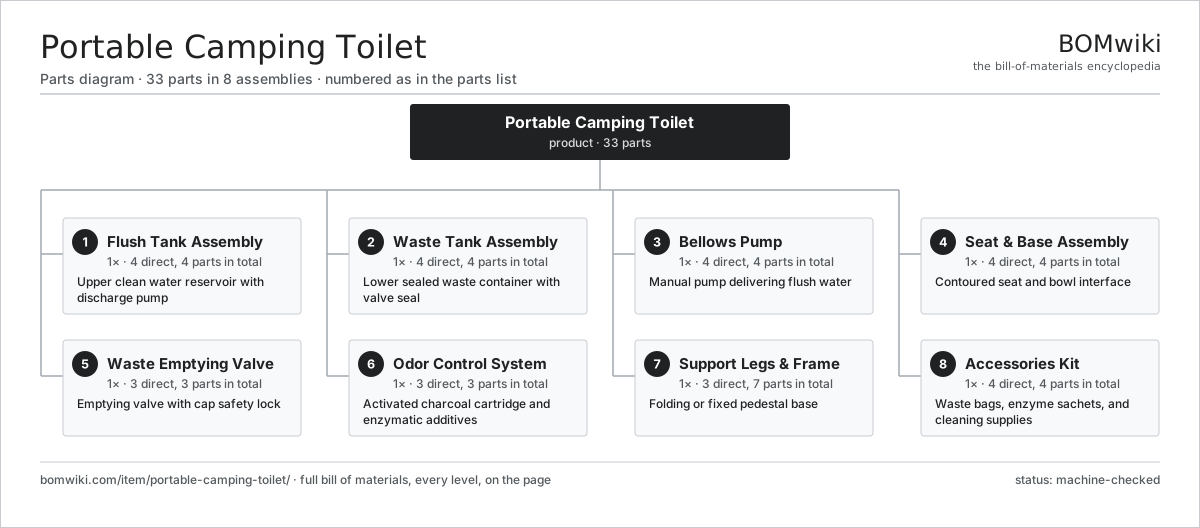
| # | Part | Qty | What it does |
|---|---|---|---|
| 1 | Flush Tank Assembly 4 parts | 1× | Upper clean water reservoir with discharge pump |
| 2 | Waste Tank Assembly 4 parts | 1× | Lower sealed waste container with valve seal |
| 3 | Bellows Pump 4 parts | 1× | Manual pump delivering flush water |
| 4 | Seat & Base Assembly 4 parts | 1× | Contoured seat and bowl interface |
| 5 | Waste Emptying Valve 3 parts | 1× | Emptying valve with cap safety lock |
| 6 | Odor Control System 3 parts | 1× | Activated charcoal cartridge and enzymatic additives |
| 7 | Support Legs & Frame 3 parts | 1× | Folding or fixed pedestal base |
| 8 | Accessories Kit 4 parts | 1× | Waste bags, enzyme sachets, and cleaning supplies |
3D model
No 3D model yet. Have a CAD file of this? Add a 3D model — STL renders right on this page; STEP, FreeCAD, and OpenSCAD sources are welcome too (openly licensed, like all 3D models on BOMwiki).
Build & assembly graph
expand / collapse · shared sub-assemblies converge · links to related products · est. labourTap an assembly to expand/collapse · tap a part to open it · use “Open page” for any node · drag to pan, scroll to zoom.
Bill of materials for Portable Camping Toilet
8 top-level lines · 37 rows shown · 33 parts total · indented to 3 levels| # | Item / sub-assembly | Part no. | Qty/assy | Ext. qty | Parts | Type |
|---|---|---|---|---|---|---|
| 1 | Flush Tank Assembly 4 parts | camping-toilet-flush-tank | 1× | 1 | 4 | assembly |
| 1.1 | Tank Chamber | camping-toilet-tank-chamber | 1× | 1 | · | part |
| 1.2 | Pump Mechanism | camping-toilet-pump-mechanism | 1× | 1 | · | part |
| 1.3 | Check Valve | camping-toilet-check-valve | 1× | 1 | · | part |
| 1.4 | Tank Cap | camping-toilet-tank-cap | 1× | 1 | · | part |
| 2 | Waste Tank Assembly 4 parts | camping-toilet-waste-tank | 1× | 1 | 4 | assembly |
| 2.1 | Waste Chamber | camping-toilet-waste-chamber | 1× | 1 | · | part |
| 2.2 | Bowl Seal Ring | camping-toilet-bowl-interface | 1× | 1 | · | part |
| 2.3 | Enzyme Cartridge | camping-toilet-enzyme-cartridge | 1× | 1 | · | part |
| 2.4 | Level Float Gauge | camping-toilet-level-indicator | 1× | 1 | · | part |
| 3 | Bellows Pump 4 parts | camping-toilet-bellows-pump | 1× | 1 | 4 | assembly |
| 3.1 | Bellows Chamber | camping-toilet-bellows-chamber | 1× | 1 | · | part |
| 3.2 | Pump Handle | camping-toilet-pump-handle | 1× | 1 | · | part |
| 3.3 | Intake Strainer | camping-toilet-pump-intake | 1× | 1 | · | part |
| 3.4 | Discharge Nozzle | camping-toilet-pump-discharge | 1× | 1 | · | part |
| 4 | Seat & Base Assembly 4 parts | camping-toilet-seat-base | 1× | 1 | 4 | assembly |
| 4.1 | Seat Cushion | camping-toilet-seat-cushion | 1× | 1 | · | part |
| 4.2 | Seat Lid | camping-toilet-seat-lid | 1× | 1 | · | part |
| 4.3 | Bowl Ring | camping-toilet-bowl-ring | 1× | 1 | · | part |
| 4.4 | Base Pedestal | camping-toilet-base-pedestal | 1× | 1 | · | part |
| 5 | Waste Emptying Valve 3 parts | camping-toilet-waste-valve | 1× | 1 | 3 | assembly |
| 5.1 | Ball Valve | camping-toilet-valve-ball | 1× | 1 | · | part |
| 5.2 | Outlet Spout | camping-toilet-valve-spout | 1× | 1 | · | part |
| 5.3 | Safety Cap | camping-toilet-valve-cap | 1× | 1 | · | part |
| 6 | Odor Control System 3 parts | camping-toilet-odor-system | 1× | 1 | 3 | assembly |
| 6.1 | Vent Filter Cartridge | camping-toilet-vent-filter | 1× | 1 | · | part |
| 6.2 | Enzyme Pod | camping-toilet-enzyme-pod | 1× | 1 | · | part |
| 6.3 | Vent Tubing | camping-toilet-vent-tube | 1× | 1 | · | part |
| 7 | Support Legs & Frame 3 parts | camping-toilet-support-legs | 1× | 1 | 7 | assembly |
| 7.1 | Folding Leg | camping-toilet-leg-pair | 2× | 2 | · | part |
| 7.2 | Foot Pad | camping-toilet-foot-pads | 4× | 4 | · | part |
| 7.3 | Lateral Brace | camping-toilet-leg-brace | 1× | 1 | · | part |
| 8 | Accessories Kit 4 parts | camping-toilet-accessories | 1× | 1 | 4 | assembly |
| 8.1 | Waste Bag Liners | camping-toilet-waste-bags | 1× | 1 | · | part |
| 8.2 | Enzyme Sachets | camping-toilet-enzyme-sachets | 1× | 1 | · | part |
| 8.3 | Cleaning Brush | camping-toilet-cleaning-brush | 1× | 1 | · | part |
| 8.4 | Instruction Manual | camping-toilet-instruction-manual | 1× | 1 | · | part |
Sourcing: possible vendors
Prices, MOQ, and lead times are algorithmic estimates, not quotes, and not claims about these companies. Company mappings are curated by keyword; est. price band $20–$2k. How estimates work| Vendor | HQ | Specialty | MOQ | Lead time |
|---|---|---|---|---|
|
🇺🇸Coleman
coleman.com ↗
|
Chicago, US | Camping gear | 1,000 units | 6–10 wks |
| thenorthface.com ↗ | Denver, US | Outdoor apparel & gear | 1,000 units | 6–10 wks |
|
🇺🇸YETI
yeti.com ↗
|
Austin, US | Coolers & drinkware | 1,000 units | 6–10 wks |
| decathlon.com ↗ | Villeneuve-d'Ascq, FR | Sporting goods | 1,000 units | 6–10 wks |
|
🇺🇸Garmin
garmin.com ↗
|
Olathe, US | GPS & wearables | 1,000 units | 6–10 wks |
1,134-word article