Portable Fire Pump
ProductOverview
A portable fire pump is a self-contained engine-and-pump package light enough to be carried by hand to a water source that no fire apparatus can reach: a creek bed below a road cut, a swimming pool behind a structure, or a portable tank in a wildland relay. Carried on brush trucks and in helicopter cargo nets, a typical unit delivers around 1300 L/min at 7 bar, enough to supply two 38 mm attack lines or to feed water uphill through a relay of identical pumps spaced along a hose lay.
The architecture is deliberately simple: a Engine close-coupled to a Centrifugal Pump End with no gearbox or clutch between them, all caged inside a Carry Frame that doubles as a roll bar and carrying fixture. Everything serviceable in the field, spark plug, Air Filter, Fuel Filter, is reachable through the frame without tools.
How it works
Water enters the Suction Inlet and reaches the eye of the Impeller, which spins at engine crankshaft speed, typically 5500–7000 rpm. Centrifugal acceleration flings the water outward into the Volute Casing, whose expanding spiral cross-section trades velocity for pressure before the flow exits through the Discharge Valve outlets. A Wear Ring holds a close clearance at the impeller eye so high-pressure water cannot short-circuit back to the suction side, and a carbon-faced Mechanical Seal keeps the pumped water out of the engine crankcase along the shared shaft.
A centrifugal pump cannot evacuate air, so drafting from open water requires the Priming System. The operator strokes the Primer Lever, and the Diaphragm Primer Pump diaphragm pulls air out of the suction hose until water reaches the impeller, at sea level the practical limit is about 7.6 m of vertical lift, falling roughly 0.3 m per 300 m of elevation as atmospheric pressure drops. Once the pump catches prime, the Primer Check Valve closes against discharge pressure and the primer drops out of the circuit. A Suction Strainer on the hose foot keeps gravel and vegetation out of the impeller.
Engine
The Engine is an air-cooled overhead-valve four-stroke in the 13–24 kW class, chosen over two-strokes in most modern designs for fuel economy and emissions, though high-pressure wildland pumps such as the Wajax-pattern units still use two-strokes for their power-to-weight ratio. The Flywheel Magneto supplies spark with no battery dependency, and its fan vanes blow cooling air across the finned Cylinder Block. Fuel flows by gravity from the Fuel Tank through the Fuel Shutoff Valve to a float-bowl Carburetor; the 6–8 L tank runs about two hours at rated load and accepts a quick-connect line from a jerry can for longer operations. The Muffler carries a spark-arresting screen, a hard requirement for wildland certification under USFS 5100 standards.
Starting is by 12 V Starter Motor fed from an 12 V Battery through a solenoid Relay, with the rope Recoil Starter retained as the dead-battery backup. The Electrical System system is otherwise minimal: a Ignition Kill Switch that grounds the magneto, an Hour Meter / Tachometer for maintenance tracking, and a Wire Bundle tied into the frame.
Hydraulic behavior and relay use
Pump output follows the centrifugal affinity laws: flow scales with speed, pressure with speed squared. At shutoff (all discharges closed) the pump develops its maximum head, around 26 bar in high-pressure models, and the operator throttles the engine to hold a target line pressure read on the Discharge Pressure Gauge. Because the casing churns the same water at shutoff, extended operation against closed valves overheats the pump; cracking the Casing Drain Valve or a discharge bleeds enough flow to carry the heat away.
In relay pumping, units are spaced so each receives water at slightly positive inlet pressure and adds its full pressure rise, a chain of three pumps can move water several hundred meters uphill through 38 mm hose despite friction losses of roughly 0.7 bar per 30 m at full flow. The Vibration Mount keep the running engine from walking the Skid Foot across rock, and the Carry Handle fold out so a four-person crew can move a 60 kg unit over broken ground.
Maintenance
After each use crews drain the casing through the Casing Drain Valve (mandatory in freezing climates), flush salt or silty water with clean water, and run the carburetor dry or treat the fuel for storage. The mechanical seal and wear ring are the main wear items; both are field-replaceable with the volute removed, sealed on reassembly by the O-Ring Set. Annual service tests verify rated flow and pressure against the manufacturer's curve, mirroring NFPA 1911 practice for larger apparatus pumps.
Portable Fire Pump parts and their functions
7 top-level parts · 53 parts in total · full bill of materials below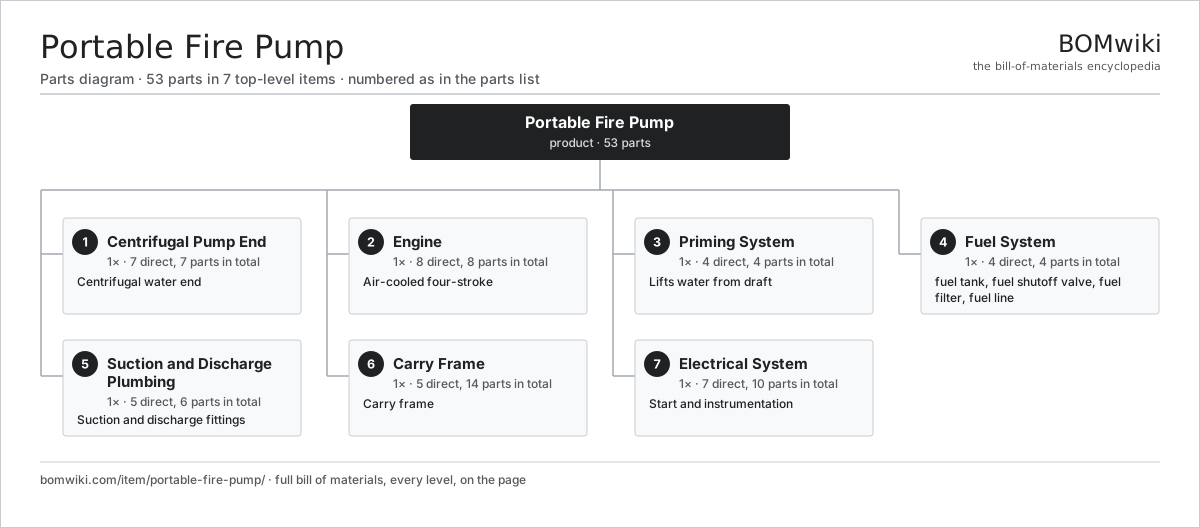
| # | Part | Qty | What it does |
|---|---|---|---|
| 1 | Centrifugal Pump End 7 parts | 1× | Centrifugal water end |
| 2 | Engine 8 parts | 1× | Air-cooled four-stroke |
| 3 | Priming System 4 parts | 1× | Lifts water from draft |
| 4 | Fuel System 4 parts | 1× | Gravity-feed gasoline supply sized for roughly two hours of full-throttle pumping. |
| 5 | Suction and Discharge Plumbing 5 parts | 1× | Suction and discharge fittings |
| 6 | Carry Frame 5 parts | 1× | Carry frame |
| 7 | Electrical System 7 parts | 1× | Start and instrumentation |
3D model
No 3D model yet. Have a CAD file of this? Add a 3D model. STL renders right on this page; STEP, FreeCAD, and OpenSCAD sources are welcome too (openly licensed, like all 3D models on BOMwiki).
Build & assembly graph
expand / collapse · shared sub-assemblies converge · links to related products · est. labourTap an assembly to expand/collapse · tap a part to open it · use “Open page” for any node · drag to pan, scroll to zoom.
Bill of materials for Portable Fire Pump
7 top-level lines · 47 rows shown · 53 parts total · indented to 3 levels| # | Item / sub-assembly | Part no. | Qty/assy | Ext. qty | Parts | Type |
|---|---|---|---|---|---|---|
| 1 | Centrifugal Pump End 7 parts | portable-fire-pump-pump-end | 1× | 1 | 7 | assembly |
| 1.1 | Volute Casing | portable-fire-pump-volute | 1× | 1 | · | part |
| 1.2 | Impeller | portable-fire-pump-impeller | 1× | 1 | · | part |
| 1.3 | Wear Ring | portable-fire-pump-wear-ring | 1× | 1 | · | part |
| 1.4 | Mechanical Seal | portable-fire-pump-mech-seal | 1× | 1 | · | part |
| 1.5 | Casing Drain Valve | portable-fire-pump-drain-valve | 1× | 1 | · | part |
| 1.6 | Ball Bearing | ball-bearing | 1× | 1 | · | part |
| 1.7 | O-Ring Set | oring-set | 1× | 1 | · | part |
| 2 | Engine 8 parts | portable-fire-pump-engine | 1× | 1 | 8 | assembly |
| 2.1 | Cylinder Block | portable-fire-pump-cylinder-block | 1× | 1 | · | part |
| 2.2 | Piston and Rod Set | portable-fire-pump-piston-set | 1× | 1 | · | part |
| 2.3 | Crankshaft | portable-fire-pump-crankshaft | 1× | 1 | · | part |
| 2.4 | Flywheel Magneto | portable-fire-pump-flywheel-magneto | 1× | 1 | · | part |
| 2.5 | Carburetor | portable-fire-pump-carburetor | 1× | 1 | · | part |
| 2.6 | Recoil Starter | portable-fire-pump-recoil-starter | 1× | 1 | · | part |
| 2.7 | Muffler | portable-fire-pump-muffler | 1× | 1 | · | part |
| 2.8 | Air Filter | portable-fire-pump-air-filter | 1× | 1 | · | part |
| 3 | Priming System 4 parts | portable-fire-pump-priming-system | 1× | 1 | 4 | assembly |
| 3.1 | Diaphragm Primer Pump | portable-fire-pump-primer-pump | 1× | 1 | · | part |
| 3.2 | Primer Lever | portable-fire-pump-primer-lever | 1× | 1 | · | part |
| 3.3 | Primer Check Valve | portable-fire-pump-primer-check-valve | 1× | 1 | · | part |
| 3.4 | Primer Hose | portable-fire-pump-primer-hose | 1× | 1 | · | part |
| 4 | Fuel System 4 parts | portable-fire-pump-fuel-system | 1× | 1 | 4 | assembly |
| 4.1 | Fuel Tank | portable-fire-pump-fuel-tank | 1× | 1 | · | part |
| 4.2 | Fuel Shutoff Valve | portable-fire-pump-fuel-valve | 1× | 1 | · | part |
| 4.3 | Fuel Filter | portable-fire-pump-fuel-filter | 1× | 1 | · | part |
| 4.4 | Fuel Line | portable-fire-pump-fuel-line | 1× | 1 | · | part |
| 5 | Suction and Discharge Plumbing 5 parts | portable-fire-pump-plumbing | 1× | 1 | 6 | assembly |
| 5.1 | Suction Inlet | portable-fire-pump-suction-inlet | 1× | 1 | · | part |
| 5.2 | Suction Strainer | portable-fire-pump-suction-strainer | 1× | 1 | · | part |
| 5.3 | Discharge Valve | portable-fire-pump-discharge-valve | 2× | 2 | · | part |
| 5.4 | Discharge Pressure Gauge | portable-fire-pump-pressure-gauge | 1× | 1 | · | part |
| 5.5 | Coupling Caps and Chains | portable-fire-pump-coupling-caps | 1× | 1 | · | part |
| 6 | Carry Frame 5 parts | portable-fire-pump-frame | 1× | 1 | 14 | assembly |
| 6.1 | Frame Tube Weldment | portable-fire-pump-frame-tubes | 1× | 1 | · | part |
| 6.2 | Carry Handle | portable-fire-pump-carry-handles | 4× | 4 | · | part |
| 6.3 | Vibration Mount | portable-fire-pump-vibration-mounts | 4× | 4 | · | part |
| 6.4 | Skid Foot | portable-fire-pump-skid-feet | 4× | 4 | · | part |
| 6.5 | Fastener Set | fastener-set | 1× | 1 | · | part |
| 7 | Electrical System 7 parts | portable-fire-pump-electrical | 1× | 1 | 10 | assembly |
| 7.1 | Starter Motor | portable-fire-pump-starter-motor | 1× | 1 | · | part |
| 7.2 | 12 V Battery | lv-battery | 1× | 1 | · | part |
| 7.3 | Relay | relay | 1× | 1 | · | part |
| 7.4 | Ignition Kill Switch | portable-fire-pump-kill-switch | 1× | 1 | · | part |
| 7.5 | Hour Meter / Tachometer | portable-fire-pump-hour-meter | 1× | 1 | · | part |
| 7.6 | Wire Bundle | wire-bundle | 1× | 1 | · | part |
| 7.7 | Connector | connector | 4× | 4 | · | part |
Something wrong in this list? Report a problem with this BOM.
Related products
same domain, ranked by shared parts Aerial Firefighting Tanker
1,816 parts · shares 2 with this page
Aerial Firefighting Tanker
1,816 parts · shares 2 with this page
 Aerial Ladder Truck
256 parts · shares 2 with this page
Aerial Ladder Truck
256 parts · shares 2 with this page
 Fire Alarm Control Panel
88 parts · shares 2 with this page
Fire Alarm Control Panel
88 parts · shares 2 with this page
 Fire Engine
547 parts · shares 2 with this page
Fire Engine
547 parts · shares 2 with this page
 Fireboat
236 parts · shares 2 with this page
Fireboat
236 parts · shares 2 with this page
 Outdoor Warning Siren
69 parts · shares 2 with this page
Outdoor Warning Siren
69 parts · shares 2 with this page
Sourcing: possible vendors
Browse the supplier directory → Prices, MOQ, and lead times are algorithmic estimates, not quotes, and not claims about these companies. Company mappings are curated by keyword; est. price band $30–$1M. How estimates work| Vendor | HQ | Specialty | MOQ | Lead time |
|---|---|---|---|---|
| rosenbauer.com ↗ | Leonding, AT | Fire apparatus | 200 units | 8–14 wks |
|
🇺🇸Oshkosh
oshkoshcorp.com ↗
|
Oshkosh, US | Specialty trucks (Pierce) | 200 units | 8–14 wks |
| msasafety.com ↗ | Cranberry Township, US | Safety equipment | 200 units | 8–14 wks |
|
🇩🇪Dräger
draeger.com ↗
|
Lübeck, DE | Safety & medical tech | 200 units | 8–14 wks |
| honeywell.com ↗ | Charlotte, US | Building & safety tech | 200 units | 8–14 wks |
884-word article