Post-Bed Sewing Machine
ProductOverview
Post-bed sewing machines are the workhorse of shoe assembly, used to stitch decorative and structural seams on shoe uppers. Unlike flat-bed machines (suited for fabric cutting and hemming), post-bed machines feature a vertical post arm that allows three-dimensional shoe lasts to be positioned and manipulated directly under the sewing head. An operator can lift the shoe upper, rotate it, align the next seam, and stitch, all without removing the shoe from the machine.
Typical post-bed operations in footwear include:
- Vamp seam: Stitching the front panel to the shoe sides.
- Toe box reinforcement: Sewing layers of leather or canvas together for structure.
- Heel counter seam: Attaching the heel counter to the shoe body.
- Toe cap stitching: Decorative or structural seam on the toe.
A skilled operator at a post-bed machine can complete 100–200 seams per hour, depending on seam length, number of fabric layers, and required backstitching.
Lockstitch Mechanism and Walking Foot
The needle bar is driven by a rotating cam or crankshaft at the machine's base. As the servo motor spins, the cam converts rotational motion into reciprocating vertical motion:
- Upper stroke (needle down): The needle descends through the fabric layers and bobbin case beneath.
- Bobbin interaction: As the needle passes through, the rotating bobbin case (a shuttle or hook) catches the upper thread loop, creating the characteristic lockstitch.
- Lower stroke (needle up): The needle retracts; upper and lower threads are drawn through the fabric, tightening the stitch.
The critical innovation of the post-bed machine is the walking foot mechanism. Ordinary presser feet hold the fabric but can slip or pucker when dealing with thick, multi-layer shoe components. The walking foot addresses this:
- Two-phase advance: During needle-down (cutting phase), the walking foot advances the fabric forward by one stitch length increment.
- Synchronized motion: As the needle descends, the walking foot simultaneously lifts slightly and "walks" the fabric forward, reducing resistance.
- Uniform stitch length: The fabric feed is mechanized and synchronized to needle motion, producing perfectly uniform stitch spacing regardless of operator hand speed variation.
Result: Thick leather or canvas seams remain straight and even, without puckering or skipped stitches.
Servo Motor and Constant Stitch Length
A servo motor with electronic feedback ensures consistent stitch length even as the operator varies pedal speed. The servo controller maintains a constant rotational speed proportional to the stitch length setpoint.
Example: If the operator sets stitch length to 3 mm and presses the foot pedal to 50% speed, the servo motor automatically adjusts its RPM to deliver exactly 3 mm stitches at whatever pedal pressure is applied. If the pedal is released to 25%, the motor slows proportionally but maintains the 3 mm stitch length.
This reduces operator fatigue and improves consistency, especially for operators working 8-hour shifts. Without servo control, operators must maintain constant foot pressure to achieve uniform stitches, mentally taxing and error-prone.
Thread Tension and Seam Quality
The thread tension disc controls the upper thread (from the spool). As thread passes through the tension disc, a spring-loaded clamp applies controlled resistance. Too-loose tension results in weak, loopy stitches; too-tight tension breaks the thread or causes skipped stitches.
For shoe leather (1–2 mm thick), typical tension is 5–7 on a 0–10 scale. Operators adjust tension via a numbered dial or digital setpoint at the start of a production run and typically leave it unchanged unless switching to a different fabric thickness.
Lower thread tension (from the bobbin) is less adjustable on most industrial machines, the bobbin case typically has a single tension screw requiring tool adjustment. Factories usually maintain uniform bobbin tension across all machines (typically setpoint 3–4) and don't change it per job.
Thread composition matters: industrial footwear threads are typically polyester or nylon, 400–600 denier, providing strength and UV resistance. Cheap cotton thread breaks easily and unravels; shoes must last years.
Presser Foot Lift and Accessibility
The presser foot lift is critical for shoe assembly. Modern post-bed machines include a foot pedal with three positions:
- Heel position (pedal released): Presser foot is lowered on the fabric; machine is ready to sew.
- Middle position (pedal mid-travel): Presser foot remains lowered; operator can lift pedal slightly for light pressure adjustment.
- Toe position (pedal fully depressed): Presser foot raises 15–20 mm, allowing the operator to insert or rotate the shoe upper without removing it from the machine.
This high lift allows operators to efficiently handle three-dimensional shoe assemblies. Without it, every seam would require removing and repositioning the shoe, dramatically slowing production.
Needle Selection and Thread Compatibility
Industrial sewing needles used in footwear are typically 130/705H (Singer classification) or 110/18 (metric). Sizes range from 12 (fine, 0.7 mm diameter) to 21 (heavy, 1.4 mm). The choice depends on fabric:
- Size 16 (1.0 mm): Leather and canvas, typical shoe upper materials.
- Size 18 (1.1 mm): Thick hides, double-layer heel counters.
- Size 21 (1.4 mm): Extra-heavy materials, rare for footwear, more common in heavy garment or industrial textiles.
Needles must match thread thickness (e.g., 400-denier thread requires 130/705H-16 needle). Mismatches cause skipped stitches or thread breakage.
Needles also wear: the needle eye becomes enlarged, and the scarf (the indentation behind the eye) becomes dull, preventing clean thread pickup from the bobbin. Needles are typically replaced every 8–16 hours of sewing, or when stitch quality degrades. A worn needle produces loopy or skipped stitches unmistakably.
Operator Technique and Quality
Despite mechanical sophistication, operator skill matters:
- Hand positioning: The operator guides the shoe, aligning seams under the needle. Poor alignment produces crooked or wandering seams.
- Seam angles: Curves (like toe-box stitching) require smooth hand motion to prevent jerky, angular stitches.
- Backstitching: At seam start and end, the operator briefly reverses the machine to lock the stitch and prevent unraveling. Forgetting to backstitch can cause seams to open during shoe wear.
Training typically requires 2–4 weeks for novice operators to achieve acceptable speed and quality. Experienced operators can average 150–200 seams per hour; novices may manage only 50–80 seams per hour initially.
Maintenance and Common Issues
- Thread breaks: Typically caused by needle damage, burrs on thread guides, or excessive tension. Replace the needle and verify guide cleanliness.
- Skipped stitches: Worn needle, incorrect needle size, or tension mismatch. Replace the needle.
- Uneven stitch length: Usually servo-controller drift or foot-pedal contact issue. Recalibrate servo or check electrical contact on pedal.
- Presser foot lift stiffness: Over-extended use; lubricate the linkage or replace spring if worn.
Modern post-bed machines also include automatic thread break detection, which stops the machine immediately if either upper or lower thread breaks, alerting the operator to re-thread before continuing. This prevents the entire seam from unraveling before the issue is noticed.
Industrial footwear post-bed machines typically run 10+ hours per day and require routine maintenance (lubrication, thread and needle replacement) every shift and professional servicing annually.
Post-Bed Sewing Machine parts and their functions
7 top-level parts · 29 parts in total · full bill of materials below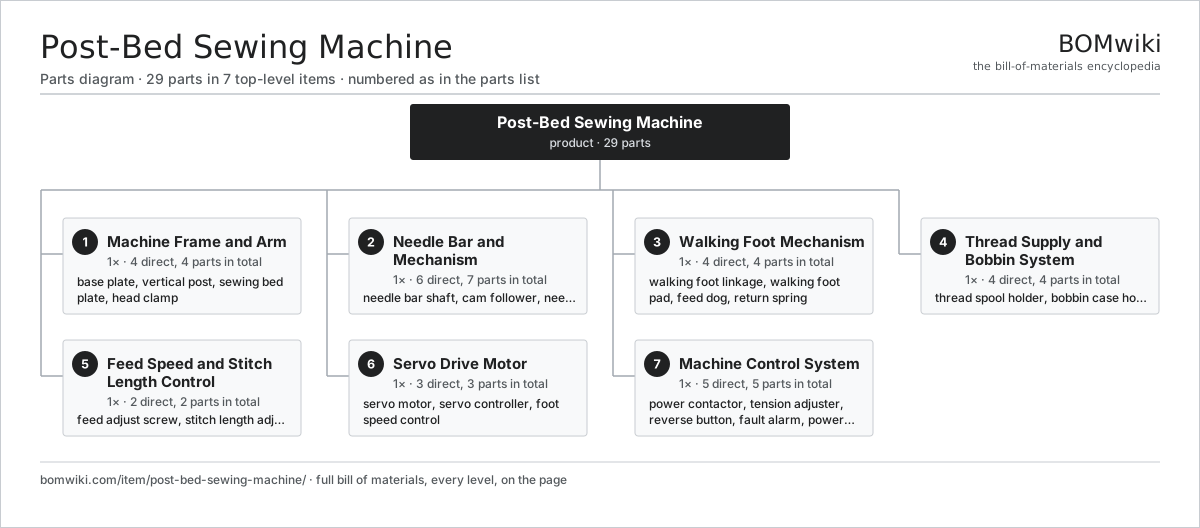
| # | Part | Qty | What it does |
|---|---|---|---|
| 1 | Machine Frame and Arm 4 parts | 1× | Rigid cast iron frame with vertical post arm providing clearance for three-dimensional shoe upper assembly. |
| 2 | Needle Bar and Mechanism 6 parts | 1× | Reciprocating needle bar driven by rotating cam, creating lockstitch with bobbin thread below. |
| 3 | Walking Foot Mechanism 4 parts | 1× | Two-phase feed system lifting and advancing fabric synchronously with needle motion, enabling uniform stitch length. |
| 4 | Thread Supply and Bobbin System 4 parts | 1× | Upper thread spool delivery and rotating bobbin case holding lower thread, creating lockstitch. |
| 5 | Feed Speed and Stitch Length Control 2 parts | 1× | Mechanism adjusting feed distance and stitch length, enabling variable stitch patterns. |
| 6 | Servo Drive Motor 3 parts | 1× | Variable-speed servo motor providing constant stitch length across fabric types and operator speed variation. |
| 7 | Machine Control System 5 parts | 1× | Electrical enclosure managing motor power, tension settings, and thread break detection. |
3D model
No 3D model yet. Have a CAD file of this? Add a 3D model. STL renders right on this page; STEP, FreeCAD, and OpenSCAD sources are welcome too (openly licensed, like all 3D models on BOMwiki).
Build & assembly graph
expand / collapse · shared sub-assemblies converge · links to related products · est. labourTap an assembly to expand/collapse · tap a part to open it · use “Open page” for any node · drag to pan, scroll to zoom.
Bill of materials for Post-Bed Sewing Machine
7 top-level lines · 35 rows shown · 29 parts total · indented to 3 levels| # | Item / sub-assembly | Part no. | Qty/assy | Ext. qty | Parts | Type |
|---|---|---|---|---|---|---|
| 1 | Machine Frame and Arm 4 parts | post-bed-sewing-machine-frame | 1× | 1 | 4 | assembly |
| 1.1 | Base Plate | post-bed-sewing-machine-base-plate | 1× | 1 | · | part |
| 1.2 | Vertical Post | post-bed-sewing-machine-vertical-post | 1× | 1 | · | part |
| 1.3 | Sewing Bed Plate | post-bed-sewing-machine-sewing-bed | 1× | 1 | · | part |
| 1.4 | Head Clamp | post-bed-sewing-machine-head-clamp | 1× | 1 | · | part |
| 2 | Needle Bar and Mechanism 6 parts | post-bed-sewing-machine-needle-bar | 1× | 1 | 7 | assembly |
| 2.1 | Needle Bar Shaft | post-bed-sewing-machine-needle-bar-shaft | 1× | 1 | · | part |
| 2.2 | Cam Follower | post-bed-sewing-machine-cam-follower | 1× | 1 | · | part |
| 2.3 | Needle Holder | post-bed-sewing-machine-needle-holder | 1× | 1 | · | part |
| 2.4 | Sewing Needle | post-bed-sewing-machine-needle | 1× | 1 | · | part |
| 2.5 | Thread Guide | post-bed-sewing-machine-thread-guide | 2× | 2 | · | part |
| 2.6 | Tension Disc | post-bed-sewing-machine-tension-disc | 1× | 1 | · | part |
| 3 | Walking Foot Mechanism 4 parts | post-bed-sewing-machine-walking-foot | 1× | 1 | 4 | assembly |
| 3.1 | Walking Foot Linkage | post-bed-sewing-machine-walking-foot-linkage | 1× | 1 | · | part |
| 3.2 | Walking Foot Pad | post-bed-sewing-machine-walking-foot-pad | 1× | 1 | · | part |
| 3.3 | Feed Dog | post-bed-sewing-machine-feed-dog | 1× | 1 | · | part |
| 3.4 | Return Spring | post-bed-sewing-machine-spring-return | 1× | 1 | · | part |
| 4 | Thread Supply and Bobbin System 4 parts | post-bed-sewing-machine-thread-system | 1× | 1 | 4 | assembly |
| 4.1 | Thread Spool Holder | post-bed-sewing-machine-thread-spool | 1× | 1 | · | part |
| 4.2 | Bobbin Case Hook | post-bed-sewing-machine-bobbin-case | 1× | 1 | · | part |
| 4.3 | Bobbin Spool | post-bed-sewing-machine-bobbin | 1× | 1 | · | part |
| 4.4 | Thread Break Detector | post-bed-sewing-machine-thread-break-sensor | 1× | 1 | · | part |
| 5 | Feed Speed and Stitch Length Control 2 parts | post-bed-sewing-machine-feed-system | 1× | 1 | 2 | assembly |
| 5.1 | Feed Adjust Screw | post-bed-sewing-machine-feed-screw | 1× | 1 | · | part |
| 5.2 | Stitch Length Adjustment | post-bed-sewing-machine-stitch-length-dial | 1× | 1 | · | part |
| 6 | Servo Drive Motor 3 parts | post-bed-sewing-machine-servo-motor | 1× | 1 | 3 | assembly |
| 6.1 | Servo Motor | post-bed-sewing-machine-servo-unit | 1× | 1 | · | part |
| 6.2 | Servo Controller | post-bed-sewing-machine-servo-controller | 1× | 1 | · | part |
| 6.3 | Foot Speed Control | post-bed-sewing-machine-foot-pedal | 1× | 1 | · | part |
| 7 | Machine Control System 5 parts | post-bed-sewing-machine-control-panel | 1× | 1 | 5 | assembly |
| 7.1 | Power Contactor | post-bed-sewing-machine-power-switch | 1× | 1 | · | part |
| 7.2 | Tension Adjuster | post-bed-sewing-machine-thread-tension-adjuster | 1× | 1 | · | part |
| 7.3 | Reverse Button | post-bed-sewing-machine-stitch-reverse-button | 1× | 1 | · | part |
| 7.4 | Fault Alarm | post-bed-sewing-machine-alarm-light | 1× | 1 | · | part |
| 7.5 | Power Supply | power-supply | 1× | 1 | · | part |
Something wrong in this list? Report a problem with this BOM.
Sourcing: possible vendors
Browse the supplier directory → Prices, MOQ, and lead times are algorithmic estimates, not quotes, and not claims about these companies. Company mappings are curated by keyword; est. price band $10k–$1M. How estimates work| Vendor | HQ | Specialty | MOQ | Lead time |
|---|---|---|---|---|
|
🇨🇭Rieter
rieter.com ↗
|
Winterthur, CH | Spinning machinery | 10 units | 14–24 wks |
| truetzschler.com ↗ | Mönchengladbach, DE | Textile machinery | 10 units | 14–24 wks |
|
🇧🇪Picanol
picanol.be ↗
|
Ypres, BE | Weaving machines | 10 units | 14–24 wks |
| karlmayer.com ↗ | Obertshausen, DE | Warp knitting machines | 10 units | 14–24 wks |
|
🇨🇭Saurer
saurer.com ↗
|
Arbon, CH | Spinning & embroidery | 10 units | 14–24 wks |
1,234-word article