Copper Pot Still
ProductOverview
The copper pot still is the cornerstone of traditional spirit production, whiskey, brandy, grappa, rum, and artisanal liqueurs. Its design has changed little since the 18th century, favored by distillers worldwide for the chemical interaction between copper and sulfur compounds, which reduces harsh mercaptan flavors and imparts smooth character. Modern pot stills retain this romance while adding precision temperature control, steam-heated jackets, and safety relief systems. A 150 L pot still produces 100–110 L of finished spirit (70 % ABV) per batch, equivalent to roughly 500–600 bottles, suitable for craft distilleries, farm distilleries, and research/experimentation.
This product represents the pinnacle of batch distillation, where skill, timing, and sensory judgment matter as much as engineering specs. No two batches are identical; wood char, yeast strain, grain selection, and fermentation temperature all contribute to the final spirit character.
The Physics of Copper & Vapor Contact
Copper's electrical and thermal properties make it essential to pot still design. When copper surfaces contact acidic vapors (containing hydrogen sulfide, mercaptans, and other sulfur volatiles produced during fermentation), a controlled redox reaction converts these sulfur compounds into less volatile or polymeric forms. This "copper scrubbing" occurs naturally as vapor rises through the swan neck and travels down the lyne arm, yielding a smoother, more refined spirit than equivalent still stills or reflux columns.
The steam jacket provides even heating across the pot bottom and lower sides, avoiding hot spots that would scorch grain solids or create off-flavors from caramelized sugars. Steam at 1–1.5 bar delivers approximately 2,000 kW/m² heat flux, gentle enough to allow slow boil control yet powerful enough to complete a 6–8 hour distillation in a single day.
The condenser cools hot spirits-rich vapor (78–82°C at the lyne arm) back to liquid via cooling water at 15–20°C, achieving a 50–60°C temperature drop across the 30-tube bundle in 2–3 seconds.
Batch Distillation Sequence
A typical whiskey or brandy distillation cycle proceeds through three distinct phases:
Phase 1: Heating & Wash Boiling (0–45 min) The still begins cold with 150 L of fermented wash (9–12 % ABV beer). The steam inlet valve opens gradually to avoid violent boiling. Temperature rises at 1–2°C per minute. The thermometer monitors bulk liquid temperature; at 60°C, light vapors appear at the swan neck opening. By 80°C, a steady stream of vapors rises and begins condensing. The condenser outlet shows droplets; spirits run begins.
Phase 2: Spirits Run / Hearts Collection (45–300 min) This is the core distillation phase. Vapor rises from the hot wash, passes through the copper swan neck (stripping sulfur volatiles via reduction reactions), travels down the insulated lyne arm maintaining ~80°C, and enters the condenser. Condensed liquid drips into the spirit safe where the hydrometer and floats show instantaneous ABV. The distiller monitors this proof:
- Heads (first 5–10 min): 85–95 % ABV, harsh acetaldehyde/methanol notes → REJECT
- Hearts (next 4–5 hours): 70–75 % ABV, smooth and flavorful → COLLECT
- Tails (final 30 min): 50–65 % ABV, oily/heavy notes → SEPARATE for redistillation
The spirit safe taps allow the distiller to switch outlet destinations on the fly: initially valve toward "tails" (waste heads), then mid-way switch to "hearts" collection, and final switch to "tails" again. Skill lies in catching the exact moment of flavor inflection as ABV drops, a 1–2 minute window that determines spirit quality.
Phase 3: Stillage Cooling & Discharge (300–360 min) Once hearts collection ends (typically when ABV drops below 70 %), the steam valve closes. The pot cools over 60 minutes as the condenser draws residual heat. The spent liquid (stillage) remaining in the pot, exhausted grain, water, congeners, is drained via bottom outlet into a sump tank for animal feed or composting (depending on local regulations).
Total cycle time: 6–8 hours from cold start to ready for next batch. A single still can produce 2–3 batches per week (if running 3 shifts) or 1–2 per week (single shift), yielding 200–600 bottles weekly.
Spirit Safe Design & Proof Monitoring
The spirit safe is the distiller's window into the still's soul. Visible through thick borosilicate glass, the hydrometer float displays instantaneous ABV via calibrated scale. As proof drops during tails phase (e.g., 75 → 70 → 65 % ABV), the float sinks visibly, cueing the operator to switch collection valve.
Advanced spirit safes include dual floats:
- Density float showing ABV percentage
- Temperature float (wax-based, specific gravity sensitive) revealing congener level
When congeners (heavy esters, oils, aldehydes) drop below a threshold (indicated by float position), hearts collection should end. This prevents excessive fusel alcohol carryover into the final spirit.
Three outlet valves on the spirit safe allow:
- Heads tap: Diverts harsh foreshots (first 5–10 minutes) to waste or redistillation tank
- Hearts tap: Sends flavorful middle cut to collection and aging vessels
- Tails tap: Routes final low-proof fraction to tails tank for later redistillation or blending
A skilled distiller executes this transition sequence by touch and observation, a craft honed over hundreds of distillations.
Copper Maintenance & Longevity
Pure copper is soft and corrosion-prone in acidic environments. The copper pot and steam jacket require care:
- Post-distillation cleaning: After each batch, the still interior is rinsed with hot water to remove grain debris and dried completely. Any standing moisture (especially if acidic from sulfur compounds) promotes blue verdigris (copper carbonate) patina
- Annual inspection: Examine all copper seams for weeping (pinhole leaks). Small seeps are sealed with solder; large leaks require skilled coppersmiths to re-rivet and re-tin the joint
- Exterior polish: The outer copper surfaces develop attractive dark patina over years; some distilleries maintain bright polish for show, others embrace natural weathering as a badge of age
Properly maintained, a copper still lasts 30–50 years. Famous distillery stills in Scotland and Ireland are often 50–100+ years old, continuously in use.
Integration with Aging & Flavor Development
Distilled spirits are not consumed immediately. Whiskey, brandy, and aged rum require barrel aging (1–20+ years depending on style):
- New-make spirit (just distilled, 68–70 % ABV) is diluted with water to 60–65 % ABV for barreling
- Barrel storage allows slow oxidation, wood extraction (vanilla, caramel, oak tannins), and angel's share evaporation
- Cask interaction with pot still character: The smooth, full-bodied character imparted by copper and the distiller's hearts cut becomes the foundation for barrel aging
A craft distillery workflow:
- Ferment 1,500 L grain mash over 7 days
- Distill in 150 L batches (10 batches total) across 2 weeks
- Collect ~1,000 L of hearts (70 % ABV)
- Dilute to 60 % ABV and barrel
- Age 2–8 years minimum before bottling
The copper pot is where the magic begins; barrels finish it.
Safety Considerations & Regulatory Context
Distillation of spirits is heavily regulated in most jurisdictions. Governments require:
- Permits & licensing: Distillery license from federal alcohol bureau (TTB in USA, HMRC in UK)
- Excise tax: Prepayment of duty on all spirits produced (in USA, $13.50/proof gallon federal tax)
- Safety equipment: Fire suppression, ventilation for ethanol vapors, relief valves on all pressure vessels
- Record-keeping: Batch-by-batch logs of production dates, proof, and alcohol withdrawal
The relief valve on the steam jacket is mandatory; it prevents overpressure should the steam inlet accidentally be left open (preventing jacket explosion). Modern stills also include:
- Excess vapor relief/condenser overflow
- Temperature monitoring at the lyne arm (if exceeds 90°C, shut steam inlet, sign of still malfunction)
- Automated shutoff systems (some artisanal operations add PLC controls)
Artisanal Variation & Equipment Customization
While copper pot stills follow a standard form, distilleries customize designs:
- Pot size: 50 L (micro), 150 L (craft), 500 L (small commercial), 5,000 L (industrial)
- Swan neck shape: Tall and thin (reflux-like, lighter spirits), short and bulbous (heavier, oily spirits)
- Lyne arm angle: Steep downslope (faster vapor travel, lighter), shallow (slower, more copper contact, heavier)
- Condenser: Tube-in-shell (compact), worm coil in tank (traditional, space-hungry), water-jacketed column (hybrid)
Many craft distillers commission custom copper stills from specialized fabricators in Scotland (Forsyths, Copper & Lyne, Abercrombie), Germany, Ireland, and increasingly USA (Kentucky, Oregon, Colorado). Lead times are 6–12 months; costs range $30K–100K+ depending on size and customization.
This equipment represents a multi-generational asset, a 150 L still, properly cared for, operates continuously for 50+ years, often becoming the distillery's most recognizable brand symbol.
Copper Pot Still parts and their functions
7 top-level parts · 52 parts in total · full bill of materials below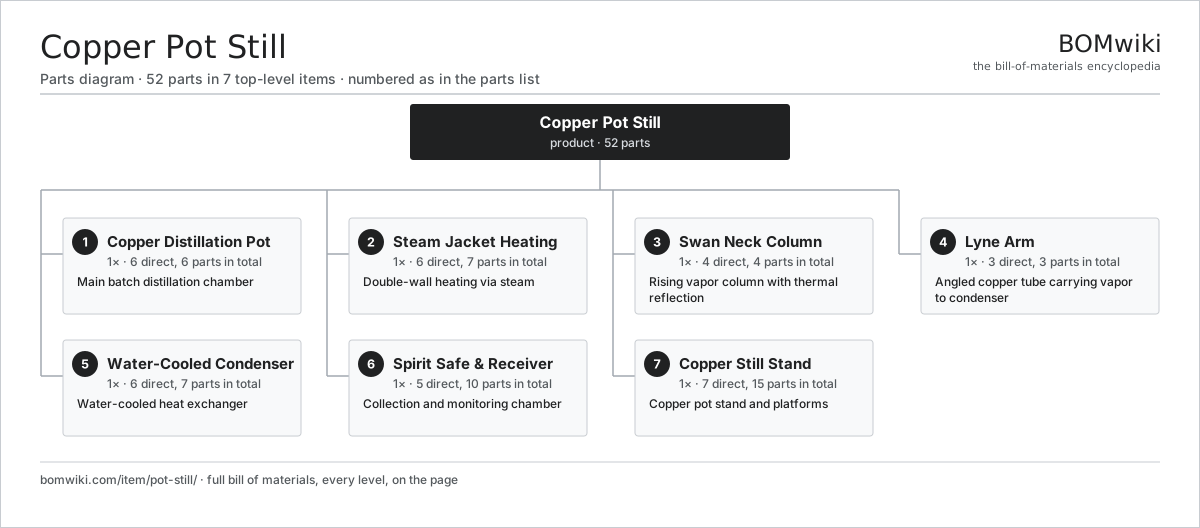
| # | Part | Qty | What it does |
|---|---|---|---|
| 1 | Copper Distillation Pot 6 parts | 1× | Main batch distillation chamber |
| 2 | Steam Jacket Heating 6 parts | 1× | Double-wall heating via steam |
| 3 | Swan Neck Column 4 parts | 1× | Rising vapor column with thermal reflection |
| 4 | Lyne Arm 3 parts | 1× | Angled copper tube carrying vapor to condenser |
| 5 | Water-Cooled Condenser 6 parts | 1× | Water-cooled heat exchanger |
| 6 | Spirit Safe & Receiver 5 parts | 1× | Collection and monitoring chamber |
| 7 | Copper Still Stand 7 parts | 1× | Copper pot stand and platforms |
3D model
No 3D model yet. Have a CAD file of this? Add a 3D model. STL renders right on this page; STEP, FreeCAD, and OpenSCAD sources are welcome too (openly licensed, like all 3D models on BOMwiki).
Build & assembly graph
expand / collapse · shared sub-assemblies converge · links to related products · est. labourTap an assembly to expand/collapse · tap a part to open it · use “Open page” for any node · drag to pan, scroll to zoom.
Bill of materials for Copper Pot Still
7 top-level lines · 44 rows shown · 52 parts total · indented to 3 levels| # | Item / sub-assembly | Part no. | Qty/assy | Ext. qty | Parts | Type |
|---|---|---|---|---|---|---|
| 1 | Copper Distillation Pot 6 parts | pot-still-copper-pot | 1× | 1 | 6 | assembly |
| 1.1 | Copper Pot Main Body | pot-still-pot-body | 1× | 1 | · | part |
| 1.2 | Pot Bottom Plate | pot-still-bottom-head | 1× | 1 | · | part |
| 1.3 | Top Collar Ring | pot-still-top-collar | 1× | 1 | · | part |
| 1.4 | Sight Glass Port | pot-still-sight-glass-port | 1× | 1 | · | part |
| 1.5 | Thermometer Well | pot-still-thermometer-pocket | 1× | 1 | · | part |
| 1.6 | Fastener Set | fastener-set | 1× | 1 | · | part |
| 2 | Steam Jacket Heating 6 parts | pot-still-steam-jacket | 1× | 1 | 7 | assembly |
| 2.1 | Outer Jacket Shell | pot-still-outer-copper-shell | 1× | 1 | · | part |
| 2.2 | Jacket Internal Baffle | pot-still-jacket-baffles | 2× | 2 | · | part |
| 2.3 | Steam Inlet Control Valve | pot-still-steam-inlet-valve | 1× | 1 | · | part |
| 2.4 | Thermostatic Steam Trap | pot-still-steam-trap | 1× | 1 | · | part |
| 2.5 | Jacket Safety Relief | pot-still-safety-relief | 1× | 1 | · | part |
| 2.6 | Pressure Sensor | pressure-sensor | 1× | 1 | · | part |
| 3 | Swan Neck Column 4 parts | pot-still-swan-neck | 1× | 1 | 4 | assembly |
| 3.1 | Swan Neck Tube | pot-still-swan-neck-tube | 1× | 1 | · | part |
| 3.2 | Lyne Arm Joint Coupling | pot-still-lyne-arm-joint | 1× | 1 | · | part |
| 3.3 | Neck Flange Base Ring | pot-still-neck-flange-base | 1× | 1 | · | part |
| 3.4 | Fastener Set | fastener-set | 1× | 1 | · | part |
| 4 | Lyne Arm 3 parts | pot-still-lyne-arm | 1× | 1 | 3 | assembly |
| 4.1 | Lyne Arm Tube | pot-still-lyne-arm-tube | 1× | 1 | · | part |
| 4.2 | Lyne Arm Heat Reflector | pot-still-lyne-arm-insulation | 1× | 1 | · | part |
| 4.3 | Lyne Arm Temperature Probe | pot-still-lyne-thermometer | 1× | 1 | · | part |
| 5 | Water-Cooled Condenser 6 parts | pot-still-condenser-assembly | 1× | 1 | 7 | assembly |
| 5.1 | Condenser Outer Shell | pot-still-condenser-shell | 1× | 1 | · | part |
| 5.2 | Condenser Tube Bundle | pot-still-condenser-tubes | 1× | 1 | · | part |
| 5.3 | Cooling Water Inlet Valve | pot-still-condenser-inlet-valve | 1× | 1 | · | part |
| 5.4 | Condenser Outlet Thermometer | pot-still-condenser-thermometer | 1× | 1 | · | part |
| 5.5 | Pressure Sensor | pressure-sensor | 1× | 1 | · | part |
| 5.6 | Connector | connector | 2× | 2 | · | part |
| 6 | Spirit Safe & Receiver 5 parts | pot-still-spirit-safe | 1× | 1 | 10 | assembly |
| 6.1 | Spirit Safe Housing | pot-still-spirit-safe-body | 1× | 1 | · | part |
| 6.2 | Spirit Safe Floats | pot-still-spirit-safe-floats | 1× | 1 | · | part |
| 6.3 | Spirit Safe Outlet Tap | pot-still-spirit-safe-tap | 3× | 3 | · | part |
| 6.4 | Spirit Safe Drain | pot-still-spirit-safe-drain | 1× | 1 | · | part |
| 6.5 | Connector | connector | 4× | 4 | · | part |
| 7 | Copper Still Stand 7 parts | pot-still-support-structure | 1× | 1 | 15 | assembly |
| 7.1 | Support Frame Post | pot-still-frame-posts | 4× | 4 | · | part |
| 7.2 | Frame Cross-Bracing | pot-still-frame-bracing | 6× | 6 | · | part |
| 7.3 | Pot Cradle Saddle | pot-still-pot-saddle | 1× | 1 | · | part |
| 7.4 | Condenser Support Bracket | pot-still-condenser-mount | 1× | 1 | · | part |
| 7.5 | Spirit Safe Working Shelf | pot-still-spirit-safe-shelf | 1× | 1 | · | part |
| 7.6 | Catwalk Grating | pot-still-catwalk-grating | 1× | 1 | · | part |
| 7.7 | Sheet Metal Panel | sheet-panel | 1× | 1 | · | part |
Something wrong in this list? Report a problem with this BOM.
Related products
same domain, ranked by shared parts Bakery Deck Oven
44 parts · shares 3 with this page
Beverage Carbonator
95 parts · shares 3 with this page
Brine Chilling System
239 parts · shares 3 with this page
Bakery Deck Oven
44 parts · shares 3 with this page
Beverage Carbonator
95 parts · shares 3 with this page
Brine Chilling System
239 parts · shares 3 with this page
 Colloid Mill
212 parts · shares 3 with this page
Continuous Ice Cream Freezer
188 parts · shares 3 with this page
Disc-Stack Separator
494 parts · shares 3 with this page
Colloid Mill
212 parts · shares 3 with this page
Continuous Ice Cream Freezer
188 parts · shares 3 with this page
Disc-Stack Separator
494 parts · shares 3 with this page
Sourcing: possible vendors
Browse the supplier directory → Prices, MOQ, and lead times are algorithmic estimates, not quotes, and not claims about these companies. Company mappings are curated by keyword; est. price band $1k–$500k. How estimates work| Vendor | HQ | Specialty | MOQ | Lead time |
|---|---|---|---|---|
| gea.com ↗ | Düsseldorf, DE | Process technology | 20 units | 12–20 wks |
| buhlergroup.com ↗ | Uzwil, CH | Food & materials processing | 20 units | 12–20 wks |
| tetrapak.com ↗ | Pully, CH | Food packaging & processing | 20 units | 12–20 wks |
| jbtc.com ↗ | Chicago, US | Food processing equipment | 20 units | 12–20 wks |
| alfalaval.com ↗ | Lund, SE | Heat transfer & separation | 20 units | 12–20 wks |
1,493-word article