Pressure Booster Set
ProductOverview
A pressure booster set is an automated water pressurization system that maintains steady household water pressure from low-pressure sources, city water with inadequate static head, private wells in elevated terrain, or rainwater collection systems. The system uses one or more centrifugal pumps with variable-frequency drive control to sense pressure demand and modulate pump speed, delivering flow only when needed and reducing energy consumption compared to fixed-speed systems.
Pressure booster sets are essential where mains pressure drops below 40 PSI (typical for homes at high elevation or far from utility pressure regulators) or where water must be lifted vertically from a groundwater well. Modern units operate silently via soft-start and speed control, avoiding the hard starts and stop-start cycles of traditional pressure tanks with fixed-speed pumps.
How it works
Water enters from low-pressure source (municipal supply, well, or tank) and flows through the inlet strainer into the primary pump. The pressure transducer on the discharge manifold continuously reads outlet pressure and sends a 4–20 mA signal to the VFD controller.
When a fixture is opened (shower, faucet) and outlet pressure drops below setpoint, the VFD ramps up the primary pump from idle speed to maintain constant pressure. As demand increases, secondary pump may be automatically enabled (via auxiliary contactor logic in the controller) to provide additional flow. When demand ceases, the VFD ramps both motors down, entering low-idle mode and consuming minimal power.
The accumulator tank pre-charged with nitrogen absorbs pump discharge transients (water hammer), smooths pressure ripple, and provides several gallons of standby flow to satisfy momentary demand spikes without pump acceleration.
Components & Design
Pump Assembly
The pump stack typically comprises a primary 20–30 GPM centrifugal pump and secondary 15–20 GPM pump mounted on a common baseplate. Both are end-suction horizontal or vertical turbine designs with bronze or ductile iron impellers and cast iron pump casings. Impeller trim (diameter reduction) is available to tune the pump curve to the application; a well-lift application may require 50 PSI at 20 GPM, while a pressure-boost application needs 80 PSI at 40 GPM. Each pump is connected to a motor via a flexible coupling absorbing shaft misalignment and vibration.
Motor & Drive
The primary pump motor is typically 1–2 HP three-phase 208–480V with a soft-starter or integrated VFD input. The secondary motor (0.75–1.5 HP) is designed for variable-frequency operation; its windings are rated for non-sinusoidal VFD output without derating. The VFD is a vector-control (field-oriented) drive capable of outputting 0.5–60 Hz to modulate pump speed from ~600 RPM (low-idle whisper-quiet mode) to full nameplate speed (1,750–3,450 RPM depending on motor poles and frequency).
Control System
The control cabinet houses the VFD, soft-starter if used, terminal blocks, and auxiliary contactors. The system senses pressure via a 4–20 mA absolute pressure transducer and optionally a differential transducer measuring pump net head. Setpoint pressure (typically 45–80 PSI) is programmed into the VFD via keypad or field communicator. The VFD proportionally adjusts motor frequency to maintain setpoint; overshooting is prevented by ramp-down acceleration and deceleration curves (5–30 second ramps typical).
Discharge Manifold & Isolation
The discharge manifold integrates two check valves (one from each pump), a differential pressure balancing valve, a pilot-operated relief valve set to system maximum (e.g., 120 PSI), and gauge ports for pressure monitoring. The isolation assembly includes inlet and discharge solenoid valves allowing operator-initiated or automatic pump shutoff without service interruption.
Accumulator Tank
The pressure tank is a 10–20 gallon horizontal or vertical steel vessel with an internal EPDM bladder separating water from a nitrogen pre-charge. Pre-charge pressure is typically set to 60% of minimum system pressure (e.g., 24 PSI for a 40 PSI minimum setpoint); this ensures the water chamber expands fully during peak demand. The air valve (Schrader-type) allows field adjustment of pre-charge. The automatic drain valve purges accumulated water that leaks past the bladder over time, extending tank life.
System Sizing & Selection
Pump capacity is chosen to meet peak simultaneous demand. A 4-bedroom home with 3 bathrooms operating concurrently (shower at 5 GPM, sink at 2.5 GPM, toilet at 3 GPM = 10.5 GPM total) plus outdoor hose demand (15 GPM) requires a 25 GPM pump. If source pressure is only 25 PSI and system requires 60 PSI, the pump must overcome 35 PSI head at full flow, requiring a 1.5–2 HP motor.
Accumulator tank volume is typically 10–20% of daily household demand (e.g., 150 gallons/day = 15–20 gallon tank). This allows the system to satisfy faucet opening transients without pump acceleration, reducing wear and noise.
VFD soft-start ramp time prevents water hammer in long discharge lines; a 100-foot 1 inch PVC line from pump to pressure tank requires 10–20 second ramp-up to avoid transient spikes above relief setting.
Efficiency & Energy Savings
Traditional fixed-speed booster pumps (pressure tank + 1 HP motor) run at 1,750 RPM whenever pressure drops 10 PSI below setpoint, cycling 20–50 times per day. Each start draws inrush current (3–5× nameplate) and wastes energy as heat during acceleration. A VFD-based system idles at 600 RPM during low-demand periods, drawing only 1–2 kW standby power, and ramps to 80% speed for typical demand, consuming 3–5 kW. Annual energy savings are 30–50% for variable-duty applications (residences, light commercial).
Maintenance & Diagnostics
Annual service includes nitrogen pre-charge verification (measure with calibrated gauge at the Schrader valve). As the bladder ages (5–10 years), nitrogen diffuses outward and water permeates inward; pre-charge pressure rises and the tank becomes ineffective. Replace the bladder if pre-charge exceeds 110% of setpoint.
Check valves may stick due to sediment; if pump runs but discharge is weak, isolate and tap the check valve housing gently or replace. Relief valve cracking is audible as a high-pitched whine; if relief opens at pressure below setpoint, verify transducer accuracy and clean relief inlet strainer.
Pressure oscillation (±5 PSI ripple) indicates the VFD ramp time is too aggressive or accumulator pre-charge is too high; reduce ramp speed or lower pre-charge 5 PSI increments until stable. Complete loss of pressure indicates pump cavitation (low inlet pressure) or check valve fully blocked.
Standards & Codes
Booster pump systems must comply with ASME B73.1 for centrifugal pump testing and NEMA MG-1 for motor design. Pressure vessels containing water are classed as "unfired pressure vessels" under ASME Section VIII and require design certification and periodic hydrostatic test (5 years typical). Relief valve setting must not exceed 150% of rated working pressure per ASME and ANSI B29.1 standards.
VFD-driven motors in boosters generate harmonic currents; where utility power is shared with sensitive electronics, add line-side harmonic filters or dV/dt filters to VFD output to protect motor insulation and reduce EMI.
Pressure Booster Set parts and their functions
7 top-level parts · 39 parts in total · full bill of materials below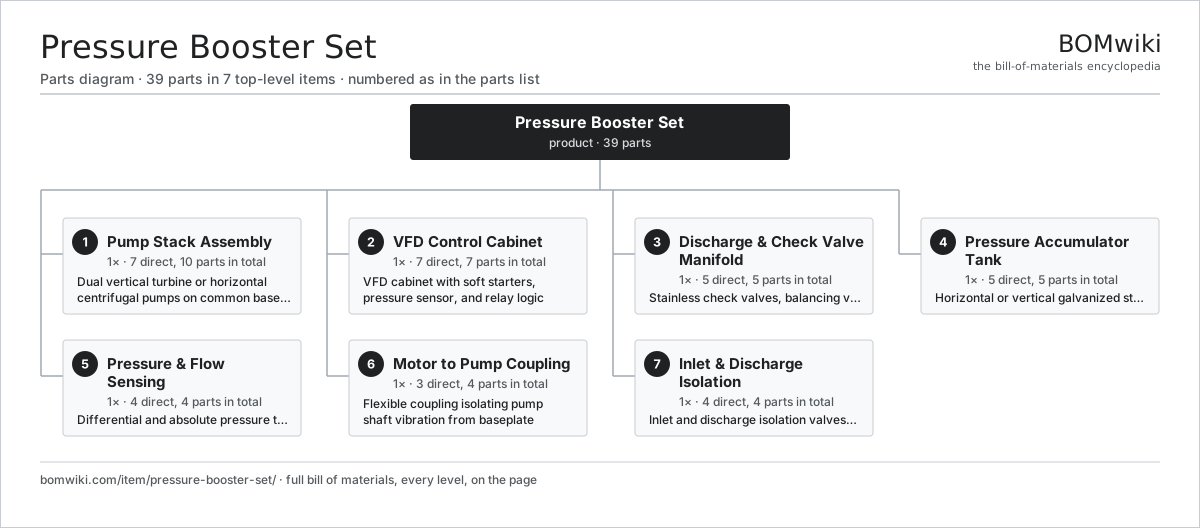
| # | Part | Qty | What it does |
|---|---|---|---|
| 1 | Pump Stack Assembly 7 parts | 1× | Dual vertical turbine or horizontal centrifugal pumps on common baseplate |
| 2 | VFD Control Cabinet 7 parts | 1× | VFD cabinet with soft starters, pressure sensor, and relay logic |
| 3 | Discharge & Check Valve Manifold 5 parts | 1× | Stainless check valves, balancing valves, and pressure taps |
| 4 | Pressure Accumulator Tank 5 parts | 1× | Horizontal or vertical galvanized steel air-charged pressure vessel |
| 5 | Pressure & Flow Sensing 4 parts | 1× | Differential and absolute pressure transducers with 4–20 mA output |
| 6 | Motor to Pump Coupling 3 parts | 1× | Flexible coupling isolating pump shaft vibration from baseplate |
| 7 | Inlet & Discharge Isolation 4 parts | 1× | Inlet and discharge isolation valves for pump servicing |
3D model
No 3D model yet. Have a CAD file of this? Add a 3D model. STL renders right on this page; STEP, FreeCAD, and OpenSCAD sources are welcome too (openly licensed, like all 3D models on BOMwiki).
Build & assembly graph
expand / collapse · shared sub-assemblies converge · links to related products · est. labourTap an assembly to expand/collapse · tap a part to open it · use “Open page” for any node · drag to pan, scroll to zoom.
Bill of materials for Pressure Booster Set
7 top-level lines · 42 rows shown · 39 parts total · indented to 3 levels| # | Item / sub-assembly | Part no. | Qty/assy | Ext. qty | Parts | Type |
|---|---|---|---|---|---|---|
| 1 | Pump Stack Assembly 7 parts | pressure-booster-set-pump-stack | 1× | 1 | 10 | assembly |
| 1.1 | Primary Centrifugal Pump | pressure-booster-set-pump-1 | 1× | 1 | · | part |
| 1.2 | Secondary Booster Pump | pressure-booster-set-pump-2 | 1× | 1 | · | part |
| 1.3 | Primary Motor | pressure-booster-set-motor-1 | 1× | 1 | · | part |
| 1.4 | Variable-Speed Motor | pressure-booster-set-motor-2 | 1× | 1 | · | part |
| 1.5 | Pump Baseplate | pressure-booster-set-baseplate | 1× | 1 | · | part |
| 1.6 | Ball Bearing | ball-bearing | 4× | 4 | · | part |
| 1.7 | Pump-Motor Coupling | pressure-booster-set-coupling | 1× | 1 | · | part |
| 2 | VFD Control Cabinet 7 parts | pressure-booster-set-drive-controller | 1× | 1 | 7 | assembly |
| 2.1 | Control Cabinet Shell | pressure-booster-set-cabinet-enclosure | 1× | 1 | · | part |
| 2.2 | Variable Frequency Drive | pressure-booster-set-vfd-drive | 1× | 1 | · | part |
| 2.3 | Soft Starter | pressure-booster-set-soft-starter | 1× | 1 | · | part |
| 2.4 | Pressure Transmitter | pressure-booster-set-pressure-transducer | 1× | 1 | · | part |
| 2.5 | Auxiliary Contactor | pressure-booster-set-contactor | 1× | 1 | · | part |
| 2.6 | Terminal Blocks | pressure-booster-set-terminal-block | 1× | 1 | · | part |
| 2.7 | Fastener Set | fastener-set | 1× | 1 | · | part |
| 3 | Discharge & Check Valve Manifold 5 parts | pressure-booster-set-manifold | 1× | 1 | 5 | assembly |
| 3.1 | Primary Check Valve | pressure-booster-set-check-valve-1 | 1× | 1 | · | part |
| 3.2 | Secondary Check Valve | pressure-booster-set-check-valve-2 | 1× | 1 | · | part |
| 3.3 | Balancing Valve | pressure-booster-set-balancing-valve | 1× | 1 | · | part |
| 3.4 | Gauge Port Manifold | pressure-booster-set-gauge-port-tee | 1× | 1 | · | part |
| 3.5 | Relief Valve | pressure-booster-set-relief-valve | 1× | 1 | · | part |
| 4 | Pressure Accumulator Tank 5 parts | pressure-booster-set-pressure-tank | 1× | 1 | 5 | assembly |
| 4.1 | Accumulator Tank Body | pressure-booster-set-tank-shell | 1× | 1 | · | part |
| 4.2 | Bladder Accumulator | pressure-booster-set-bladder | 1× | 1 | · | part |
| 4.3 | Air Charge Valve | pressure-booster-set-air-valve | 1× | 1 | · | part |
| 4.4 | Tank Drain Valve | pressure-booster-set-tank-drain | 1× | 1 | · | part |
| 4.5 | Tank Isolation Valve | pressure-booster-set-isolation-ball-valve | 1× | 1 | · | part |
| 5 | Pressure & Flow Sensing 4 parts | pressure-booster-set-sensor-array | 1× | 1 | 4 | assembly |
| 5.1 | Absolute Pressure Transducer | pressure-booster-set-absolute-transducer | 1× | 1 | · | part |
| 5.2 | Differential Pressure Transducer | pressure-booster-set-diff-transducer | 1× | 1 | · | part |
| 5.3 | Transducer Enclosure | pressure-booster-set-transmitter-housing | 1× | 1 | · | part |
| 5.4 | Sensor Connector | pressure-booster-set-terminal-connector | 1× | 1 | · | part |
| 6 | Motor to Pump Coupling 3 parts | pressure-booster-set-motor-coupling | 1× | 1 | 4 | assembly |
| 6.1 | Coupling Hub | pressure-booster-set-coupling-hub | 2× | 2 | · | part |
| 6.2 | Elastomer Coupling Element | pressure-booster-set-coupling-element | 1× | 1 | · | part |
| 6.3 | Coupling Guard | pressure-booster-set-coupling-guard | 1× | 1 | · | part |
| 7 | Inlet & Discharge Isolation 4 parts | pressure-booster-set-isolation-assembly | 1× | 1 | 4 | assembly |
| 7.1 | Inlet Isolation Valve | pressure-booster-set-inlet-ball-valve | 1× | 1 | · | part |
| 7.2 | Inlet Strainer | pressure-booster-set-inlet-strainer | 1× | 1 | · | part |
| 7.3 | Discharge Solenoid Valve | pressure-booster-set-discharge-solenoid | 1× | 1 | · | part |
| 7.4 | Discharge Union | pressure-booster-set-discharge-union | 1× | 1 | · | part |
Something wrong in this list? Report a problem with this BOM.
Related products
same domain, ranked by shared parts Electric Drain Auger
50 parts · shares 1 with this page
Electric Drain Auger
50 parts · shares 1 with this page
 Electronic Bidet Seat
197 parts · shares 1 with this page
Electronic Bidet Seat
197 parts · shares 1 with this page
 Greywater Recycling Unit
77 parts · shares 1 with this page
Greywater Recycling Unit
77 parts · shares 1 with this page
 HDPE Pipe Butt-Fusion Machine
110 parts · shares 1 with this page
HDPE Pipe Butt-Fusion Machine
110 parts · shares 1 with this page
 Heat-Pump Water Heater
152 parts · shares 1 with this page
Heat-Pump Water Heater
152 parts · shares 1 with this page
Sourcing: possible vendors
Browse the supplier directory → Prices, MOQ, and lead times are algorithmic estimates, not quotes, and not claims about these companies. Company mappings are curated by keyword; est. price band $20–$3k. How estimates work| Vendor | HQ | Specialty | MOQ | Lead time |
|---|---|---|---|---|
|
🇺🇸Kohler
kohler.com ↗
|
Kohler, US | Plumbing fixtures | 1,000 units | 6–12 wks |
|
🇯🇵TOTO
toto.com ↗
|
Kitakyushu, JP | Sanitaryware | 1,000 units | 6–12 wks |
|
🇯🇵LIXIL
lixil.com ↗
|
Tokyo, JP | Plumbing (Grohe, American Std) | 1,000 units | 6–12 wks |
|
🇺🇸Moen
moen.com ↗
|
North Olmsted, US | Faucets & fixtures | 1,000 units | 6–12 wks |
|
🇨🇭Geberit
geberit.com ↗
|
Rapperswil, CH | Sanitary systems | 1,000 units | 6–12 wks |
1,341-word article