Pressure Intensifier
ProductOverview
A pressure intensifier is a hydraulic transformer that multiplies inlet pressure to ultra-high levels using the area-ratio principle. A Drive Pump delivers primary circuit pressure (210 bar) to a Piston Assembly with a stepped bore, large-diameter input side and small-diameter output side. Pressure on the large area pushes the piston, which in turn intensifies pressure on the small area by the ratio of bore diameters. Example: 3:1 ratio with 200 bar input = 600 bar output. Intensifiers are used for deep-hole diamond core drilling, metal sheet forming, waterjet cutting, and high-pressure test equipment. Flow output is inversely proportional to pressure gain (3:1 intensity reduces flow to 1/3).
Piston design and pressure multiplication
The Piston Assembly is the core element. A stepped steel piston is precision-machined with a large-diameter input bore (e.g., 50 mm, area = 1963 mm²) and small-diameter output bore (e.g., 25 mm, area = 491 mm²). Intensification ratio = 1963 / 491 ≈ 4:1. When a Drive Pump applies 210 bar to the input bore, force on piston = 210 bar × 1963 mm² = 412 kN. This force is transmitted through the piston to the output bore: pressure = 412 kN / 491 mm² ≈ 840 bar. The intensifier operates in cycles: pump fills the input chamber, check valve opens discharge, piston moves slowly across bore, and when output reaches relief setpoint, outlet pressure holds and no further flow occurs until the load consumes fluid.
Check valve configuration
The Inlet Check Valve is a simple ball or poppet check allowing primary fluid to fill the input chamber when pump pressure exceeds intensifier input pressure. The Outlet Check Valve is a pilot-operated cartridge rated for the maximum output pressure (e.g., 630 bar if pumping oil). The outlet check cracks open when output pressure exceeds secondary load pressure plus 5 bar, allowing intensified fluid to discharge. On return stroke or load release, outlet pressure drops below input pressure; the outlet check closes, trapping fluid in the secondary circuit and preventing reverse flow.
Pump sizing and duty cycle
The Drive Pump must be sized for intermittent (pulse) operation or continuous operation with an accumulator. Intermittent duty: a 15–30 second cycle fills the secondary line to setpoint, then pump stops until load consumes fluid. Typical electric motor is 2–5 kW (3–7 hp), supplying 20–40 L/min at 210 bar. Continuous duty: an Accumulator (Optional) stores 50–100 L of intensified fluid, allowing rapid pulse response without continuous pump run. Accumulator must be sized to supply the full load demand (pressure integral over cycle time), then recharge during idle periods.
Relief valve and pressure control
The Relief Valve is a pilot-operated cartridge limiting secondary pressure to 110% of the design maximum (e.g., 700 bar if specified for 630 bar max). Relief is adjustable via needle valve; over-pressurization causes thermal runaway and fluid degradation. High-pressure systems (> 700 bar) require synthetic fluid (ISO VG 46 fire-resistant fluid) and hardened seals (Viton or PTFE backups) to prevent seal extrusion.
Applications and pressure classes
Deep-hole core drilling (geothermal, mineral exploration) uses 500–700 bar intensified pressure to force diamond bits through rock. Metal forming presses use 600–1000 bar for blank-holder force, piercing, and shearing operations. Waterjet cutting systems run 600–900 bar at 50–200 L/min for abrasive jet applications. Pressure test benches (hydrostatic testing of engine blocks, manifolds) operate at 350–500 bar to verify component strength and leakage limits.
Safety and maintenance
Ultra-high-pressure hoses (rated 1.4× working pressure minimum) must be used for secondary lines; standard 350 bar hose will fail catastrophically at 700 bar. All connections are fitted with shear-seal fittings (JIC or ISO flange) to prevent hose whip on rupture. Annual inspection includes pressure relief setting verification (dead-weight tester or pressure gauge), LVDT feedback check if equipped with pilot control, and visual inspection for leaks at rod seals. Fluid cleanliness to ISO 16/14/11 is essential; particles cause check valve stiction and seal degradation. Seal replacement interval is 500–1000 operating hours due to high cycle stress.
Pressure Intensifier parts and their functions
8 top-level parts · 51 parts in total · full bill of materials below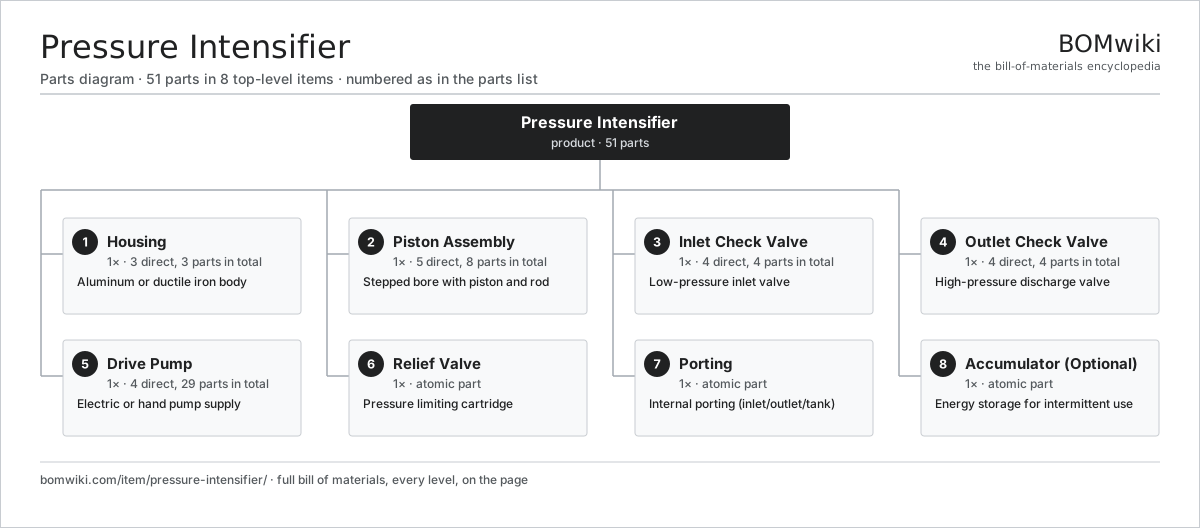
| # | Part | Qty | What it does |
|---|---|---|---|
| 1 | Housing 3 parts | 1× | Aluminum or ductile iron body |
| 2 | Piston Assembly 5 parts | 1× | Stepped bore with piston and rod |
| 3 | Inlet Check Valve 4 parts | 1× | Low-pressure inlet valve |
| 4 | Outlet Check Valve 4 parts | 1× | High-pressure discharge valve |
| 5 | Drive Pump 4 parts | 1× | Electric or hand pump supply |
| 6 | Relief Valve | 1× | Pressure limiting cartridge |
| 7 | Porting | 1× | Internal porting (inlet/outlet/tank) |
| 8 | Accumulator (Optional) | 1× | Energy storage for intermittent use |
3D model
No 3D model yet. Have a CAD file of this? Add a 3D model. STL renders right on this page; STEP, FreeCAD, and OpenSCAD sources are welcome too (openly licensed, like all 3D models on BOMwiki).
Build & assembly graph
expand / collapse · shared sub-assemblies converge · links to related products · est. labourTap an assembly to expand/collapse · tap a part to open it · use “Open page” for any node · drag to pan, scroll to zoom.
Bill of materials for Pressure Intensifier
8 top-level lines · 32 rows shown · 51 parts total · indented to 3 levels| # | Item / sub-assembly | Part no. | Qty/assy | Ext. qty | Parts | Type |
|---|---|---|---|---|---|---|
| 1 | Housing 3 parts | pressure-intensifier-housing | 1× | 1 | 3 | assembly |
| 1.1 | Housing Body | pressure-intensifier-housing-body | 1× | 1 | · | part |
| 1.2 | Housing Ports | pressure-intensifier-housing-ports | 1× | 1 | · | part |
| 1.3 | Fastener Set | fastener-set | 1× | 1 | · | part |
| 2 | Piston Assembly 5 parts | pressure-intensifier-piston-assembly | 1× | 1 | 8 | assembly |
| 2.1 | Piston Body | pressure-intensifier-piston-body | 1× | 1 | · | part |
| 2.2 | Input Rod | pressure-intensifier-input-rod | 1× | 1 | · | part |
| 2.3 | Output Rod | pressure-intensifier-output-rod | 1× | 1 | · | part |
| 2.4 | O-Ring Set | oring-set | 4× | 4 | · | part |
| 2.5 | Fastener Set | fastener-set | 1× | 1 | · | part |
| 3 | Inlet Check Valve 4 parts | pressure-intensifier-inlet-check | 1× | 1 | 4 | assembly |
| 3.1 | Inlet Check Body | pressure-intensifier-inlet-check-body | 1× | 1 | · | part |
| 3.2 | Inlet Check Ball | pressure-intensifier-inlet-check-ball | 1× | 1 | · | part |
| 3.3 | Coil Spring | coil-spring | 1× | 1 | · | part |
| 3.4 | Fastener Set | fastener-set | 1× | 1 | · | part |
| 4 | Outlet Check Valve 4 parts | pressure-intensifier-outlet-check | 1× | 1 | 4 | assembly |
| 4.1 | Outlet Check Body | pressure-intensifier-outlet-check-body | 1× | 1 | · | part |
| 4.2 | Outlet Check Poppet | pressure-intensifier-outlet-check-poppet | 1× | 1 | · | part |
| 4.3 | Coil Spring | coil-spring | 1× | 1 | · | part |
| 4.4 | Fastener Set | fastener-set | 1× | 1 | · | part |
| 5 | Drive Pump 4 parts | pressure-intensifier-pump | 1× | 1 | 29 | assembly |
| 5.1 | Motor Housing | motor-housing | 1× | 1 | · | part |
| 5.2 | Displacement Unit 4 parts | hydraulic-motor-displacement | 1× | 1 | 26 | assembly |
| 5.2.1 | Rotor Assembly 4 parts + deeper › | rotor-assembly | 1× | 1 | 19 | assembly |
| 5.2.2 | Stator Assembly 3 parts + deeper › | stator-assembly | 1× | 1 | 3 | assembly |
| 5.2.3 | Port Plate | hydraulic-motor-port-plate | 1× | 1 | · | part |
| 5.2.4 | O-Ring Set | oring-set | 3× | 3 | · | part |
| 5.3 | Power Supply | power-supply | 1× | 1 | · | part |
| 5.4 | Fastener Set | fastener-set | 1× | 1 | · | part |
| 6 | Relief Valve | pressure-intensifier-relief-valve | 1× | 1 | · | part |
| 7 | Porting | pressure-intensifier-galleries | 1× | 1 | · | part |
| 8 | Accumulator (Optional) | pressure-intensifier-accumulator-optional | 1× | 1 | · | part |
Something wrong in this list? Report a problem with this BOM.
Related products
same domain, ranked by shared parts Hydraulic Motor
38 parts · shares 2 with this page
Hydraulic Test Bench
77 parts · shares 3 with this page
Hydraulic Motor
38 parts · shares 2 with this page
Hydraulic Test Bench
77 parts · shares 3 with this page
 Irrigation Pump Station
1,881 parts · shares 2 with this page
Irrigation Pump Station
1,881 parts · shares 2 with this page
 Radial Spillway Gate
264 parts · shares 2 with this page
Radial Spillway Gate
264 parts · shares 2 with this page
 Hydraulic Hose Crimper
27 parts · shares 1 with this page
Offline Filtration Cart
61 parts · shares 1 with this page
Hydraulic Hose Crimper
27 parts · shares 1 with this page
Offline Filtration Cart
61 parts · shares 1 with this page
Sourcing: possible vendors
Browse the supplier directory → Prices, MOQ, and lead times are algorithmic estimates, not quotes, and not claims about these companies. Company mappings are curated by keyword; est. price band $50–$50k. How estimates work| Vendor | HQ | Specialty | MOQ | Lead time |
|---|---|---|---|---|
|
🇩🇰Grundfos
grundfos.com ↗
|
Bjerringbro, DK | Pumps | 200 units | 6–12 wks |
|
🇺🇸Xylem
xylem.com ↗
|
Washington, US | Water technology | 200 units | 6–12 wks |
| flowserve.com ↗ | Irving, US | Pumps & valves | 200 units | 6–12 wks |
|
🇩🇪KSB
ksb.com ↗
|
Frankenthal, DE | Pumps & valves | 200 units | 6–12 wks |
| parker.com ↗ | Cleveland, US | Motion & fluid control | 200 units | 6–12 wks |
703-word article