Pressure Safety Mat
ProductOverview
Pressure-sensitive safety mats detect when a person steps onto or stands within a monitored floor zone, instantly disabling hazardous machinery. They are commonly used around industrial robot arms, heavy stamping presses, automated guided vehicles (AGV) in warehouses, and conveyor systems where human access is occasional but unpredictable.
This 1200 × 1200 mm (1.44 m²) model contains two parallel conductive rubber sensing plates separated by a 10 mm polymer spacer. When a person (minimum 12 kg load) steps on the mat, the top plate deforms downward and makes electrical contact with the bottom plate through suspended springs. This contact closes a circuit that signals the Safety Controller safety processor to immediately open dual Relay OSSD outputs, which cut power to machine servos, hydraulic solenoids, or motor drives.
The mat is embedded flush into the floor with a PVC Edge Trim Assembly frame protecting the perimeter. No adhesive or fasteners penetrate the mat itself, allowing field replacement if damaged.
Sensing Principle
The Sensing Plates assembly is based on a pressure-sensitive switch principle. The top Top Plate is a conductive rubber sheet (5 mm thick) with a surface resistance of approximately 1 MΩ per square (per ISO 4649 test). The bottom Bottom Plate is identical, also 5 mm conductive rubber. Between them lies a Spacer Grid polyethylene grid 10 mm tall with an open-cell structure.
At each corner, a small Insulating Post nylon or PEEK post creates a point contact between the two plates. These insulating posts prevent an accidental short circuit if the mat is compressed (e.g., during installation). When loaded, distributed pressure (not a point contact) causes the flexible rubber sheets to deflect the spacer grid and come into broad contact.
Two stainless steel Contact Spring dome springs at the mat's edges provide electrical continuity between the two plates when they are pressed together. When weight is removed, the springs push the plates apart, breaking the circuit.
Pressure Detection and Signal Conditioning
As the top plate descends under load, contact resistance between the plates decreases. At a 12 kg distributed load (approximately 1.2 kPa pressure assuming load spread over the entire mat), the contact resistance drops below 100 Ω. The Safety Controller ARM microcontroller continuously samples the plate resistance via a Analog-Digital Converter 12-bit analog-to-digital converter at 1 kHz.
Firmware applies a debouncing algorithm: the processor waits for the measured resistance to remain below the configured threshold for at least 50 ms before asserting a safety fault. This prevents false activations from brief disturbances (vibrations, spilled liquids transiting the mat).
A Threshold Selector programmable setpoint selector, using three DIP Switch binary switches, allows site configuration of the pressure threshold between 12 kg and 50 kg in 5 kg increments. Different machines have different requirements: a light-duty robotic arm might trip at 12 kg, while a heavy conveyor requires at least 30 kg to prevent accidental activation from dropped packages.
Dual-Channel Safety Output
When the pressure threshold is exceeded for >50 ms, the controller immediately signals two independent OSSD Driver MOSFET drivers. Each driver independently de-energizes a Relay solenoid. The relays are wired in series with the machine's safety circuit; when either relay opens, current stops flowing to the servo enable or hydraulic pilot solenoid, bringing the machine to a controlled stop within 200 ms.
The dual-channel architecture prevents single-point failure:
- Relay 1 fails open (contacts weld shut): Relay 2 still functions; the mat can still stop the machine.
- Relay 1 fails closed (contacts weld open): The system detects asymmetry (Relay 2 opens but Relay 1 does not), and the external safety relay module triggers an alarm, removing power completely.
An independent Watchdog Processor circuit (separate logic gate, no shared MCU) monitors the processor's heartbeat signal. Every 10 ms, the MCU outputs a toggle pulse. If this pulse stops (processor hangs or crashes), the watchdog timer immediately forces both OSSD lines open within 5 ms.
Response Time and Reliability
Measured response time from foot contact to OSSD relay opening is <50 ms under laboratory conditions. In real deployment, response time is typically 80–150 ms (including machine mechanical lag). ISO 13849-1 safety standard requires <500 ms for machinery with hazard distances >1500 mm, so this design is well within specification.
The mat is rated for 100,000 pressure cycles at rated load (continuous industrial use for ~3 years in a busy factory). The conductive rubber deteriorates ~10% per year due to UV exposure (if outdoors) and mechanical compression set; field replacement of the top Top Plate can extend service life another 5 years.
Installation and Maintenance
The mat is designed for flush floor mounting. The Edge Frame PVC extrusion frame is 40 mm tall and contains the mat perimeter. The frame is typically mounted to a wood or concrete subfloor using epoxy adhesive or mechanical fasteners in the frame's outer edges (not through the mat itself).
Fastener Clip spring-loaded snap clips hold the mat edges within the frame without penetrating the mat. This allows the mat to be unclipped and replaced without cutting out the frame.
The Cable Gland M20 cable entry on the frame accommodates the shielded Cable Assembly four-pair cable that runs to the Safety Controller. The controller is typically mounted in a wall-mounted junction box at the edge of the work cell, receiving 24V DC power from the facility's main safety circuit and outputting OSSD relay signals back to the machine's safety controller.
Corner Guard rubber corner bumpers at the mat's four corners prevent workers from stubbing toes or equipment from snagging the edge. These are field-replaceable if damaged.
Pressure Sensitivity Calibration
The three DIP Switch binary switches on the Threshold Selector set the pressure sensitivity:
- DIP 1, 2, 3 all OFF = 12 kg threshold
- DIP 1 ON, DIP 2 & 3 OFF = 17 kg threshold
- DIP 1 & 2 ON, DIP 3 OFF = 22 kg threshold
- ... (5 kg increments) ...
- DIP 1, 2, 3 all ON = 50 kg threshold
Sensitivity must be configured before installation. The Label Dial adhesive overlay shows the current setting as a visual reference for field technicians.
Some applications require a two-mat "AND" logic: both mats must be pressed simultaneously to initiate motion (preventing a single foot step from activating machinery). This is typically configured at the plant's safety relay module level, wiring both mats' OSSD outputs in series.
Environmental Factors
The mat's conductive rubber surface provides ~0.7 coefficient of friction (μ = 0.7 per DIN 51130 test), making it slip-resistant even when wet. The IP67 enclosure rating permits exposure to splashing water and detergent washdown but not submersion. Outdoor installations require UV-protective paint or shade, as continuous sunlight degrades the conductive rubber's elasticity.
Temperature range is 0 to 50 °C ambient. At <0 °C, the rubber becomes stiff and may not deflect normally, causing false non-activations. At >60 °C (high ambient or heat from nearby machinery), the rubber softens and response time may slow. In extreme environments, heated or cooled mat covers can be installed.
Regulations and Certification
Pressure-sensitive safety mats are covered by ISO 13849-1 (Safety of Machinery, Safety-Related Parts of Control Systems) and ISO 13851 (Logic Safety Applications). This design achieves PLd Performance Level (equivalent to SIL 2 for machinery). CSA B167.19 (Canada) and OSHA 29 CFR 1910.212 (US) recognize pressure mats as acceptable guarding for certain applications.
The mat is NOT suitable as the sole guard for high-speed machinery (presses >500 strokes/min, robots with acceleration >1g). In such cases, the mat serves as a supplementary guard in combination with light curtains or interlocks.
Pressure Safety Mat parts and their functions
5 top-level parts · 69 parts in total · full bill of materials below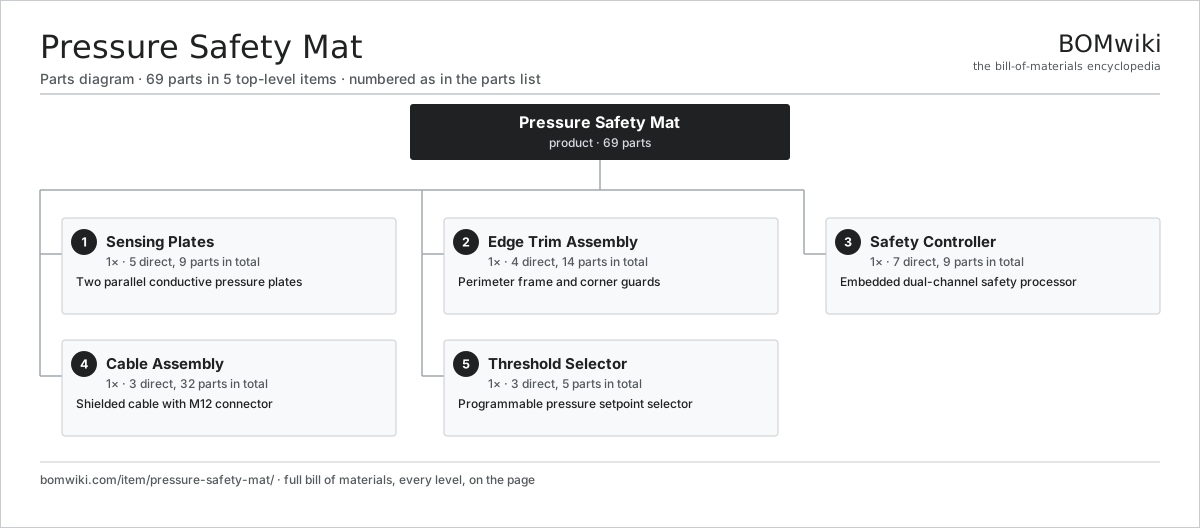
| # | Part | Qty | What it does |
|---|---|---|---|
| 1 | Sensing Plates 5 parts | 1× | Two parallel conductive pressure plates |
| 2 | Edge Trim Assembly 4 parts | 1× | Perimeter frame and corner guards |
| 3 | Safety Controller 7 parts | 1× | Embedded dual-channel safety processor |
| 4 | Cable Assembly 3 parts | 1× | Shielded cable with M12 connector |
| 5 | Threshold Selector 3 parts | 1× | Programmable pressure setpoint selector |
3D model
No 3D model yet. Have a CAD file of this? Add a 3D model. STL renders right on this page; STEP, FreeCAD, and OpenSCAD sources are welcome too (openly licensed, like all 3D models on BOMwiki).
Build & assembly graph
expand / collapse · shared sub-assemblies converge · links to related products · est. labourTap an assembly to expand/collapse · tap a part to open it · use “Open page” for any node · drag to pan, scroll to zoom.
Bill of materials for Pressure Safety Mat
5 top-level lines · 27 rows shown · 69 parts total · indented to 3 levels| # | Item / sub-assembly | Part no. | Qty/assy | Ext. qty | Parts | Type |
|---|---|---|---|---|---|---|
| 1 | Sensing Plates 5 parts | pressure-safety-mat-sensing-plates | 1× | 1 | 9 | assembly |
| 1.1 | Top Plate | pressure-safety-mat-top-plate | 1× | 1 | · | part |
| 1.2 | Bottom Plate | pressure-safety-mat-bottom-plate | 1× | 1 | · | part |
| 1.3 | Spacer Grid | pressure-safety-mat-spacer-grid | 1× | 1 | · | part |
| 1.4 | Insulating Post | pressure-safety-mat-insulated-spacer | 4× | 4 | · | part |
| 1.5 | Contact Spring | pressure-safety-mat-contact-spring | 2× | 2 | · | part |
| 2 | Edge Trim Assembly 4 parts | pressure-safety-mat-edge-trim | 1× | 1 | 14 | assembly |
| 2.1 | Edge Frame | pressure-safety-mat-edge-frame | 1× | 1 | · | part |
| 2.2 | Corner Guard | pressure-safety-mat-corner-guard | 4× | 4 | · | part |
| 2.3 | Cable Gland | pressure-safety-mat-cable-gland | 1× | 1 | · | part |
| 2.4 | Fastener Clip | pressure-safety-mat-fastener-clip | 8× | 8 | · | part |
| 3 | Safety Controller 7 parts | pressure-safety-mat-controller | 1× | 1 | 9 | assembly |
| 3.1 | Microcontroller | mcu | 1× | 1 | · | part |
| 3.2 | Analog-Digital Converter | pressure-safety-mat-adc | 1× | 1 | · | part |
| 3.3 | OSSD Driver | pressure-safety-mat-ossd-driver | 2× | 2 | · | part |
| 3.4 | Watchdog Processor | pressure-safety-mat-watchdog | 1× | 1 | · | part |
| 3.5 | Power Converter | pressure-safety-mat-power-module | 1× | 1 | · | part |
| 3.6 | Controller PCB | pressure-safety-mat-controller-pcb | 1× | 1 | · | part |
| 3.7 | Relay | relay | 2× | 2 | · | part |
| 4 | Cable Assembly 3 parts | pressure-safety-mat-cable-assembly | 1× | 1 | 32 | assembly |
| 4.1 | Mat Cable | pressure-safety-mat-cable-main | 30× | 30 | · | part |
| 4.2 | M12 Connector | pressure-safety-mat-connector-m12 | 1× | 1 | · | part |
| 4.3 | Strain Relief | pressure-safety-mat-strain-relief | 1× | 1 | · | part |
| 5 | Threshold Selector 3 parts | pressure-safety-mat-threshold-module | 1× | 1 | 5 | assembly |
| 5.1 | DIP Switch | pressure-safety-mat-dip-switch | 3× | 3 | · | part |
| 5.2 | Module Bracket | pressure-safety-mat-module-bracket | 1× | 1 | · | part |
| 5.3 | Label Dial | pressure-safety-mat-label-dial | 1× | 1 | · | part |
Something wrong in this list? Report a problem with this BOM.
Sourcing: possible vendors
Browse the supplier directory → Prices, MOQ, and lead times are algorithmic estimates, not quotes, and not claims about these companies. Company mappings are curated by keyword; est. price band $50–$10k. How estimates work| Vendor | HQ | Specialty | MOQ | Lead time |
|---|---|---|---|---|
| assaabloy.com ↗ | Stockholm, SE | Locks & access | 1,000 units | 8–12 wks |
|
🇺🇸Allegion
allegion.com ↗
|
Dublin, US | Security products (Schlage) | 1,000 units | 8–12 wks |
| dormakaba.com ↗ | Rümlang, CH | Access & door systems | 1,000 units | 8–12 wks |
| honeywell.com ↗ | Charlotte, US | Building & safety tech | 1,000 units | 8–12 wks |
| hikvision.com ↗ | Hangzhou, CN | Surveillance & security | 1,000 units | 8–12 wks |
1,345-word article