Pretzel Line
ProductOverview
The Pretzel Line is a fully integrated continuous system for manufacturing soft or hard pretzels from dough to finished, salted, baked product. The process combines traditional pretzel-making steps, dough extrusion, manual rope twisting (now automated), caustic lye bath treatment, salt application, and baking, into a single coordinated machine. Production rates reach 150–250 pretzels per hour, making the system suitable for regional bakeries, food courts, and industrial snack manufacturers.
The machine is distinctive for its incorporation of the caustic bath stage, a critical step in pretzel production. A brief submersion in 2–4% sodium hydroxide (NaOH) solution treats the pretzel surface, creating the characteristic dark brown, slightly crispy crust and enabling large salt crystals to adhere firmly. Without the lye bath, the product is simply a salted breadstick; the caustic treatment is what defines a "true" pretzel.
How It Works
Prepared pretzel dough (flour, water, yeast or chemical leavener, salt, optionally malt extract) is loaded into the Rope Extruder hopper. The Extruder Screw single screw rotates at 20–40 rpm (controlled by a Extruder Motor with frequency inversion), advancing dough through the Extruder Barrel. Two heating zones maintain the barrel at 55–65°C, warming the dough to optimal workability without causing fermentation or crust formation. The Extruder Die (12 mm circular orifice) extrudes a continuous rope onto an inclined conveyor.
The dough rope is then fed to the Twisting Mechanism, a programmable Twisting Arm robot arm (SCARA or 6-axis with 2–3 m reach). The robot grips the rope with a soft Twister Gripper (pneumatic or vacuum-cup based) and performs a precise knot-folding motion: picking up the rope, looping it into a twisted pretzel shape (characteristic U-bend with two twisted strands), and depositing the shaped pretzel onto a transfer conveyor. A Twister Controller motion control unit stores multiple pretzel shape recipes, allowing quick changeovers from classic twisted pretzels to specialty shapes (braided, small bites, large knots).
The shaped, still-raw pretzels then transit on a conveyor to the Caustic Bath, a critical process step. Pretzels are submerged briefly (3–5 seconds) in a Bath Tank containing 2–4% NaOH solution maintained at 20–25°C by a Bath Thermostat. This alkaline bath denatures surface proteins and causes Maillard browning during subsequent baking, producing the deep mahogany color and distinctive chewy-crispy crust texture characteristic of pretzels. The caustic also promotes salt adhesion. Post-bath, pretzels must be immediately rinsed by overhead Bath Spray Rinse spray nozzles to neutralize residual lye; any alkaline residue would create an unpleasant soap-like taste if left on the product.
Damp, just-rinsed pretzels are then fed into the Salt Applicator, a rotating drum with internal paddles. A Salter Hopper vibratory feeder dispenses coarse pretzel salt (larger crystals, ~5 mm diameter) onto the rotating product; the Salter Motor tumbles pretzels at 30 rpm for 20–30 seconds, coating all surfaces evenly with 10–15 g salt per pretzel. Optional oil or seasoning sprays can apply butter flavoring, garlic powder, or cinnamon-sugar coatings in this stage.
Salted pretzels then move onto a conveyor feeding the Baking Oven, a long tunnel oven (8 m) with 3–4 independent heating zones. Temperature in zone 1 is 200–210°C, zone 2 is 210–220°C, and zone 3–4 are 220°C. A Oven Motor drives the conveyor belt at variable speed (0.1–0.3 m/s), controlling residence time. Soft pretzels require 12–15 minutes of baking (slower belt speed); hard pretzels require 25–35 minutes. During baking, the alkaline surface from the lye bath rapidly browns (Maillard caramelization), creating the dark crust. Simultaneously, the interior dough bakes through, with yeast/chemical leavening producing a light, airy crumb structure. A Oven Exhaust dampered fan removes moisture vapor, maintaining a controlled humidity that produces even browning without excessive crust hardening.
Post-oven, pretzels exit at 80–90°C, soft (soft pretzels) or crispy (hard pretzels) depending on oven residence and temperature. They cool passively on a final conveyor (3–5 minutes) to room temperature, after which they are ready for packaging.
Caustic Chemistry and Safety
Sodium hydroxide (NaOH) is a strong alkaline chemical that must be handled with strict safety protocols. In the Bath Tank, a 2–4% solution by weight is typical (stronger solutions brown too quickly and create excessive crispness; weaker solutions under-brown). The solution is typically maintained at room temperature (20–25°C) to prevent rapid hydration reactions and heat generation. A Bath Recirculation pump continuously circulates the bath through a cartridge filter, removing flour dust and protein particles that would cloud the solution and reduce effectiveness.
The caustic solution degrades over time as CO₂ from air converts NaOH to sodium carbonate (Na₂CO₃). A typical bath life is 1–2 weeks of continuous operation (40–80 hours) before replacement. The Bath Drain solenoid valve periodically drains spent bath into a collection tank; this caustic waste must be neutralized (pH brought to 7–8) using acid (citric or hydrochloric) before disposal, per environmental regulations.
Personal protective equipment (goggles, gloves, apron) is mandatory for operators working near the caustic bath. Accidental skin contact requires immediate water rinsing (15+ minutes) and medical attention.
Soft vs. Hard Pretzel Parameters
Soft pretzels are achieved with short bake time (12–18 minutes at 200–215°C), moderate oven humidity (controlled by exhaust damper), and immediate consumption post-cooling. The interior remains moist and chewy; the crust is brown but not hard. Soft pretzels have a 2–3 day shelf life at room temperature or 1–2 weeks frozen.
Hard pretzels require extended bake time (25–35 minutes at 200–230°C), lower oven humidity (closed exhaust damper), and sometimes a post-bake drying step at 100–120°C for 2–4 hours. The entire product dries to approximately 5–8% moisture, creating a shelf-stable, crispy product with 3–6 month shelf life.
The Extruder Thermostat dough temperature adjustment allows recipe tuning: cooler dough (50–55°C) extrudes more easily for large, soft pretzels; warmer dough (60–65°C) produces firmer pretzels with tighter crumb structure.
Yield and Economics
Typical yield from raw dough to finished pretzels is 90–95% (accounting for evaporation during bake and minor trim/handling loss). A dough batch of 50 kg produces 47–48 kg finished soft pretzels, or 45–46 kg finished hard pretzels (due to lower final moisture).
Energy consumption is approximately 40–60 kWh electrical and 200–300 kWth thermal per 1000 kg finished product, depending on bake time (soft vs. hard) and oven insulation efficiency.
Caustic cost is significant: a 200 liter bath at 3% concentration contains 6 kg NaOH, costing ~USD 30–50. Extended operational life (1–2 weeks per charge) amortizes this cost across 500–1000 pretzels, adding ~USD 0.03–0.06 material cost per unit.
The robot twister arm is a capital investment (USD 50k–150k depending on brand and speed capability), but eliminates manual labor, ensures consistent shape, and allows rapid recipe changeovers. Payback occurs within 1–2 years in high-volume settings.
Pretzel Line parts and their functions
6 top-level parts · 49 parts in total · full bill of materials below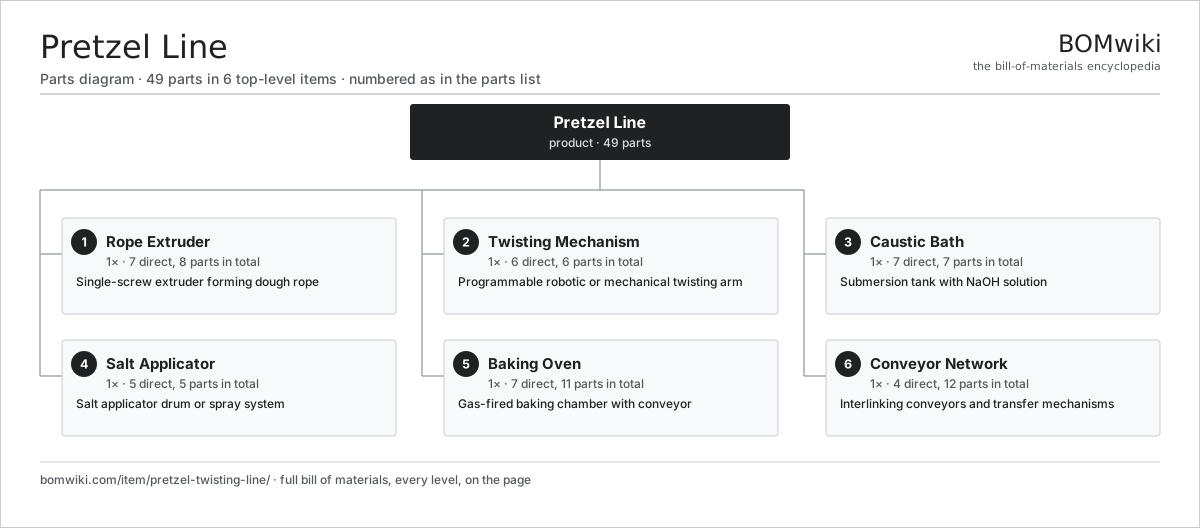
| # | Part | Qty | What it does |
|---|---|---|---|
| 1 | Rope Extruder 7 parts | 1× | Single-screw extruder forming dough rope |
| 2 | Twisting Mechanism 6 parts | 1× | Programmable robotic or mechanical twisting arm |
| 3 | Caustic Bath 7 parts | 1× | Submersion tank with NaOH solution |
| 4 | Salt Applicator 5 parts | 1× | Salt applicator drum or spray system |
| 5 | Baking Oven 7 parts | 1× | Gas-fired baking chamber with conveyor |
| 6 | Conveyor Network 4 parts | 1× | Interlinking conveyors and transfer mechanisms |
3D model
No 3D model yet. Have a CAD file of this? Add a 3D model. STL renders right on this page; STEP, FreeCAD, and OpenSCAD sources are welcome too (openly licensed, like all 3D models on BOMwiki).
Build & assembly graph
expand / collapse · shared sub-assemblies converge · links to related products · est. labourTap an assembly to expand/collapse · tap a part to open it · use “Open page” for any node · drag to pan, scroll to zoom.
Bill of materials for Pretzel Line
6 top-level lines · 42 rows shown · 49 parts total · indented to 3 levels| # | Item / sub-assembly | Part no. | Qty/assy | Ext. qty | Parts | Type |
|---|---|---|---|---|---|---|
| 1 | Rope Extruder 7 parts | pretzel-twisting-line-extruder | 1× | 1 | 8 | assembly |
| 1.1 | Extruder Hopper | pretzel-twisting-line-extruder-hopper | 1× | 1 | · | part |
| 1.2 | Extruder Screw | pretzel-twisting-line-extruder-screw | 1× | 1 | · | part |
| 1.3 | Extruder Barrel | pretzel-twisting-line-extruder-barrel | 1× | 1 | · | part |
| 1.4 | Extruder Motor | pretzel-twisting-line-extruder-motor | 1× | 1 | · | part |
| 1.5 | Extruder Die | pretzel-twisting-line-extruder-die | 1× | 1 | · | part |
| 1.6 | Extruder Heater | pretzel-twisting-line-extruder-heater | 2× | 2 | · | part |
| 1.7 | Extruder Thermostat | pretzel-twisting-line-extruder-thermostat | 1× | 1 | · | part |
| 2 | Twisting Mechanism 6 parts | pretzel-twisting-line-twister | 1× | 1 | 6 | assembly |
| 2.1 | Twisting Arm | pretzel-twisting-line-twister-arm | 1× | 1 | · | part |
| 2.2 | Twister Gripper | pretzel-twisting-line-twister-gripper | 1× | 1 | · | part |
| 2.3 | Twister Controller | pretzel-twisting-line-twister-controller | 1× | 1 | · | part |
| 2.4 | Twister Conveyor | pretzel-twisting-line-twister-conveyor | 1× | 1 | · | part |
| 2.5 | Twister Motor | pretzel-twisting-line-twister-motor | 1× | 1 | · | part |
| 2.6 | Twister Pneumatics | pretzel-twisting-line-twister-pneumatics | 1× | 1 | · | part |
| 3 | Caustic Bath 7 parts | pretzel-twisting-line-caustic-bath | 1× | 1 | 7 | assembly |
| 3.1 | Bath Tank | pretzel-twisting-line-bath-tank | 1× | 1 | · | part |
| 3.2 | Bath Conveyor | pretzel-twisting-line-bath-conveyor | 1× | 1 | · | part |
| 3.3 | Bath Motor | pretzel-twisting-line-bath-motor | 1× | 1 | · | part |
| 3.4 | Bath Recirculation | pretzel-twisting-line-bath-recirculation | 1× | 1 | · | part |
| 3.5 | Bath Thermostat | pretzel-twisting-line-bath-thermostat | 1× | 1 | · | part |
| 3.6 | Bath Spray Rinse | pretzel-twisting-line-bath-spray-rinse | 1× | 1 | · | part |
| 3.7 | Bath Drain | pretzel-twisting-line-bath-drain | 1× | 1 | · | part |
| 4 | Salt Applicator 5 parts | pretzel-twisting-line-salter | 1× | 1 | 5 | assembly |
| 4.1 | Salter Drum | pretzel-twisting-line-salter-drum | 1× | 1 | · | part |
| 4.2 | Salter Motor | pretzel-twisting-line-salter-motor | 1× | 1 | · | part |
| 4.3 | Salter Hopper | pretzel-twisting-line-salter-hopper | 1× | 1 | · | part |
| 4.4 | Salter Spray | pretzel-twisting-line-salter-spray | 1× | 1 | · | part |
| 4.5 | Salter Discharge | pretzel-twisting-line-salter-discharge | 1× | 1 | · | part |
| 5 | Baking Oven 7 parts | pretzel-twisting-line-oven | 1× | 1 | 11 | assembly |
| 5.1 | Oven Chamber | pretzel-twisting-line-oven-chamber | 1× | 1 | · | part |
| 5.2 | Oven Conveyor | pretzel-twisting-line-oven-conveyor | 1× | 1 | · | part |
| 5.3 | Oven Motor | pretzel-twisting-line-oven-motor | 1× | 1 | · | part |
| 5.4 | Oven Burner | pretzel-twisting-line-oven-burners | 3× | 3 | · | part |
| 5.5 | Oven Thermostat | pretzel-twisting-line-oven-thermostats | 3× | 3 | · | part |
| 5.6 | Oven Exhaust | pretzel-twisting-line-oven-exhaust | 1× | 1 | · | part |
| 5.7 | Oven Cooling | pretzel-twisting-line-oven-cooling-section | 1× | 1 | · | part |
| 6 | Conveyor Network 4 parts | pretzel-twisting-line-conveyor-network | 1× | 1 | 12 | assembly |
| 6.1 | Conveyor Belt | pretzel-twisting-line-conveyor-belts | 4× | 4 | · | part |
| 6.2 | Conveyor Motor | pretzel-twisting-line-conveyor-motors | 4× | 4 | · | part |
| 6.3 | Conveyor Frame | pretzel-twisting-line-conveyor-frame | 1× | 1 | · | part |
| 6.4 | Transfer Chute | pretzel-twisting-line-transfer-chutes | 3× | 3 | · | part |
Something wrong in this list? Report a problem with this BOM.
Sourcing: possible vendors
Browse the supplier directory → Prices, MOQ, and lead times are algorithmic estimates, not quotes, and not claims about these companies. Company mappings are curated by keyword; est. price band $1k–$500k. How estimates work| Vendor | HQ | Specialty | MOQ | Lead time |
|---|---|---|---|---|
| gea.com ↗ | Düsseldorf, DE | Process technology | 20 units | 12–20 wks |
| buhlergroup.com ↗ | Uzwil, CH | Food & materials processing | 20 units | 12–20 wks |
| tetrapak.com ↗ | Pully, CH | Food packaging & processing | 20 units | 12–20 wks |
| jbtc.com ↗ | Chicago, US | Food processing equipment | 20 units | 12–20 wks |
| alfalaval.com ↗ | Lund, SE | Heat transfer & separation | 20 units | 12–20 wks |
1,257-word article