Waterproof Equipment Case
ProductOverview
A waterproof equipment case is a rigid protective container designed for marine, diving, outdoor, and scientific equipment that must survive immersion or prolonged moisture exposure. Unlike hardside suitcases (travel) or road cases (touring), waterproof cases prioritize three things: seal integrity, pressure equalization, and impact resistance in wet environments.
The cases are manufactured using injection molding of polypropylene (PPH) or copolymer, creating seamless two-piece shells. An o-ring sandwiched between the lid and base creates a waterproof seal; a pressure-relief valve prevents over-pressurization during altitude changes. Equipment like cameras, diving lights, scientific instruments, or emergency radios depends on these cases for survival in harsh conditions.
Shell Design
The Molded Shell Housing is a two-piece injection-molded polypropylene structure (top and bottom clamshells). Polypropylene is chosen for its:
- Chemical resistance: Unaffected by saltwater, fuel, acids, or solvents.
- Lightweight: 0.9 g/cm³ (vs. ABS 1.05, aluminum 2.7).
- Impact toughness: PP can absorb drops without cracking; maintains flexibility in cold.
- Cost: Injection molding is economical for high-volume production.
Molding process:
- Top Top Shell and Bottom Shell are molded as complete units with integral hinge posts, seal grooves, and ribs.
- Seal groove: A precisely machined circular ledge (0.25 inch wide, 0.1 inch deep) captures the o-ring.
- Rib pattern: Internal structural ribs (visible on the interior) prevent flexing and maintain lid-to-base alignment.
Design tolerance:
- Manufacturing variation: Molded parts can have ±0.05 inch (1.3 mm) tolerance on seal surfaces.
- Seal quality depends on flatness: If the seal surface has 0.1 inch (2.5 mm) deviation, the o-ring cannot compress evenly, creating leak points.
- High-end waterproof cases are precision-molded to ±0.02 inch; budget cases accept larger tolerances, resulting in intermittent leaks.
Common defects:
- Flash (thin plastic along parting line): Removed post-molding but can reappear if stored in heat.
- Warping: If the case is left in direct sunlight or stored in a hot vehicle, the polypropylene can warp slightly, compromising the seal.
- Rib cracking: Drop impacts can crack internal ribs, reducing structural integrity.
Seal System
The O-Ring Seal System is the critical waterproofing component. The seal comprises:
- Two o-rings: Primary (outer diameter 3–4 inches) seated in the seal groove on the base shell; secondary (on the lid) providing redundancy.
- O-ring material: Nitrile (NBR) or EPDM rubber; Viton for chemical resistance to fuels.
- Compressed when the lid closes: The lid presses the o-ring into the groove, creating a watertight interface.
- Lubrication: O-Ring Lubricant (silicone grease) reduces friction during closure and prevents o-ring extrusion.
Seal mechanics:
- O-ring compression: Typically 10–20% of the o-ring cross-section is squeezed into the groove.
- Squeeze pressure: ~50–100 PSI (required by the springs in the latches).
- Water tightness: At 1 meter depth (~1.5 PSI external pressure) and proper compression, the o-ring prevents water ingress indefinitely.
Maintenance:
- Clean the o-ring grooves quarterly: Saltwater crystallizes, jamming the o-ring.
- Reapply silicone grease: Prevents o-ring degradation and eases lid closure.
- Replace o-rings every 2–3 years: Ozone and UV exposure harden rubber.
- Do not over-tighten latches: Excessive clamp force extrudes the o-ring, creating leak paths.
Pressure Equalization Valve
The Pressure Equalization Valve is essential for cases transported at altitude or exposed to temperature changes. Without this valve:
- Altitude ascent: Internal pressure drops, creating a vacuum that deforms the case and sucks water into any microscopic seal gaps.
- Sun exposure: Internal air warms, building pressure that distorts the case or forces the lid open.
The valve features:
- Valve Housing: Polypropylene housing threaded into the shell.
- Check Cartridge: A cracking-pressure cartridge (0.3–0.5 PSI differential) that opens if internal pressure deviates from external.
- Vent Membrane: Gore-Tex or synthetic microporous membrane that allows air exchange but blocks water entry.
Function:
- Climbing to 10,000 feet: Cabin pressure drops ~3.5 PSI; the internal case pressure drops initially, triggering the valve to open and allow external air in, equalizing pressure.
- Heating in sunlight: Internal air expands, building pressure; the valve cracks open and allows excess air to escape.
- Submersion: External water pressure is 1.5 PSI at 1 meter depth; the valve remains closed because internal pressure (atmospheric, 14.7 PSI at sea level) exceeds external pressure.
Maintenance:
- The membrane can clog with salt or dust; rinse quarterly with fresh water.
- If the case becomes difficult to open (too much internal vacuum), the valve may be blocked; soak the case in fresh water for 1 hour to dissolve crystallized salt.
Latch System
The Pressure-Release Latch Assembly consists of four spring-loaded latches providing the clamp force necessary to compress the o-ring seal:
- Latch Toggle: Plastic lever with dual-position: downward (locked) and upward (released).
- Latch Spring: Compression spring providing 50–150 newtons of downward force per latch (total 200–600 N across all four).
- Latch Catch: Strike plate on the base shell catching the latch toggle.
Closure procedure:
- Lower the lid until it contacts the o-ring (resistance felt).
- Pull down the latches one by one (or all four simultaneously on some designs).
- Each latch moves downward 0.5–1 inch (13–25 mm) before striking the catch.
- Final clamp force is provided by the spring, pushing down with constant pressure.
Over-pressure protection:
- If the lid is forced down too hard, the latch can strip or the o-ring can extrude.
- Design mitigation: Latch design limits downward travel to prevent excessive clamp force; users should feel resistance and not force the latches.
Failure modes:
- Spring fatigue: After 500+ open/close cycles, the spring weakens, reducing clamp force.
- Latch toggle cracking: Impact or stress can crack the plastic lever; the case becomes difficult to seal.
- Catch wear: The catch plate rounds over, allowing the latch to slip.
Hinge Assembly
The Snap Hinge Pin is a simple stainless steel pin enabling the lid to rotate. Unlike road cases (dual hinges), waterproof cases use a single snap pin:
Design:
- Left or right side mounting: The pin is molded into one side of the shell, acting as a fixed pivot.
- Snap-fit: The lid has a corresponding hole that snaps over the pin; no mechanical fastening required.
- Full 180° rotation: The lid can open flat against the base or flip fully open.
Advantage: Minimizes seal-surface interruptions (fewer seams = fewer leak points).
Disadvantage: Single pivot means the opposite end of the lid must be supported by latches; if latches release suddenly, the lid can slam shut.
Interior Foam System
The Interior Foam Packing uses pluck-and-pick foam, allowing users to customize compartments on-site without tools. The foam comprises:
- Interlocking cubes: 0.5–1 inch cubes held together loosely.
- User removal: Grasp the top of a cube, pluck it out to create a custom cutout.
- Reusability: Cubes can be reinstalled or rearranged as needed.
Material: Closed-cell polyethylene or EVA foam, ~2 lbs/cubic foot, buoyant (floats).
Customization example:
- Dive light: Pluck out a 4-inch-diameter hole.
- Camera: Pluck a rectangular cuboid matching the camera body.
- Electronics: Arrange cubes to create individual compartments for each device.
Lifespan: Foam ages over years, becoming stiffer and more brittle; compression sets in (deformed areas don't spring back). Replacement foam is inexpensive ($20–50 per case).
Handles & Transport
Two handle styles enable different carrying modes:
- Top Handle: Center-mounted top handle for one-handed carrying (small to medium cases).
- Side handles: Optional side grips for two-person carries or mounting on a belt.
Handles are injection-molded polypropylene with rubberized grip coating, resisting saltwater degradation.
Waterproof Rating & Limitations
Waterproof cases are rated per IP (Ingress Protection) standards:
- IP67: Protected against temporary submersion (1 meter, 30 minutes). Standard for consumer waterproof cases.
- IP68: Protected against continuous submersion at specified depth (e.g., 100 meters for diving cases). Requires more robust seal design.
Important caveat: IP ratings assume:
- Intact seal surfaces and o-rings (no damage).
- Closure at nominal clamp force (not over-tightened or under-tightened).
- Compliance with pressure equalization valve operation.
- Absence of thermal shock (placing a warm, sealed case in cold water rapidly).
Failure scenarios:
- Over-tightened latches: Extrudes o-ring, creating leak paths at latches.
- Sand in seal groove: Creates microscopic channels bypassing the o-ring.
- Prolonged sun exposure: Hardens o-rings, reducing compression.
- Cracked shell: Compromises structural integrity; sealing becomes impossible.
Durability & Maintenance
A well-maintained waterproof case lasts 10–20+ years:
| Component | Lifespan | Maintenance |
|---|---|---|
| Polypropylene shell | 20+ years | Avoid UV (store indoors); rinse with fresh water |
| O-ring seals | 2–3 years | Replace every 2–3 years or if hardened |
| Latches | 10+ years | Clean salt deposits; replace if spring fails |
| Hinge pin | 15+ years | Rare failure unless corroded |
| Pressure valve | 10+ years | Rinse membrane; replace if clogged |
| Foam interior | 5–10 years | Replace if degraded or compressed |
Maintenance procedure (marine use):
- After each use: Rinse the entire case with fresh water to remove salt.
- Monthly: Clean o-ring grooves with a soft brush and fresh water.
- Quarterly: Inspect the pressure valve membrane; rinse if chalky salt deposits visible.
- Annually: Reapply silicone grease to o-rings; test the pressure valve by sealing the case in a warm location.
- Every 2–3 years: Replace o-rings with fresh ones (cost: $10–30 per set).
Cost of ownership (15-year example):
- Initial: $150–800 depending on size and brand.
- O-ring replacement (3 sets): $50.
- Foam replacement: $40.
- Total: ~$250–900 (amortized $17–60/year).
Comparison: Waterproof Case Materials
| Material | Weight | Waterproof | Impact | Cost | Durability |
|---|---|---|---|---|---|
| Polypropylene (molded) | Light | Excellent (IP67) | Very good | Low–Mid ($150–500) | 10–20 years |
| ABS plastic | Light | Good (requires sealing) | Excellent | Mid ($200–600) | 8–15 years |
| Aluminum (hard case) | Heavy | Poor (unsealed) | Excellent | High ($400–2,000) | 15–25 years |
| Rotomolded plastic | Light | Very good | Excellent | Mid ($300–1,500) | 10–20 years |
Injection-molded polypropylene dominates the waterproof case market due to cost-effectiveness, adequate waterproofing, and ease of customization.
Waterproof Equipment Case parts and their functions
7 top-level parts · 45 parts in total · full bill of materials below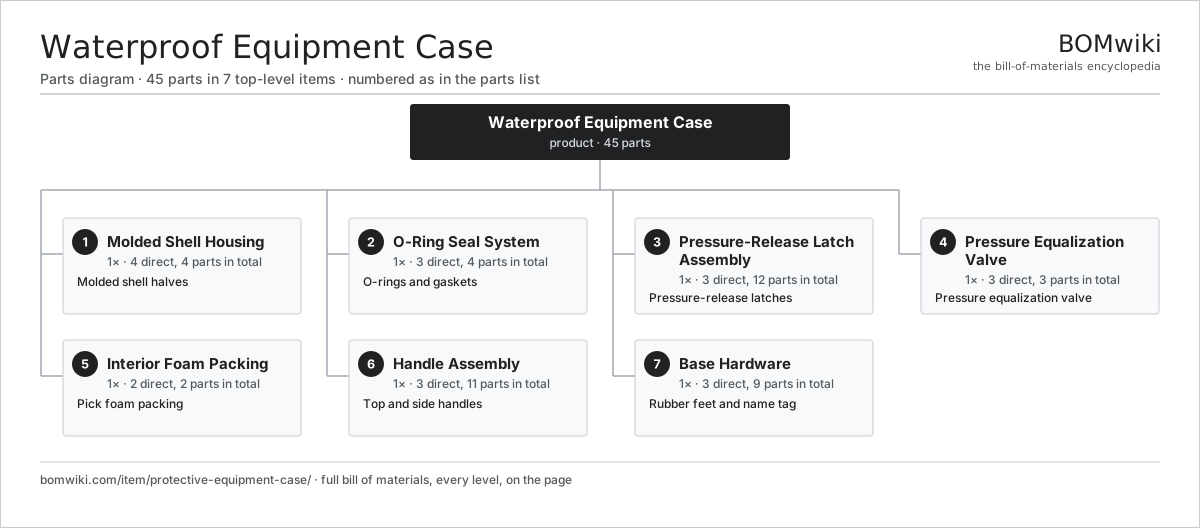
| # | Part | Qty | What it does |
|---|---|---|---|
| 1 | Molded Shell Housing 4 parts | 1× | Molded shell halves |
| 2 | O-Ring Seal System 3 parts | 1× | O-rings and gaskets |
| 3 | Pressure-Release Latch Assembly 3 parts | 1× | Pressure-release latches |
| 4 | Pressure Equalization Valve 3 parts | 1× | Pressure equalization valve |
| 5 | Interior Foam Packing 2 parts | 1× | Pick foam packing |
| 6 | Handle Assembly 3 parts | 1× | Top and side handles |
| 7 | Base Hardware 3 parts | 1× | Rubber feet and name tag |
3D model
No 3D model yet. Have a CAD file of this? Add a 3D model. STL renders right on this page; STEP, FreeCAD, and OpenSCAD sources are welcome too (openly licensed, like all 3D models on BOMwiki).
Build & assembly graph
expand / collapse · shared sub-assemblies converge · links to related products · est. labourTap an assembly to expand/collapse · tap a part to open it · use “Open page” for any node · drag to pan, scroll to zoom.
Bill of materials for Waterproof Equipment Case
7 top-level lines · 28 rows shown · 45 parts total · indented to 3 levels| # | Item / sub-assembly | Part no. | Qty/assy | Ext. qty | Parts | Type |
|---|---|---|---|---|---|---|
| 1 | Molded Shell Housing 4 parts | protective-equipment-case-housing | 1× | 1 | 4 | assembly |
| 1.1 | Top Shell | protective-equipment-case-top-shell | 1× | 1 | · | part |
| 1.2 | Bottom Shell | protective-equipment-case-bottom-shell | 1× | 1 | · | part |
| 1.3 | Snap Hinge Pin | protective-equipment-case-snap-pin | 1× | 1 | · | part |
| 1.4 | Radial Drain | protective-equipment-case-radial-drain | 1× | 1 | · | part |
| 2 | O-Ring Seal System 3 parts | protective-equipment-case-seal-system | 1× | 1 | 4 | assembly |
| 2.1 | O-Ring Set | oring-set | 2× | 2 | · | part |
| 2.2 | O-Ring Lubricant | protective-equipment-case-seal-lubricant | 1× | 1 | · | part |
| 2.3 | Seal Groove | protective-equipment-case-seal-groove | 1× | 1 | · | part |
| 3 | Pressure-Release Latch Assembly 3 parts | protective-equipment-case-latch-system | 1× | 1 | 12 | assembly |
| 3.1 | Latch Toggle | protective-equipment-case-latch-toggle | 4× | 4 | · | part |
| 3.2 | Latch Spring | protective-equipment-case-latch-spring | 4× | 4 | · | part |
| 3.3 | Latch Catch | protective-equipment-case-latch-catch | 4× | 4 | · | part |
| 4 | Pressure Equalization Valve 3 parts | protective-equipment-case-valve-system | 1× | 1 | 3 | assembly |
| 4.1 | Valve Housing | protective-equipment-case-valve-body | 1× | 1 | · | part |
| 4.2 | Check Cartridge | protective-equipment-case-check-cartridge | 1× | 1 | · | part |
| 4.3 | Vent Membrane | protective-equipment-case-valve-membrane | 1× | 1 | · | part |
| 5 | Interior Foam Packing 2 parts | protective-equipment-case-interior-foam | 1× | 1 | 2 | assembly |
| 5.1 | Foam Layer | protective-equipment-case-foam-layer | 1× | 1 | · | part |
| 5.2 | Foam Density | protective-equipment-case-foam-density | 1× | 1 | · | part |
| 6 | Handle Assembly 3 parts | protective-equipment-case-handle-system | 1× | 1 | 11 | assembly |
| 6.1 | Top Handle | protective-equipment-case-handle-top | 1× | 1 | · | part |
| 6.2 | Side Handle | protective-equipment-case-handle-side | 2× | 2 | · | part |
| 6.3 | Handle Rivet | protective-equipment-case-handle-rivet | 8× | 8 | · | part |
| 7 | Base Hardware 3 parts | protective-equipment-case-hardware | 1× | 1 | 9 | assembly |
| 7.1 | Rubber Foot | protective-equipment-case-rubber-foot | 4× | 4 | · | part |
| 7.2 | Name Plate | protective-equipment-case-name-plate | 1× | 1 | · | part |
| 7.3 | Cable Tie Loop | protective-equipment-case-cable-tie-point | 4× | 4 | · | part |
Something wrong in this list? Report a problem with this BOM.
Related products
same domain, ranked by shared parts Backpacking Stove
32 parts · shares 1 with this page
Backpacking Stove
32 parts · shares 1 with this page
 Inflatable Kayak
71 parts · shares 1 with this page
LED Headlamp
33 parts · shares 1 with this page
Inflatable Kayak
71 parts · shares 1 with this page
LED Headlamp
33 parts · shares 1 with this page
 Packraft
32 parts · shares 1 with this page
Packraft
32 parts · shares 1 with this page
 Portable Gas Grill
44 parts · shares 1 with this page
Portable Gas Grill
44 parts · shares 1 with this page
 Portable Water Filter
23 parts · shares 1 with this page
Portable Water Filter
23 parts · shares 1 with this page
Sourcing: possible vendors
Browse the supplier directory → Prices, MOQ, and lead times are algorithmic estimates, not quotes, and not claims about these companies. Company mappings are curated by keyword; est. price band $20–$2k. How estimates work| Vendor | HQ | Specialty | MOQ | Lead time |
|---|---|---|---|---|
|
🇺🇸Coleman
coleman.com ↗
|
Chicago, US | Camping gear | 1,000 units | 6–10 wks |
| thenorthface.com ↗ | Denver, US | Outdoor apparel & gear | 1,000 units | 6–10 wks |
|
🇺🇸YETI
yeti.com ↗
|
Austin, US | Coolers & drinkware | 1,000 units | 6–10 wks |
| decathlon.com ↗ | Villeneuve-d'Ascq, FR | Sporting goods | 1,000 units | 6–10 wks |
|
🇺🇸Garmin
garmin.com ↗
|
Olathe, US | GPS & wearables | 1,000 units | 6–10 wks |
1,709-word article