Proton Therapy System
ProductOverview
Proton therapy is a form of particle radiotherapy exploiting the Bragg peak, a characteristic dose profile where protons deposit minimal energy until near the end of their range, then deposit maximum dose in a narrow peak, then stop abruptly. Unlike X-rays, which deliver dose throughout the patient and beyond, protons stop at a physician-defined depth, minimizing dose to tissues downstream. This makes proton therapy ideal for pediatric cancers (reducing lifetime secondary-cancer risk), base-of-skull and paraspinal tumors, and other sites where downstream organs are critical.
The Proton Therapy System accelerates protons to 70–250 MeV in a compact medical cyclotron or synchrotron, transports them through a magnet beamline, and delivers them via a motorized Nozzle Assembly with pencil-beam scanning (also called spot scanning), allowing 3D conformal dose coverage within a single patient session.
How it works
Acceleration
The Accelerator is typically a compact cyclotron (1.5–2.5 m diameter) or synchrotron. Both use the same fundamental physics: the Ion Source produces 10–30 mA protons. In a cyclotron, the RF frequency is fixed; a proton's cyclotron frequency (qB/2πm) is energy-independent, allowing resonant acceleration at a single frequency despite the proton's changing energy. A synchrotron ramps RF frequency as proton energy increases, maintaining resonance throughout the acceleration cycle.
At extraction, the Extraction Magnet deflects the proton beam (now 70–250 MeV) toward the beamline. The Vacuum System maintains <10⁻⁶ Torr inside the accelerator, preventing scattering of protons by residual gas.
Beamline Transport
The Beamline guides protons from the accelerator to the treatment room via a series of bending and focusing magnets. The Bending Magnet performs achromatic bending, selecting particles by energy: only protons of the desired energy (within ~0.5% bandwidth) pass through to treatment. The Quadrupole Focuser magnets (typically two, orthogonal) converge the beam to <5 mm spot size at the Nozzle Assembly.
A Beamline Monitor ionization chamber continuously measures beam current and transverse profile, feeding back to the proton-therapy-control-system to ensure dose accuracy.
Nozzle and Scanning
At the Nozzle Assembly, two fast scanning magnets (X and Y) deflect the proton beam at 50–100 Hz, painting out an arbitrary 2D distribution within the treatment field. The Range Shifter is a variable-thickness aluminum or plastic absorber that reduces proton energy, effectively moving the Bragg peak closer to the patient surface. Modern systems achieve sub-mm pencil-beam spacing, enabling near-continuous 3D dose sculpting.
A Final Monitor ionization chamber at the nozzle exit measures dose rate and interlocks the beam if rate falls out of tolerance.
Range and Energy Modulation
The key to proton therapy is precise range control. The Bragg peak position depends on proton energy: 250 MeV stops at ~37 cm in water; 70 MeV at ~8 cm. The Range Shifter moves between scans, adjusting effective energy for each spot. Treatment planning software computes the exact range and spot sequence needed to fill the tumor volume with uniform dose while sparing critical structures.
Patient Positioning and Imaging
The motorized 6-axis treatment couch aligns the patient with <2 mm accuracy. The Imaging System provides kV orthogonal radiographs or kV-CT, which are matched to planning images via deformable registration. Real-time image guidance before treatment ensures correct patient setup; some proton centers employ in-beam PET (detecting prompt-gamma or positron-annihilation photons) for intrafraction range verification.
Control System
The proton-therapy-control-system integrates dose calculation, beam delivery sequencing, and real-time monitoring. A treatment plan defines:
- Energy (70–250 MeV)
- Spot position (x, y mm at isocenter)
- Spot weight (monitor units)
- Sequence
The Current Regulator maintains constant beam current within ±1%, ensuring reproducible dose per monitor unit. The Dose Control system monitors absolute dose via ionization chamber and interlock dose-rate excursions.
Bragg Peak Physics
A 250 MeV proton in water deposits minimal dose until the last ~10 cm of its range, where it undergoes rapid energy loss (Bragg ionization peak) and deposits 2–3× the entrance dose. This creates a "peak-to-entrance" dose ratio of 2–3, well above X-ray therapy (entrance dose is maximum). However, protons stop abruptly; dose beyond the range is negligible, whereas X-rays deliver 10–20% dose at depth.
The clinical advantage: tumors 5–30 cm deep can be treated with lower integral dose to healthy tissue, reducing side effects and long-term secondary malignancy risk, especially in children.
Treatment Workflow
- Patient simulation: CT imaging with treatment positioning and couch angles.
- Dose planning: software calculates optimal energy, spot positions, and weights to achieve prescription dose to target while meeting organ-at-risk constraints.
- Patient setup day: align on treatment couch; verify imaging; execute plan.
- Delivery: linac extracts protons, beamline transports them, scanning nozzle paints 3D dose. Treatment duration: 15–30 minutes per fraction.
Clinical Applications
- Pediatric cancers: medulloblastoma, hepatoblastoma, lymphomas (reduced secondary-cancer risk).
- Head/neck: base-of-skull tumors, nasopharyngeal carcinoma, sarcomas.
- CNS: brain tumors adjacent to optic nerve, brainstem.
- Thorax: lung cancer when cardiac dose must be minimized.
- Pelvis: prostate (some centers), sarcomas near critical structures.
Proton therapy remains more expensive than X-ray therapy ($1–2 M capital equipment, higher operational cost), limiting access. However, clinical evidence for dose reduction and improved outcomes in certain pediatric and critical-location tumor sites justifies the expense for those patient populations.
Proton Therapy System parts and their functions
8 top-level parts · 38 parts in total · full bill of materials below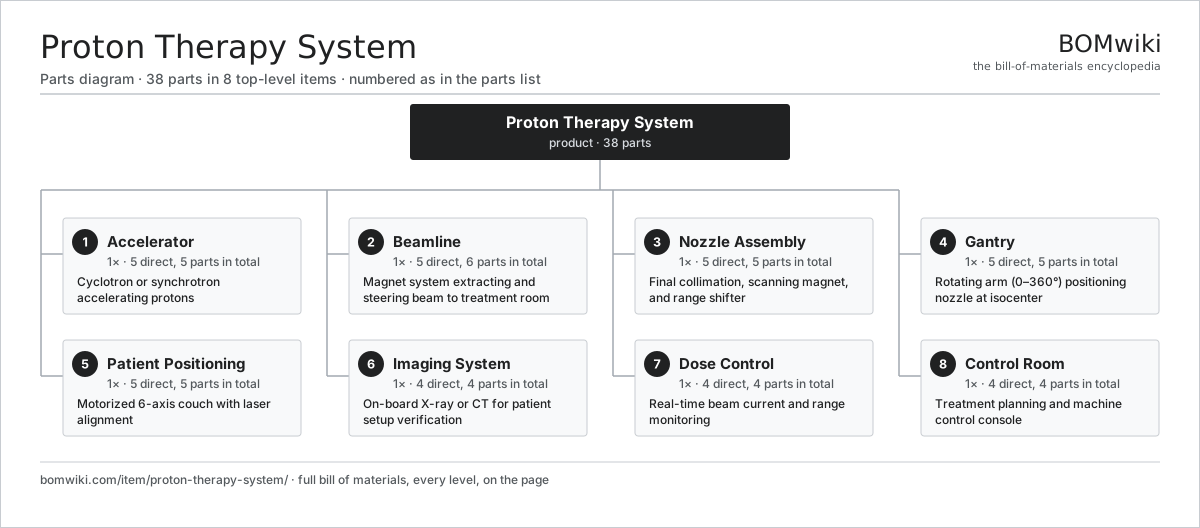
| # | Part | Qty | What it does |
|---|---|---|---|
| 1 | Accelerator 5 parts | 1× | Cyclotron or synchrotron accelerating protons |
| 2 | Beamline 5 parts | 1× | Magnet system extracting and steering beam to treatment room |
| 3 | Nozzle Assembly 5 parts | 1× | Final collimation, scanning magnet, and range shifter |
| 4 | Gantry 5 parts | 1× | Rotating arm (0–360°) positioning nozzle at isocenter |
| 5 | Patient Positioning 5 parts | 1× | Motorized 6-axis couch with laser alignment |
| 6 | Imaging System 4 parts | 1× | On-board X-ray or CT for patient setup verification |
| 7 | Dose Control 4 parts | 1× | Real-time beam current and range monitoring |
| 8 | Control Room 4 parts | 1× | Treatment planning and machine control console |
3D model
No 3D model yet. Have a CAD file of this? Add a 3D model. STL renders right on this page; STEP, FreeCAD, and OpenSCAD sources are welcome too (openly licensed, like all 3D models on BOMwiki).
Build & assembly graph
expand / collapse · shared sub-assemblies converge · links to related products · est. labourTap an assembly to expand/collapse · tap a part to open it · use “Open page” for any node · drag to pan, scroll to zoom.
Bill of materials for Proton Therapy System
8 top-level lines · 45 rows shown · 38 parts total · indented to 3 levels| # | Item / sub-assembly | Part no. | Qty/assy | Ext. qty | Parts | Type |
|---|---|---|---|---|---|---|
| 1 | Accelerator 5 parts | proton-therapy-accelerator | 1× | 1 | 5 | assembly |
| 1.1 | Magnet Yoke | proton-therapy-magnet-yoke | 1× | 1 | · | part |
| 1.2 | RF Cavity | proton-therapy-rf-cavity | 1× | 1 | · | part |
| 1.3 | Ion Source | proton-therapy-ion-source | 1× | 1 | · | part |
| 1.4 | Extraction Magnet | proton-therapy-extraction-magnet | 1× | 1 | · | part |
| 1.5 | Vacuum System | proton-therapy-vacuum-system | 1× | 1 | · | part |
| 2 | Beamline 5 parts | proton-therapy-beamline | 1× | 1 | 6 | assembly |
| 2.1 | Bending Magnet | proton-therapy-bending-magnet | 1× | 1 | · | part |
| 2.2 | Quadrupole Focuser | proton-therapy-quadrupole-focuser | 2× | 2 | · | part |
| 2.3 | Steerer Magnet | proton-therapy-steerer-magnet | 1× | 1 | · | part |
| 2.4 | Beamline Monitor | proton-therapy-beamline-monitor | 1× | 1 | · | part |
| 2.5 | Beam Dump | proton-therapy-beam-dump | 1× | 1 | · | part |
| 3 | Nozzle Assembly 5 parts | proton-therapy-nozzle-assembly | 1× | 1 | 5 | assembly |
| 3.1 | Scanning Magnet X | proton-therapy-scanning-magnet-x | 1× | 1 | · | part |
| 3.2 | Scanning Magnet Y | proton-therapy-scanning-magnet-y | 1× | 1 | · | part |
| 3.3 | Range Shifter | proton-therapy-range-shifter | 1× | 1 | · | part |
| 3.4 | Collimator Aperture | proton-therapy-collimator-aperture | 1× | 1 | · | part |
| 3.5 | Final Monitor | proton-therapy-final-monitor | 1× | 1 | · | part |
| 4 | Gantry 5 parts | proton-therapy-gantry | 1× | 1 | 5 | assembly |
| 4.1 | Gantry Ring | proton-therapy-gantry-ring | 1× | 1 | · | part |
| 4.2 | Gantry Bearing | proton-therapy-gantry-bearing | 1× | 1 | · | part |
| 4.3 | Gantry Motor | proton-therapy-gantry-motor | 1× | 1 | · | part |
| 4.4 | Cable Wrap | proton-therapy-gantry-cable-wrap | 1× | 1 | · | part |
| 4.5 | Nozzle Mount | proton-therapy-nozzle-mount | 1× | 1 | · | part |
| 5 | Patient Positioning 5 parts | proton-therapy-patient-positioning | 1× | 1 | 5 | assembly |
| 5.1 | Couch Top | proton-therapy-couch-top | 1× | 1 | · | part |
| 5.2 | XYZ Stage | proton-therapy-couch-xyz-stage | 1× | 1 | · | part |
| 5.3 | Tilt Drives | proton-therapy-couch-tilt-drives | 1× | 1 | · | part |
| 5.4 | Laser Alignment | proton-therapy-couch-laser-alignment | 1× | 1 | · | part |
| 5.5 | Couch Controller | proton-therapy-couch-controller | 1× | 1 | · | part |
| 6 | Imaging System 4 parts | proton-therapy-imaging-system | 1× | 1 | 4 | assembly |
| 6.1 | kV Tube | proton-therapy-imaging-kv-tube | 1× | 1 | · | part |
| 6.2 | Imaging Detector | proton-therapy-imaging-detector | 1× | 1 | · | part |
| 6.3 | Imaging Support | proton-therapy-imaging-support | 1× | 1 | · | part |
| 6.4 | Imaging Workstation | proton-therapy-imaging-workstation | 1× | 1 | · | part |
| 7 | Dose Control 4 parts | proton-therapy-dose-control | 1× | 1 | 4 | assembly |
| 7.1 | Current Regulator | proton-therapy-current-regulator | 1× | 1 | · | part |
| 7.2 | Range Verifier | proton-therapy-range-verifier | 1× | 1 | · | part |
| 7.3 | Dose Rate Monitor | proton-therapy-dose-rate-monitor | 1× | 1 | · | part |
| 7.4 | Safety Computer | proton-therapy-safety-computer | 1× | 1 | · | part |
| 8 | Control Room 4 parts | proton-therapy-control-room | 1× | 1 | 4 | assembly |
| 8.1 | Control PC | proton-therapy-control-pc | 1× | 1 | · | part |
| 8.2 | Emergency Panel | proton-therapy-emergency-panel | 1× | 1 | · | part |
| 8.3 | Dose Display | proton-therapy-dose-display | 1× | 1 | · | part |
| 8.4 | Power Supply | power-supply | 1× | 1 | · | part |
Something wrong in this list? Report a problem with this BOM.
Related products
same domain, ranked by shared parts Anesthesia Machine
562 parts · shares 1 with this page
Anesthesia Machine
562 parts · shares 1 with this page
 Apheresis Machine
199 parts · shares 1 with this page
Apheresis Machine
199 parts · shares 1 with this page
 Autorefractor
513 parts · shares 1 with this page
Autorefractor
513 parts · shares 1 with this page
 Blood Bank Refrigerator
79 parts · shares 1 with this page
Blood Gas Analyzer
386 parts · shares 1 with this page
Blood Bank Refrigerator
79 parts · shares 1 with this page
Blood Gas Analyzer
386 parts · shares 1 with this page
 Blood/Fluid Warmer
28 parts · shares 1 with this page
Blood/Fluid Warmer
28 parts · shares 1 with this page
Sourcing: possible vendors
Browse the supplier directory → Prices, MOQ, and lead times are algorithmic estimates, not quotes, and not claims about these companies. Company mappings are curated by keyword; est. price band $500–$3M. How estimates work| Vendor | HQ | Specialty | MOQ | Lead time |
|---|---|---|---|---|
| gehealthcare.com ↗ | Chicago, US | Medical imaging & devices | 100 units | 12–20 wks |
| siemens-healthineers.com ↗ | Erlangen, DE | Medical systems | 100 units | 12–20 wks |
|
🇳🇱Philips
philips.com ↗
|
Amsterdam, NL | Health technology | 100 units | 12–20 wks |
| medtronic.com ↗ | Minneapolis, US | Medical devices | 100 units | 12–20 wks |
|
🇨🇳Mindray
mindray.com ↗
|
Shenzhen, CN | Medical devices | 100 units | 12–20 wks |
936-word article