Digital Pupilometer
ProductOverview
The digital pupilometer is a clinical and optical-lab instrument measuring interpupillary distance (IPD, also called pupillary distance or PD) and pupil diameter, critical measurements for eyewear fitting and progressive-lens design. An accurate IPD is essential for proper binocular vision through eyeglasses; errors of ±2 mm can cause discomfort, eye strain, and visual fatigue.
Traditional IPD measurement relied on manual rulers and patient self-positioning, with typical errors of ±3–5 mm. Modern automated pupilometers use infrared corneal reflections and digital image analysis to achieve ±0.5 mm repeatability, enabling prescription eyewear customization and contact-lens fitting optimization. The device is standard in modern eyecare clinics and high-end optical labs.
How it works
Corneal Reflection Principle
The Optical Head Assembly employs a classic binocular optical setup. Paired Ir Illuminators (infrared LEDs at 850 nm) create bright, symmetrical reflections on the cornea of each eye. These reflections appear as small white spots on the black pupil in the image. The key insight is that corneal reflections are highly consistent and predictable: light reflects from the spherical corneal surface at the same location regardless of small head movements or eye orientation.
The Position Sensors (CMOS line or area sensors) detect these reflection centroids with sub-pixel precision. By measuring the horizontal separation between left and right corneal reflections, the Control and Image Processing calculates IPD. This approach is robust: unlike iris or pupil edge detection (which vary with lighting and pigmentation), the bright corneal spot is virtually invariant.
Optical Paths and Infrared Isolation
Each eye has a separate optical path consisting of an IR illuminator, a viewing objective, and a reflection-detection sensor. The Infrared Beamsplitter is a dichroic mirror that reflects 850 nm infrared light while passing visible light (400–700 nm). This allows the IR illuminators to create reflections while the operator observes the pupil in visible light.
The Display Imaging Optics objective lens and Infrared Blocking Filter eliminate IR before reaching the operator's eye, ensuring comfortable, flicker-free viewing.
Image Analysis and Pupil Detection
The Image Signal Processor executes real-time algorithms on CMOS sensor data:
- Corneal reflection detection: Identifies bright spots (reflections) and computes their centroids to ±0.05 pixel precision.
- Pupil boundary detection: Edges of the iris/pupil are extracted using gradient analysis; ellipse fitting determines pupil center and diameter.
- IPD calculation: Distance between left and right reflection centroids is converted to physical IPD using calibration.
- Data validation: Repeatability checking confirms three consecutive measurements agree within ±0.5 mm before display.
Automatic Triggering and Distance Measurement
The Distance Detection Sensor (IR time-of-flight) continuously monitors the distance from the patient's eyes to the optical head. When the patient positions their head at the optimal working distance (typically 200–250 mm), the trigger logic automatically captures and processes an image. This removes the need for the operator to press a button, accelerating the measurement workflow.
Measurement Result and Data Logging
The Display Screen shows:
- Real-time pupil images with corneal reflections highlighted.
- Numerical IPD reading (45–80 mm range) with repeatability indicator.
- Pupil diameter (2–8 mm) if recorded.
- Measurement history (previous 5–10 readings for comparison).
All measurements are time-stamped and logged in the Data Storage Module. The Data Communication Module exports data to eyewear-dispensing software or electronic health records (EHRs), enabling customized lens designs and automated frame-to-lens fitting calculations.
Measurement Accuracy and Repeatability
Repeatability and Optical Factors
The ±0.5 mm IPD repeatability specified in ISO standards accounts for:
- Corneal reflection jitter (±0.05 mm) from micro-movements.
- Optical aberrations in viewing optics (±0.1 mm equivalent).
- Patient positioning variation (±0.2 mm if using manual forehead rest).
Automated instruments with servo-controlled positioning or fixed patient rests achieve ±0.25 mm.
Calibration Standards
Pupilometers are calibrated using precision reference plates with etched marks at known IPD intervals (60 mm, 65 mm, 70 mm, etc.). Annual calibration verification ensures systematic errors (bias) remain <0.2 mm.
Clinical and Manufacturing Applications
Eyewear Dispensing
In optical clinics, IPD is measured at two distances:
- Distance PD (eyes looking far): used for single-vision and distance zones of progressive lenses.
- Near PD (eyes converged at reading distance): used for reading zones of bifocals and progressives.
Modern pupilometers measure distance PD automatically; near PD may require manual measurement or prism analysis.
Progressive Lens Design
High-end progressive eyewear depends on precise IPD. Lens manufacturers offer "customized" progressives that adjust the progressive corridor and prism profile based on measured IPD, optimizing field of view and comfort.
Contact Lens Fitting
Corneal diameter and pupil size inform contact-lens selection. A pupil diameter of <3 mm may cause edge transparency in progressive lenses; lenses must be designed with smaller optical zones.
Comparison to Alternative Methods
Manual ruler measurement: Operator holds ruler at eye level while patient looks straight ahead; typical error ±3–5 mm. Still used in low-cost optical shops.
Video recording: Operator records video of patient's eyes with calibration reference, then manually measures pixel distance offline; error ±1–2 mm. Labor-intensive but cheaper than dedicated instruments.
Automated pupilometer: Gold standard, ±0.5 mm repeatability, <1 second measurement time, full data integration.
Data Privacy and Integration
Modern pupilometers store patient measurement history locally and often support wireless upload to practice management systems (PMS) or EHR platforms. Patient data is typically encrypted and protected by HIPAA or local privacy regulations. Some instruments offer anonymized export for research or quality monitoring.
Maintenance and Troubleshooting
Monthly inspection: Clean optical surfaces (IR LEDs, objectives, sensors) with lens tissue and isopropyl alcohol. Check forehead and chin rests for debris or staining.
Quarterly calibration verification: Measure a reference plate at known IPD values (60, 65, 70 mm); compare against stored calibration. If >±0.2 mm error, perform full recalibration using manufacturer reference kit.
Common issues:
- Weak or no reflections: IR LEDs may be dim; check power supply and lens transmission.
- High IPD repeatability error (>±1 mm): Patient may be moving; ensure chin rest is secure. Recalibrate optics.
- Display lag or frozen image: Restart image processor and sensor electronics; may indicate USB communication issue.
Modern pupilometers are robust instruments with 5–10 year service life if maintained regularly.
Digital Pupilometer parts and their functions
8 top-level parts · 30 parts in total · full bill of materials below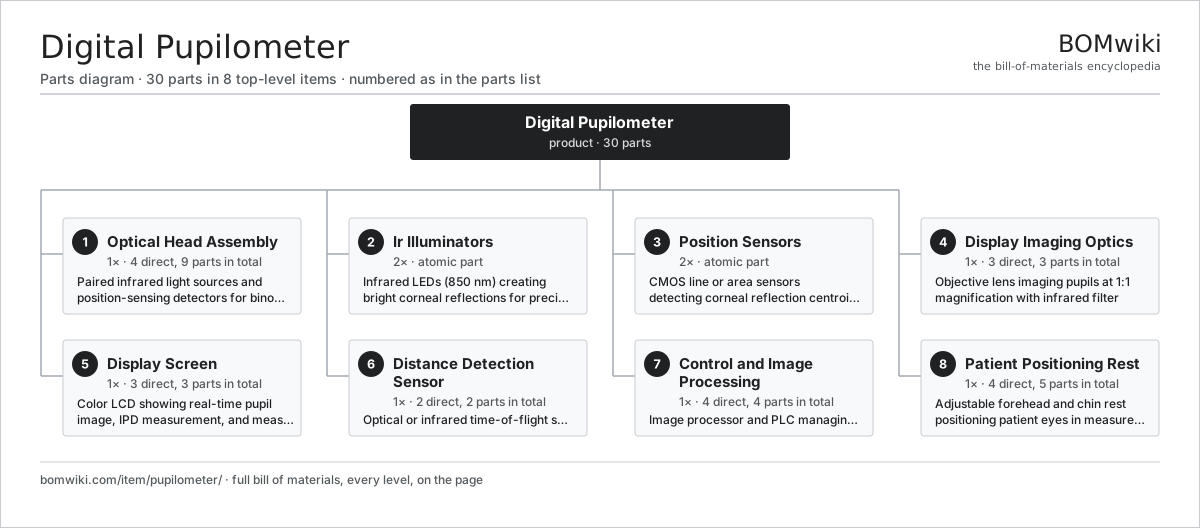
| # | Part | Qty | What it does |
|---|---|---|---|
| 1 | Optical Head Assembly 4 parts | 1× | Paired infrared light sources and position-sensing detectors for binocular measurement |
| 2 | Ir Illuminators | 2× | Infrared LEDs (850 nm) creating bright corneal reflections for precise centering |
| 3 | Position Sensors | 2× | CMOS line or area sensors detecting corneal reflection centroids |
| 4 | Display Imaging Optics 3 parts | 1× | Objective lens imaging pupils at 1:1 magnification with infrared filter |
| 5 | Display Screen 3 parts | 1× | Color LCD showing real-time pupil image, IPD measurement, and measurement history |
| 6 | Distance Detection Sensor 2 parts | 1× | Optical or infrared time-of-flight sensor detecting working distance and triggering measurement |
| 7 | Control and Image Processing 4 parts | 1× | Image processor and PLC managing illumination, sensing, and data logging |
| 8 | Patient Positioning Rest 4 parts | 1× | Adjustable forehead and chin rest positioning patient eyes in measurement plane |
3D model
No 3D model yet. Have a CAD file of this? Add a 3D model. STL renders right on this page; STEP, FreeCAD, and OpenSCAD sources are welcome too (openly licensed, like all 3D models on BOMwiki).
Build & assembly graph
expand / collapse · shared sub-assemblies converge · links to related products · est. labourTap an assembly to expand/collapse · tap a part to open it · use “Open page” for any node · drag to pan, scroll to zoom.
Bill of materials for Digital Pupilometer
8 top-level lines · 34 rows shown · 30 parts total · indented to 3 levels| # | Item / sub-assembly | Part no. | Qty/assy | Ext. qty | Parts | Type |
|---|---|---|---|---|---|---|
| 1 | Optical Head Assembly 4 parts | pupilometer-optical-head | 1× | 1 | 9 | assembly |
| 1.1 | Left-Eye Optical Path 3 parts | pupilometer-left-optical-path | 1× | 1 | 3 | assembly |
| 1.1.1 | Left IR LED | pupilometer-ir-led-left | 1× | 1 | · | part |
| 1.1.2 | Left Position Sensor | pupilometer-sensor-left | 1× | 1 | · | part |
| 1.1.3 | Left Objective Lens | pupilometer-objective-left | 1× | 1 | · | part |
| 1.2 | Right-Eye Optical Path 3 parts | pupilometer-right-optical-path | 1× | 1 | 3 | assembly |
| 1.2.1 | Right IR LED | pupilometer-ir-led-right | 1× | 1 | · | part |
| 1.2.2 | Right Position Sensor | pupilometer-sensor-right | 1× | 1 | · | part |
| 1.2.3 | Right Objective Lens | pupilometer-objective-right | 1× | 1 | · | part |
| 1.3 | Infrared Beamsplitter | pupilometer-infrared-beamsplitter | 2× | 2 | · | part |
| 1.4 | Optical Head Housing | pupilometer-optical-housing | 1× | 1 | · | part |
| 2 | Ir Illuminators | pupilometer-ir-illuminators | 2× | 2 | · | part |
| 3 | Position Sensors | pupilometer-position-sensors | 2× | 2 | · | part |
| 4 | Display Imaging Optics 3 parts | pupilometer-viewing-optics | 1× | 1 | 3 | assembly |
| 4.1 | Display Objective Lens | pupilometer-display-objective | 1× | 1 | · | part |
| 4.2 | Infrared Blocking Filter | pupilometer-ir-blocking-filter | 1× | 1 | · | part |
| 4.3 | Eyepiece Magnifier | pupilometer-eyepiece-magnifier | 1× | 1 | · | part |
| 5 | Display Screen 3 parts | pupilometer-display-screen | 1× | 1 | 3 | assembly |
| 5.1 | LCD Display Panel | pupilometer-screen-lcd | 1× | 1 | · | part |
| 5.2 | Touch Interface | pupilometer-screen-touch-interface | 1× | 1 | · | part |
| 5.3 | Display Mounting Arm | pupilometer-screen-stand | 1× | 1 | · | part |
| 6 | Distance Detection Sensor 2 parts | pupilometer-distance-sensor | 1× | 1 | 2 | assembly |
| 6.1 | TOF Distance Sensor | pupilometer-tof-sensor | 1× | 1 | · | part |
| 6.2 | Trigger Logic | pupilometer-tof-trigger-electronics | 1× | 1 | · | part |
| 7 | Control and Image Processing 4 parts | pupilometer-control-electronics | 1× | 1 | 4 | assembly |
| 7.1 | Microcontroller | mcu | 1× | 1 | · | part |
| 7.2 | Image Signal Processor | pupilometer-image-processor | 1× | 1 | · | part |
| 7.3 | Data Storage Module | pupilometer-memory-storage | 1× | 1 | · | part |
| 7.4 | Data Communication Module | pupilometer-communication-module | 1× | 1 | · | part |
| 8 | Patient Positioning Rest 4 parts | pupilometer-forehead-rest | 1× | 1 | 5 | assembly |
| 8.1 | Forehead Rest Pad | pupilometer-forehead-pad | 1× | 1 | · | part |
| 8.2 | Chin Rest Cup | pupilometer-chin-rest | 1× | 1 | · | part |
| 8.3 | Adjustment Knobs | pupilometer-position-adjustment-knobs | 2× | 2 | · | part |
| 8.4 | Measurement Aperture Frame | pupilometer-viewing-window-frame | 1× | 1 | · | part |
Something wrong in this list? Report a problem with this BOM.
Related products
same domain, ranked by shared parts 360 Panoramic Camera
339 parts · shares 1 with this page
360 Panoramic Camera
339 parts · shares 1 with this page
 Action Camera
271 parts · shares 1 with this page
Astro Camera
27 parts · shares 1 with this page
Action Camera
271 parts · shares 1 with this page
Astro Camera
27 parts · shares 1 with this page
 Autoguider
31 parts · shares 1 with this page
Autoguider
31 parts · shares 1 with this page
 Borescope Inspection Camera
169 parts · shares 1 with this page
Borescope Inspection Camera
169 parts · shares 1 with this page
 Cable Camera System
138 parts · shares 1 with this page
Cable Camera System
138 parts · shares 1 with this page
Sourcing: possible vendors
Browse the supplier directory → Prices, MOQ, and lead times are algorithmic estimates, not quotes, and not claims about these companies. Company mappings are curated by keyword; est. price band $100–$8k. How estimates work| Vendor | HQ | Specialty | MOQ | Lead time |
|---|---|---|---|---|
|
🇯🇵Canon
canon.com ↗
|
Tokyo, JP | Imaging & optics | 500 units | 10–16 wks |
|
🇯🇵Nikon
nikon.com ↗
|
Tokyo, JP | Imaging & optics | 500 units | 10–16 wks |
|
🇩🇪ZEISS
zeiss.com ↗
|
Oberkochen, DE | Optics & optoelectronics | 500 units | 10–16 wks |
| leica-camera.com ↗ | Wetzlar, DE | Cameras & optics | 500 units | 10–16 wks |
| flir.com ↗ | Wilsonville, US | Thermal imaging | 500 units | 10–16 wks |
1,038-word article