Aircraft Pushback Tug
ProductOverview
An aircraft pushback tug (or apron tug) is a heavy, low-profile tractor designed to push aircraft backward from their parking stands or forward into position without nose gear damage. Towbarless designs use hydraulic cradles to lift and grip the nose wheel directly, eliminating towbar coupling wear and reducing operator training. Conventional tugs couple via towbar to nose linkages.
Pushback tugs operate on concrete/asphalt aprons at speeds of 1–5 km/h during maneuvering and up to 40 km/h during road towing between facilities. Modern designs pair hydrostatic transmissions (infinitely variable speed control) with articulated steering (40–50° crab angle) to position aircraft in confined gate areas.
Chassis & Ballasting
The Chassis & Frame is a welded steel frame supporting the engine, hydraulics, ballast, and coupling device. Typical weight distribution is 60–70% rear-axle load (via Ballast & Weight Distribution) to maximize traction on apron concrete without wheel slip. This is critical: insufficient ballast reduces traction and risks failure to push or tow; excessive ballast increases tire wear and fuel consumption.
Ballast strategy:
- Lower center of gravity (ballast mounted low in frame) improves stability during tight turns.
- Lead or steel weights mounted beneath the cab and engine (0.3–0.5 m above ground).
- Total ballast: 20–40 ton in a 100 ton GVWR tug.
The Suspension Unit typically uses leaf springs or air suspensions, allowing the tug to absorb apron surface irregularities while maintaining load control. Air suspension (preferred for high-powered tugs) enables load-leveling and improves operator comfort during long shifts.
Powertrain & Transmission
Most pushback tugs employ hydrostatic transmissions (variable-displacement pump coupled to fixed-displacement motor), offering:
- Infinite speed control: Creep as slowly as 0.1 m/s (ideal for precise positioning).
- Torque multiplication: Hydraulic transmission provides inherent torque boost, allowing smaller engines (160–180 kW) to match 250+ kW mechanical drive performance.
- Smooth engagement: No gear shift shocks to aircraft frame or nose gear.
The Diesel Engine is a turbocharged 6-cylinder (common: Cummins, Duramax, or European equivalent) with intercooling for high-altitude operation (Denver, Mexico City airports to 2500+ m). Typical power output: 160–250 kW continuous at 2800–3000 rpm.
Fuel consumption: 35–50 L/hour under load (typical 8-hour shift = 280–400 L/day), driving 200–300 L tank capacity and frequent refueling schedules.
Hydraulic System & Cradle
The Hydraulic System provides energy for:
- Lift Cylinder: Raising nose gear 0.3–0.5 m for engagement/disengagement.
- Steering System: Proportional steering to full crab angle.
- Brake boost (via accumulator).
Towbarless cradle operation:
- Operator positions tug beneath aircraft nose wheel.
- Hydraulic lift cylinders raise the Cradle Frame against nose wheel.
- Coupling Lock (solenoid-operated pin or hydraulic clamping) engages, locking wheel in place.
- Coupling Sensors confirm engagement (pressure switch or proximity sensor).
- Tug retracts slightly, lifting nose gear clear of stand and beginning maneuver.
Disengagement is the reverse: lower cradle, unlock, and separation allows aircraft to maintain nose gear alignment on stand.
Engagement pressure: Typically 5–10 bar of cradle-to-wheel contact, sufficient to prevent slip during push/pull but low enough to avoid nose gear damage.
Steering & Maneuverability
The Steering System incorporates an articulated front axle (kingpin pivot), capable of 40–50° crab steering. Operator commands a proportional Steering Cylinder, which angles the entire front axle left or right.
Maneuvering advantages:
- Gate positioning in tight aprons (35–40 m × 60 m typical gate area).
- Crab steering allows simultaneous forward motion and lateral shear, permitting nose-in and nose-out alignment without multi-point backing.
- Reduced turning radius: 6–8 m (vs. 12–15 m for articulated buses of similar weight).
Steering feedback (via Steering Position Transducer potentiometer or LVDT) allows operator to monitor axle angle on cab console, critical for safe positioning near other aircraft and ground equipment.
Braking & Safety
Dual-circuit air brakes (primary) with hydraulic backup ensure safe deceleration on wet aprons and parking hold. The Air Compressor runs continuously (engine-driven), supplying the Air Reservoir and Brake Cylinder via a Proportional Brake Valve.
Brake behavior:
- Service braking: Proportional air pressure modulates wheel brakes, allowing smooth deceleration (1–2 m/s² typical).
- Parking brake: Spring-applied, air-released (fail-safe: springs lock wheels if air pressure drops).
- Emergency: Accumulator backup pressure via Hydraulic System provides 2–3 additional brake applications without engine running.
Most tugs include Load Moment Indicator (LMI) systems to prevent tipping during towing on inclined surfaces or with unbalanced aircraft configurations (heavy one side).
Operator Cab & Controls
The Operator Cabin is a low-profile glass structure (0.5–0.7 m above chassis) providing 360° visibility critical for apron work. Modern designs include:
- Proportional joystick controlling steering and throttle simultaneously.
- Push-button engagement/disengagement (solenoid valve modulation).
- Digital dashboard: engine oil pressure, hydraulic pressure, cradle engagement status, engine RPM.
- HVAC Unit for climate control (−40 to +55 °C operation across global airports).
Visibility: Large tinted/tempered glass panels reduce glare from apron concrete and allow detection of ground personnel, baggage carts, and other aircraft.
Electrical & Control Module
The Electrical System is 24 V DC with dual 12 V 200 Ah lead-acid batteries (series configuration). The Control Module (PLC or embedded ECU) monitors:
- Hydraulic pressure (pilot signal from pump).
- Steering axle angle (LVDR transducer).
- Brake pressure.
- Coupling engagement (pressure or proximity switch).
- Engine parameters (oil temp, coolant, fuel level).
Safety interlocks prevent dangerous conditions:
- Cannot engage push/pull if steering angle is excessive (prevents nose gear side-loading).
- Cannot exceed max hydraulic pressure without relief activation.
- Parking brake applies automatically if pilot air pressure drops below threshold.
Operational Patterns
Daily cycle (typical 8-hour shift):
- Pre-flight: Check ballast securing, inspect tires, verify brake pressure, test hydraulic response.
- Push/tow operations: Average 8–15 aircraft movements (3–6 minute cycle per movement).
- Fuel/maintenance: Mid-shift refueling (15–20 minutes), daily fluid top-ups.
Apron environment challenges:
- Salt spray (coastal airports): Corrosion protection via zinc plating and painted steel.
- Extreme heat (Middle East, India): Engine over-temp, tire degradation; thermal imaging of brake temps necessary.
- High altitude (Denver 5280 ft, Lhasa 11,975 ft): Reduced air density → lower engine power, increased turbo load.
- Confined spaces: Precision steering in 35 m wide gates with other aircraft 5 m away.
Maintenance & Lifecycle
| Component | Service Interval | Cost |
|---|---|---|
| Engine Oil | 250–500 h | $200–400 |
| Hydraulic Fluid | 1000 h (filter 250 h) | $1000–2000 |
| Tire Replacement (4) | 2000–4000 h | $4000–8000 |
| Battery Replacement | 3–5 years | $1000–1500 |
| Major Overhaul | 8000–10,000 h | $50,000–80,000 |
Lifespan: Pushback tugs typically operate 8000–12,000 hours over 10–15 years before major rebuild or retirement. High-utilization hubs (LAX, Frankfurt, Dubai) may retire tugs at 6000 h due to apron heat stress.
Types of Pushback/Apron Tugs
- Towbarless (modern): Hydraulic cradle, 210 bar system, 160–250 kW, $800k–1.2M.
- Towbar (legacy): Mechanical towbar coupling, simpler hydraulics, still common at secondary airports.
- Conventional tow tractor: Uses towbar to nose linkage (not wheel cradle), lower cost, higher nose gear wear.
- Hybrid: Switchable cradle/towbar (rare, high complexity).
Modern operators transition to towbarless due to reduced maintenance cost and faster turnarounds (no towbar alignment time).
Aircraft Pushback Tug parts and their functions
9 top-level parts · 93 parts in total · full bill of materials below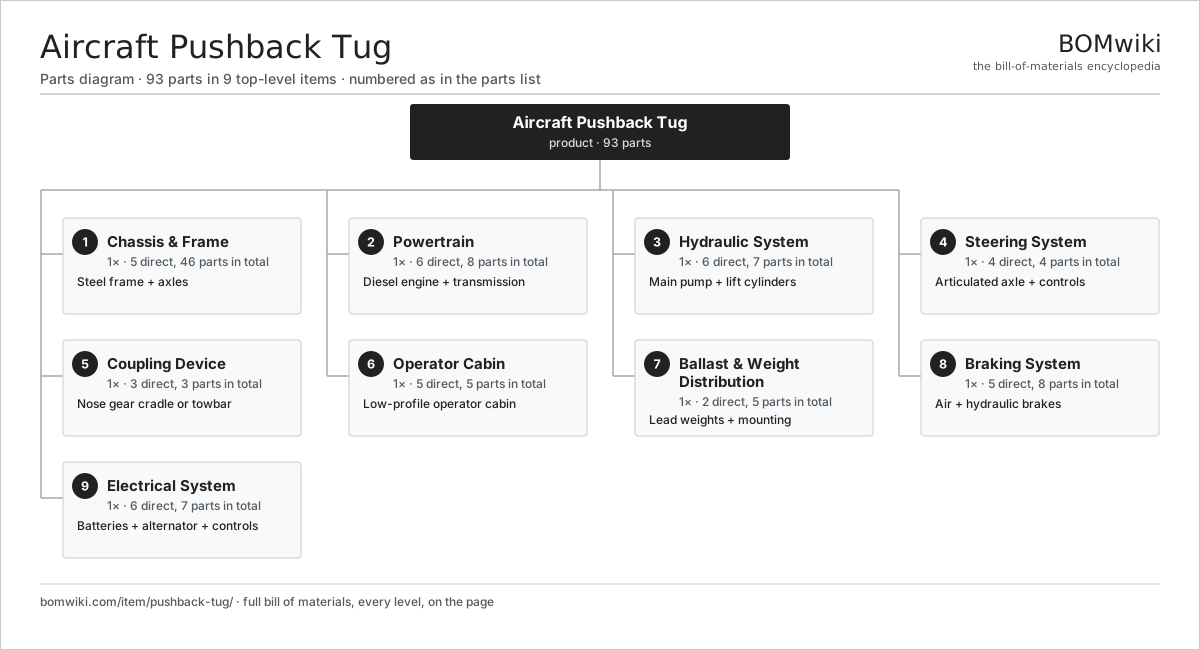
| # | Part | Qty | What it does |
|---|---|---|---|
| 1 | Chassis & Frame 5 parts | 1× | Steel frame + axles |
| 2 | Powertrain 6 parts | 1× | Diesel engine + transmission |
| 3 | Hydraulic System 6 parts | 1× | Main pump + lift cylinders |
| 4 | Steering System 4 parts | 1× | Articulated axle + controls |
| 5 | Coupling Device 3 parts | 1× | Nose gear cradle or towbar |
| 6 | Operator Cabin 5 parts | 1× | Low-profile operator cabin |
| 7 | Ballast & Weight Distribution 2 parts | 1× | Lead weights + mounting |
| 8 | Braking System 5 parts | 1× | Air + hydraulic brakes |
| 9 | Electrical System 6 parts | 1× | Batteries + alternator + controls |
3D model
No 3D model yet. Have a CAD file of this? Add a 3D model. STL renders right on this page; STEP, FreeCAD, and OpenSCAD sources are welcome too (openly licensed, like all 3D models on BOMwiki).
Build & assembly graph
expand / collapse · shared sub-assemblies converge · links to related products · est. labourTap an assembly to expand/collapse · tap a part to open it · use “Open page” for any node · drag to pan, scroll to zoom.
Bill of materials for Aircraft Pushback Tug
9 top-level lines · 56 rows shown · 93 parts total · indented to 3 levels| # | Item / sub-assembly | Part no. | Qty/assy | Ext. qty | Parts | Type |
|---|---|---|---|---|---|---|
| 1 | Chassis & Frame 5 parts | pushback-tug-chassis | 1× | 1 | 46 | assembly |
| 1.1 | Chassis Beam | pushback-tug-frame-beam | 2× | 2 | · | part |
| 1.2 | Cross-Member | pushback-tug-cross-member | 4× | 4 | · | part |
| 1.3 | Axle Assembly | pushback-tug-axle-assembly | 2× | 2 | · | part |
| 1.4 | Suspension Unit | pushback-tug-suspension | 2× | 2 | · | part |
| 1.5 | Wheel Assembly 5 parts | wheel-assembly | 4× | 4 | 9 | assembly |
| 1.5.1 | Alloy Wheel | alloy-wheel | 1× | 4 | · | part |
| 1.5.2 | Tire | tire | 1× | 4 | · | part |
| 1.5.3 | TPMS Sensor | tpms-sensor | 1× | 4 | · | part |
| 1.5.4 | Lug Nut | lug-nut | 5× | 20 | · | part |
| 1.5.5 | Valve Stem | valve-stem | 1× | 4 | · | part |
| 2 | Powertrain 6 parts | pushback-tug-powertrain | 1× | 1 | 8 | assembly |
| 2.1 | Diesel Engine | pushback-tug-diesel-engine | 1× | 1 | · | part |
| 2.2 | Hydrostatic Transmission | pushback-tug-transmission | 1× | 1 | · | part |
| 2.3 | Engine Mount | pushback-tug-engine-mount | 3× | 3 | · | part |
| 2.4 | Radiator | pushback-tug-radiator | 1× | 1 | · | part |
| 2.5 | Air Filter | pushback-tug-air-filter | 1× | 1 | · | part |
| 2.6 | Fuel Tank | pushback-tug-fuel-tank | 1× | 1 | · | part |
| 3 | Hydraulic System 6 parts | pushback-tug-hydraulic-system | 1× | 1 | 7 | assembly |
| 3.1 | Variable Pump | pushback-tug-hydraulic-pump | 1× | 1 | · | part |
| 3.2 | Lift Cylinder | pushback-tug-lift-cylinder | 2× | 2 | · | part |
| 3.3 | Steering Proportional Valve | pushback-tug-steering-valve | 1× | 1 | · | part |
| 3.4 | Accumulator | pushback-tug-accumulator | 1× | 1 | · | part |
| 3.5 | Hydraulic Hoses & Lines | pushback-tug-hydraulic-lines | 1× | 1 | · | part |
| 3.6 | Hydraulic Fluid | pushback-tug-hydraulic-fluid | 1× | 1 | · | part |
| 4 | Steering System 4 parts | pushback-tug-steering-system | 1× | 1 | 4 | assembly |
| 4.1 | Steering Axle | pushback-tug-steering-axle | 1× | 1 | · | part |
| 4.2 | Steering Cylinder | pushback-tug-steering-cylinder | 1× | 1 | · | part |
| 4.3 | Steering Control Valve | pushback-tug-steering-control-valve | 1× | 1 | · | part |
| 4.4 | Steering Position Transducer | pushback-tug-steering-feedback | 1× | 1 | · | part |
| 5 | Coupling Device 3 parts | pushback-tug-coupling-device | 1× | 1 | 3 | assembly |
| 5.1 | Cradle Frame | pushback-tug-cradle-frame | 1× | 1 | · | part |
| 5.2 | Coupling Lock | pushback-tug-coupling-lock | 1× | 1 | · | part |
| 5.3 | Coupling Sensors | pushback-tug-coupling-sensors | 1× | 1 | · | part |
| 6 | Operator Cabin 5 parts | pushback-tug-cab-assembly | 1× | 1 | 5 | assembly |
| 6.1 | Cab Shell | pushback-tug-cab-shell | 1× | 1 | · | part |
| 6.2 | Operator Seat | pushback-tug-seat-assembly | 1× | 1 | · | part |
| 6.3 | Control Console | pushback-tug-control-console | 1× | 1 | · | part |
| 6.4 | HVAC Unit | pushback-tug-hvac-unit | 1× | 1 | · | part |
| 6.5 | Lighting Package | pushback-tug-lighting | 1× | 1 | · | part |
| 7 | Ballast & Weight Distribution 2 parts | pushback-tug-ballast-system | 1× | 1 | 5 | assembly |
| 7.1 | Ballast Weights | pushback-tug-ballast-blocks | 4× | 4 | · | part |
| 7.2 | Ballast Mounting Frame | pushback-tug-ballast-frame | 1× | 1 | · | part |
| 8 | Braking System 5 parts | pushback-tug-braking-system | 1× | 1 | 8 | assembly |
| 8.1 | Air Compressor | pushback-tug-air-compressor | 1× | 1 | · | part |
| 8.2 | Air Reservoir | pushback-tug-air-reservoir | 1× | 1 | · | part |
| 8.3 | Proportional Brake Valve | pushback-tug-brake-valve | 1× | 1 | · | part |
| 8.4 | Brake Cylinder | pushback-tug-brake-cylinders | 4× | 4 | · | part |
| 8.5 | Brake Air Lines | pushback-tug-brake-lines | 1× | 1 | · | part |
| 9 | Electrical System 6 parts | pushback-tug-electrical-system | 1× | 1 | 7 | assembly |
| 9.1 | Battery | pushback-tug-battery | 2× | 2 | · | part |
| 9.2 | Alternator | pushback-tug-alternator | 1× | 1 | · | part |
| 9.3 | Starter Motor | pushback-tug-starter-motor | 1× | 1 | · | part |
| 9.4 | Fuse Box | pushback-tug-fuse-box | 1× | 1 | · | part |
| 9.5 | Electrical Harness | pushback-tug-lighting-wiring | 1× | 1 | · | part |
| 9.6 | Control Module | pushback-tug-control-module | 1× | 1 | · | part |
Something wrong in this list? Report a problem with this BOM.
Sourcing: possible vendors
Browse the supplier directory → Prices, MOQ, and lead times are algorithmic estimates, not quotes, and not claims about these companies. Company mappings are curated by keyword; est. price band $30k–$1.5M. How estimates work| Vendor | HQ | Specialty | MOQ | Lead time |
|---|---|---|---|---|
| oshkoshaerotech.com ↗ | Orlando, US | Airport ground support | made to order | 16–30 wks |
| tld-group.com ↗ | Paris, FR | Ground support equipment | made to order | 16–30 wks |
| textrongse.txtsv.com ↗ | Augusta, US | Ground support equipment | made to order | 16–30 wks |
| vestergaardcompany.com ↗ | Skanderborg, DK | De-icers & GSE | made to order | 16–30 wks |
| mallaghangse.com ↗ | Dungannon, GB | Ground support equipment | made to order | 16–30 wks |
1,236-word article