Quadracycle (Pedal Car)
ProductOverview
A quadracycle is a pedal-powered four-wheeled vehicle carrying two to four seated riders. Unlike tricycles or bicycles, it offers the stability of a car platform and the efficiency of distributed human power. Visitors ride side-by-side or in tandem rows, each pedalling independently, and their combined force turns the rear wheels through a gear reduction that trades high pedal cadence for strong, steady propulsion.
The welded steel chassis forms a rigid rectangular box. Four pedal cranks are mounted on a common axle spanning the width of the car. Each rider has their own pedal, and all four (or two, on smaller versions) rotate together, driving a large sprocket that meshes with a heavy chain. This chain transmits power rearward to a reduction gearbox, which converts high pedal rpm into lower-speed, higher-torque rotation of the rear axle.
The steering system is a mechanical linkage: the driver turns a large steering wheel, which rotates the Pitman arm, pulling a drag link that pivots both front wheels in parallel. This parallel steering (unlike a bicycle, which counter-steers) makes the vehicle feel like a miniature car.
The passenger benches are bolted directly to the chassis. The fabric canopy provides sun and light rain protection. The dual-brake system combines a pedal-actuated primary brake with a hand-lever emergency secondary, offering safe, predictable stops on slopes or in traffic.
How it works
Propulsion begins with the riders' legs. Each pedal crank is 180–200 mm long, bolted to the pedal axle. As riders push their pedals (in the same rhythm), the crankset rotates at pedal cadence (typically 60–80 rpm). A 60–80 tooth sprocket bolted to the crank axle drives a heavy chain or synchronous belt. This chain is routed rearward to the reduction gearbox, a pair of meshed gears (typically 3:1 to 5:1 ratio) mounted at the rear axle centreline.
The gearbox does two jobs: it multiplies torque (so a 60 rpm pedal spin becomes a 12–20 rpm wheel spin), and it rotates the power vector from horizontal (pedal axis) to vertical (wheel axis). Both rear wheels are rigidly locked to the gearbox output, so they turn in synchrony. The rear tyres (18–20 inches, wider than the front) make contact with the ground and propel the whole car forward.
Steering is purely mechanical. The driver or primary operator rotates the steering wheel, which is rigidly attached to the steering column. The column is a tapered tube rotating in bearing cups at the frame's steering head. At the base of the column is a Pitman arm, a lever bolted 90° to the column. As the steering wheel rotates, the Pitman arm rocks back and forth, pulling or releasing a drag link connected to both front wheels. This pulls both wheels left or right in parallel (not counter-steering as a bicycle would), giving the car-like handling that makes quadracycles intuitive for riders familiar with automobiles.
Both front wheels are mounted on caster-geometry kingpins, with 5–8° caster angle (slight tilt from vertical) providing self-centering and stability at speed.
Braking is dual-channel for safety. The primary brake is mechanically linked to a pedal or pedal-position switch: pressing a brake pedal or reversing pedal pressure actuates the rear hub drum brake. The drum is a sealed unit inside the rear hub, with expanding shoes pressing outward against an iron drum surface inside the hub. This provides consistent, weather-resistant braking.
A secondary hand-lever brake is a cable-actuated emergency control, mounted on the steering wheel or on a handlebar. Pulling it directly engages the rear brake via a stainless steel cable. The dual system provides redundancy: if the primary link fails, the hand lever still stops the car.
The bench seats are bolted to the chassis frame, typically upholstered with 50 mm foam and vinyl. Riders sit side-by-side on each bench, or in tandem (front and rear) configurations depending on the car's intended use. The canopy frame is a lightweight steel tube arch bolted to vertical posts, supporting a canvas or polyester shade cloth. The canopy can usually be removed or lowered for passenger accessibility or parking in tight spaces.
Variants and use cases
Small quadracycles (two riders) are popular in amusement parks, resorts, and community recreation. Larger versions (four riders) are used for small-group tourism, museum tours, and corporate team-building events. Some designs feature side-by-side seating only; others stack riders front-to-rear to reduce wheelbase.
High-performance versions upgrade to sealed cartridge bearings throughout and precision welding. Cargo quadracycles remove passenger seats and fit a large platform or bed (100–150 kg capacity) for light delivery work in pedestrian zones. Electric-assist variants add a motor and battery to support hill climbing and extended range, while retaining the pedal drivetrain for fitness and regenerative braking.
Steering feel varies by Pitman arm geometry and tie-rod length; tighter ratios make the car nimble in tight spaces, while longer arms reduce steering effort for riders with less arm strength.
Quadracycle (Pedal Car) parts and their functions
7 top-level parts · 80 parts in total · full bill of materials below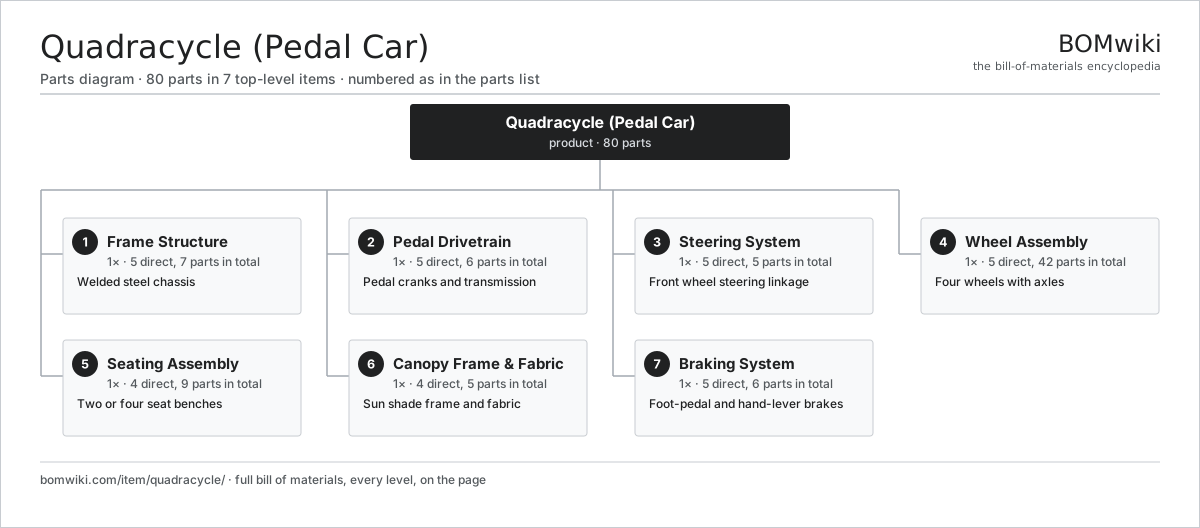
| # | Part | Qty | What it does |
|---|---|---|---|
| 1 | Frame Structure 5 parts | 1× | Welded steel chassis |
| 2 | Pedal Drivetrain 5 parts | 1× | Pedal cranks and transmission |
| 3 | Steering System 5 parts | 1× | Front wheel steering linkage |
| 4 | Wheel Assembly 5 parts | 1× | Four wheels with axles |
| 5 | Seating Assembly 4 parts | 1× | Two or four seat benches |
| 6 | Canopy Frame & Fabric 4 parts | 1× | Sun shade frame and fabric |
| 7 | Braking System 5 parts | 1× | Foot-pedal and hand-lever brakes |
3D model
No 3D model yet. Have a CAD file of this? Add a 3D model. STL renders right on this page; STEP, FreeCAD, and OpenSCAD sources are welcome too (openly licensed, like all 3D models on BOMwiki).
Build & assembly graph
expand / collapse · shared sub-assemblies converge · links to related products · est. labourTap an assembly to expand/collapse · tap a part to open it · use “Open page” for any node · drag to pan, scroll to zoom.
Bill of materials for Quadracycle (Pedal Car)
7 top-level lines · 45 rows shown · 80 parts total · indented to 3 levels| # | Item / sub-assembly | Part no. | Qty/assy | Ext. qty | Parts | Type |
|---|---|---|---|---|---|---|
| 1 | Frame Structure 5 parts | quadracycle-frame | 1× | 1 | 7 | assembly |
| 1.1 | Main Chassis Rails | quadracycle-main-chassis | 1× | 1 | · | part |
| 1.2 | Cross Member | quadracycle-cross-member | 2× | 2 | · | part |
| 1.3 | Steering Head | quadracycle-steering-head | 1× | 1 | · | part |
| 1.4 | Axle Bosses | quadracycle-axle-bosses | 2× | 2 | · | part |
| 1.5 | Canopy Support Posts | quadracycle-canopy-supports | 1× | 1 | · | part |
| 2 | Pedal Drivetrain 5 parts | quadracycle-drivetrain | 1× | 1 | 6 | assembly |
| 2.1 | Pedal Cranks | quadracycle-pedal-cranks | 2× | 2 | · | part |
| 2.2 | Pedal Axle | quadracycle-pedal-axle | 1× | 1 | · | part |
| 2.3 | Front Sprocket | quadracycle-sprocket-front | 1× | 1 | · | part |
| 2.4 | Chain Drive | quadracycle-chain-drive | 1× | 1 | · | part |
| 2.5 | Gear Reduction Box | quadracycle-gear-reduction | 1× | 1 | · | part |
| 3 | Steering System 5 parts | quadracycle-steering | 1× | 1 | 5 | assembly |
| 3.1 | Steering Wheel | quadracycle-steering-wheel | 1× | 1 | · | part |
| 3.2 | Steering Column | quadracycle-steering-column | 1× | 1 | · | part |
| 3.3 | Pitman Arm | quadracycle-pitman-arm | 1× | 1 | · | part |
| 3.4 | Tie Rod (Drag Link) | quadracycle-tie-rod | 1× | 1 | · | part |
| 3.5 | Caster and Toe Geometry | quadracycle-caster-geometry | 1× | 1 | · | part |
| 4 | Wheel Assembly 5 parts | quadracycle-wheel-assembly | 1× | 1 | 42 | assembly |
| 4.1 | Front Axle | quadracycle-front-axle | 1× | 1 | · | part |
| 4.2 | Rear Axle | quadracycle-rear-axle | 1× | 1 | · | part |
| 4.3 | Wheel Assembly 5 parts | wheel-assembly | 4× | 4 | 9 | assembly |
| 4.3.1 | Alloy Wheel | alloy-wheel | 1× | 4 | · | part |
| 4.3.2 | Tire | tire | 1× | 4 | · | part |
| 4.3.3 | TPMS Sensor | tpms-sensor | 1× | 4 | · | part |
| 4.3.4 | Lug Nut | lug-nut | 5× | 20 | · | part |
| 4.3.5 | Valve Stem | valve-stem | 1× | 4 | · | part |
| 4.4 | Front Tyre | quadracycle-tyre-front | 2× | 2 | · | part |
| 4.5 | Rear Tyre | quadracycle-tyre-rear | 2× | 2 | · | part |
| 5 | Seating Assembly 4 parts | quadracycle-seating | 1× | 1 | 9 | assembly |
| 5.1 | Seat Bench | quadracycle-seat-bench | 2× | 2 | · | part |
| 5.2 | Seat Frame Structure | quadracycle-seat-frame | 1× | 1 | · | part |
| 5.3 | Seat Cushion Pad | quadracycle-cushion-pad | 4× | 4 | · | part |
| 5.4 | Footrest Bar | quadracycle-footrest-bar | 2× | 2 | · | part |
| 6 | Canopy Frame & Fabric 4 parts | quadracycle-canopy | 1× | 1 | 5 | assembly |
| 6.1 | Canopy Frame | quadracycle-canopy-frame | 1× | 1 | · | part |
| 6.2 | Canopy Fabric | quadracycle-canopy-fabric | 1× | 1 | · | part |
| 6.3 | Canopy Bows | quadracycle-canopy-bows | 1× | 1 | · | part |
| 6.4 | Canopy Latch | quadracycle-canopy-latch | 2× | 2 | · | part |
| 7 | Braking System 5 parts | quadracycle-braking | 1× | 1 | 6 | assembly |
| 7.1 | Rear Brake Drum | quadracycle-rear-brake-drum | 1× | 1 | · | part |
| 7.2 | Hand Brake Lever | quadracycle-hand-brake-lever | 1× | 1 | · | part |
| 7.3 | Brake Rod Linkage | quadracycle-brake-rod | 1× | 1 | · | part |
| 7.4 | Brake Cable | quadracycle-brake-cable | 1× | 1 | · | part |
| 7.5 | Brake Pad (Drum) | quadracycle-brake-pad | 2× | 2 | · | part |
Something wrong in this list? Report a problem with this BOM.
Related products
same domain, ranked by shared parts Adult Tricycle
77 parts · shares 6 with this page
 Bicycle Cargo Trailer
59 parts · shares 6 with this page
 Cargo Trike
96 parts · shares 6 with this page
 Motorized Bicycle
78 parts · shares 6 with this page
 Pedal Go-Kart
243 parts · shares 6 with this page
 Velomobile
112 parts · shares 6 with this page
Sourcing: possible vendors
Browse the supplier directory → Prices, MOQ, and lead times are algorithmic estimates, not quotes, and not claims about these companies. Company mappings are curated by keyword; est. price band $200–$12k. How estimates work| Vendor | HQ | Specialty | MOQ | Lead time |
|---|---|---|---|---|
|
🇹🇼Giant
giant-bicycles.com ↗
|
Taichung, TW | Bicycles | 500 units | 6–12 wks |
|
🇺🇸Trek
trekbikes.com ↗
|
Waterloo, US | Bicycles | 500 units | 6–12 wks |
| specialized.com ↗ | Morgan Hill, US | Bicycles | 500 units | 6–12 wks |
|
🇹🇼Merida
merida-bikes.com ↗
|
Yuanlin, TW | Bicycles | 500 units | 6–12 wks |
| cannondale.com ↗ | Wilton, US | Bicycles | 500 units | 6–12 wks |
943-word article