Quarry Drill Rig
ProductOverview
A quarry drill rig is a self-propelled machine designed to drill blast holes in open-pit mining operations, quarries, and aggregate extraction sites. These rigs use either down-the-hole (DTH) or top-hammer drifter technology to create precisely spaced boreholes, typically 51–165 mm in diameter and up to 40 meters deep. The rig combines a pneumatic or hydraulic hammer, a hydraulic feed system, and a tracked platform to deliver the drilling force needed for granite, limestone, and other hard rock. Quarry drill rigs are the backbone of the blasting cycle: they must drill fast, align holes accurately to blast designs, and handle multiple drill types and depths in a single pit.
How it works
The drilling process begins when the operator positions the tracked carrier over the marked blast hole. The diesel engine drives a variable-displacement hydraulic pump that supplies both the carrier transmission and all drilling circuits. The pneumatic compressor (25–35 bar) is powered by the engine via belt or direct coupling.
The mast, a welded lattice structure, is erected vertically and locked into place. The hammer is threaded onto the feed system, which consists of dual 250–400 bar cylinders driven by load-sensing proportional valves. As the operator pushes the joystick, hydraulic fluid extends the feed cylinders downward, forcing the rotation motor and hammer onto the rock face.
Inside the hammer, incoming compressed air pushes a hardened piston against the drill rod 1000–2000 times per minute. Simultaneously, a separate low-speed high-torque motor rotates the rod at 40–100 rpm, allowing fresh rock to be struck. The compressor maintains pressure via a receiver tank, which absorbs pulsations and ensures steady flow to the hammer.
Drill rods are fed automatically or manually from the rod magazine. As one rod is fully extended, the rod gripper releases it and the magazine indexes to the next rod. The new rod is inserted into the hammering assembly, and drilling resumes. This cycle repeats until the hole reaches the target depth, typically 20–40 meters, at which point the mast is retracted and the rig relocates.
The hydraulic system is the circulatory system of the rig. A main variable-displacement pump continuously adjusts output to meet load demand. Pressure sensors at key points feed back to the PLC, which automatically adjusts pump displacement and valve settings. The cooler rejects excess heat generated during heavy drilling. Return oil passes through filters before entering the tank, protecting cylinders and motors from contamination.
The control cabin is the operator's interface. Proportional joysticks allow independent control of feed force, rotation speed, and track movement. The display shows hole depth, pressure, and system faults. A programmable controller monitors all drilling parameters and can enforce feed limits, rotation cutoffs, and emergency stops if pressure or temperature exceed safe limits.
Track propulsion uses a hydrostatic transmission or torque-converter gearbox, allowing smooth speed variation without gear shifting. The track units are oscillating rubber or steel links sealed to exclude mud and water, critical in wet pit environments. Idler wheels and tension adjustment systems maintain track tension over the mast footprint.
Drilling Strategy and Precision
Blast hole alignment is critical: a hole drilled 100 mm off-design at 20 meters creates dead zones in the blast fragmentation and increases explosive consumption. Professional pit design specifies hole spacing (2–3 meters center-to-center), depth tolerance (±0.5 m), and inclination (up to 30° from vertical). The mast is laser-aligned or manually set to angle and the operator uses depth counters and collision detection sensors to hit target depths reliably.
Hole production rates vary by rock hardness and diameter. In limestone a modern rig may drill 30–50 holes per 10-hour shift, each hole 20 meters deep and 89 mm diameter. In hard granite, the same rig may average 15–20 holes per shift due to slower penetration and hammer stress. The compressor is often the limiting factor: undersized compressors cause the hammer to stall or "starve," dropping penetration rate below 3 meters per hour.
Durability and Maintenance
Quarry drill rigs operate in abrasive, high-vibration environments. The feed cylinders and rotation motors experience 250–400 bar pressure continuously and are rated for 10,000+ operating hours before major overhaul. The hammer head and bit threads wear rapidly; bits are replaced every 100–500 holes depending on rock type. The track links are sealed but require annual tension adjustment and inspection for cracks. Oil and pressure monitoring systems are essential to detect early wear.
Most rigs are serviced after 2000–4000 operating hours, replacing seals (o-rings), filters, and hoses. Major overhauls happen every 8000–10000 hours and include pump and motor rebuilds. Compressor head rebuilds occur every 5000 hours in dusty conditions.
Environmental and Safety Considerations
Modern rigs comply with Tier 3 or Tier 4 diesel engine standards to reduce particulate emissions. Many quarries now require compressor water misting systems to suppress dust during hole flushing. Noise levels reach 120 dB at the operator position, mandating hearing protection and cab insulation.
Safety interlocks prevent the mast from raising while drilling, and automatic feed disengagement protects the rod assembly if back-pressure spikes. The alarm horn warns nearby personnel during rig movement. Load monitoring in the hydraulic circuits prevents over-stress of cylinders and rods.
Quarry Drill Rig parts and their functions
8 top-level parts · 94 parts in total · full bill of materials below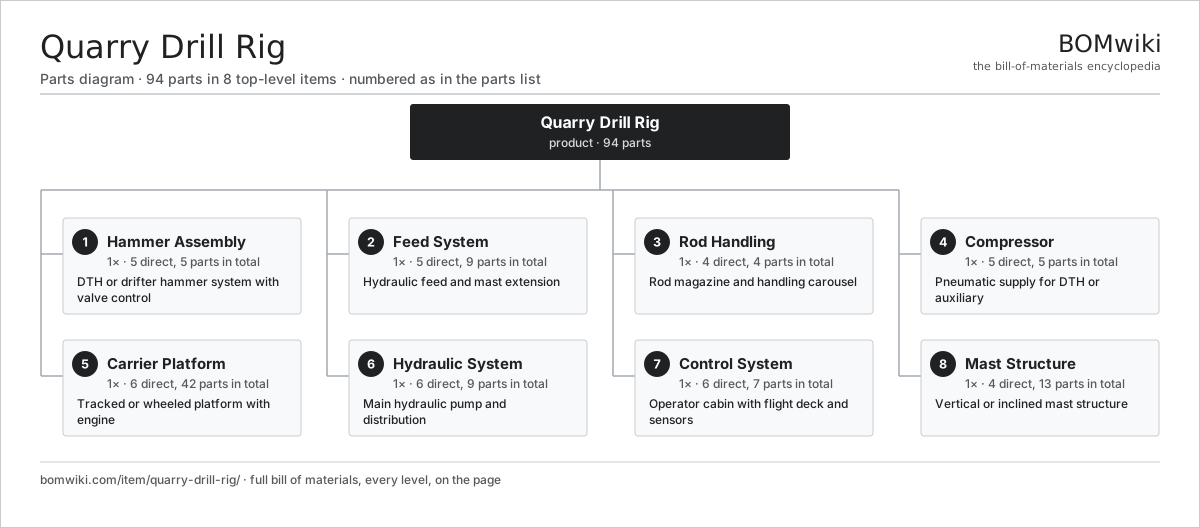
| # | Part | Qty | What it does |
|---|---|---|---|
| 1 | Hammer Assembly 5 parts | 1× | DTH or drifter hammer system with valve control |
| 2 | Feed System 5 parts | 1× | Hydraulic feed and mast extension |
| 3 | Rod Handling 4 parts | 1× | Rod magazine and handling carousel |
| 4 | Compressor 5 parts | 1× | Pneumatic supply for DTH or auxiliary |
| 5 | Carrier Platform 6 parts | 1× | Tracked or wheeled platform with engine |
| 6 | Hydraulic System 6 parts | 1× | Main hydraulic pump and distribution |
| 7 | Control System 6 parts | 1× | Operator cabin with flight deck and sensors |
| 8 | Mast Structure 4 parts | 1× | Vertical or inclined mast structure |
3D model
No 3D model yet. Have a CAD file of this? Add a 3D model. STL renders right on this page; STEP, FreeCAD, and OpenSCAD sources are welcome too (openly licensed, like all 3D models on BOMwiki).
Build & assembly graph
expand / collapse · shared sub-assemblies converge · links to related products · est. labourTap an assembly to expand/collapse · tap a part to open it · use “Open page” for any node · drag to pan, scroll to zoom.
Bill of materials for Quarry Drill Rig
8 top-level lines · 54 rows shown · 94 parts total · indented to 3 levels| # | Item / sub-assembly | Part no. | Qty/assy | Ext. qty | Parts | Type |
|---|---|---|---|---|---|---|
| 1 | Hammer Assembly 5 parts | quarry-drill-rig-hammer-assembly | 1× | 1 | 5 | assembly |
| 1.1 | Hammer Head | quarry-drill-rig-hammer-head | 1× | 1 | · | part |
| 1.2 | Hammer Valve | quarry-drill-rig-hammer-valve | 1× | 1 | · | part |
| 1.3 | Rotation Motor | quarry-drill-rig-rotation-motor | 1× | 1 | · | part |
| 1.4 | O-Ring Set | oring-set | 1× | 1 | · | part |
| 1.5 | Bit Adapter | quarry-drill-rig-bit-adapter | 1× | 1 | · | part |
| 2 | Feed System 5 parts | quarry-drill-rig-feed-system | 1× | 1 | 9 | assembly |
| 2.1 | Feed Cylinder | quarry-drill-rig-feed-cylinder | 2× | 2 | · | part |
| 2.2 | Stabilizer Cylinder | quarry-drill-rig-stabilizer-cylinder | 2× | 2 | · | part |
| 2.3 | Pressure Sensor | pressure-sensor | 2× | 2 | · | part |
| 2.4 | Feed Proportional Valve | quarry-drill-rig-feed-valve | 1× | 1 | · | part |
| 2.5 | Coil Spring | coil-spring | 2× | 2 | · | part |
| 3 | Rod Handling 4 parts | quarry-drill-rig-rod-handling | 1× | 1 | 4 | assembly |
| 3.1 | Rod Magazine | quarry-drill-rig-rod-magazine | 1× | 1 | · | part |
| 3.2 | Rod Gripper | quarry-drill-rig-rod-gripper | 1× | 1 | · | part |
| 3.3 | Indexing Motor | quarry-drill-rig-indexing-motor | 1× | 1 | · | part |
| 3.4 | Encoder | encoder | 1× | 1 | · | part |
| 4 | Compressor 5 parts | quarry-drill-rig-compressor | 1× | 1 | 5 | assembly |
| 4.1 | Compressor Head | quarry-drill-rig-compressor-head | 1× | 1 | · | part |
| 4.2 | Compressor Drive Motor | quarry-drill-rig-compressor-motor | 1× | 1 | · | part |
| 4.3 | Air Receiver | quarry-drill-rig-air-receiver | 1× | 1 | · | part |
| 4.4 | Air Dryer | quarry-drill-rig-dryer-unit | 1× | 1 | · | part |
| 4.5 | Pressure Sensor | pressure-sensor | 1× | 1 | · | part |
| 5 | Carrier Platform 6 parts | quarry-drill-rig-carrier | 1× | 1 | 42 | assembly |
| 5.1 | Diesel Engine | quarry-drill-rig-engine | 1× | 1 | · | part |
| 5.2 | Transmission | quarry-drill-rig-transmission | 1× | 1 | · | part |
| 5.3 | Track Unit | quarry-drill-rig-track-unit | 2× | 2 | · | part |
| 5.4 | Hydraulic Pump | quarry-drill-rig-hydraulic-pump | 1× | 1 | · | part |
| 5.5 | Fuel Tank | quarry-drill-rig-fuel-tank | 1× | 1 | · | part |
| 5.6 | Wheel Assembly 5 parts | wheel-assembly | 4× | 4 | 9 | assembly |
| 5.6.1 | Alloy Wheel | alloy-wheel | 1× | 4 | · | part |
| 5.6.2 | Tire | tire | 1× | 4 | · | part |
| 5.6.3 | TPMS Sensor | tpms-sensor | 1× | 4 | · | part |
| 5.6.4 | Lug Nut | lug-nut | 5× | 20 | · | part |
| 5.6.5 | Valve Stem | valve-stem | 1× | 4 | · | part |
| 6 | Hydraulic System 6 parts | quarry-drill-rig-hydraulics | 1× | 1 | 9 | assembly |
| 6.1 | Main Pressure Pump | quarry-drill-rig-main-pump | 1× | 1 | · | part |
| 6.2 | Accumulator | quarry-drill-rig-accumulator | 2× | 2 | · | part |
| 6.3 | Filter Assembly | quarry-drill-rig-filter-assembly | 1× | 1 | · | part |
| 6.4 | Cooler | quarry-drill-rig-cooler | 1× | 1 | · | part |
| 6.5 | Hose Bundle | quarry-drill-rig-hose-bundle | 1× | 1 | · | part |
| 6.6 | Pressure Sensor | pressure-sensor | 3× | 3 | · | part |
| 7 | Control System 6 parts | quarry-drill-rig-controls | 1× | 1 | 7 | assembly |
| 7.1 | Cabin | quarry-drill-rig-cabin | 1× | 1 | · | part |
| 7.2 | PLC | quarry-drill-rig-plc | 1× | 1 | · | part |
| 7.3 | Joystick Pair | quarry-drill-rig-joystick-pair | 1× | 1 | · | part |
| 7.4 | LCD Panel | lcd-panel | 1× | 1 | · | part |
| 7.5 | Alarm Horn | quarry-drill-rig-alarm-horn | 1× | 1 | · | part |
| 7.6 | Pressure Sensor | pressure-sensor | 2× | 2 | · | part |
| 8 | Mast Structure 4 parts | quarry-drill-rig-mast | 1× | 1 | 13 | assembly |
| 8.1 | Mast Box Section | quarry-drill-rig-mast-box | 1× | 1 | · | part |
| 8.2 | Slider Unit | quarry-drill-rig-slider-unit | 2× | 2 | · | part |
| 8.3 | Guide Rod | quarry-drill-rig-guide-rod | 4× | 4 | · | part |
| 8.4 | Sheet Metal Panel | sheet-panel | 6× | 6 | · | part |
Something wrong in this list? Report a problem with this BOM.
Related products
same domain, ranked by shared parts Drilling Jumbo
175 parts · shares 8 with this page
Rock Bolter
117 parts · shares 8 with this page
Drilling Jumbo
175 parts · shares 8 with this page
Rock Bolter
117 parts · shares 8 with this page
 Underground Utility Vehicle
148 parts · shares 8 with this page
Underground Utility Vehicle
148 parts · shares 8 with this page
 Load-Haul-Dump (LHD)
164 parts · shares 7 with this page
Load-Haul-Dump (LHD)
164 parts · shares 7 with this page
 Mining Haul Truck
1,000 parts · shares 7 with this page
Mining Haul Truck
1,000 parts · shares 7 with this page
 Quarry Wheel Loader
227 parts · shares 7 with this page
Quarry Wheel Loader
227 parts · shares 7 with this page
Sourcing: possible vendors
Browse the supplier directory → Prices, MOQ, and lead times are algorithmic estimates, not quotes, and not claims about these companies. Company mappings are curated by keyword; est. price band $200k–$5M. How estimates work| Vendor | HQ | Specialty | MOQ | Lead time |
|---|---|---|---|---|
| caterpillar.com ↗ | Irving, US | Construction & mining equipment | made to order | 20–36 wks |
|
🇯🇵Komatsu
komatsu.com ↗
|
Tokyo, JP | Construction & mining equipment | made to order | 20–36 wks |
|
🇸🇪Sandvik
rocktechnology.sandvik ↗
|
Stockholm, SE | Mining & rock technology | made to order | 20–36 wks |
|
🇸🇪Epiroc
epiroc.com ↗
|
Stockholm, SE | Mining & drilling equipment | made to order | 20–36 wks |
|
🇫🇮Metso
metso.com ↗
|
Helsinki, FI | Crushing & minerals processing | made to order | 20–36 wks |
1,018-word article