Radio Telescope
ProductOverview
Radio telescopes form the foundation of modern astronomy, enabling observations of the universe in wavelengths invisible to optical instruments. A parabolic-dish radio telescope collects weak electromagnetic radiation from distant astronomical objects, galaxies, pulsars, quasars, and the cosmic microwave background. The system described here is a medium-scale facility with aperture 8–12 m, covering frequencies from 300 MHz to 100 GHz, typical of university research stations or regional astronomy networks.
The core principle is simple but demanding: a large parabolic reflector focuses faint radio waves onto a sensitive receiver, which amplifies and downconverts the signal for digitization and correlation. The telescope must point with sub-arcminute precision and track the sky continuously while rejecting thermal noise and atmospheric distortion.
How it works
Mechanical Structure and Drive
The Mechanical Structure comprises a welded-steel truss supporting the Reflector Dish. The reflector, a parabolic surface 8–12 m in diameter, is composed of 50–60 individual aluminum panels held to tight tolerance (±2 mm relative to the focal surface). Each panel is adjustable via the Backing Ring, a rib network with jack-screw tuning points. This allows active shape correction as the telescope tilts under gravity and solar heating.
The Drive System uses two large AC induction motors (10–50 kW each) driven by variable-frequency drives. One motor rotates the entire assembly in azimuth (0–360°), while the other lifts the dish in elevation (typically 0–90°). Encoders on both axes feed position data back to the control PC at 1 Hz or better, enabling closed-loop tracking within 1 arcsecond over hours.
Cryogenic Receiver
At the Feed Horn, positioned at the parabolic focal point 15–30 m above the reflector, the Receiver System begins. The Cryogenic Dewar houses a LNA Module, a low-noise amplifier cooled to 50–100 K by liquid nitrogen or a closed-cycle refrigerator. A good cryogenic LNA achieves a noise figure of 0.3–0.5 dB, meaning it adds minimal thermal noise compared to the sky background.
The amplified signal flows through a Mixer Stage, which heterodyne-downconverts the received frequency (say, 10 GHz) to an intermediate frequency (IF, typically 0–3 GHz) using a stable local oscillator. The IF Chain then bandpass-filters and amplifies this IF signal to a level suitable for digitization.
Correlator and Data Acquisition
The Correlator receives the digitized IF stream(s) from an ADC Board running at 1–10 GHz sampling rate. An FPGA Correlator performs real-time cross-correlation of antenna channels (or single-dish autocorrelation), computing visibility matrices that encode the angular structure of the radio source. In a single-dish mode, the correlator effectively becomes a spectrometer; in interferometer arrays, multiple telescopes correlate their signals to achieve ultra-high angular resolution.
Power and Control
The Control Cabinet distributes three-phase AC power through switchgear and UPS backup, ensuring uninterrupted tracking during brief power interruptions. A networked Linux PC or workstation runs scheduling and observing scripts, commanding the Motor Controller to slew between sources and synchronizing data acquisition with the Correlator.
Angular Resolution and Sensitivity
Angular resolution improves with frequency (shorter wavelengths diffract less). A 10 m dish at 10 GHz achieves ~30 arcsecond resolution; at 100 GHz (millimeter wavelengths), it resolves ~3 arcsecond features. Sensitivity improves with aperture area and cryogenic reception: a well-designed system can detect sources as faint as 1 mJy (millijansky) in one-hour integrations.
Atmospheric water vapor and oxygen absorption become significant above 30 GHz, requiring dry sites (high altitude, low humidity) and sometimes dual-band receivers. The Cabling Harness includes slip rings passing RF signals through the rotating azimuth axis without twisting.
Maintenance and Upgrades
The Reflector Dish panels require periodic realignment, especially after wind or thermal cycling. The receiver cryogenic supply (LN₂ dewar or compressor) demands quarterly service. Modern upgrades often include wideband receivers (multi-GHz bandwidth), digital backends replacing analog correlators, and phased-array elements at the focus for simultaneous multi-beam observations.
Radio Telescope parts and their functions
8 top-level parts · 104 parts in total · full bill of materials below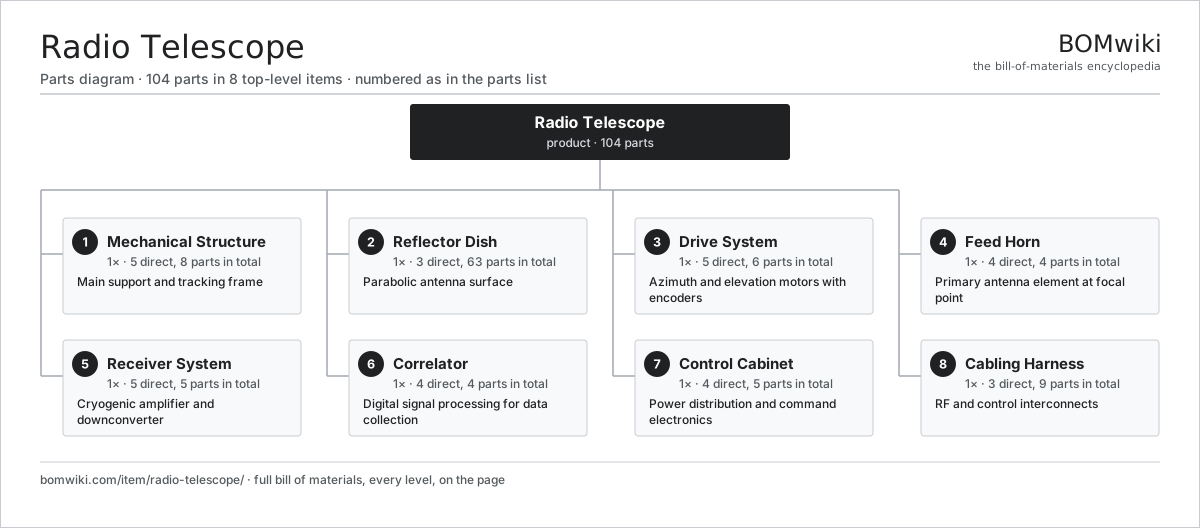
| # | Part | Qty | What it does |
|---|---|---|---|
| 1 | Mechanical Structure 5 parts | 1× | Main support and tracking frame |
| 2 | Reflector Dish 3 parts | 1× | Parabolic antenna surface |
| 3 | Drive System 5 parts | 1× | Azimuth and elevation motors with encoders |
| 4 | Feed Horn 4 parts | 1× | Primary antenna element at focal point |
| 5 | Receiver System 5 parts | 1× | Cryogenic amplifier and downconverter |
| 6 | Correlator 4 parts | 1× | Digital signal processing for data collection |
| 7 | Control Cabinet 4 parts | 1× | Power distribution and command electronics |
| 8 | Cabling Harness 3 parts | 1× | RF and control interconnects |
3D model
No 3D model yet. Have a CAD file of this? Add a 3D model. STL renders right on this page; STEP, FreeCAD, and OpenSCAD sources are welcome too (openly licensed, like all 3D models on BOMwiki).
Build & assembly graph
expand / collapse · shared sub-assemblies converge · links to related products · est. labourTap an assembly to expand/collapse · tap a part to open it · use “Open page” for any node · drag to pan, scroll to zoom.
Bill of materials for Radio Telescope
8 top-level lines · 41 rows shown · 104 parts total · indented to 3 levels| # | Item / sub-assembly | Part no. | Qty/assy | Ext. qty | Parts | Type |
|---|---|---|---|---|---|---|
| 1 | Mechanical Structure 5 parts | radio-telescope-mechanical-structure | 1× | 1 | 8 | assembly |
| 1.1 | Main Truss | radio-telescope-main-truss | 1× | 1 | · | part |
| 1.2 | Azimuth Bearing | radio-telescope-azimuth-bearing | 1× | 1 | · | part |
| 1.3 | Elevation Cradle | radio-telescope-elevation-cradle | 1× | 1 | · | part |
| 1.4 | Fastener Set | fastener-set | 4× | 4 | · | part |
| 1.5 | Cable Tray Assembly | cable-tray-assembly | 1× | 1 | · | part |
| 2 | Reflector Dish 3 parts | radio-telescope-reflector-dish | 1× | 1 | 63 | assembly |
| 2.1 | Dish Panels | radio-telescope-dish-panels | 60× | 60 | · | part |
| 2.2 | Backing Ring | radio-telescope-backing-ring | 1× | 1 | · | part |
| 2.3 | Fastener Set | fastener-set | 2× | 2 | · | part |
| 3 | Drive System 5 parts | radio-telescope-drive-system | 1× | 1 | 6 | assembly |
| 3.1 | Azimuth Motor | radio-telescope-azimuth-motor | 1× | 1 | · | part |
| 3.2 | Elevation Motor | radio-telescope-elevation-motor | 1× | 1 | · | part |
| 3.3 | Encoder Pair | radio-telescope-encoder-pair | 2× | 2 | · | part |
| 3.4 | Motor Controller | radio-telescope-motor-controller | 1× | 1 | · | part |
| 3.5 | Wire Bundle | wire-bundle | 1× | 1 | · | part |
| 4 | Feed Horn 4 parts | radio-telescope-feed-horn | 1× | 1 | 4 | assembly |
| 4.1 | Horn Waveguide | radio-telescope-horn-waveguide | 1× | 1 | · | part |
| 4.2 | Polarization Combiner | radio-telescope-polarization-combiner | 1× | 1 | · | part |
| 4.3 | Feed Support | radio-telescope-feed-support | 1× | 1 | · | part |
| 4.4 | Fastener Set | fastener-set | 1× | 1 | · | part |
| 5 | Receiver System 5 parts | radio-telescope-receiver-system | 1× | 1 | 5 | assembly |
| 5.1 | Cryogenic Dewar | radio-telescope-cryogenic-dewar | 1× | 1 | · | part |
| 5.2 | LNA Module | radio-telescope-lna-module | 1× | 1 | · | part |
| 5.3 | Mixer Stage | radio-telescope-mixer-stage | 1× | 1 | · | part |
| 5.4 | IF Chain | radio-telescope-if-chain | 1× | 1 | · | part |
| 5.5 | LO Oscillator | radio-telescope-lo-oscillator | 1× | 1 | · | part |
| 6 | Correlator 4 parts | radio-telescope-correlator | 1× | 1 | 4 | assembly |
| 6.1 | ADC Board | radio-telescope-adc-board | 1× | 1 | · | part |
| 6.2 | FPGA Correlator | radio-telescope-fpga-correlator | 1× | 1 | · | part |
| 6.3 | Packetizer | radio-telescope-packetizer | 1× | 1 | · | part |
| 6.4 | Power Supply | power-supply | 1× | 1 | · | part |
| 7 | Control Cabinet 4 parts | radio-telescope-control-cabinet | 1× | 1 | 5 | assembly |
| 7.1 | Power Distribution | radio-telescope-power-distribution | 1× | 1 | · | part |
| 7.2 | Network Interface | radio-telescope-network-interface | 1× | 1 | · | part |
| 7.3 | UPS Battery | radio-telescope-ups-battery | 1× | 1 | · | part |
| 7.4 | Power Supply | power-supply | 2× | 2 | · | part |
| 8 | Cabling Harness 3 parts | radio-telescope-cabling-harness | 1× | 1 | 9 | assembly |
| 8.1 | RF Coaxial Cable | radio-telescope-rf-coaxial | 6× | 6 | · | part |
| 8.2 | Slip Ring Assembly | radio-telescope-slip-ring-assembly | 1× | 1 | · | part |
| 8.3 | Wire Bundle | wire-bundle | 2× | 2 | · | part |
Something wrong in this list? Report a problem with this BOM.
Related products
same domain, ranked by shared parts Camera Motion Control Rig
210 parts · shares 2 with this page
Camera Motion Control Rig
210 parts · shares 2 with this page
 Document Camera
247 parts · shares 2 with this page
Document Camera
247 parts · shares 2 with this page
 Industrial 3D Scanner
149 parts · shares 2 with this page
Industrial 3D Scanner
149 parts · shares 2 with this page
 Laser Tracker
142 parts · shares 2 with this page
Laser Tracker
142 parts · shares 2 with this page
 Microfilm Scanner
348 parts · shares 2 with this page
Microfilm Scanner
348 parts · shares 2 with this page
 Motorized Camera Slider
41 parts · shares 2 with this page
Motorized Camera Slider
41 parts · shares 2 with this page
Sourcing: possible vendors
Browse the supplier directory → Prices, MOQ, and lead times are algorithmic estimates, not quotes, and not claims about these companies. Company mappings are curated by keyword; est. price band $100–$8k. How estimates work| Vendor | HQ | Specialty | MOQ | Lead time |
|---|---|---|---|---|
|
🇯🇵Canon
canon.com ↗
|
Tokyo, JP | Imaging & optics | 500 units | 10–16 wks |
|
🇯🇵Nikon
nikon.com ↗
|
Tokyo, JP | Imaging & optics | 500 units | 10–16 wks |
|
🇩🇪ZEISS
zeiss.com ↗
|
Oberkochen, DE | Optics & optoelectronics | 500 units | 10–16 wks |
| leica-camera.com ↗ | Wetzlar, DE | Cameras & optics | 500 units | 10–16 wks |
| flir.com ↗ | Wilsonville, US | Thermal imaging | 500 units | 10–16 wks |
703-word article