Rail Drilling Machine
ProductOverview
A rail drilling machine is a portable or semi-fixed installation for drilling precisely positioned bolt holes in railroad rail, specifically in the web and flange to accommodate fishplates (splice plates) that join two rail sections end-to-end. Manual drilling of rail with handheld drills produces inaccurate, wandering holes, unacceptable for bearing loads where bolt friction must be uniform. A dedicated rail-drilling machine ensures every hole is concentric, correctly sized, and drilled perpendicular to the rail axis, allowing bolts and fishplates to carry full shear and tension loads.
The Spindle Rotary Drive is a high-speed rotary head (500–2,000 RPM) carrying a standard drill chuck with bits ranging from 10–25 mm diameter. The Automatic Feed and Depth Control automatically advances the spindle at a programmed rate (typically 10–30 mm/min for 20 mm steel holes), with a Spindle Load Cell monitoring cutting load so that if the load exceeds a threshold (indicating dull bit or jam), the operator is alerted. The Rail Clamping Vise is a vise that locks the rail longitudinally during drilling, preventing walkoff or vibration. The Coolant Supply and Recovery supplies pressurized cutting fluid at the drill point, extending tool life and reducing friction heat. A Programmable Depth Stop automatically retracts the spindle once the hole reaches target depth, eliminating overdrilling and preventing bit breakage.
The entire machine is mounted on a Machine Structural Frame either on wheels (for portability to field splice sites) or bolted to a pit floor (for high-volume rail mill operations). The Main Power Motor powers the spindle via belt drive; a Operator Control Handle pendant allows the operator to position the machine, start the spindle, adjust feed speed, and monitor drilling progress from a distance.
How it works
A damaged rail section needs to be spliced: two rail ends are brought together and fishplates (thick steel angle brackets) are bolted across the web and flange on both sides, restoring structural continuity. Before bolting, a series of 4–8 holes must be drilled through the rail web and flange at precise locations to accept M20 or M24 bolts. The machine operator positions the machine over the first hole location (marked beforehand) and engages the Rail Clamping Vise vise, squeezing the movable jaw against the rail with ~8 tonnes of force via a manual screw or quick-tighten lever, enough to lock the rail against the drilling torque.
At the Operator Control Handle pendant, the operator inserts a 20 mm drill bit into the Drill Chuck, then presses START. The Spindle Motor ramps the spindle to, say, 800 RPM (appropriate for 20 mm drill in steel, cutting speed ~60 m/min). The operator then manually dials the Speed Dial to 20 mm/min and presses FEED to engage the Feed Motor. The Feed Screw slowly advances the spindle downward, and the rotating drill bit bites into the rail surface, creating shavings.
As the hole deepens, the Coolant Supply and Recovery delivers cutting fluid via Coolant Nozzle jets, keeping the tool cool and removing swarf. The Spindle Load Cell continuously measures spindle torque; if torque exceeds a safe threshold (indicating dulling or jam), the pendant beeps a warning, the operator can then manually retract or reduce feed speed. Once the Programmable Depth Stop detects that the spindle has advanced 52 mm (the target hole depth for this rail), a Depth Stop Switch microswitch triggers, automatically deactivating the feed motor. The spindle coasts briefly then stops.
The operator then retracts the spindle via RETRACT on the pendant, removes the bit (now blunt and too dull for the next hole), and manually repositions the machine over the next hole location. The entire sequence repeats 6–8 times, producing a complete drilled fishplate pattern in 20–30 minutes for a typical splice.
Design considerations
The rail-drilling-machine-spindle-speed and Automatic Feed and Depth Control rate are coupled to material and tool: for 20 mm diameter in steel rail, a cutting speed of 60 m/min is standard (rpm = 60v / πd = 60 × 60 / π × 20 ≈ 570 RPM is typical). Slower feed (~10 mm/min) produces a cleaner hole; faster feed (30+ mm/min) risks bit breakage if the bit is even slightly dull. Modern machines have a Spindle Load Cell tachometer: the Automatic Feed and Depth Control automatically reduces feed if torque spikes, protecting the bit.
The Coolant Supply and Recovery is essential: drilling 25 mm through steel rail without coolant will dull a bit after 2–3 holes; with coolant, a single bit may last 20–30 holes. Soluble-oil or semi-synthetic coolants are typical; synthetic is preferred because it has better biodegradability and lower odor. The Coolant Sump sump allows chips to settle; periodic draining and refilling are maintenance tasks.
The Rail Clamping Vise must grip hard enough to resist the radial drilling torque (torque = cutting force × radius). For a 20 mm drill in steel at 10 mm/min feed, cutting force is roughly 2–3 kN radially; clamping force of 5–10 tonnes (50–100 kN) provides a safety factor of 30+, ensuring no slip. Power clamping (hydraulic or pneumatic actuator) is sometimes added for high-volume mills, eliminating manual screw tightening.
The Programmable Depth Stop must be accurately set: a 50 mm depth hole requires the spindle to advance 52 mm (accounting for drill tip geometry, the point adds ~2 mm at end); overshooting by 5 mm will overload the bit on exit and cause breakage. Modern machines use digital depth readout with microswitch stop or electronic PLC logic reading a position encoder, achieving ±1 mm repeatability.
Portability is valued for field operations: a compact rail-drilling machine on a movable cart can be wheeled to any splice site, clamped to the rail, and operated without fixed infrastructure. Heavier machines in rail mills sacrifice portability for precision and throughput.
Rail Drilling Machine parts and their functions
8 top-level parts · 44 parts in total · full bill of materials below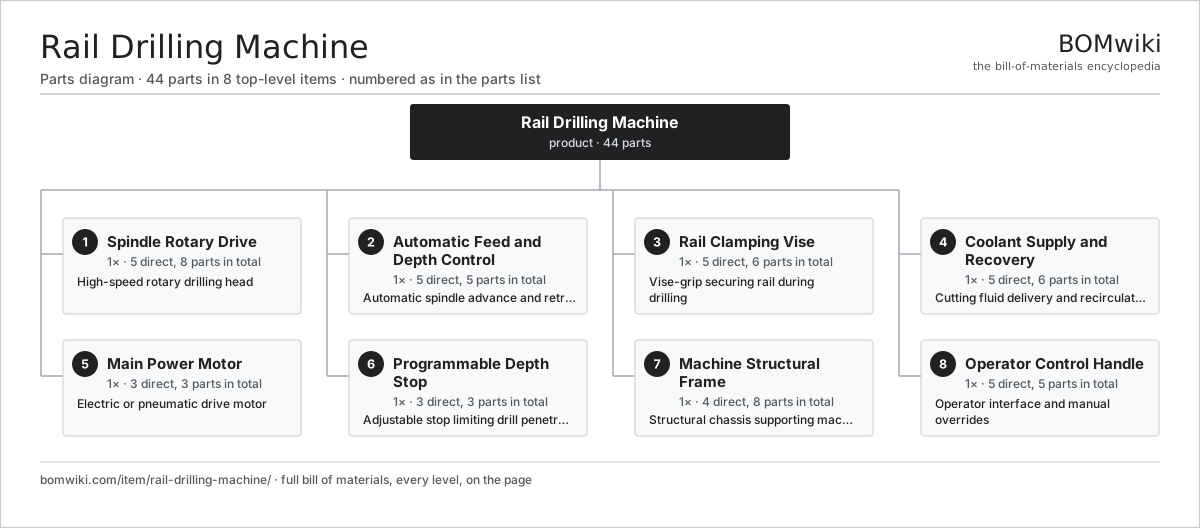
| # | Part | Qty | What it does |
|---|---|---|---|
| 1 | Spindle Rotary Drive 5 parts | 1× | High-speed rotary drilling head |
| 2 | Automatic Feed and Depth Control 5 parts | 1× | Automatic spindle advance and retract |
| 3 | Rail Clamping Vise 5 parts | 1× | Vise-grip securing rail during drilling |
| 4 | Coolant Supply and Recovery 5 parts | 1× | Cutting fluid delivery and recirculation |
| 5 | Main Power Motor 3 parts | 1× | Electric or pneumatic drive motor |
| 6 | Programmable Depth Stop 3 parts | 1× | Adjustable stop limiting drill penetration |
| 7 | Machine Structural Frame 4 parts | 1× | Structural chassis supporting machine |
| 8 | Operator Control Handle 5 parts | 1× | Operator interface and manual overrides |
3D model
No 3D model yet. Have a CAD file of this? Add a 3D model. STL renders right on this page; STEP, FreeCAD, and OpenSCAD sources are welcome too (openly licensed, like all 3D models on BOMwiki).
Build & assembly graph
expand / collapse · shared sub-assemblies converge · links to related products · est. labourTap an assembly to expand/collapse · tap a part to open it · use “Open page” for any node · drag to pan, scroll to zoom.
Bill of materials for Rail Drilling Machine
8 top-level lines · 43 rows shown · 44 parts total · indented to 3 levels| # | Item / sub-assembly | Part no. | Qty/assy | Ext. qty | Parts | Type |
|---|---|---|---|---|---|---|
| 1 | Spindle Rotary Drive 5 parts | rail-drilling-machine-spindle-drive | 1× | 1 | 8 | assembly |
| 1.1 | Spindle Motor | rail-drilling-machine-spindle-motor | 1× | 1 | · | part |
| 1.2 | Spindle Shaft | rail-drilling-machine-spindle-shaft | 1× | 1 | · | part |
| 1.3 | Spindle Bearing | rail-drilling-machine-spindle-bearing | 4× | 4 | · | part |
| 1.4 | Drill Chuck | rail-drilling-machine-tool-chuck | 1× | 1 | · | part |
| 1.5 | Spindle Belt Drive | rail-drilling-machine-spindle-belt-drive | 1× | 1 | · | part |
| 2 | Automatic Feed and Depth Control 5 parts | rail-drilling-machine-feed-mechanism | 1× | 1 | 5 | assembly |
| 2.1 | Feed Screw | rail-drilling-machine-feed-screw | 1× | 1 | · | part |
| 2.2 | Feed Motor | rail-drilling-machine-feed-motor | 1× | 1 | · | part |
| 2.3 | Depth Sensor | rail-drilling-machine-depth-sensor | 1× | 1 | · | part |
| 2.4 | Spindle Load Cell | rail-drilling-machine-load-cell-feedback | 1× | 1 | · | part |
| 2.5 | Feed Arm | rail-drilling-machine-feed-arm | 1× | 1 | · | part |
| 3 | Rail Clamping Vise 5 parts | rail-drilling-machine-rail-clamp | 1× | 1 | 6 | assembly |
| 3.1 | Clamp Base | rail-drilling-machine-clamp-base | 1× | 1 | · | part |
| 3.2 | Movable Clamp Jaw | rail-drilling-machine-clamp-movable-jaw | 1× | 1 | · | part |
| 3.3 | Clamping Screw | rail-drilling-machine-clamp-screw | 1× | 1 | · | part |
| 3.4 | Jaw Pad | rail-drilling-machine-clamp-jaw-pad | 2× | 2 | · | part |
| 3.5 | Quick-Tighten Lever | rail-drilling-machine-clamp-lever | 1× | 1 | · | part |
| 4 | Coolant Supply and Recovery 5 parts | rail-drilling-machine-coolant-system | 1× | 1 | 6 | assembly |
| 4.1 | Coolant Pump | rail-drilling-machine-coolant-pump | 1× | 1 | · | part |
| 4.2 | Coolant Sump | rail-drilling-machine-coolant-tank | 1× | 1 | · | part |
| 4.3 | Return Filter | rail-drilling-machine-coolant-filter | 1× | 1 | · | part |
| 4.4 | Coolant Nozzle | rail-drilling-machine-coolant-nozzle | 2× | 2 | · | part |
| 4.5 | Coolant Hose | rail-drilling-machine-coolant-hose | 1× | 1 | · | part |
| 5 | Main Power Motor 3 parts | rail-drilling-machine-motor-unit | 1× | 1 | 3 | assembly |
| 5.1 | AC Motor | rail-drilling-machine-ac-motor | 1× | 1 | · | part |
| 5.2 | Motor Switch | rail-drilling-machine-motor-switch | 1× | 1 | · | part |
| 5.3 | Soft Starter | rail-drilling-machine-motor-soft-start | 1× | 1 | · | part |
| 6 | Programmable Depth Stop 3 parts | rail-drilling-machine-depth-stop | 1× | 1 | 3 | assembly |
| 6.1 | Depth Collar | rail-drilling-machine-depth-stop-collar | 1× | 1 | · | part |
| 6.2 | Depth Stop Switch | rail-drilling-machine-depth-switch | 1× | 1 | · | part |
| 6.3 | Stop Relay | rail-drilling-machine-stop-relay | 1× | 1 | · | part |
| 7 | Machine Structural Frame 4 parts | rail-drilling-machine-frame | 1× | 1 | 8 | assembly |
| 7.1 | Frame Beam | rail-drilling-machine-frame-beam | 2× | 2 | · | part |
| 7.2 | Frame Column | rail-drilling-machine-frame-column | 1× | 1 | · | part |
| 7.3 | Frame Brace | rail-drilling-machine-frame-brace | 2× | 2 | · | part |
| 7.4 | Vibration Isolator | rail-drilling-machine-vibration-isolator | 3× | 3 | · | part |
| 8 | Operator Control Handle 5 parts | rail-drilling-machine-control-handle | 1× | 1 | 5 | assembly |
| 8.1 | Control Pendant | rail-drilling-machine-handle-pendant | 1× | 1 | · | part |
| 8.2 | Start Button | rail-drilling-machine-start-button | 1× | 1 | · | part |
| 8.3 | Speed Dial | rail-drilling-machine-feed-speed-dial | 1× | 1 | · | part |
| 8.4 | Emergency Stop | rail-drilling-machine-emergency-stop | 1× | 1 | · | part |
| 8.5 | Control Cable | rail-drilling-machine-control-cable | 1× | 1 | · | part |
Something wrong in this list? Report a problem with this BOM.
Sourcing: possible vendors
Browse the supplier directory → Prices, MOQ, and lead times are algorithmic estimates, not quotes, and not claims about these companies. Company mappings are curated by keyword; est. price band $500k–$60M. How estimates work| Vendor | HQ | Specialty | MOQ | Lead time |
|---|---|---|---|---|
|
🇨🇳CRRC
crrcgc.cc ↗
|
Beijing, CN | Rolling stock & rail systems | made to order | 40–72 wks |
|
🇫🇷Alstom
alstom.com ↗
|
Saint-Ouen, FR | Rail rolling stock | made to order | 40–72 wks |
| mobility.siemens.com ↗ | Munich, DE | Rail systems | made to order | 40–72 wks |
| stadlerrail.com ↗ | Bussnang, CH | Rail rolling stock | made to order | 40–72 wks |
|
🇺🇸Wabtec
wabteccorp.com ↗
|
Pittsburgh, US | Rail equipment | made to order | 40–72 wks |
1,031-word article