Rail Milling Train
ProductOverview
Rail milling is a high-precision resurfacing technique used to restore worn or corroded rail running surfaces on in-service track, extending rail life by 10–20 years without replacement. Unlike undercutting (which replaces ballast) or tamping (which compacts ballast), milling directly removes the top 2–4 mm of rail steel, exposing fresh material beneath and restoring proper profile geometry.
Modern rail milling trains operate continuously over extended track sections, grinding both rails simultaneously while traveling at 5–15 m/min. A single power car drives the entire consist, with specialized milling wagons, swarf recovery, and measuring units.
Rail Wear Mechanisms
Profile Degradation
New rail profile (e.g., UIC 60) is precisely machined with:
- Head radius: 14 mm (top curved surface where wheel contacts).
- Flange face: Inclined at 70° to vertical (wheel flange slides).
- Fillet radius: Smooth transitions between head and web.
After 20–30 years of heavy traffic (freight or high-speed passenger lines):
- Head surface roughness: Micro-spalling and delamination create rough texture; friction coefficient increases, leading to wheel slip and heating.
- Corrugation: Periodic ripples (25–50 mm wavelength, 0.5–2 mm amplitude) develop due to wheel-rail resonance; cause noise, vibration, and accelerated wear.
- Flange wear: Lateral contact with wheel flange creates a groove; depth can reach 3–5 mm.
- White layer formation: Severe plastic deformation near surface, converting crystalline steel to amorphous "white etching layer" (WEL) ~0.1–0.3 mm thick; WEL is harder but brittle, leading to spalling.
Collectively, these degradations increase rolling resistance, noise (70–85 dB from wheel-rail interaction), and risk of wheel climb or flange fracture.
Corrosion & Chemical Attack
Coastal railways or lines in heavy-snow regions experience:
- Rust formation: Iron oxide layer ~0.5–2 mm thick on rail surface.
- Pitting: Localized corrosion creating pits 0.5–1 mm deep; stress concentration risk.
- De-icing salt penetration: Chloride ions accelerate oxidation; corrosion rate ~0.1–0.3 mm/year in harsh environments.
Milling removes the corroded outer layer, exposing sound steel and restoring load-carrying capacity.
Milling Process & Mechanics
Grinding Wheel Fundamentals
The primary grinding cylinder (400 mm diameter) is a hardened steel drum covered with aluminum oxide abrasive particles (size 60–120 grit, aggregate bonded with resin or vitreous bond).
As the drum rotates and contacts the rail head:
- Contact pressure: 50–100 MPa localized contact stress between abrasive particles and rail surface.
- Shear strength: Rail steel (yield ~310 MPa) is exceeded locally, causing plastic deformation and removal of surface material.
- Grain fracture & re-exposure: Abrasive grains fracture and self-expose fresh sharp edges, maintaining cutting efficiency (unlike file cutting, which dulls).
Grinding rate: Proportional to:
$$ ext{Material removal} = ext{(wheel surface speed)} imes ext{(contact pressure)} imes ext{(abrasive sharpness)}$$
At 200 rpm (3.8 m/s wheel speed), 80 MPa contact pressure, and fresh abrasive grain:
$$ ext{Removal rate} = 0.5 ext{–}1.0 ext{ mm depth per pass at } 10 ext{ m/min feed}$$
Thermal Effects
Grinding generates friction heat at the contact interface:
$$Q = ext{Friction force} imes ext{Relative velocity} = (F_N) imes (v)$$
With typical 50 kN grinding force and 3.8 m/s wheel speed, ~190 kW is dissipated as heat. Coolant circulation is essential:
- Function: The coolant pump delivers chilled water or oil-based coolant to the grinding interface.
- Heat removal: Coolant absorbs friction heat, preventing thermal stress in rail steel.
- Thermal gradient mitigation: Rapid temperature gradient (1000+ K/mm) can cause brittleness and cracking if coolant is inadequate.
Temperature monitoring via IR sensors keeps rail surface <100 °C.
Dressing & Wheel Maintenance
Over 20–30 km of milling, abrasive particles fracture and dull. The dressing tool (diamond-impregnated roller) periodically trues and sharpens the wheel surface:
- Dressing frequency: Every 5–10 km of milling (dependent on rail hardness and desired finish).
- Dressing duration: 30 seconds of light pressure applied to wheel while rotating.
- Wheel wear: Diamond dresser removes ~0.2–0.5 mm of wheel diameter per dressing cycle; wheel design accommodates ~20 mm total wear before replacement (typical wheel life: 500–1000 km milling).
Multi-Unit Train Architecture
Power Car
The power car is the locomotive equivalent:
- Diesel engine (300 kW, 12-cylinder Tier II): Drives the main hydraulic pump supplying all milling wagon circuits.
- Traction power: In some modern designs, a separate traction converter drives electric traction motors for propulsion, allowing independent speed control from grinding wheels.
- Operator cab: Mounted on power car with full control panel for cycle synchronization, speed adjustment, and emergency stops.
Milling Wagons (Left & Right Rail)
Two specialized wagons, one per rail:
- Left rail milling wagon: Dual grinding cylinders (primary head + flange).
- Right rail milling wagon: Identical to left.
- Articulated frame: Each wagon is semi-independently suspended to allow one wheel to follow rail profile while the other milling wagon operates on the opposite rail.
- Feedback control: Pressure sensors on hydraulic feed detect grinding load; if pressure spikes (indicating dull wheel or hard rail section), operator reduces feed speed or triggers dressing cycle.
Swarf & Waste Wagon
The swarf wagon collects ground material:
- Suction fan: Centrifugal blower evacuates fine swarf from milling zones via ductwork.
- Cyclone separator: Inertial separator removes dust; heavy particles (metal chips) drop to hopper, air exits filtered.
- Recovery rate: 90–95% of ground steel is recoverable as chips or fines; only ~5% dust is lost to atmosphere (with proper filtration).
Swarf composition: Ground rail steel (Fe, Mn, Cr, Mo alloy depending on rail grade). Cost: €100–€150/ton as scrap steel, partly offsetting milling costs.
Measuring Wagon
The measuring wagon trails the milling wagons:
- Laser profile system: Multi-line laser scans rail head and flange profile at 100 Hz.
- Accelerometer cluster: Six triaxial accelerometers capture residual vibration and dynamic contact.
- Acoustic monitoring: Microphone records wheel-rail impact noise; noise reduction indicates successful profile restoration.
- Data logging: Onboard PC compares post-milling profile to reference specification (EN 13350 or similar), confirming tolerance compliance.
Operational Workflow
Pre-Work Setup
- Rail section selection: Target 10–50 km of rail needing attention (identified via visual inspection or OHL recording car data).
- Section isolation: Line closure or severe speed restriction (40 km/h max) imposed.
- Track inspection: Walkover survey to identify major defects (cracks, large holes) that milling cannot fix; cracks are marked for welding repair before milling.
- Materials staging: Swarf dumping location arranged (nearby rail yard with scrap recovery capability).
Milling Sequence
- Consist assembly (1 hour): Power car + 2 milling wagons + swarf + measuring car couple and test-run locally.
- Entry onto work section (15 minutes): Slow entry at 5 m/min to establish good contact and verify all grinding wheels engaging uniformly.
- Continuous milling (5–15 m/min dependent on rail condition):
- Operator monitors pressure gauges and display screens showing real-time grinding load and wheel dressing status.
- Speed modulation: If grinding load exceeds 120 bar (indicating increased wear or hard section), operator reduces speed to 5 m/min or initiates dressing cycle.
- Dressing triggers: Automatic or manual, typically every 5–10 km; dressing pause ~30 seconds.
- Swarf management (continuous): Suction fan evacuates swarf. Hopper capacity is 8 m³; when full, consist halts, and truck or vacuum tanker empties hopper (30–45 minutes).
- Post-milling inspection (continuous):
- Laser profiler confirms each rail section meets tolerance (±0.5 mm on head radius, ±0.3 mm on flange wear depth).
- Non-conforming sections (under-ground or over-ground) are flagged and sometimes re-passed at second trip.
Productivity
- Milling rate: 5–15 m/min, depending on rail wear severity (heavily corroded rail requires slower speed and frequent dressing).
- Average production: 10 m/min = 600 m/hour = 4.8 km per 8-hour shift.
- 50 km section: ~40 hours milling = 5–10 working days (including setup, hopper changes, dressing).
Abrasive Wheel Technology & Durability
Wheel Material & Composition
Modern grinding wheels are resin-bonded aluminum oxide:
- Abrasive grains: Al₂O₃, 60–120 grit (nominal grain size 150–250 μm).
- Binder: Phenolic resin (~10% by weight) bonding grains together.
- Porosity: ~40% void fraction (allows debris evacuation and coolant circulation).
- Hardness: Typical hardness grade M–N (medium-soft), self-dressing during use.
Dressing Technology
The dressing tool is a diamond-impregnated wheel or stick:
- Diamond concentration: ~50–100 carats per wheel, evenly distributed.
- Diamond size: 140–170 mesh (~100 μm individual stone size).
- Dressing action: Diamond grains scratch and fracture abrasive grains, exposing fresh edges.
- Dressing geometry: Shallow angle (5–10°) dressing prevents excessive material removal.
Wheel Life & Replacement Economics
Wheel wear rate: ~0.2–0.5 mm per dressing. With 20 dressing cycles per 100 km milling:
$$ ext{Total wear} = 20 imes 0.3 ext{ mm} = 6 ext{ mm diameter loss per 100 km}$$
Typical wheel diameter: 400 mm initial, minimum safe diameter 360 mm (mechanical balance consideration). Thus:
$$ ext{Wheel life} = (400 - 360) / 0.06 ext{ mm/km} = 670 ext{ km}$$
At €3,000–€5,000 per wheel and 670 km life:
$$ ext{Wheel cost} = €4.50 ext{–}€7.50 ext{ per km milled}$$
Maintenance & Field Durability
Hydraulic System Stress
The hydraulic system operates at 280 bar continuously over 8+ hours. Contamination is a failure mode:
- Filtration: Return filter (10 μm) requires cartridge changes every 150–200 hours.
- Seal wear: High-pressure hoses degrade in 3–5 years of field service; preventive replacement is prudent.
- Pump cavitation: If suction line is partially blocked, pump inlet pressure drops below vapor pressure, causing cavitation (erosion and noise). Regular inlet strainer inspection is critical.
Thermal Runaway Prevention
Grinding generates sustained heat. The oil cooler must have sufficient capacity:
$$ ext{Required cooling} = ext{Grinding power} - ext{Work output} = 190 ext{ kW} imes (1 - 0.1) = 171 ext{ kW dissipation required}$$
A 150 kW cooler (typical for milling train) is marginal; if ambient temperature exceeds 35 °C, oil temperature may exceed 60 °C and pump efficiency drops, risking thermal shutdown. Modern designs include dual coolers for redundancy.
Economics & Environmental Benefit
Cost Structure
- Equipment amortization (10-year life): €500k machine ÷ 500,000 km = €1/km.
- Abrasive wheels: €5–€7/km (wheel + dressing).
- Labor (operator + assistant): €100–€150/shift ÷ 50 km/shift = €2–€3/km.
- Fuel & hydraulic oil: €1–€2/km.
- Total cost: €9–€13 per km milled.
Comparison to rail replacement (€50,000–€100,000 per km installed, plus disruption costs): Milling at €10k–€13k per 30 km section is 5–10× cheaper.
Environmental Benefit
- Material recovery: 90–95% of ground steel (~3–5 tons per km milled) is recovered as scrap, reducing virgin steel demand.
- CO₂ savings: Rail milling extends life by ~15 years; deferred replacement equals deferred steelmaking emissions (~8 tons CO₂ per ton steel avoided per km).
Standards & Specification
European railway authorities specify milling work per EN 13349:
- Head profile: Head radius 14.0 ± 0.3 mm post-milling.
- Flange geometry: Flange wear depth <1.5 mm per side.
- Surface finish: Ra (arithmetic roughness) 1.6–3.2 μm (smooth finish reduces noise).
- Dimensional tolerance: ±0.5 mm across rail crown.
Rail Milling Train parts and their functions
5 top-level parts · 35 parts in total · full bill of materials below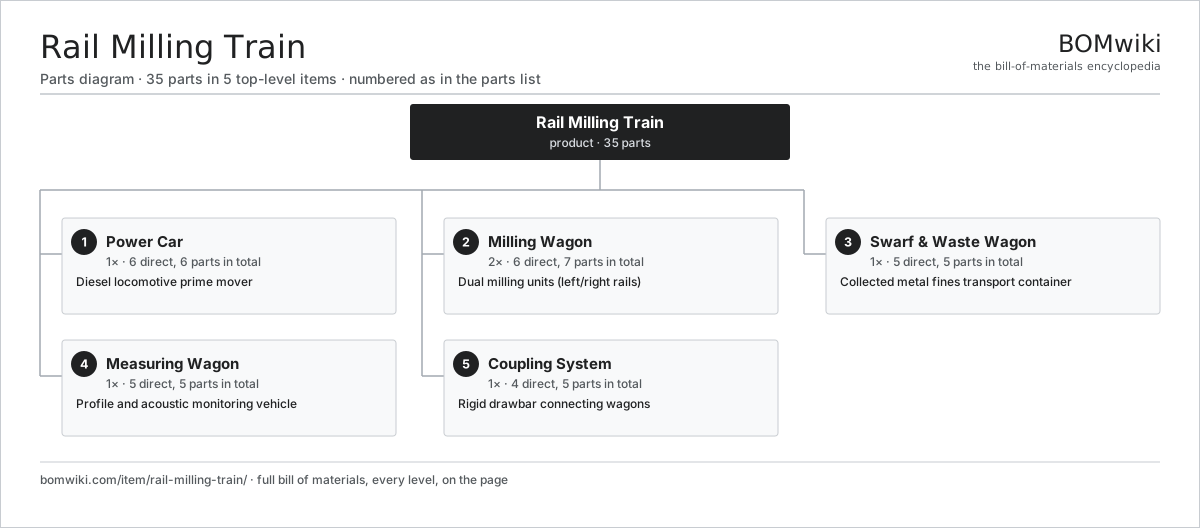
| # | Part | Qty | What it does |
|---|---|---|---|
| 1 | Power Car 6 parts | 1× | Diesel locomotive prime mover |
| 2 | Milling Wagon 6 parts | 2× | Dual milling units (left/right rails) |
| 3 | Swarf & Waste Wagon 5 parts | 1× | Collected metal fines transport container |
| 4 | Measuring Wagon 5 parts | 1× | Profile and acoustic monitoring vehicle |
| 5 | Coupling System 4 parts | 1× | Rigid drawbar connecting wagons |
3D model
No 3D model yet. Have a CAD file of this? Add a 3D model. STL renders right on this page; STEP, FreeCAD, and OpenSCAD sources are welcome too (openly licensed, like all 3D models on BOMwiki).
Build & assembly graph
expand / collapse · shared sub-assemblies converge · links to related products · est. labourTap an assembly to expand/collapse · tap a part to open it · use “Open page” for any node · drag to pan, scroll to zoom.
Bill of materials for Rail Milling Train
5 top-level lines · 31 rows shown · 35 parts total · indented to 3 levels| # | Item / sub-assembly | Part no. | Qty/assy | Ext. qty | Parts | Type |
|---|---|---|---|---|---|---|
| 1 | Power Car 6 parts | rail-milling-train-power-car | 1× | 1 | 6 | assembly |
| 1.1 | Diesel Engine | rail-milling-train-diesel-engine | 1× | 1 | · | part |
| 1.2 | Alternator | rail-milling-train-alternator | 1× | 1 | · | part |
| 1.3 | Traction Converter | rail-milling-train-traction-converter | 1× | 1 | · | part |
| 1.4 | Hydraulic Pump | rail-milling-train-hydraulic-pump | 1× | 1 | · | part |
| 1.5 | Battery Pack | rail-milling-train-battery-pack | 1× | 1 | · | part |
| 1.6 | Control Cabin | rail-milling-train-control-cabin | 1× | 1 | · | part |
| 2 | Milling Wagon 6 parts | rail-milling-train-milling-wagon | 2× | 2 | 7 | assembly |
| 2.1 | Wagon Frame | rail-milling-train-wagon-frame | 1× | 2 | · | part |
| 2.2 | Milling Head | rail-milling-train-milling-head | 1× | 2 | · | part |
| 2.3 | Hydraulic Feed | rail-milling-train-hydraulic-feed | 1× | 2 | · | part |
| 2.4 | Motor Drive | rail-milling-train-motor-drive | 1× | 2 | · | part |
| 2.5 | Debris Collection Hood | rail-milling-train-debris-collection | 1× | 2 | · | part |
| 2.6 | Pressure Sensor | pressure-sensor | 2× | 4 | · | part |
| 3 | Swarf & Waste Wagon 5 parts | rail-milling-train-swarf-wagon | 1× | 1 | 5 | assembly |
| 3.1 | Swarf Hopper | rail-milling-train-swarf-hopper | 1× | 1 | · | part |
| 3.2 | Suction Fan | rail-milling-train-suction-fan | 1× | 1 | · | part |
| 3.3 | Cyclone Separator | rail-milling-train-cyclone-separator | 1× | 1 | · | part |
| 3.4 | Filter Cartridge | rail-milling-train-filter-cartridge | 1× | 1 | · | part |
| 3.5 | Discharge Chute | rail-milling-train-discharge-chute | 1× | 1 | · | part |
| 4 | Measuring Wagon 5 parts | rail-milling-train-measuring-wagon | 1× | 1 | 5 | assembly |
| 4.1 | Laser Profile Sensor | rail-milling-train-laser-profile | 1× | 1 | · | part |
| 4.2 | IMU Array | rail-milling-train-imu-array | 1× | 1 | · | part |
| 4.3 | Acoustic Sensor | rail-milling-train-acoustic-sensor | 1× | 1 | · | part |
| 4.4 | Data Logger | rail-milling-train-data-logger | 1× | 1 | · | part |
| 4.5 | Encoder | encoder | 1× | 1 | · | part |
| 5 | Coupling System 4 parts | rail-milling-train-coupling-system | 1× | 1 | 5 | assembly |
| 5.1 | Drawbar | rail-milling-train-drawbar | 1× | 1 | · | part |
| 5.2 | Coupler Knuckle | rail-milling-train-coupler-knuckle | 2× | 2 | · | part |
| 5.3 | Hydraulic Jumper Hose | rail-milling-train-hydraulic-jumper | 1× | 1 | · | part |
| 5.4 | Electrical Connector | rail-milling-train-electrical-connector | 1× | 1 | · | part |
Something wrong in this list? Report a problem with this BOM.
Related products
same domain, ranked by shared parts Automated People Mover
450 parts · shares 1 with this page
Automated People Mover
450 parts · shares 1 with this page
 Ballast Cleaning Machine
54 parts · shares 1 with this page
Ballast Cleaning Machine
54 parts · shares 1 with this page
 Ballast Tamping Machine
51 parts · shares 1 with this page
Ballast Tamping Machine
51 parts · shares 1 with this page
 Ballast Undercutter
38 parts · shares 1 with this page
Ballast Undercutter
38 parts · shares 1 with this page
 Bus Rapid Transit Vehicle
4,251 parts · shares 1 with this page
Bus Rapid Transit Vehicle
4,251 parts · shares 1 with this page
 Coach Bus
999 parts · shares 1 with this page
Coach Bus
999 parts · shares 1 with this page
Sourcing: possible vendors
Browse the supplier directory → Prices, MOQ, and lead times are algorithmic estimates, not quotes, and not claims about these companies. Company mappings are curated by keyword; est. price band $500k–$60M. How estimates work| Vendor | HQ | Specialty | MOQ | Lead time |
|---|---|---|---|---|
|
🇨🇳CRRC
crrcgc.cc ↗
|
Beijing, CN | Rolling stock & rail systems | made to order | 40–72 wks |
|
🇫🇷Alstom
alstom.com ↗
|
Saint-Ouen, FR | Rail rolling stock | made to order | 40–72 wks |
| mobility.siemens.com ↗ | Munich, DE | Rail systems | made to order | 40–72 wks |
| stadlerrail.com ↗ | Bussnang, CH | Rail rolling stock | made to order | 40–72 wks |
|
🇺🇸Wabtec
wabteccorp.com ↗
|
Pittsburgh, US | Rail equipment | made to order | 40–72 wks |
1,947-word article