Rail Saw
ProductOverview
A rail saw is a field-portable, self-powered cutting tool used by railway maintenance crews to section rail in place without removing it from the track. Anchored in a steel yoke that clamps the rail head and web, the saw carries a high-speed abrasive disc driven by a small gasoline engine; the disc makes a straight plunge cut across the rail cross-section in seconds, producing minimal heat and sparks compared to oxy-acetylene or plasma. The tool is indispensable for rail replacement, accident recovery, and emergency line clearance where disconnecting track sections by hand would be infeasible or slow.
The Gasoline Engine Motor is a rugged air-cooled single-cylinder four-stroke engine (150–250 cc), running lean gasoline mixture for economy and low smoke. The engine drives a Spindle Drive Transmission reduction gear, lowering the crankshaft RPM (typically 3,500) to a safe spindle speed (3,000–6,000 RPM) at the cutting disc. A mechanical Centrifugal Clutch engages automatically at a threshold RPM, so starting the engine does not spin the disc until the engine is warm and running steadily. The Cutting Disc Assembly is a bonded abrasive wheel, corundum or silicon carbide, chosen for rail steel hardness; a fresh disc cuts a rail in 30–60 seconds, creating a precision kerf with minimal burr.
The Rail Clamping Frame is the critical safety system: manual screw clamps grip the rail head and web, locking the rail against the yoke so that cutting forces push radially outward, not axially, preventing chattering. The Main Base Frame mounts the entire assembly on vibration isolators, dampening oscillation as the disc enters the rail. The Directional Guide System system keeps the saw perpendicular to the track, ensuring square cuts. All exposed edges are guarded with the Guard and Safety Assembly, and an emergency dead-man switch cuts ignition if the operator releases the handle.
How it works
Preparation begins with positioning the saw over the cut location (marked beforehand). Crew members loosen the Rail Clamping Frame yoke, rotate or slide it around the rail web, and manually tighten the clamp screws until the rail is immobilized. The saw body is then rotated on the guide wheels until the Abrasive Cutting Disc is aligned perpendicular to the rail head. The operator fills the Fuel Tank and Supply tank with unleaded gasoline, primes the Carburetor (if required), and pulls the starter rope. The Engine Block fires and idles; once warm, the operator slowly increases throttle. At a set engine speed (roughly 60% of maximum), the Centrifugal Clutch engages and the Spindle Drive Transmission transmits power through a V-belt, spinning the disc.
The operator holds both handles of the Guard and Safety Assembly and applies steady downward pressure on the saw body. The disc feeds slowly into the rail, cutting abrasively as the disc circumference speeds past the rail steel at 60–100 m/s. As the cut deepens, the disc reaches the rail bottom; the operator feels a characteristic change in vibration and sound as the disc breaks through. At this moment the cut is complete and the operator releases the throttle, allowing the clutch to disengage and the disc to coast to a stop. Total cutting time is typically 30–90 seconds depending on rail weight (60 vs. 75 kg/m).
Once cooled, the separated rail sections are retrieved and stacked. Crew inspects the cut surface for delamination or spalling (rare with abrasive saws) and marks the ends with paint for identification. The saw is refueled, the clamp is repositioned for the next cut, and the process repeats.
Design considerations
The gasoline engine is chosen for field autonomy: no grid, no compressed-air line, no diesel-injection complexity. Carburetor models (not fuel-injected) tolerate extreme cold and sitting idle for weeks between uses. The Spindle Drive Transmission uses V-belts (not gears) to absorb shock loads, a disc hitting a hard spot in the rail suddenly spikes torque, and a belt slips slightly, protecting the engine and clutch. The Abrasive Cutting Disc is a consumable; typical life is 30–50 rail cuts before diameter loss makes replacement necessary. The Guard and Safety Assembly is extensive because the disc is open-sided and spinning at lethal speed; the shroud covers the exit side but leaves the approach side clear so the operator sees the cut progress.
The Rail Clamping Frame yoke must be manually positioned because different rail profiles (flat-bottom, heavy, light) have different head and web dimensions. A universal clamp yoke with adjustable pads accommodates 40–75 kg/m rail. The Vibration Isolator mounts dampen engine vibration and disc chatter, critical for cut quality and operator fatigue; without isolation, a 90-second cut would be exhausting. Weight is kept to 60–90 kg by using aluminum castings for guards and fuel tank, so crews can reposition the saw between cuts without a mechanical lift, field practicality over precision infrastructure.
Rail Saw parts and their functions
8 top-level parts · 52 parts in total · full bill of materials below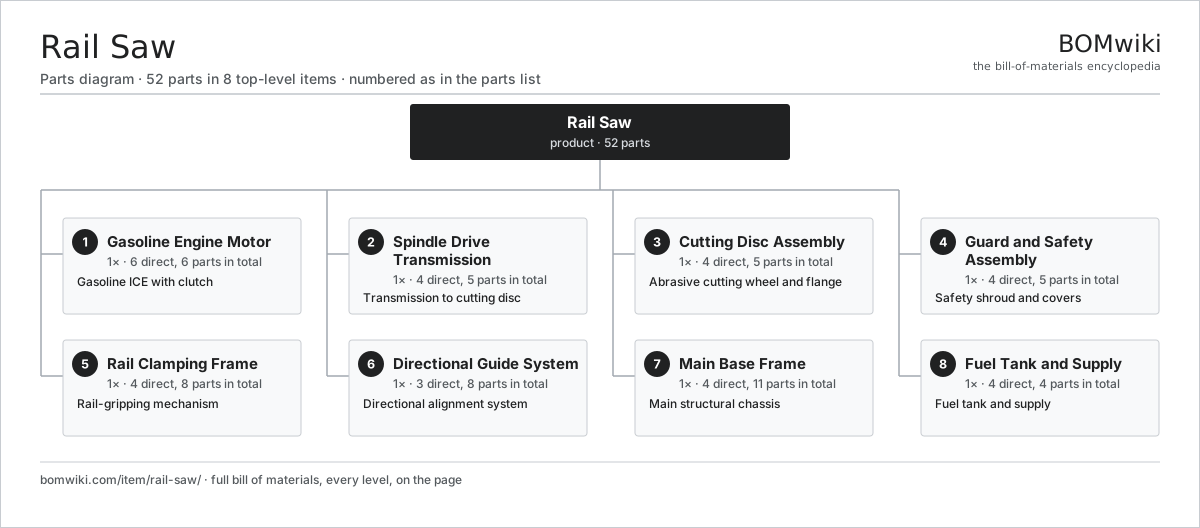
| # | Part | Qty | What it does |
|---|---|---|---|
| 1 | Gasoline Engine Motor 6 parts | 1× | Gasoline ICE with clutch |
| 2 | Spindle Drive Transmission 4 parts | 1× | Transmission to cutting disc |
| 3 | Cutting Disc Assembly 4 parts | 1× | Abrasive cutting wheel and flange |
| 4 | Guard and Safety Assembly 4 parts | 1× | Safety shroud and covers |
| 5 | Rail Clamping Frame 4 parts | 1× | Rail-gripping mechanism |
| 6 | Directional Guide System 3 parts | 1× | Directional alignment system |
| 7 | Main Base Frame 4 parts | 1× | Main structural chassis |
| 8 | Fuel Tank and Supply 4 parts | 1× | Fuel tank and supply |
3D model
No 3D model yet. Have a CAD file of this? Add a 3D model. STL renders right on this page; STEP, FreeCAD, and OpenSCAD sources are welcome too (openly licensed, like all 3D models on BOMwiki).
Build & assembly graph
expand / collapse · shared sub-assemblies converge · links to related products · est. labourTap an assembly to expand/collapse · tap a part to open it · use “Open page” for any node · drag to pan, scroll to zoom.
Bill of materials for Rail Saw
8 top-level lines · 41 rows shown · 52 parts total · indented to 3 levels| # | Item / sub-assembly | Part no. | Qty/assy | Ext. qty | Parts | Type |
|---|---|---|---|---|---|---|
| 1 | Gasoline Engine Motor 6 parts | rail-saw-motor | 1× | 1 | 6 | assembly |
| 1.1 | Engine Block | rail-saw-engine-block | 1× | 1 | · | part |
| 1.2 | Carburetor | rail-saw-carburetor | 1× | 1 | · | part |
| 1.3 | Ignition System | rail-saw-ignition-system | 1× | 1 | · | part |
| 1.4 | Air Filter | rail-saw-air-filter | 1× | 1 | · | part |
| 1.5 | Exhaust Muffler | rail-saw-muffler | 1× | 1 | · | part |
| 1.6 | Centrifugal Clutch | rail-saw-clutch | 1× | 1 | · | part |
| 2 | Spindle Drive Transmission 4 parts | rail-saw-spindle-drive | 1× | 1 | 5 | assembly |
| 2.1 | Drive Belt | rail-saw-drive-belt | 1× | 1 | · | part |
| 2.2 | Spindle Pulley | rail-saw-spindle-pulley | 1× | 1 | · | part |
| 2.3 | Engine Pulley | rail-saw-engine-pulley | 1× | 1 | · | part |
| 2.4 | Spindle Bearing | rail-saw-spindle-bearing | 2× | 2 | · | part |
| 3 | Cutting Disc Assembly 4 parts | rail-saw-disc-assembly | 1× | 1 | 5 | assembly |
| 3.1 | Abrasive Cutting Disc | rail-saw-abrasive-disc | 1× | 1 | · | part |
| 3.2 | Backing Flange | rail-saw-backing-flange | 2× | 2 | · | part |
| 3.3 | Spindle Retention Nut | rail-saw-spindle-nut | 1× | 1 | · | part |
| 3.4 | Spindle Shaft | rail-saw-spindle-shaft | 1× | 1 | · | part |
| 4 | Guard and Safety Assembly 4 parts | rail-saw-guard-assembly | 1× | 1 | 5 | assembly |
| 4.1 | Disc Shroud | rail-saw-disc-shroud | 1× | 1 | · | part |
| 4.2 | Exhaust Heat Shield | rail-saw-exhaust-shield | 1× | 1 | · | part |
| 4.3 | Operator Handle | rail-saw-operator-handle | 2× | 2 | · | part |
| 4.4 | Emergency Stop Switch | rail-saw-emergency-stop | 1× | 1 | · | part |
| 5 | Rail Clamping Frame 4 parts | rail-saw-clamping-frame | 1× | 1 | 8 | assembly |
| 5.1 | Clamp Yoke | rail-saw-clamp-yoke | 1× | 1 | · | part |
| 5.2 | Clamp Pad | rail-saw-clamp-pad | 4× | 4 | · | part |
| 5.3 | Clamp Screw | rail-saw-clamp-screw | 2× | 2 | · | part |
| 5.4 | Clamp Link Arm | rail-saw-clamp-link | 1× | 1 | · | part |
| 6 | Directional Guide System 3 parts | rail-saw-guide-rail | 1× | 1 | 8 | assembly |
| 6.1 | Guide Wheel | rail-saw-guide-wheel | 2× | 2 | · | part |
| 6.2 | Guide Bracket | rail-saw-guide-bracket | 2× | 2 | · | part |
| 6.3 | Guide Bearing | rail-saw-wheel-bearing | 4× | 4 | · | part |
| 7 | Main Base Frame 4 parts | rail-saw-base-frame | 1× | 1 | 11 | assembly |
| 7.1 | Frame Beam | rail-saw-frame-beam | 2× | 2 | · | part |
| 7.2 | Frame Brace | rail-saw-frame-brace | 4× | 4 | · | part |
| 7.3 | Vibration Isolator | rail-saw-vibration-isolator | 4× | 4 | · | part |
| 7.4 | Fastener Set | fastener-set | 1× | 1 | · | part |
| 8 | Fuel Tank and Supply 4 parts | rail-saw-fuel-system | 1× | 1 | 4 | assembly |
| 8.1 | Fuel Tank | rail-saw-fuel-tank | 1× | 1 | · | part |
| 8.2 | Fuel Line | rail-saw-fuel-line | 1× | 1 | · | part |
| 8.3 | Fuel Filter | rail-saw-fuel-filter | 1× | 1 | · | part |
| 8.4 | Fuel Valve | rail-saw-fuel-valve | 1× | 1 | · | part |
Something wrong in this list? Report a problem with this BOM.
Sourcing: possible vendors
Browse the supplier directory → Prices, MOQ, and lead times are algorithmic estimates, not quotes, and not claims about these companies. Company mappings are curated by keyword; est. price band $500k–$60M. How estimates work| Vendor | HQ | Specialty | MOQ | Lead time |
|---|---|---|---|---|
|
🇨🇳CRRC
crrcgc.cc ↗
|
Beijing, CN | Rolling stock & rail systems | made to order | 40–72 wks |
|
🇫🇷Alstom
alstom.com ↗
|
Saint-Ouen, FR | Rail rolling stock | made to order | 40–72 wks |
| mobility.siemens.com ↗ | Munich, DE | Rail systems | made to order | 40–72 wks |
| stadlerrail.com ↗ | Bussnang, CH | Rail rolling stock | made to order | 40–72 wks |
|
🇺🇸Wabtec
wabteccorp.com ↗
|
Pittsburgh, US | Rail equipment | made to order | 40–72 wks |
840-word article