Railway Lifting Jack Set
ProductOverview
A railway lifting jack set is a stationary or pit-mounted apparatus for safely raising an entire locomotive or freight car vertically to provide clearance for wheel removal, bearing inspection, and axle-related maintenance. Unlike simple hydraulic jacks which require continuous pressure to hold a load, railway jacks employ mechanical ball-screw drives with self-locking characteristics: the load is held passively even if power is lost, a critical safety feature when working under a several-hundred-tonne vehicle. A full set consists of four independent Screw Jack Column columns (one under each corner of the locomotive/car frame), synchronized by an Automatic Leveling Governor governor system that ensures all four rise at virtually identical rates, critical because even a 5–10 mm height difference across a locomotive will tilt it, straining couplers and draft gears and risking catastrophic collapse.
The Motor and Drive Shaft System is a single electric motor turning a common Main Drive Shaft via Universal Joint couplings; this shaft has four Drive Socket connection points driving the four jacks. The Automatic Leveling Governor employs either mechanical Governor Logic (rotating-ball governors, a 19th-century design still in use) or modern Individual Clutch packs with Load Cell Sensor feedback to electronic logic, ensuring that if one jack encounters a slightly higher load (e.g., one corner sits on higher ballast), the controller automatically slips its clutch, allowing that jack to move more freely to catch up. The Base Carriage Frame and Locators provides the structural base, with Locating Pin Set ensuring the locomotive is positioned repeatably for every lift.
How it works
A locomotive arrives at the maintenance pit on its own power and comes to a stop over the jack set. Crew members position Locating Pin Set (adjustable stops) to bracket the locomotive frame, and then hydraulic or gravity pushes the locomotive down slightly to rest on the pins, which now bear 10–20% of the load while the wheels remain on the track. This precaution prevents a runaway if a jack fails mid-lift.
The operator, at the Operator Control and Monitoring Panel located at pit edge, presses UP and sets the speed dial to 30 mm/min (a safe speed for such mass). The VFD Motor Drive ramps the Electric Motor from 0 to roughly 300 RPM. The Main Drive Shaft spins, and all four Drive Socket drive the Ball-Screw Drive in each Screw Jack Column simultaneously.
As the screw-nuts rotate, they drive the Upper Piston Sleeve (piston) upward within the Lower Outer Column (outer cylinder). The Load Pad at the top of each piston presses upward against the locomotive frame. Simultaneously, the Load Cell Sensor under each jack transmits a load signal to the Governor Logic. If one jack reads 48 tonnes and another reads 50 tonnes, the governor immediately applies extra drag to the slower jack or reduces drag on the faster one, ensuring they stay in step.
Over 3–5 minutes, the locomotive rises 2.5 meters, clearing all wheels from the track. The Height Display shows "2500 mm". The operator releases UP; the soft-start Soft Starter decelerates the motor smoothly to zero. The Ball-Screw Drive is self-locking (a property of high-ratio ball-screws: friction prevents backslip when torque is removed), so the locomotive remains at height indefinitely with zero power draw. Maintenance crews now freely remove wheels, grease journal bearings, and replace worn pads or springs.
When maintenance is complete, the operator presses DOWN, and the motor reverses. The jacks lower at the same synchronized speed (3–5 minutes for full descent). Once wheels touch rail, the operator reduces speed to 5 mm/min for the final 100 mm and then stops. Crew removes the Locating Pin Set, the locomotive driver carefully advances on power, and the jacks return to the neutral (compressed) position ready for the next lift.
Design considerations
The Ball-Screw Drive is the critical component: a 16 mm pitch ball-screw at 300 RPM delivers 16 mm × 300 ÷ 60 = 80 mm/sec = 4.8 m/min linear speed, appropriate for a 200-tonne load lift (too fast and inertia becomes unmanageable; too slow and maintenance cycles stretch). Self-locking is inherent in the screw geometry when the lead angle is less than the friction angle, typical ball-screws with ~5° helix angle are naturally self-locking and resist backslip even under load and vibration.
The Automatic Leveling Governor governor is the most sophisticated element. Mechanical governors (19th-century design, still widely used) employ rotating balls on an internal spindle; as rotation speed changes, centrifugal force moves balls outward, which mechanically engage or disengage clutch discs, proportionally controlling each jack's speed based on the common motor speed. Modern alternatives use Load Cell Sensor feedback: the Governor Logic PLC compares load and height differences between jacks and electronically modulates Individual Clutch slip, achieving ±1 mm synchronization vs. ±2–3 mm for mechanical governors. Electronic systems cost more but allow programmable ramp profiles (lift slower at the start to reduce shock, faster in the middle, slower at the end) which reduces wear on the locomotive draft gear.
The Motor and Drive Shaft System is always powered by a common shaft because independent motors would require expensive electronic synchronization; a single motor and clever mechanical governors or clutch packs are simpler and more robust. Soft-starting via Soft Starter or VFD ramps motor current from 0 to full over 5–10 seconds, preventing mechanical shock to the drive shaft and universal joints.
Weight distribution checks are mandatory: the Load Display shows each jack's load. If one jack reads 70 tonnes and another reads 30 tonnes, the locomotive is off-center or rocking; the operator must stop, lower, reposition the locating pins, and re-lift. Load balancing ensures even stress on the draft gear and allows safe extension to the maximum rated height.
Railway Lifting Jack Set parts and their functions
6 top-level parts · 74 parts in total · full bill of materials below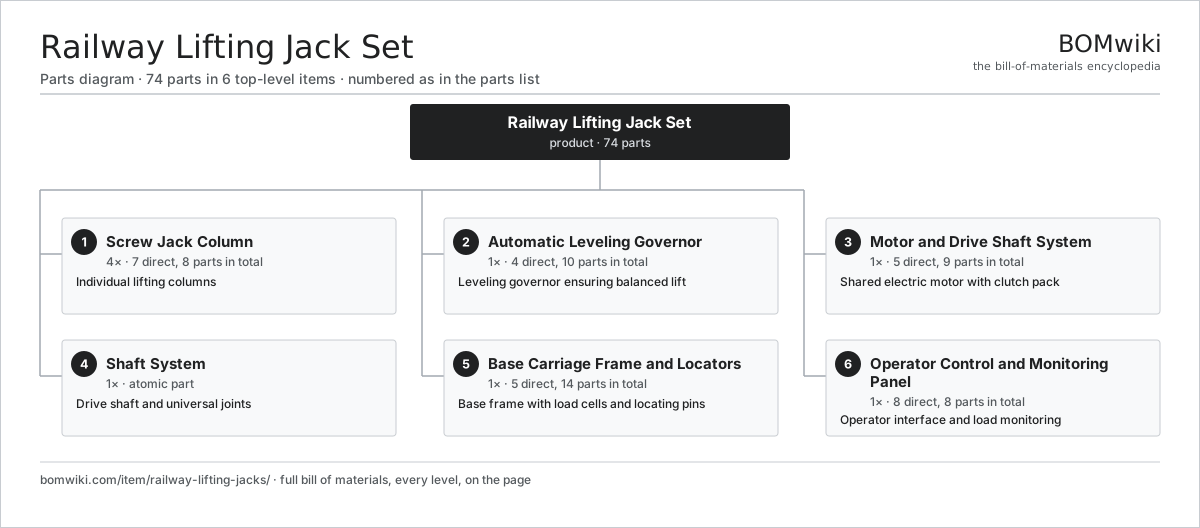
| # | Part | Qty | What it does |
|---|---|---|---|
| 1 | Screw Jack Column 7 parts | 4× | Individual lifting columns |
| 2 | Automatic Leveling Governor 4 parts | 1× | Leveling governor ensuring balanced lift |
| 3 | Motor and Drive Shaft System 5 parts | 1× | Shared electric motor with clutch pack |
| 4 | Shaft System | 1× | Drive shaft and universal joints |
| 5 | Base Carriage Frame and Locators 5 parts | 1× | Base frame with load cells and locating pins |
| 6 | Operator Control and Monitoring Panel 8 parts | 1× | Operator interface and load monitoring |
3D model
No 3D model yet. Have a CAD file of this? Add a 3D model. STL renders right on this page; STEP, FreeCAD, and OpenSCAD sources are welcome too (openly licensed, like all 3D models on BOMwiki).
Build & assembly graph
expand / collapse · shared sub-assemblies converge · links to related products · est. labourTap an assembly to expand/collapse · tap a part to open it · use “Open page” for any node · drag to pan, scroll to zoom.
Bill of materials for Railway Lifting Jack Set
6 top-level lines · 35 rows shown · 74 parts total · indented to 3 levels| # | Item / sub-assembly | Part no. | Qty/assy | Ext. qty | Parts | Type |
|---|---|---|---|---|---|---|
| 1 | Screw Jack Column 7 parts | railway-lifting-jacks-screw-jack | 4× | 4 | 8 | assembly |
| 1.1 | Ball-Screw Drive | railway-lifting-jacks-ball-screw | 1× | 4 | · | part |
| 1.2 | Ball-Screw Nut | railway-lifting-jacks-screw-nut | 1× | 4 | · | part |
| 1.3 | Drive Socket | railway-lifting-jacks-drive-socket | 1× | 4 | · | part |
| 1.4 | Lower Outer Column | railway-lifting-jacks-lower-sleeve | 1× | 4 | · | part |
| 1.5 | Upper Piston Sleeve | railway-lifting-jacks-upper-sleeve | 1× | 4 | · | part |
| 1.6 | Column Guidance Bearing | railway-lifting-jacks-column-bearing | 2× | 8 | · | part |
| 1.7 | Load Pad | railway-lifting-jacks-load-pad | 1× | 4 | · | part |
| 2 | Automatic Leveling Governor 4 parts | railway-lifting-jacks-synchronization-control | 1× | 1 | 10 | assembly |
| 2.1 | Load Cell Sensor | railway-lifting-jacks-load-cell-sensor | 4× | 4 | · | part |
| 2.2 | Height Sensor | railway-lifting-jacks-height-sensor | 1× | 1 | · | part |
| 2.3 | Governor Logic | railway-lifting-jacks-governor-logic | 1× | 1 | · | part |
| 2.4 | Individual Clutch | railway-lifting-jacks-individual-clutch | 4× | 4 | · | part |
| 3 | Motor and Drive Shaft System 5 parts | railway-lifting-jacks-motor-drive | 1× | 1 | 9 | assembly |
| 3.1 | Electric Motor | railway-lifting-jacks-motor-unit | 1× | 1 | · | part |
| 3.2 | Flex Coupling | railway-lifting-jacks-motor-coupling | 1× | 1 | · | part |
| 3.3 | Main Drive Shaft | railway-lifting-jacks-main-drive-shaft | 1× | 1 | · | part |
| 3.4 | Universal Joint | railway-lifting-jacks-universal-joint | 2× | 2 | · | part |
| 3.5 | Shaft Bearing | railway-lifting-jacks-shaft-bearing | 4× | 4 | · | part |
| 4 | Shaft System | railway-lifting-jacks-shaft-system | 1× | 1 | · | part |
| 5 | Base Carriage Frame and Locators 5 parts | railway-lifting-jacks-carriage-frame | 1× | 1 | 14 | assembly |
| 5.1 | Base Frame | railway-lifting-jacks-frame-base | 1× | 1 | · | part |
| 5.2 | Jack Mounting Pad | railway-lifting-jacks-jack-pad | 4× | 4 | · | part |
| 5.3 | Locating Pin Set | railway-lifting-jacks-locating-pin-set | 1× | 1 | · | part |
| 5.4 | Frame Brace | railway-lifting-jacks-frame-bracing | 4× | 4 | · | part |
| 5.5 | Load Cell Bracket | railway-lifting-jacks-load-cell-mount | 4× | 4 | · | part |
| 6 | Operator Control and Monitoring Panel 8 parts | railway-lifting-jacks-control-panel | 1× | 1 | 8 | assembly |
| 6.1 | Control Pedestal | railway-lifting-jacks-control-pedestal | 1× | 1 | · | part |
| 6.2 | Up/Down Switch | railway-lifting-jacks-up-down-switch | 1× | 1 | · | part |
| 6.3 | Speed Potentiometer | railway-lifting-jacks-speed-control | 1× | 1 | · | part |
| 6.4 | Load Display | railway-lifting-jacks-load-display | 1× | 1 | · | part |
| 6.5 | Height Display | railway-lifting-jacks-height-display | 1× | 1 | · | part |
| 6.6 | Emergency Stop | railway-lifting-jacks-emergency-stop | 1× | 1 | · | part |
| 6.7 | VFD Motor Drive | railway-lifting-jacks-vfd-controller | 1× | 1 | · | part |
| 6.8 | Soft Starter | railway-lifting-jacks-soft-start | 1× | 1 | · | part |
Something wrong in this list? Report a problem with this BOM.
Sourcing: possible vendors
Browse the supplier directory → Prices, MOQ, and lead times are algorithmic estimates, not quotes, and not claims about these companies. Company mappings are curated by keyword; est. price band $500k–$60M. How estimates work| Vendor | HQ | Specialty | MOQ | Lead time |
|---|---|---|---|---|
|
🇨🇳CRRC
crrcgc.cc ↗
|
Beijing, CN | Rolling stock & rail systems | made to order | 40–72 wks |
|
🇫🇷Alstom
alstom.com ↗
|
Saint-Ouen, FR | Rail rolling stock | made to order | 40–72 wks |
| mobility.siemens.com ↗ | Munich, DE | Rail systems | made to order | 40–72 wks |
| stadlerrail.com ↗ | Bussnang, CH | Rail rolling stock | made to order | 40–72 wks |
|
🇺🇸Wabtec
wabteccorp.com ↗
|
Pittsburgh, US | Rail equipment | made to order | 40–72 wks |
1,069-word article