Raise Boring Machine
ProductOverview
A raise boring machine (RBM) is a specialized vertical drilling rig that excavates raises (ore passes, ventilation shafts) from lower working levels upward through staged drilling and reaming. The machine drills a small pilot hole from the bottom level, then pulls a reaming head upward through the pilot to enlarge it to final diameter in a single pass. Raise borers dominate modern mining because they eliminate dangerous hand-mucking in raises and deliver finished shafts with minimal fragmentation and ground disturbance.
Traditional raise sinking via drop-blast (creating a pile of broken ore below that falls to lower level) is slow, dangerous, and leaves poor collar conditions. Raise borers complete shafts in weeks rather than months and produce vertical openings suitable for direct installation of ore passes, conveyor systems, and ventilation fans.
Two-Stage Drilling Process
Stage 1: Pilot Hole (bottom-up): The Rotary Head and Drive grips the Kelly Drive Rod (top drill section with square key interface) and rotates at 30–80 rpm. The Pilot Hole Bit, typically a 200–400 mm diameter core sampler or chisel bit, is fed downward by the Feed Thrust Cylinder at 500–3000 kN thrust. The pilot hole advances at 2–10 m/hour depending on rock strength and drill string compliance.
Drill Pipe Extension Sections are added as the pilot hole deepens. Drill string torque is applied via a Torque Reaction Arm and proportional Torque Control Cylinder, typically 500–2000 kNm for 3 m diameter raises in hard rock. The drill string is suspended from the Spindle Shaft on tapered-roller Spindle Bearing Assembly, which carry both thrust and rotary loads.
Once the pilot hole reaches the upper level (detected by sudden torque drop or breakthrough indication), the rig transitions to reaming.
Stage 2: Reaming (top-down): The rig is repositioned above the raise collar. A Reaming Head Assembly (expandable or fixed) is pushed down through the pilot hole. The Reaming Tool Shell contains carbide inserts arranged in spiral rows at increasing diameters. As the head moves upward through the hole, Reaming Shell Expansion Mechanism hydraulic pressure (or mechanical linkage) gradually opens the shell, bringing outer cutters into contact with the rock.
The reaming head advances upward at 1–5 m/hour, continuously enlarging the hole diameter. Feed force (thrust) is reduced compared to pilot drilling, typically 300–1000 kN, because the reaming cutters work in relief and require less force-to-fracture ratio. Torque increases due to larger cutting diameter, reaching 1500–2000 kNm.
Operational Constraints
Pilot Hole Straightness: A 10° deviation in a 200 m raise creates 35 m of lateral offset at the upper end, unacceptable. Drill-string stiffness is maximized through optimal rod wall-thickness and minimize unsupported span. Modern rigs employ Linear Guide Rails on the mast that keep the Spindle Traveling Carriage vertical to within 1°.
Thread Connections: Drill rod connections (typically pin-and-box or API threads) must be torque-controlled and inspected regularly. Over-torque causes thread stripping; under-torque allows slipping. Typical thread connection torque is 50–150 kNm depending on rod diameter. A single failed connection mid-drill requires pulling 300+ rods (2–3 days lost time).
Rock Quality and Hole Stability: Hole collapse in weak ground (poor RQD, clay zones) can trap the drill string. Probe drilling (small test holes ahead) or pilot-hole camera inspection identifies problem zones for contingency support (resin anchors, casing).
Reaming Tool Selection
Two main reaming approaches:
Fixed (non-expanding) reaming head: All cutters are active throughout the upward pass. Simpler, no hydraulic complexity, but requires precise pilot-hole centering. Used in hard, stable rock.
Expanding (hydraulic or mechanical) reaming head Reaming Shell Expansion Mechanism: Outer cutters are closed during descent and opened progressively during ascent. More forgiving of pilot-hole drift, but adds complexity and requires controlled reaming-shell opening pressure (20–40 bar differential).
Most raises >2 m diameter use expanding heads for safety and flexibility.
Typical Timeline and Costs
A 300 m diameter × 3 m raise:
| Phase | Duration | Cost |
|---|---|---|
| Rig mobilization & setup | 5–7 days | $50k–$100k |
| Pilot hole drilling | 30–50 days | $150k–$250k |
| Thread maintenance & rod pulls | 10–15 days | $30k–$60k |
| Reaming | 20–30 days | $100k–$150k |
| Demobilization | 3–5 days | $25k–$50k |
| Total | 70–110 days | $400k–$700k |
Cost per meter: $400–$700/m, depending on rock strength and raise diameter.
Maintenance and Wear
Drill Pipe:
- Thread connections inspected every 500 m drilled; worn threads replaced
- Pipe body wear from bit eccentric motion; 10–20 mm erosion typical over project life
- Replacement cost: $500–$1000 per rod (many rods = major expense)
Spindle Bearings Spindle Bearing Assembly:
- Tapered roller bearings support 1–2 million cycles per project
- Preload adjusted annually; typical bearing life 5–10 years
- Bearing replacement: $20k–$50k for spindle-down work
Reaming Inserts Reaming Carbide Cutters:
- Tungsten-carbide insert wear 5–10 mm per raise; replaced every 2–3 raises
- Cost: $15k–$40k per tool set
Hydraulic System:
- Filters changed every 500 operating hours
- Fluid analysis sampled monthly to detect contamination
- Seal replacement during fluid change cycles
Safety Considerations
- Drill-string failure: catastrophic if chuck release occurs during rotation; safety pins and redundant holding mechanisms required
- Torque reaction: reaction arm swing hazard if control pressure lost; emergency pressure relief prevents uncontrolled motion
- High-pressure hoses: 280 bar hydraulic lines subject to failure; annual non-destructive test and hose age replacement
- Confined space: pilot and reaming holes are entries for inspection; respiratory protection and rescue equipment mandatory
Advanced Features in Modern RBMs
- Torque limiting: proportional hydraulic torque control within ±50 kNm to prevent string breakage
- Automated rod handling: powered rod rack and chasing gear reduce manual labor and thread-wear risk
- Laser/gyro navigation: navigation-grade inertial measurement or gyroscope feedback detects drift in real-time; warning alerts for >5° deviation
- Pressure-monitoring telemetry: wireless data logging of feed, torque, and rotary pressures for performance trending and failure prediction
Raise Boring Machine parts and their functions
7 top-level parts · 39 parts in total · full bill of materials below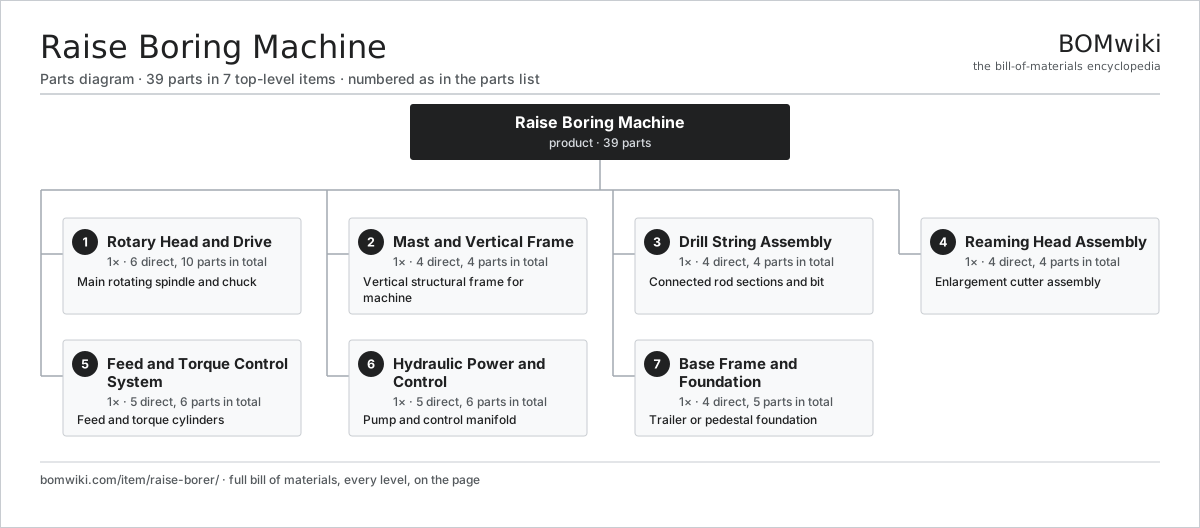
| # | Part | Qty | What it does |
|---|---|---|---|
| 1 | Rotary Head and Drive 6 parts | 1× | Main rotating spindle and chuck |
| 2 | Mast and Vertical Frame 4 parts | 1× | Vertical structural frame for machine |
| 3 | Drill String Assembly 4 parts | 1× | Connected rod sections and bit |
| 4 | Reaming Head Assembly 4 parts | 1× | Enlargement cutter assembly |
| 5 | Feed and Torque Control System 5 parts | 1× | Feed and torque cylinders |
| 6 | Hydraulic Power and Control 5 parts | 1× | Pump and control manifold |
| 7 | Base Frame and Foundation 4 parts | 1× | Trailer or pedestal foundation |
3D model
No 3D model yet. Have a CAD file of this? Add a 3D model. STL renders right on this page; STEP, FreeCAD, and OpenSCAD sources are welcome too (openly licensed, like all 3D models on BOMwiki).
Build & assembly graph
expand / collapse · shared sub-assemblies converge · links to related products · est. labourTap an assembly to expand/collapse · tap a part to open it · use “Open page” for any node · drag to pan, scroll to zoom.
Bill of materials for Raise Boring Machine
7 top-level lines · 39 rows shown · 39 parts total · indented to 3 levels| # | Item / sub-assembly | Part no. | Qty/assy | Ext. qty | Parts | Type |
|---|---|---|---|---|---|---|
| 1 | Rotary Head and Drive 6 parts | raise-borer-rotary-head | 1× | 1 | 10 | assembly |
| 1.1 | Spindle Shaft | raise-borer-spindle-shaft | 1× | 1 | · | part |
| 1.2 | Spindle Bearing Assembly | raise-borer-spindle-bearings | 1× | 1 | · | part |
| 1.3 | Drive Chuck | raise-borer-chuck-body | 1× | 1 | · | part |
| 1.4 | Spindle Drive Motor | raise-borer-drive-motor | 1× | 1 | · | part |
| 1.5 | Ball Bearing | ball-bearing | 4× | 4 | · | part |
| 1.6 | Oil Seal | oil-seal | 2× | 2 | · | part |
| 2 | Mast and Vertical Frame 4 parts | raise-borer-mast-tower | 1× | 1 | 4 | assembly |
| 2.1 | Main Vertical Mast | raise-borer-main-mast | 1× | 1 | · | part |
| 2.2 | Cross-Bracing Members | raise-borer-side-braces | 1× | 1 | · | part |
| 2.3 | Spindle Traveling Carriage | raise-borer-spindle-carriage | 1× | 1 | · | part |
| 2.4 | Linear Guide Rails | raise-borer-guide-rails | 1× | 1 | · | part |
| 3 | Drill String Assembly 4 parts | raise-borer-drill-string | 1× | 1 | 4 | assembly |
| 3.1 | Kelly Drive Rod | raise-borer-kelly-rod | 1× | 1 | · | part |
| 3.2 | Drill Pipe Extension Sections | raise-borer-extension-rods | 1× | 1 | · | part |
| 3.3 | Pilot Hole Bit | raise-borer-pilot-bit | 1× | 1 | · | part |
| 3.4 | Drill Pipe Protector Sleeve | raise-borer-rod-protector | 1× | 1 | · | part |
| 4 | Reaming Head Assembly 4 parts | raise-borer-reaming-head | 1× | 1 | 4 | assembly |
| 4.1 | Reaming Tool Shell | raise-borer-reaming-shell | 1× | 1 | · | part |
| 4.2 | Reaming Carbide Cutters | raise-borer-reaming-cutters | 1× | 1 | · | part |
| 4.3 | Reaming Shell Expansion Mechanism | raise-borer-reaming-expansion | 1× | 1 | · | part |
| 4.4 | Pressure Sensor | pressure-sensor | 1× | 1 | · | part |
| 5 | Feed and Torque Control System 5 parts | raise-borer-thrust-system | 1× | 1 | 6 | assembly |
| 5.1 | Feed Thrust Cylinder | raise-borer-feed-cylinder | 1× | 1 | · | part |
| 5.2 | Torque Reaction Arm | raise-borer-torque-arm | 1× | 1 | · | part |
| 5.3 | Torque Control Cylinder | raise-borer-torque-cylinder | 1× | 1 | · | part |
| 5.4 | Rod Break-Out Wrench | raise-borer-break-out-wrench | 1× | 1 | · | part |
| 5.5 | Pressure Sensor | pressure-sensor | 2× | 2 | · | part |
| 6 | Hydraulic Power and Control 5 parts | raise-borer-hydraulic-power | 1× | 1 | 6 | assembly |
| 6.1 | Main Hydraulic Pump | raise-borer-pump | 1× | 1 | · | part |
| 6.2 | Pump Prime Mover | raise-borer-pump-motor | 1× | 1 | · | part |
| 6.3 | Proportional Valve Manifold | raise-borer-valve-block | 1× | 1 | · | part |
| 6.4 | Pressure Accumulator | raise-borer-accumulator | 1× | 1 | · | part |
| 6.5 | Pressure Sensor | pressure-sensor | 2× | 2 | · | part |
| 7 | Base Frame and Foundation 4 parts | raise-borer-base-frame | 1× | 1 | 5 | assembly |
| 7.1 | Base Welded Steel Frame | raise-borer-base-structure | 1× | 1 | · | part |
| 7.2 | Hydraulic Leveling Jacks | raise-borer-leveling-jacks | 1× | 1 | · | part |
| 7.3 | Mechanical Anchoring System | raise-borer-anchor-points | 1× | 1 | · | part |
| 7.4 | Fastener Set | fastener-set | 2× | 2 | · | part |
Something wrong in this list? Report a problem with this BOM.
Related products
same domain, ranked by shared parts All-Terrain Mobile Crane
594 parts · shares 1 with this page
All-Terrain Mobile Crane
594 parts · shares 1 with this page
 Articulated Dump Truck
128 parts · shares 1 with this page
Articulated Dump Truck
128 parts · shares 1 with this page
 Articulated Haul Truck
128 parts · shares 1 with this page
Articulated Haul Truck
128 parts · shares 1 with this page
 Articulating Boom Lift
120 parts · shares 1 with this page
Articulating Boom Lift
120 parts · shares 1 with this page
 Asphalt Batch Plant
160 parts · shares 1 with this page
Asphalt Batch Plant
160 parts · shares 1 with this page
 Asphalt Distributor Truck
113 parts · shares 1 with this page
Asphalt Distributor Truck
113 parts · shares 1 with this page
Sourcing: possible vendors
Browse the supplier directory → Prices, MOQ, and lead times are algorithmic estimates, not quotes, and not claims about these companies. Company mappings are curated by keyword; est. price band $15k–$2M. How estimates work| Vendor | HQ | Specialty | MOQ | Lead time |
|---|---|---|---|---|
| caterpillar.com ↗ | Irving, US | Construction & mining equipment | made to order | 16–28 wks |
|
🇯🇵Komatsu
komatsu.com ↗
|
Tokyo, JP | Construction & mining equipment | made to order | 16–28 wks |
|
🇸🇪Volvo CE
volvoce.com ↗
|
Gothenburg, SE | Construction equipment | made to order | 16–28 wks |
|
🇨🇭Liebherr
liebherr.com ↗
|
Bulle, CH | Cranes & heavy equipment | made to order | 16–28 wks |
|
🇨🇳XCMG
xcmg.com ↗
|
Xuzhou, CN | Construction machinery | made to order | 16–28 wks |
1,003-word article