Raising Machine
ProductOverview
A raising machine (also called a napping or brushing machine) lifts and teases fiber tips from fabric surface, creating soft, plush napped textures. This finishing process is essential for creating flannel, fleece, velveteen, corduroy, and other brushed fabrics. The machine uses multiple wire-covered cylinders rotating at high speed against the fabric surface. Fibers catch on the wire and are lifted; counterpile cylinders then lay fibers in a consistent direction. The result is a uniform pile (raised fiber surface) enhancing softness, warmth, and visual appeal.
Raising is distinct from knapping (which uses felting) and pile weaving (where pile is woven in). Raised fabrics are produced from regular woven or knit constructions and can be made from almost any fiber.
How It Works
Fabric from the unwind stand advances through feed guide rollers at constant speed (50–150 m/minute depending on fabric weight). The fabric passes under the first pile raising cylinder, which rotates at 300–1000 rpm with the fabric moving slower, creating relative motion. The cylinder's surface is covered with carding wire (short, barbed wire woven into fabric covering the cylinder). As the wire-covered cylinder rotates against the fabric, wire teeth catch protruding fiber ends and lift them away from the yarn surface.
The lifted fibers create a temporary raised pile (standing perpendicular to the fabric). A second pile raising cylinder increases the raising effect. For heavy napping (flannels, fleece), a third optional cylinder is sometimes added.
The counterpile cylinders, rotating in the opposite direction, then comb the raised fibers and lay them uniformly in one direction. This creates a smooth, directional nap (like petting an animal in one direction). The large tension drum maintains constant fabric tension throughout, preventing stretching or distortion.
Finally, the raised fabric is rewound onto the output roll. The finished fabric has a soft surface with fibers lying parallel, creating a brushed appearance and plush hand-feel.
Wire Coverage and Fiber Lifting
The raising cylinder is wrapped with carded wire (typically cotton linter covered with short steel or brass wire barbs). Wire density (number of wire tufts per square inch) and wire height (length of wire protrusion) determine raising intensity.
Light raising: Sparse wire, short-length wire removes only loose fiber ends. Heavy raising: Dense wire, long-length wire teases out more fiber.
The wire mechanism works because fibers projecting above the yarn surface catch the wire teeth; well-settled fibers below the surface are not lifted. Proper yarn structure (tight, settled) resists over-raising and fiber loss.
Counterpile Action
Without counterpile cylinders, raised fibers stick up in random directions (popcorn effect). Counterpile cylinders comb and align fibers parallel to fabric length. Counterpile wire is typically lighter and finer than pile wire, serving to smooth rather than lift. Counterpile rotation direction is opposite to pile cylinders: if pile cylinder rotates forward with the fabric, counterpile rotates backward, laying fibers down.
The angle of pile and counterpile cylinders, their relative speeds, and the number of counterpile passes determine final nap uniformity and direction.
Tension Control
The tension drum is critical. Raising creates friction and can cause fabric distortion. Constant tension (typically 20–100 kg depending on width and fabric) prevents:
- Wrinkling (insufficient tension)
- Stretching (excessive tension)
- Uneven raising (varying tension)
The tension adjustment mechanism allows operators to set tension per fabric type. Heavy fabrics need higher tension; delicate fabrics need gentle tension.
Fabric Types and Raising Effects
Different fabrics produce different raising results:
- Flannel: Light fabric (120–200 g/m²) raised to create soft feel; fibers come from staple yarn nubs.
- Fleece: Synthetic pile fabric with fibers extensively raised to create fuzzy, insulating layer.
- Corduroy: Pile weave fabric; raising enhances and unifies pile height.
- Velveteen: Woven pile fabric raised for uniform appearance.
- Sueded fabric: Extensive raising creating suede-like feel (intentional fiber loss).
Over-raising causes excessive fiber loss and strength reduction. Fabric becomes weak and pills easily. Under-raising leaves insufficient nap, defeating the purpose.
Speed and Intensity
Production speed inversely affects raising intensity. At 150 m/minute, fabric spends only 1–2 seconds under the raising cylinders; fewer fibers are lifted. At 50 m/minute, fibers have 5–6 seconds of contact, allowing deeper raising.
Raising cylinder speed also affects intensity. Higher cylinder speeds (800–1000 rpm) create more aggressive wire action; lower speeds (300–500 rpm) produce gentler effects. Operators adjust both fabric speed and cylinder speed to achieve desired nap depth.
Fiber Loss and Sustainability
Raising inherently removes some fiber from the fabric; raising dust (loose fibers collected during the process) can be 5–10% of fabric weight for heavy raising. The dust is typically landfilled or recycled as stuffing.
Modern mills are adopting gentler raising methods (slower speeds, lower wire density) to reduce fiber loss while maintaining acceptable nap appearance. Some manufacturers use enzymatic or thermal methods (not purely mechanical) to raise fibers more gently.
Integration in Finishing Lines
Raising is one step in a multi-step finishing sequence. Typical order:
- Singeing: Removing surface fuzz.
- Scouring: Washing to remove oils and impurities.
- Bleaching (if needed): Whitening the fiber.
- Raising: This machine, napping the surface.
- Shearing (optional): Trimming raised fibers to uniform height.
- Dyeing: Color application (often post-raising to avoid uneven dyeing).
- Calendering (optional): Heat and pressure flattening and finishing.
Some mills do raising before dyeing; others after. Pre-raising dyeing allows dye to penetrate all fibers uniformly. Post-raising dyeing preserves raised appearance in the final product.
Variants
- Wire-covered rollers: Standard configuration (described above).
- Teasing machine: Lighter wire density for gentler raising of delicate fabrics.
- Felting machine: Using needle felting instead of wire for nonwoven fabrics.
- Brush raising: Using synthetic bristles instead of wire for certain fibers (less harsh).
- Shearing-raising combination: Machines that raise and then shear (trim) fibers to uniform height in one pass.
Most traditional mills use wire-covered raising. Newer machines incorporate controlled heating and lower speeds for improved sustainability.
Raising Machine parts and their functions
8 top-level parts · 73 parts in total · full bill of materials below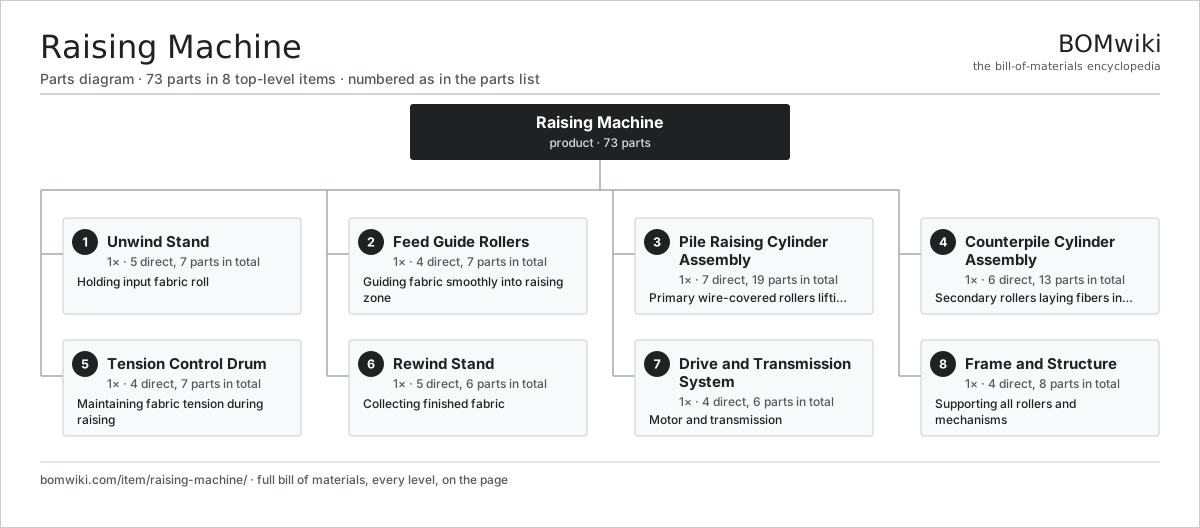
| # | Part | Qty | What it does |
|---|---|---|---|
| 1 | Unwind Stand 5 parts | 1× | Holding input fabric roll |
| 2 | Feed Guide Rollers 4 parts | 1× | Guiding fabric smoothly into raising zone |
| 3 | Pile Raising Cylinder Assembly 7 parts | 1× | Primary wire-covered rollers lifting fibers |
| 4 | Counterpile Cylinder Assembly 6 parts | 1× | Secondary rollers laying fibers in direction |
| 5 | Tension Control Drum 4 parts | 1× | Maintaining fabric tension during raising |
| 6 | Rewind Stand 5 parts | 1× | Collecting finished fabric |
| 7 | Drive and Transmission System 4 parts | 1× | Motor and transmission |
| 8 | Frame and Structure 4 parts | 1× | Supporting all rollers and mechanisms |
3D model
No 3D model yet. Have a CAD file of this? Add a 3D model. STL renders right on this page; STEP, FreeCAD, and OpenSCAD sources are welcome too (openly licensed, like all 3D models on BOMwiki).
Build & assembly graph
expand / collapse · shared sub-assemblies converge · links to related products · est. labourTap an assembly to expand/collapse · tap a part to open it · use “Open page” for any node · drag to pan, scroll to zoom.
Bill of materials for Raising Machine
8 top-level lines · 47 rows shown · 73 parts total · indented to 3 levels| # | Item / sub-assembly | Part no. | Qty/assy | Ext. qty | Parts | Type |
|---|---|---|---|---|---|---|
| 1 | Unwind Stand 5 parts | raising-machine-unwind-stand | 1× | 1 | 7 | assembly |
| 1.1 | Unwind Roll Shaft | raising-machine-roll-shaft | 1× | 1 | · | part |
| 1.2 | Bearing Block | raising-machine-bearing-block | 2× | 2 | · | part |
| 1.3 | Tension Brake | raising-machine-tension-brake | 1× | 1 | · | part |
| 1.4 | Dancer Arm | raising-machine-dancer-arm | 1× | 1 | · | part |
| 1.5 | Ball Bearing | ball-bearing | 2× | 2 | · | part |
| 2 | Feed Guide Rollers 4 parts | raising-machine-feed-rollers | 1× | 1 | 7 | assembly |
| 2.1 | Top Feed Roller | raising-machine-feed-roller-top | 1× | 1 | · | part |
| 2.2 | Bottom Feed Roller | raising-machine-feed-roller-bottom | 1× | 1 | · | part |
| 2.3 | Nip Pressure Adjuster | raising-machine-feed-nip-adjustment | 1× | 1 | · | part |
| 2.4 | Ball Bearing | ball-bearing | 4× | 4 | · | part |
| 3 | Pile Raising Cylinder Assembly 7 parts | raising-machine-pile-raising-cylinders | 1× | 1 | 19 | assembly |
| 3.1 | First Pile Raising Cylinder | raising-machine-pile-cylinder-1 | 1× | 1 | · | part |
| 3.2 | Second Pile Raising Cylinder | raising-machine-pile-cylinder-2 | 1× | 1 | · | part |
| 3.3 | Third Pile Raising Cylinder | raising-machine-pile-cylinder-3 | 1× | 1 | · | part |
| 3.4 | Raising Cylinder Shaft | raising-machine-cylinder-shaft | 3× | 3 | · | part |
| 3.5 | Cylinder Bearing Block | raising-machine-cylinder-bearing-block | 6× | 6 | · | part |
| 3.6 | Pile Cylinder Drive Motor | raising-machine-pile-motor | 1× | 1 | · | part |
| 3.7 | Ball Bearing | ball-bearing | 6× | 6 | · | part |
| 4 | Counterpile Cylinder Assembly 6 parts | raising-machine-counterpile-cylinders | 1× | 1 | 13 | assembly |
| 4.1 | First Counterpile Cylinder | raising-machine-counterpile-cylinder-1 | 1× | 1 | · | part |
| 4.2 | Second Counterpile Cylinder | raising-machine-counterpile-cylinder-2 | 1× | 1 | · | part |
| 4.3 | Counterpile Shaft | raising-machine-counterpile-shaft | 2× | 2 | · | part |
| 4.4 | Counterpile Bearing Block | raising-machine-counterpile-bearing-block | 4× | 4 | · | part |
| 4.5 | Counterpile Motor | raising-machine-counterpile-motor | 1× | 1 | · | part |
| 4.6 | Ball Bearing | ball-bearing | 4× | 4 | · | part |
| 5 | Tension Control Drum 4 parts | raising-machine-tension-drum | 1× | 1 | 7 | assembly |
| 5.1 | Tension Drum | raising-machine-tension-drum-cylinder | 1× | 1 | · | part |
| 5.2 | Tension Drum Shaft | raising-machine-tension-drum-shaft | 1× | 1 | · | part |
| 5.3 | Tension Drum Bearing | raising-machine-tension-drum-bearing | 4× | 4 | · | part |
| 5.4 | Tension Adjustment Mechanism | raising-machine-tension-adjustment-screw | 1× | 1 | · | part |
| 6 | Rewind Stand 5 parts | raising-machine-rewind-stand | 1× | 1 | 6 | assembly |
| 6.1 | Rewind Motor | raising-machine-rewind-motor | 1× | 1 | · | part |
| 6.2 | Rewind Shaft | raising-machine-rewind-shaft | 1× | 1 | · | part |
| 6.3 | Rewind Nip Roller | raising-machine-rewind-nip-roller | 1× | 1 | · | part |
| 6.4 | Rewind Tension Arm | raising-machine-rewind-tension-arm | 1× | 1 | · | part |
| 6.5 | Ball Bearing | ball-bearing | 2× | 2 | · | part |
| 7 | Drive and Transmission System 4 parts | raising-machine-drive-system | 1× | 1 | 6 | assembly |
| 7.1 | Main Motor | raising-machine-main-motor | 1× | 1 | · | part |
| 7.2 | Variable Frequency Drive | raising-machine-frequency-converter | 1× | 1 | · | part |
| 7.3 | Power Transmission | raising-machine-transmission-belts | 1× | 1 | · | part |
| 7.4 | Relay | relay | 3× | 3 | · | part |
| 8 | Frame and Structure 4 parts | raising-machine-frame-structure | 1× | 1 | 8 | assembly |
| 8.1 | Main Frame | raising-machine-main-frame-casting | 1× | 1 | · | part |
| 8.2 | Side Frame Plate | raising-machine-side-plates | 2× | 2 | · | part |
| 8.3 | Safety Guard | raising-machine-safety-guard | 4× | 4 | · | part |
| 8.4 | Fastener Set | fastener-set | 1× | 1 | · | part |
Something wrong in this list? Report a problem with this BOM.
Sourcing: possible vendors
Browse the supplier directory → Prices, MOQ, and lead times are algorithmic estimates, not quotes, and not claims about these companies. Company mappings are curated by keyword; est. price band $10k–$1M. How estimates work| Vendor | HQ | Specialty | MOQ | Lead time |
|---|---|---|---|---|
|
🇨🇭Rieter
rieter.com ↗
|
Winterthur, CH | Spinning machinery | 10 units | 14–24 wks |
| truetzschler.com ↗ | Mönchengladbach, DE | Textile machinery | 10 units | 14–24 wks |
|
🇧🇪Picanol
picanol.be ↗
|
Ypres, BE | Weaving machines | 10 units | 14–24 wks |
| karlmayer.com ↗ | Obertshausen, DE | Warp knitting machines | 10 units | 14–24 wks |
|
🇨🇭Saurer
saurer.com ↗
|
Arbon, CH | Spinning & embroidery | 10 units | 14–24 wks |
1,054-word article