RC Excavator Model
ProductOverview
The rc-excavator is a scaled working model of a construction excavator (also called a digger or backhoe). Unlike RC bulldozers or wheel loaders, which push material, excavators use a jointed boom-arm-bucket system to dig, scoop, and lift material. The tracked chassis provides ground locomotion; a servo-driven boom and articulated arm reach and position the digging bucket. Five servo channels give the pilot independent control over boom lift, arm curl, and bucket dump, replicating the three axes of motion found in full-scale excavators. The rubber tracks enable operation on sand, gravel, and soft terrain where wheels would sink. Real-time sound effects (engine rumble, hydraulic pressure) enhance the operating experience.
How it works
The operator steers the excavator using a two-channel throttle input (forward/reverse on each track via motor mixer), allowing pivot turns and precise positioning. A second transmitter stick controls boom height: pushing forward lifts the boom via the servo-driven boom linkage, raising reach. A third stick controls the arm curl: forward curls the arm closer (like flexing a bicep), increasing dig depth and scoop load.
The fourth stick controls the bucket dump: pulling the stick opens the bucket, releasing material; pushing it closes the bucket for loading. All five motions are servo-driven and proportional: half-stick produces half-speed movement, allowing smooth and controlled digging.
The track drive motors each have independent speed controllers fed from the throttle channel via a motor mixer PCB. This allows left-track forward and right-track reverse (pivot turn) or both forward at different speeds (turning arc).
Digging mechanics
The bucket has hardened steel teeth on the leading edge, providing traction and cutting action into sand or soil. As the arm curls via servo command, the bucket is pulled through material, scooping and loading. The bucket capacity is typically 50–100 mL, matching the excavator's scale. Once loaded, the pilot lifts the boom to raise the bucket above the chassis, then releases the bucket by executing a dump command (servo opening the bucket linkage).
Real bucket mechanisms vary:
- Simple open/close hinged models (bucket spins around rear pivot).
- Hydraulic-simulation models (separate servo pulls linkage).
- Pendulum-dump models (servo pulls pin; gravity dumps the load).
Track and mobility
The rubber-metal tracks distribute weight over a larger footprint than wheels, reducing ground pressure and allowing operation on sand and soft soil without sinking. The idler wheels tension the track; over-tension increases drag and motor load, reducing speed and battery life. Most pilots adjust track tension to the point of slight slip when pushed by hand, a balance between grip and efficiency.
Climbing slopes of 10–15° is possible with full throttle; steeper slopes exceed available traction. Muddy or slippery surfaces require lower speeds to maintain control and prevent skidding.
Sound and sensory feedback
The sound system plays pre-recorded engine rumble continuously and adds hydraulic system pressure sounds when the boom or arm servos move. Impact sounds trigger when the bucket hits the ground or loads heavy material. This immersive audio feedback transforms the model from a silent toy into a realistic construction experience, especially appealing to children who enjoy heavy equipment.
Some advanced models integrate motion sensors (accelerometers) that detect digging impacts and automatically trigger bucket-full alarms or strain sounds, adding another layer of realism.
Servo-to-mechanical linkage
All motion on the excavator is servo-driven. Each servo generates torque proportional to input signal (0–100% throttle = 0° to 90° rotation, typically). The servo horn is mechanically linked to the boom or arm via push rods with ball ends. Push-rod linkages are more robust than rigid connections; they flex slightly under load, reducing servo stall current and improving longevity.
The boom lift linkage is typically a parallel-link mechanism: two rods of equal length convert servo rotation into proportional vertical motion. This ensures boom height changes linearly with servo stick travel, giving consistent and predictable control. The arm curl and bucket dump are typically simple pivot linkages where the servo horn directly drives a pin on the arm or bucket.
Power and endurance
At full throttle with all servos active, power draw is approximately 40–50 watts. The 2200 mAh 2S LiPo stores 16 Wh (2.2 Ah × 7.4 V), supporting 20 minutes of continuous digging at moderate duty cycle (not all servos active simultaneously). In intermittent play, a single charge lasts 30+ minutes. The motor controllers are programmable to limit acceleration, protecting the battery and drivetrain from shock loads during rapid movement changes.
Variants and skills
Stock models offer realistic proportions and controls matching full-scale excavators. Competition variants (in construction-equipment RC events) optimize for speed digging or precise placement tasks, using lighter materials and tuned servos. Modders add:
- Dual hydraulic cylinders (dual servos per boom) for more realistic speed curves.
- Proportional bucket-flow control (servo partially opening bucket during arm curl for realistic material spillage).
- Working lights (rotating beacon, bucket floodlight) for night operations.
These upgrades appeal to serious enthusiasts who spend 40+ hours assembling and customizing a single model.
Maintenance and durability
Servo linkages wear at ball ends; periodic re-torquing of clevis pins prevents play. The bucket teeth dull over time; replacement with hardened steel inserts restores digging performance. Track tension should be checked after every 2–3 hours of play; re-tension using the idler wheel bolts. The sound module is durable but can develop battery contact issues in humid environments; periodic interior cleaning prevents dropouts.
RC Excavator Model parts and their functions
9 top-level parts · 241 parts in total · full bill of materials below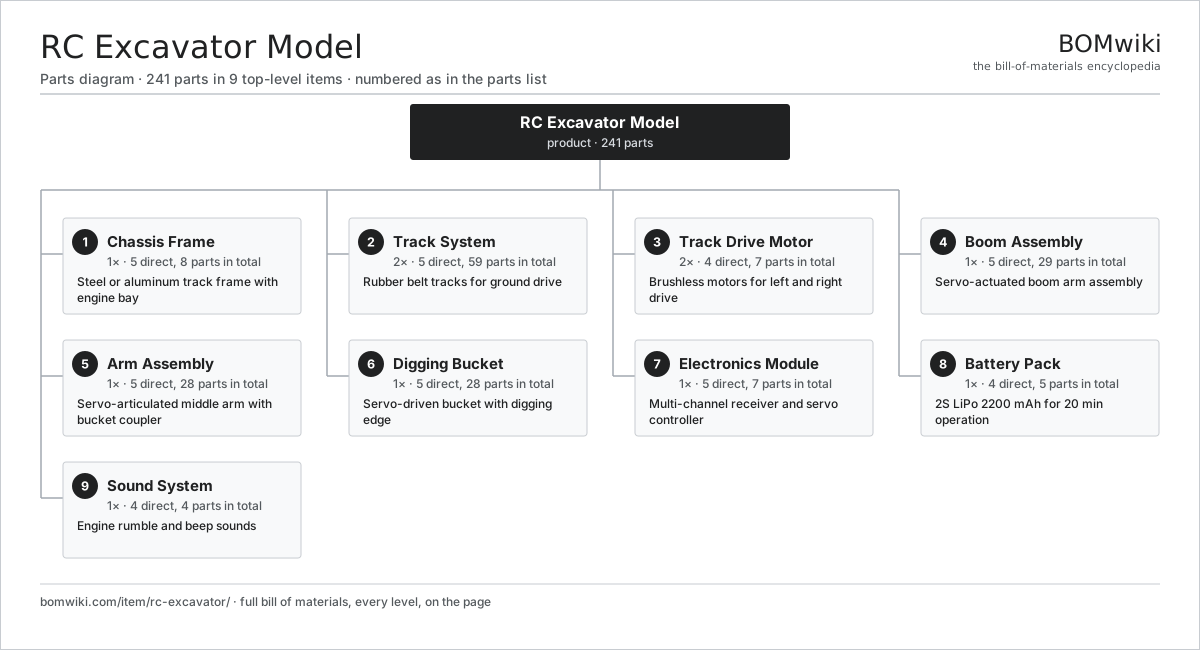
| # | Part | Qty | What it does |
|---|---|---|---|
| 1 | Chassis Frame 5 parts | 1× | Steel or aluminum track frame with engine bay |
| 2 | Track System 5 parts | 2× | Rubber belt tracks for ground drive |
| 3 | Track Drive Motor 4 parts | 2× | Brushless motors for left and right drive |
| 4 | Boom Assembly 5 parts | 1× | Servo-actuated boom arm assembly |
| 5 | Arm Assembly 5 parts | 1× | Servo-articulated middle arm with bucket coupler |
| 6 | Digging Bucket 5 parts | 1× | Servo-driven bucket with digging edge |
| 7 | Electronics Module 5 parts | 1× | Multi-channel receiver and servo controller |
| 8 | Battery Pack 4 parts | 1× | 2S LiPo 2200 mAh for 20 min operation |
| 9 | Sound System 4 parts | 1× | Engine rumble and beep sounds |
3D model
No 3D model yet. Have a CAD file of this? Add a 3D model. STL renders right on this page; STEP, FreeCAD, and OpenSCAD sources are welcome too (openly licensed, like all 3D models on BOMwiki).
Build & assembly graph
expand / collapse · shared sub-assemblies converge · links to related products · est. labourTap an assembly to expand/collapse · tap a part to open it · use “Open page” for any node · drag to pan, scroll to zoom.
Bill of materials for RC Excavator Model
9 top-level lines · 63 rows shown · 241 parts total · indented to 3 levels| # | Item / sub-assembly | Part no. | Qty/assy | Ext. qty | Parts | Type |
|---|---|---|---|---|---|---|
| 1 | Chassis Frame 5 parts | rc-excavator-chassis | 1× | 1 | 8 | assembly |
| 1.1 | Main Frame Tubes | rc-excavator-frame-tubes | 1× | 1 | · | part |
| 1.2 | Track Bracket | rc-excavator-track-mount | 4× | 4 | · | part |
| 1.3 | Battery Compartment | rc-excavator-battery-box | 1× | 1 | · | part |
| 1.4 | Slewing Bearing | rc-excavator-turntable-ring | 1× | 1 | · | part |
| 1.5 | Fastener Set | fastener-set | 1× | 1 | · | part |
| 2 | Track System 5 parts | rc-excavator-tracks | 2× | 2 | 59 | assembly |
| 2.1 | Track Links | rc-excavator-track-links | 50× | 100 | · | part |
| 2.2 | Idler Wheel | rc-excavator-idler-wheel | 2× | 4 | · | part |
| 2.3 | Drive Sprocket | rc-excavator-sprocket | 2× | 4 | · | part |
| 2.4 | Ball Bearing | ball-bearing | 4× | 8 | · | part |
| 2.5 | Fastener Set | fastener-set | 1× | 2 | · | part |
| 3 | Track Drive Motor 4 parts | rc-excavator-drive-motor | 2× | 2 | 7 | assembly |
| 3.1 | Brushless Motor | rc-excavator-motor | 2× | 4 | · | part |
| 3.2 | Drive Gearbox | rc-excavator-gearbox | 2× | 4 | · | part |
| 3.3 | Motor Speed Controller | rc-excavator-motor-esc | 2× | 4 | · | part |
| 3.4 | Fastener Set | fastener-set | 1× | 2 | · | part |
| 4 | Boom Assembly 5 parts | rc-excavator-boom | 1× | 1 | 29 | assembly |
| 4.1 | Servo Motor 4 parts | servo-motor | 1× | 1 | 24 | assembly |
| 4.1.1 | Stator Assembly 3 parts + deeper › | stator-assembly | 1× | 1 | 3 | assembly |
| 4.1.2 | Rotor Assembly 4 parts + deeper › | rotor-assembly | 1× | 1 | 19 | assembly |
| 4.1.3 | Encoder | encoder | 1× | 1 | · | part |
| 4.1.4 | Motor Housing | motor-housing | 1× | 1 | · | part |
| 4.2 | Boom Tube | rc-excavator-boom-pipe | 1× | 1 | · | part |
| 4.3 | Boom Lift Linkage | rc-excavator-boom-linkage | 2× | 2 | · | part |
| 4.4 | Arm Coupler | rc-excavator-boom-coupler | 1× | 1 | · | part |
| 4.5 | Fastener Set | fastener-set | 1× | 1 | · | part |
| 5 | Arm Assembly 5 parts | rc-excavator-arm | 1× | 1 | 28 | assembly |
| 5.1 | Servo Motor 4 parts | servo-motor | 1× | 1 | 24 | assembly |
| 5.1.1 | Stator Assembly 3 parts + deeper › | stator-assembly | 1× | 1 | 3 | assembly |
| 5.1.2 | Rotor Assembly 4 parts + deeper › | rotor-assembly | 1× | 1 | 19 | assembly |
| 5.1.3 | Encoder | encoder | 1× | 1 | · | part |
| 5.1.4 | Motor Housing | motor-housing | 1× | 1 | · | part |
| 5.2 | Arm Tube | rc-excavator-arm-pipe | 1× | 1 | · | part |
| 5.3 | Arm Curl Linkage | rc-excavator-arm-linkage | 1× | 1 | · | part |
| 5.4 | Bucket Coupler | rc-excavator-bucket-coupler | 1× | 1 | · | part |
| 5.5 | Fastener Set | fastener-set | 1× | 1 | · | part |
| 6 | Digging Bucket 5 parts | rc-excavator-bucket | 1× | 1 | 28 | assembly |
| 6.1 | Servo Motor 4 parts | servo-motor | 1× | 1 | 24 | assembly |
| 6.1.1 | Stator Assembly 3 parts + deeper › | stator-assembly | 1× | 1 | 3 | assembly |
| 6.1.2 | Rotor Assembly 4 parts + deeper › | rotor-assembly | 1× | 1 | 19 | assembly |
| 6.1.3 | Encoder | encoder | 1× | 1 | · | part |
| 6.1.4 | Motor Housing | motor-housing | 1× | 1 | · | part |
| 6.2 | Bucket Shell | rc-excavator-bucket-body | 1× | 1 | · | part |
| 6.3 | Bucket Teeth | rc-excavator-bucket-teeth | 1× | 1 | · | part |
| 6.4 | Bucket Control Rod | rc-excavator-bucket-linkage | 1× | 1 | · | part |
| 6.5 | Fastener Set | fastener-set | 1× | 1 | · | part |
| 7 | Electronics Module 5 parts | rc-excavator-electronics | 1× | 1 | 7 | assembly |
| 7.1 | Radio Receiver | rc-excavator-receiver | 1× | 1 | · | part |
| 7.2 | Motor Mixer Board | rc-excavator-motor-mixer | 1× | 1 | · | part |
| 7.3 | Servo Driver Board | rc-excavator-servo-driver | 1× | 1 | · | part |
| 7.4 | Connector | connector | 3× | 3 | · | part |
| 7.5 | Fastener Set | fastener-set | 1× | 1 | · | part |
| 8 | Battery Pack 4 parts | rc-excavator-battery | 1× | 1 | 5 | assembly |
| 8.1 | LiPo Cell | lipo-cell | 2× | 2 | · | part |
| 8.2 | Battery Connector | rc-excavator-battery-connector | 1× | 1 | · | part |
| 8.3 | Battery Tray | rc-excavator-battery-tray | 1× | 1 | · | part |
| 8.4 | Thermal Fuse | thermal-fuse | 1× | 1 | · | part |
| 9 | Sound System 4 parts | rc-excavator-sound-unit | 1× | 1 | 4 | assembly |
| 9.1 | Speaker | speaker | 1× | 1 | · | part |
| 9.2 | Sound Playback Module | rc-excavator-sound-module | 1× | 1 | · | part |
| 9.3 | Audio Amplifier | rc-excavator-amplifier | 1× | 1 | · | part |
| 9.4 | Fastener Set | fastener-set | 1× | 1 | · | part |
Something wrong in this list? Report a problem with this BOM.
Related products
same domain, ranked by shared parts


Sourcing: possible vendors
Browse the supplier directory → Prices, MOQ, and lead times are algorithmic estimates, not quotes, and not claims about these companies. Company mappings are curated by keyword; est. price band $20–$3k. How estimates work| Vendor | HQ | Specialty | MOQ | Lead time |
|---|---|---|---|---|
|
🇩🇰LEGO
lego.com ↗
|
Billund, DK | Construction toys | 2,000 units | 6–10 wks |
|
🇺🇸Mattel
mattel.com ↗
|
El Segundo, US | Toys | 2,000 units | 6–10 wks |
|
🇺🇸Hasbro
hasbro.com ↗
|
Pawtucket, US | Toys & games | 2,000 units | 6–10 wks |
| bandainamco.co.jp ↗ | Tokyo, JP | Toys & amusement | 2,000 units | 6–10 wks |
| spinmaster.com ↗ | Toronto, CA | Toys | 2,000 units | 6–10 wks |
1,010-word article