RC Submarine
ProductOverview
The rc-submarine is a small submersible vehicle designed for recreational diving in pools and calm shallow water. It differs fundamentally from surface RC vehicles: all electronics must be sealed inside a watertight pressure hull, and buoyancy control is critical. The submarine hovers at neutral buoyancy (neither sinking nor rising) by managing water in an internal ballast tank. A servo-driven piston pump adds or expels water, adjusting weight and thus depth. The brushless motor provides horizontal thrust via a propeller; a rudder servo controls steering. Three-channel control, throttle, rudder, and ballast trim, allows the pilot to navigate in three dimensions, ascending, descending, and turning with precision.
How it works
At the surface, the submarine is slightly buoyant (negative weight = positive buoyancy). To dive, the ballast servo operates a piston pump that draws water through an intake check valve into an internal chamber. As water floods in, total weight increases; when weight exceeds buoyancy, the submarine sinks. To surface, the servo reverses, expelling water through an exhaust relief valve, reducing weight and causing ascent.
Horizontal motion is governed by the electric motor, which drives a propeller producing thrust proportional to motor speed. A vertical rudder creates side force for yaw control, allowing left/right turns at any depth. All motor speed and servo commands originate from the radio receiver, potted inside the pressure hull along with the power pack.
The aluminum or acrylic cylinder is the structural core. Both materials are pressure-resistant up to 2–3 meters. Aluminum is heavier and more robust; acrylic is transparent for observation. Threaded end caps with O-ring seals provide watertight closure. The observation window is a secondary acrylic window allowing the pilot to record video or take photos underwater.
Depth control and buoyancy
Neutral buoyancy is the goal: the submarine neither sinks nor rises when the motor is off. This requires careful water ballast calibration at the start of each session. Too much water in the ballast tank makes the sub heavy and slow to surface; too little makes it tend upward. Most pilots carry a trim weight (lead shot) in a pocket to fine-tune dry weight before launching. Once in water with neutral buoyancy, the ballast servo modulates depth by adding or removing precise amounts of water.
Maximum safe depth is determined by hull material strength. Aluminum hulls typically tolerate 2 meters; acrylic hulls up to 3 meters. Deeper dives require much thicker walls and higher-strength materials. Pressure-relief valves in the ballast system prevent over-pressurization from external water force.
Steering and turning radius
The rudder fin has a large moment arm from the center of buoyancy, making the submarine responsive to steering inputs. A 30° rudder deflection produces a 1-meter turn radius at cruise speed. Combined with pitch control from throttle reduction (nose-down when slowing), the submarine can navigate through obstacle courses or follow winding underwater paths.
Waterproofing details
Every penetration through the hull must be sealed. The motor shaft passes through an oil-seal assembly that prevents water from entering the bearing. The ballast intake uses small-diameter tubing with a one-way check valve, so even if the tube breaks, water only flows outward. The receiver is potted in epoxy or conformal coating, and the battery enclosure is sealed with adhesive and gaskets. Some designs use silicone conformal coating on all PCBs as backup protection.
Operating envelope
Freshwater pools are ideal: calm, temperature-stable, and visibility sufficient for pilot control. Salt water is compatible but requires rinsing after each session to prevent corrosion. Cold water increases battery resistance and reduces capacity. Most submarines operate in the 15–25°C range; sub-10°C water causes significant power loss.
Radio range in water is severely limited. The 2.4 GHz signal penetrates water only 1–2 meters line-of-sight from the receiver antenna. Tethering the antenna to a surface float via a waterproof cable extends range. Most pilots accept the limitation and operate in small contained areas, pools, ponds, or calm bays.
Maintenance and longevity
After each dive, flush the submarine with fresh water to remove salt, sediment, or algae. Inspect all O-rings for cracks or deformation; replace if suspect. The ballast pump is the most wear-prone component; prolonged use may require piston seal replacement. Electronics potted in epoxy are mostly maintenance-free, but the battery should be removed and dried after use to prevent long-term corrosion.
RC Submarine parts and their functions
8 top-level parts · 86 parts in total · full bill of materials below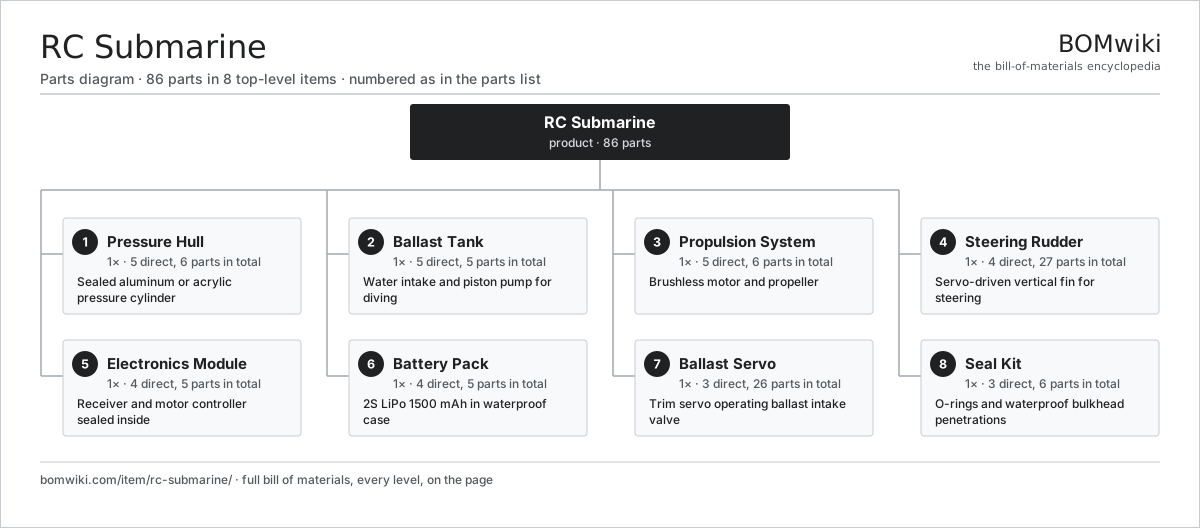
| # | Part | Qty | What it does |
|---|---|---|---|
| 1 | Pressure Hull 5 parts | 1× | Sealed aluminum or acrylic pressure cylinder |
| 2 | Ballast Tank 5 parts | 1× | Water intake and piston pump for diving |
| 3 | Propulsion System 5 parts | 1× | Brushless motor and propeller |
| 4 | Steering Rudder 4 parts | 1× | Servo-driven vertical fin for steering |
| 5 | Electronics Module 4 parts | 1× | Receiver and motor controller sealed inside |
| 6 | Battery Pack 4 parts | 1× | 2S LiPo 1500 mAh in waterproof case |
| 7 | Ballast Servo 3 parts | 1× | Trim servo operating ballast intake valve |
| 8 | Seal Kit 3 parts | 1× | O-rings and waterproof bulkhead penetrations |
3D model
No 3D model yet. Have a CAD file of this? Add a 3D model. STL renders right on this page; STEP, FreeCAD, and OpenSCAD sources are welcome too (openly licensed, like all 3D models on BOMwiki).
Build & assembly graph
expand / collapse · shared sub-assemblies converge · links to related products · est. labourTap an assembly to expand/collapse · tap a part to open it · use “Open page” for any node · drag to pan, scroll to zoom.
Bill of materials for RC Submarine
8 top-level lines · 49 rows shown · 86 parts total · indented to 3 levels| # | Item / sub-assembly | Part no. | Qty/assy | Ext. qty | Parts | Type |
|---|---|---|---|---|---|---|
| 1 | Pressure Hull 5 parts | rc-submarine-hull | 1× | 1 | 6 | assembly |
| 1.1 | Hull Tube | rc-submarine-main-tube | 1× | 1 | · | part |
| 1.2 | Bow End Cap | rc-submarine-bow-cap | 1× | 1 | · | part |
| 1.3 | Stern End Cap | rc-submarine-stern-cap | 1× | 1 | · | part |
| 1.4 | Observation Window | rc-submarine-viewport | 1× | 1 | · | part |
| 1.5 | O-Ring Set | oring-set | 2× | 2 | · | part |
| 2 | Ballast Tank 5 parts | rc-submarine-ballast | 1× | 1 | 5 | assembly |
| 2.1 | Ballast Pump | rc-submarine-piston-pump | 1× | 1 | · | part |
| 2.2 | Intake Check Valve | rc-submarine-intake-valve | 1× | 1 | · | part |
| 2.3 | Exhaust Relief Valve | rc-submarine-exhaust-valve | 1× | 1 | · | part |
| 2.4 | Ballast Plumbing | rc-submarine-pump-plumbing | 1× | 1 | · | part |
| 2.5 | Fastener Set | fastener-set | 1× | 1 | · | part |
| 3 | Propulsion System 5 parts | rc-submarine-propulsion | 1× | 1 | 6 | assembly |
| 3.1 | Brushless Motor | rc-submarine-motor | 1× | 1 | · | part |
| 3.2 | Sealed Motor Controller | rc-submarine-motor-esc | 1× | 1 | · | part |
| 3.3 | Propeller | rc-submarine-propeller | 1× | 1 | · | part |
| 3.4 | Motor Pod | rc-submarine-motor-pod | 1× | 1 | · | part |
| 3.5 | Oil Seal | oil-seal | 2× | 2 | · | part |
| 4 | Steering Rudder 4 parts | rc-submarine-rudder | 1× | 1 | 27 | assembly |
| 4.1 | Servo Motor 4 parts | servo-motor | 1× | 1 | 24 | assembly |
| 4.1.1 | Stator Assembly 3 parts + deeper › | stator-assembly | 1× | 1 | 3 | assembly |
| 4.1.2 | Rotor Assembly 4 parts + deeper › | rotor-assembly | 1× | 1 | 19 | assembly |
| 4.1.3 | Encoder | encoder | 1× | 1 | · | part |
| 4.1.4 | Motor Housing | motor-housing | 1× | 1 | · | part |
| 4.2 | Rudder Fin | rc-submarine-rudder-blade | 1× | 1 | · | part |
| 4.3 | Rudder Horn | rc-submarine-rudder-horn | 1× | 1 | · | part |
| 4.4 | Rudder Push Rod | rc-submarine-rudder-linkage | 1× | 1 | · | part |
| 5 | Electronics Module 4 parts | rc-submarine-electronics | 1× | 1 | 5 | assembly |
| 5.1 | Waterproof Receiver | rc-submarine-receiver | 1× | 1 | · | part |
| 5.2 | PCB Rail System | rc-submarine-pcb-rails | 1× | 1 | · | part |
| 5.3 | Connector | connector | 2× | 2 | · | part |
| 5.4 | Fastener Set | fastener-set | 1× | 1 | · | part |
| 6 | Battery Pack 4 parts | rc-submarine-battery | 1× | 1 | 5 | assembly |
| 6.1 | LiPo Cell | lipo-cell | 2× | 2 | · | part |
| 6.2 | Battery Enclosure | rc-submarine-battery-case | 1× | 1 | · | part |
| 6.3 | Battery Connector | rc-submarine-connector | 1× | 1 | · | part |
| 6.4 | Thermal Fuse | thermal-fuse | 1× | 1 | · | part |
| 7 | Ballast Servo 3 parts | rc-submarine-ballast-servo | 1× | 1 | 26 | assembly |
| 7.1 | Servo Motor 4 parts | servo-motor | 1× | 1 | 24 | assembly |
| 7.1.1 | Stator Assembly 3 parts + deeper › | stator-assembly | 1× | 1 | 3 | assembly |
| 7.1.2 | Rotor Assembly 4 parts + deeper › | rotor-assembly | 1× | 1 | 19 | assembly |
| 7.1.3 | Encoder | encoder | 1× | 1 | · | part |
| 7.1.4 | Motor Housing | motor-housing | 1× | 1 | · | part |
| 7.2 | Pump Crank | rc-submarine-pump-linkage | 1× | 1 | · | part |
| 7.3 | Fastener Set | fastener-set | 1× | 1 | · | part |
| 8 | Seal Kit 3 parts | rc-submarine-seals | 1× | 1 | 6 | assembly |
| 8.1 | O-Ring Set | oring-set | 3× | 3 | · | part |
| 8.2 | Propeller Shaft Seal | rc-submarine-shaft-seal | 2× | 2 | · | part |
| 8.3 | Fastener Set | fastener-set | 1× | 1 | · | part |
Something wrong in this list? Report a problem with this BOM.
Related products
same domain, ranked by shared parts RC Tank
207 parts · shares 13 with this page
RC Tank
207 parts · shares 13 with this page
 Fiberglass Water Slide
191 parts · shares 11 with this page
Fiberglass Water Slide
191 parts · shares 11 with this page
 Hobby RC Car
114 parts · shares 13 with this page
Hobby RC Car
114 parts · shares 13 with this page
 RC Boat
101 parts · shares 13 with this page
RC Boat
101 parts · shares 13 with this page
Sourcing: possible vendors
Browse the supplier directory → Prices, MOQ, and lead times are algorithmic estimates, not quotes, and not claims about these companies. Company mappings are curated by keyword; est. price band $20–$3k. How estimates work| Vendor | HQ | Specialty | MOQ | Lead time |
|---|---|---|---|---|
|
🇩🇰LEGO
lego.com ↗
|
Billund, DK | Construction toys | 2,000 units | 6–10 wks |
|
🇺🇸Mattel
mattel.com ↗
|
El Segundo, US | Toys | 2,000 units | 6–10 wks |
|
🇺🇸Hasbro
hasbro.com ↗
|
Pawtucket, US | Toys & games | 2,000 units | 6–10 wks |
| bandainamco.co.jp ↗ | Tokyo, JP | Toys & amusement | 2,000 units | 6–10 wks |
| spinmaster.com ↗ | Toronto, CA | Toys | 2,000 units | 6–10 wks |
832-word article