Rebar Bending Machine
ProductOverview
A rebar bending machine bends reinforcement steel bars to the angles and shapes required for concrete reinforcement cages and assemblies. The machine consists of a fixed die on the work table, a rotating die disc on the lever arm, and a pivot pin around which the rebar is bent. The operator manually positions the rebar against the fixed die, presses the foot pedal to engage the drive, and the rotating die sweeps the rebar around the fixed pin to the desired angle, then releases and cycles back for the next bend.
The machine is essential in precast concrete shops and on large job sites where hundreds of bars must be bent to standard shapes, hooks, bends at 45, 90, and 135 degrees, with high accuracy and repeatability. A skilled operator can bend and flip bars in a rhythmic cycle, producing 50–100 bars per hour.
How it works
The Electric Motor, a compact three-phase or single-phase electric motor rated 3–7.5 kW, runs continuously. Its shaft connects through a rebar-bending-machine-flexible-coupling to the Gearbox & Speed Reduction, which contains helical Gear Pair reducing the motor's 1,450 rpm down to 70–150 rpm at the output shaft.
The gearbox output drives the Lever Shaft, which carries the Lever Arm. The lever arm rotates slowly and is always running when the motor is on. At the end of the lever arm sits the Rotating Die Disc, a hardened steel disc sized for the rebar diameter being bent.
On the work table sits the Fixed Die, a matching hardened steel die bolted to the Bending Head Casting. Between them is the Fixed Pivot Pin, a fixed steel pin around which the rebar bends. The operator inserts a straight rebar through the Guide Pin locators on the table, positions it against the fixed die and pivot pin, and then presses the Foot Pedal.
The foot pedal is mechanically linked to the Friction Clutch via a Connecting Rod. Pressing the pedal engages the clutch, locking the lever arm output to the continuously running gearbox. The lever arm sweeps the rotating die forward, dragging the rebar around the fixed pivot pin in a smooth arc. The operator watches the angle, and releases the pedal when the desired bend angle is reached, typically marked by an Angle Stop that blocks the lever arm.
The friction clutch disengages as soon as the pedal is released, and a Coil Spring returns the lever arm back to its starting position, ready for the next cycle. The rebar stays bent because the bend is permanent, the yield point of the steel has been exceeded, and the operator removes it from the dies and positions the next bar.
Different rebar diameters require different Die & Bending Pin Set sets, separate fixed and rotating dies machined for 6 mm, 10 mm, 16 mm, 20 mm, 25 mm, and 32 mm bars. Changing dies takes 10–15 minutes. The Stop Block on the table limits how far the rebar can be pushed under the dies, protecting the operator's hands and ensuring consistent bending geometry.
Smaller machines bend up to 16 mm bar; larger industrial units handle 32 mm or even larger special steel. The torque in the system is substantial, a 20 mm rebar bar can require 400–600 Nm of bending torque, so the Base Plate must be heavily bolted to the floor to prevent the whole machine from rocking backward under load.
Rebar Bending Machine parts and their functions
8 top-level parts · 49 parts in total · full bill of materials below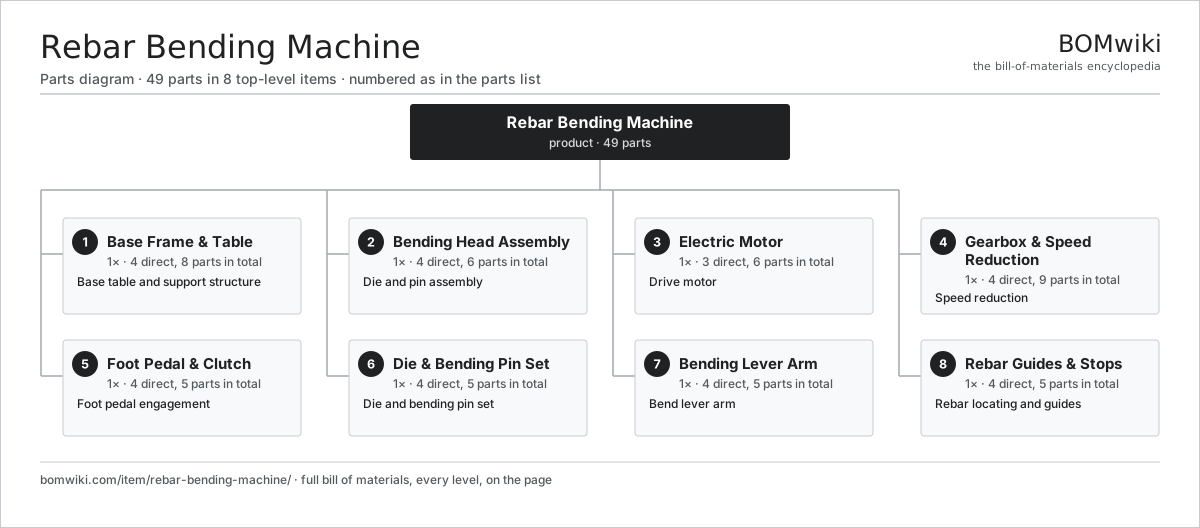
| # | Part | Qty | What it does |
|---|---|---|---|
| 1 | Base Frame & Table 4 parts | 1× | Base table and support structure |
| 2 | Bending Head Assembly 4 parts | 1× | Die and pin assembly |
| 3 | Electric Motor 3 parts | 1× | Drive motor |
| 4 | Gearbox & Speed Reduction 4 parts | 1× | Speed reduction |
| 5 | Foot Pedal & Clutch 4 parts | 1× | Foot pedal engagement |
| 6 | Die & Bending Pin Set 4 parts | 1× | Die and bending pin set |
| 7 | Bending Lever Arm 4 parts | 1× | Bend lever arm |
| 8 | Rebar Guides & Stops 4 parts | 1× | Rebar locating and guides |
3D model
No 3D model yet. Have a CAD file of this? Add a 3D model. STL renders right on this page; STEP, FreeCAD, and OpenSCAD sources are welcome too (openly licensed, like all 3D models on BOMwiki).
Build & assembly graph
expand / collapse · shared sub-assemblies converge · links to related products · est. labourTap an assembly to expand/collapse · tap a part to open it · use “Open page” for any node · drag to pan, scroll to zoom.
Bill of materials for Rebar Bending Machine
8 top-level lines · 39 rows shown · 49 parts total · indented to 3 levels| # | Item / sub-assembly | Part no. | Qty/assy | Ext. qty | Parts | Type |
|---|---|---|---|---|---|---|
| 1 | Base Frame & Table 4 parts | rebar-bending-machine-frame | 1× | 1 | 8 | assembly |
| 1.1 | Base Plate | rebar-bending-machine-base-plate | 1× | 1 | · | part |
| 1.2 | Side Frame | rebar-bending-machine-side-frame | 2× | 2 | · | part |
| 1.3 | Work Table | rebar-bending-machine-work-table | 1× | 1 | · | part |
| 1.4 | Fastener Set | fastener-set | 4× | 4 | · | part |
| 2 | Bending Head Assembly 4 parts | rebar-bending-machine-bending-head | 1× | 1 | 6 | assembly |
| 2.1 | Bending Head Casting | rebar-bending-machine-head-casting | 1× | 1 | · | part |
| 2.2 | Fixed Pivot Pin | rebar-bending-machine-pivot-pin | 1× | 1 | · | part |
| 2.3 | Ball Bearing | ball-bearing | 2× | 2 | · | part |
| 2.4 | Fastener Set | fastener-set | 2× | 2 | · | part |
| 3 | Electric Motor 3 parts | rebar-bending-machine-motor | 1× | 1 | 6 | assembly |
| 3.1 | Motor | rebar-bending-machine-motor-body | 1× | 1 | · | part |
| 3.2 | Flexible Coupling | rebar-bending-machine-motor-coupling | 1× | 1 | · | part |
| 3.3 | Vibration Isolator | rebar-bending-machine-isolator-pad | 4× | 4 | · | part |
| 4 | Gearbox & Speed Reduction 4 parts | rebar-bending-machine-gearbox | 1× | 1 | 9 | assembly |
| 4.1 | Gearbox Housing | rebar-bending-machine-gear-case | 1× | 1 | · | part |
| 4.2 | Gear Pair | rebar-bending-machine-gear-set | 2× | 2 | · | part |
| 4.3 | Ball Bearing | ball-bearing | 4× | 4 | · | part |
| 4.4 | Oil Seal | oil-seal | 2× | 2 | · | part |
| 5 | Foot Pedal & Clutch 4 parts | rebar-bending-machine-clutch | 1× | 1 | 5 | assembly |
| 5.1 | Foot Pedal | rebar-bending-machine-pedal-arm | 1× | 1 | · | part |
| 5.2 | Connecting Rod | rebar-bending-machine-connecting-rod | 1× | 1 | · | part |
| 5.3 | Friction Clutch | rebar-bending-machine-friction-clutch | 1× | 1 | · | part |
| 5.4 | Coil Spring | coil-spring | 2× | 2 | · | part |
| 6 | Die & Bending Pin Set 4 parts | rebar-bending-machine-pin-die | 1× | 1 | 5 | assembly |
| 6.1 | Fixed Die | rebar-bending-machine-fixed-die | 1× | 1 | · | part |
| 6.2 | Rotating Die Disc | rebar-bending-machine-rotating-die | 1× | 1 | · | part |
| 6.3 | Pin Carrier Block | rebar-bending-machine-pin-carrier | 1× | 1 | · | part |
| 6.4 | Fastener Set | fastener-set | 2× | 2 | · | part |
| 7 | Bending Lever Arm 4 parts | rebar-bending-machine-lever | 1× | 1 | 5 | assembly |
| 7.1 | Lever Shaft | rebar-bending-machine-lever-shaft | 1× | 1 | · | part |
| 7.2 | Lever Arm | rebar-bending-machine-lever-arm-steel | 1× | 1 | · | part |
| 7.3 | Lever Bearing | rebar-bending-machine-lever-bearing | 2× | 2 | · | part |
| 7.4 | Fastener Set | fastener-set | 1× | 1 | · | part |
| 8 | Rebar Guides & Stops 4 parts | rebar-bending-machine-guides | 1× | 1 | 5 | assembly |
| 8.1 | Guide Pin | rebar-bending-machine-guide-pin | 2× | 2 | · | part |
| 8.2 | Stop Block | rebar-bending-machine-stop-block | 1× | 1 | · | part |
| 8.3 | Angle Stop | rebar-bending-machine-adjustable-angle-stop | 1× | 1 | · | part |
| 8.4 | Fastener Set | fastener-set | 1× | 1 | · | part |
Something wrong in this list? Report a problem with this BOM.
Related products
same domain, ranked by shared parts Articulated Haul Truck
128 parts · shares 1 with this page
Articulated Haul Truck
128 parts · shares 1 with this page
 Bridge Girder Launching Gantry
1,542 parts · shares 1 with this page
Bridge Girder Launching Gantry
1,542 parts · shares 1 with this page
 Cold Planer
1,646 parts · shares 1 with this page
Cold Planer
1,646 parts · shares 1 with this page
 Construction Hoist
457 parts · shares 1 with this page
Construction Hoist
457 parts · shares 1 with this page
 Crawler Dozer
1,111 parts · shares 1 with this page
Crawler Dozer
1,111 parts · shares 1 with this page
 Crawler Excavator
1,241 parts · shares 1 with this page
Crawler Excavator
1,241 parts · shares 1 with this page
Sourcing: possible vendors
Browse the supplier directory → Prices, MOQ, and lead times are algorithmic estimates, not quotes, and not claims about these companies. Company mappings are curated by keyword; est. price band $15k–$2M. How estimates work| Vendor | HQ | Specialty | MOQ | Lead time |
|---|---|---|---|---|
| caterpillar.com ↗ | Irving, US | Construction & mining equipment | made to order | 16–28 wks |
|
🇯🇵Komatsu
komatsu.com ↗
|
Tokyo, JP | Construction & mining equipment | made to order | 16–28 wks |
|
🇸🇪Volvo CE
volvoce.com ↗
|
Gothenburg, SE | Construction equipment | made to order | 16–28 wks |
|
🇨🇭Liebherr
liebherr.com ↗
|
Bulle, CH | Cranes & heavy equipment | made to order | 16–28 wks |
|
🇨🇳XCMG
xcmg.com ↗
|
Xuzhou, CN | Construction machinery | made to order | 16–28 wks |
623-word article