Recurve Bow
ProductOverview
A recurve bow is an archery bow characterized by a string-following limb shape that curves away from the archer when strung. Unlike a traditional "self-bow" (single wood stave) or compound bow (mechanical pulleys), the recurve's simple mechanical design, nested wood and fiberglass laminates in a riser handle, has remained largely unchanged for 75 years. It is the Olympic standard for target archery, preferred by hunters for silent operation, and favored by enthusiasts for reliability and low maintenance.
A typical adult recurve bow weighs 3–5 pounds, draws 30–50 pounds of force, and launches arrows at 180–210 feet per second (55–64 m/s). Effective range for target shooting is 50–100 yards; hunting effective range is 20–40 yards (accuracy and lethality decline beyond this).
Limb Engineering
The Limb Pair consist of a wood core (maple, yew, or ash) laminated with fiberglass sheets (0.5–1.5 mm thick) on the back (tension) and belly (compression) surfaces. This composite structure leverages the distinct mechanical properties:
- Wood core: Provides structural integrity and directional stiffness. High modulus of elasticity (E ≈ 10–15 GPa for hard woods) enables long-distance energy storage.
- Back fiberglass: Withstands tensile stress during draw; fiberglass is much stronger in tension than wood alone (tensile strength ≈ 100–150 MPa).
- Belly fiberglass: Resists compression during release. Combined with wood, the laminate distributes bending stress away from the wood–fiberglass interface.
Lamination stress:
- At full draw (60 lbs × 28″ = 1,680 inch-pounds = 190 N-m torque in each limb), the bow stores ~60 joules of elastic energy.
- Peak strain in outer fiber layers ≈ 1.5–2.0%, within safe limits for fiberglass (failure strain ≈ 2.5–3.0%).
- Limbs are narrower and deeper (oval cross-section, ~0.75″ wide × 1.5″ deep) to optimize bending stiffness and minimize stress concentration.
The Bow Riser attaches limb tenons (tapered wooden or aluminum extensions) to machined pockets, with Limb Wedge inserts ensuring perpendicular alignment. Misalignment causes uneven string track, leading to dry-fire risk (accidental release without arrow) and limb failure.
String Mechanics
The Bowstring Assembly is twisted Dacron (polyester, 35–50 strands yielding ~300 lbs tensile strength) or fast-flight synthetic (Spectra or HMPE, ~400 lbs strength, lower mass). Draw weight varies with string tension and recurve-bow-brace-height (vertical distance from grip to string at rest).
String physics:
- At full draw, string tension ≈ draw weight / (2 × sin θ), where θ = half the angle between string limbs.
- For a 60 lbs draw, 56″ string, limbs angled 120°, tension ≈ 80 lbs per side = 160 lbs total.
- String mass affects arrow acceleration: heavier strings waste energy moving themselves instead of the arrow. Fast-flight strings (~0.05 lbs/64″) reduce mass loss vs. Dacron (~0.08 lbs/64″).
The Nocking Point is a small crimp or pinch at the midpoint marking arrow nock height. Typically 0.5–1 inch above the 90-degree perpendicular (the "center serving"), this offset prevents arrow shaft contact with the riser at full draw.
String maintenance is minimal: wax once per 50 shots to preserve fibers, inspect for fraying monthly, and replace every 2–3 years (older strings creep and lose weight, reducing arrow speed).
Riser & Rest System
The Bow Riser (typically 22–25 cm tall aluminum alloy or hardwood) provides the connection point for both limbs and houses the arrow rest and pressure plunger system. The Grip Wrap & Padding covers the handle (non-slip is critical for consistent grouping; a slipping hand shifts the center of force, causing vertical scatter).
The Arrow Rest & Plunger is a simple mechanical centering device:
- The Arrow Rest Platform is a horizontal shelf (usually tuned plastic or cork) supporting the arrow shaft.
- The Plunger Button is a spring-loaded nylon or plastic button pressing laterally against the arrow nock, forcing the arrow spine to flex at release and track the center of the bow window.
- Spring tension is 3–6 lbs, tuned so the arrow's dynamic spine oscillation aligns with centerline.
Improper plunger adjustment causes:
- Too tight: Arrow flexes excessive, misses to center side (nock kicks outward).
- Too loose: Arrow is unguided, erratic grouping.
Many competitive archers spend hours tuning rest pressure, horizontal height, and vertical position to within ±1 mm precision.
Draw Weight & Arrow Speed
Draw weight is the force (measured in pounds) required to draw the bow to a standard 28-inch distance. A 50 lb bow requires 50 lbs of human effort at 28″ draw; at 30″ draw, force increases slightly due to longer limb deflection.
Arrow velocity is governed by energy transfer:
- Stored energy at full draw: E = (1/2) × k × x², where k = spring constant, x = draw distance.
- For a 60 lb, 28″ draw bow: E ≈ 60 lbs × 28″ / 2 = 840 ft-lbf = 1,140 joules (accounting for 85% system efficiency).
- After string and riser losses, a 430-grain arrow receives ~65 joules kinetic energy, exiting at ~210 ft/s (64 m/s).
Lighter arrows shoot faster; a 300-grain arrow from the same bow might reach 240 ft/s but loses penetration due to reduced kinetic energy (E = 0.5 × m × v²). Hunting applications favor 400–500 grain arrows for energy retention over distance.
Sight Mounting & Accuracy
The Sight Mounting System system allows the archer to aim using pin sights or peep sights. A pin sight mounted on the Sight Rail holds 1–5 pins (small fiber optic or tritium dots) at known distances (20, 30, 40, 50 yards). Adjustable Sight Bracket permits vertical and horizontal zero.
Olympic target archery uses larger sights with magnification (up to 8×), placing pins at 10 meter intervals. Hunting sights are compact, with 3–5 pins set for expected hunting ranges (20, 30, 40 yards).
Damping & Noise
The String Damping Assembly system reduces vibration and noise through:
- Silencer Bead: Foam or rubber beads threaded on the string absorb oscillation energy. Placement 4–6 inches from the nocking point is typical.
- Stabilizer Button: A threaded insert (often on the riser) allows optional attachment of a balance rod (8–16 oz weight extending forward) dampening fore-aft torque.
Without dampers, a recurve releases acoustic energy at 100–110 decibels (comparable to a chainsaw). Dampers reduce this to 85–95 dB, important for hunting (reduces game alarm) and indoor range safety.
Maintenance & Lifespan
Recurve bows are remarkably durable if maintained:
Regular care:
- Inspect limbs monthly for cracks or delamination (separation of fiberglass from wood). Small cracks can be epoxied; large delamination requires limb replacement ($300–600 per pair).
- Wax the string every 50 shots using bowstring wax or paraffin.
- Clean the riser with mild soap and dry.
- Store unstrung in a temperature-stable, dry environment (extreme heat or humidity causes wood warping and glue failure).
Lifespan: Modern recurve limbs last 20–30 years of regular use. Risers are essentially eternal if not dropped. Strings require replacement every 2–3 years ($30–60).
Cost of ownership:
- Entry bow (Samick Sage equivalent): $150–300.
- Riser upgrade: $600–1,200 (high-end aluminum).
- Limb replacement: $300–600 per pair.
- Arrows: $100–200 per dozen.
- Annual maintenance: $20–50 (wax, inspections).
Comparison to Other Archery Types
| Feature | Recurve | Compound | Longbow |
|---|---|---|---|
| Draw Weight Feel | Linear increase | Plateau (let-off) | Very steep curve |
| Noise | 100–110 dB | 80–90 dB (less shock) | 110+ dB (louder) |
| Learning Curve | Moderate (2–4 weeks) | Steep (needs tuning) | Gentle (forgiving) |
| Cost | $200–1,500 | $600–3,000 | $400–2,000 |
| Maintenance | Minimal | High (cable, cam) | Low |
| Olympic Sport | Yes | No | No |
| Hunting Effective Range | 30–40 yards | 50–70 yards (less skill required) | 20–30 yards |
The recurve remains the standard for target archery because its simplicity, low cost, and high feedback reward precision training. Compound bows dominate hunting due to let-off (mechanical advantage), reducing fatigue and easing aiming. Longbows appeal to traditionalists and historical reenactors.
Tuning & Paper Tuning
A crucial step before hunting or competition is "paper tuning", shooting through a sheet of newsprint held in a frame 8 feet downrange to diagnose arrow flight. The tear pattern indicates misalignment:
- Bullet hole (round tear): Perfectly aligned arrow.
- Horizontal tear (left or right tail): Rest height or plunger adjustment needed.
- Vertical tear (top or bottom tail): Rest position (forward/back) needs adjustment.
- Spiraling tear: Spine or arrow quality issue; try a different shaft.
Achieving a bullet hole requires iterative rest and plunger tuning, sometimes taking hours. Once dialed, a properly tuned recurve can group arrows within 2–3 inches at 20 yards in the hands of a skilled archer.
Recurve Bow parts and their functions
8 top-level parts · 26 parts in total · full bill of materials below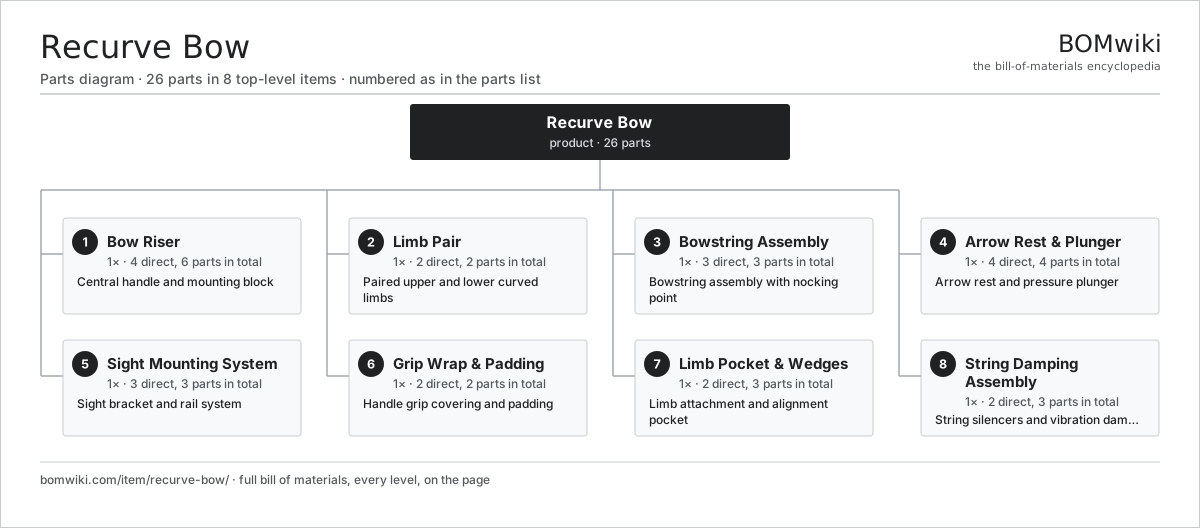
| # | Part | Qty | What it does |
|---|---|---|---|
| 1 | Bow Riser 4 parts | 1× | Central handle and mounting block |
| 2 | Limb Pair 2 parts | 1× | Paired upper and lower curved limbs |
| 3 | Bowstring Assembly 3 parts | 1× | Bowstring assembly with nocking point |
| 4 | Arrow Rest & Plunger 4 parts | 1× | Arrow rest and pressure plunger |
| 5 | Sight Mounting System 3 parts | 1× | Sight bracket and rail system |
| 6 | Grip Wrap & Padding 2 parts | 1× | Handle grip covering and padding |
| 7 | Limb Pocket & Wedges 2 parts | 1× | Limb attachment and alignment pocket |
| 8 | String Damping Assembly 2 parts | 1× | String silencers and vibration dampers |
3D model
No 3D model yet. Have a CAD file of this? Add a 3D model. STL renders right on this page; STEP, FreeCAD, and OpenSCAD sources are welcome too (openly licensed, like all 3D models on BOMwiki).
Build & assembly graph
expand / collapse · shared sub-assemblies converge · links to related products · est. labourTap an assembly to expand/collapse · tap a part to open it · use “Open page” for any node · drag to pan, scroll to zoom.
Bill of materials for Recurve Bow
8 top-level lines · 32 rows shown · 26 parts total · indented to 3 levels| # | Item / sub-assembly | Part no. | Qty/assy | Ext. qty | Parts | Type |
|---|---|---|---|---|---|---|
| 1 | Bow Riser 4 parts | recurve-bow-riser | 1× | 1 | 6 | assembly |
| 1.1 | Riser Body | recurve-bow-riser-body | 1× | 1 | · | part |
| 1.2 | Limb Pocket & Wedges 2 parts | recurve-bow-limb-pocket | 1× | 1 | 3 | assembly |
| 1.2.1 | Pocket Insert | recurve-bow-pocket-insert | 1× | 1 | · | part |
| 1.2.2 | Limb Wedge | recurve-bow-limb-wedge | 2× | 2 | · | part |
| 1.3 | Sight Rail | recurve-bow-riser-sight-rail | 1× | 1 | · | part |
| 1.4 | Fastener Set | fastener-set | 1× | 1 | · | part |
| 2 | Limb Pair 2 parts | recurve-bow-limbs | 1× | 1 | 2 | assembly |
| 2.1 | Upper Limb | recurve-bow-upper-limb | 1× | 1 | · | part |
| 2.2 | Lower Limb | recurve-bow-lower-limb | 1× | 1 | · | part |
| 3 | Bowstring Assembly 3 parts | recurve-bow-string | 1× | 1 | 3 | assembly |
| 3.1 | String Fiber Bundle | recurve-bow-string-strand | 1× | 1 | · | part |
| 3.2 | Nocking Point | recurve-bow-nocking-point | 1× | 1 | · | part |
| 3.3 | String Serving Wrap | recurve-bow-string-serving | 1× | 1 | · | part |
| 4 | Arrow Rest & Plunger 4 parts | recurve-bow-rest-plunger | 1× | 1 | 4 | assembly |
| 4.1 | Arrow Rest Platform | recurve-bow-arrow-rest | 1× | 1 | · | part |
| 4.2 | Plunger Spring | recurve-bow-plunger-spring | 1× | 1 | · | part |
| 4.3 | Plunger Button | recurve-bow-plunger-button | 1× | 1 | · | part |
| 4.4 | Fastener Set | fastener-set | 1× | 1 | · | part |
| 5 | Sight Mounting System 3 parts | recurve-bow-sight-mounting | 1× | 1 | 3 | assembly |
| 5.1 | Sight Bracket | recurve-bow-sight-bracket | 1× | 1 | · | part |
| 5.2 | Sight Clamp | recurve-bow-sight-clamp | 1× | 1 | · | part |
| 5.3 | Fastener Set | fastener-set | 1× | 1 | · | part |
| 6 | Grip Wrap & Padding 2 parts | recurve-bow-grip-wrap | 1× | 1 | 2 | assembly |
| 6.1 | Grip Material | recurve-bow-grip-material | 1× | 1 | · | part |
| 6.2 | Grip Foam Padding | recurve-bow-grip-foam | 1× | 1 | · | part |
| 7 | Limb Pocket & Wedges 2 parts | recurve-bow-limb-pocket | 1× | 1 | 3 | assembly |
| 7.1 | Pocket Insert | recurve-bow-pocket-insert | 1× | 1 | · | part |
| 7.2 | Limb Wedge | recurve-bow-limb-wedge | 2× | 2 | · | part |
| 8 | String Damping Assembly 2 parts | recurve-bow-damping | 1× | 1 | 3 | assembly |
| 8.1 | Silencer Bead | recurve-bow-silencer-bead | 2× | 2 | · | part |
| 8.2 | Stabilizer Button | recurve-bow-stabilizer-button | 1× | 1 | · | part |
Something wrong in this list? Report a problem with this BOM.
Related products
same domain, ranked by shared parts Avalanche Transceiver
35 parts · shares 1 with this page
Avalanche Transceiver
35 parts · shares 1 with this page
 Backpacking Stove
32 parts · shares 1 with this page
Backpacking Stove
32 parts · shares 1 with this page
 Baitcasting Reel
51 parts · shares 1 with this page
Bow Press
17 parts · shares 1 with this page
Bow Sight
72 parts · shares 1 with this page
Baitcasting Reel
51 parts · shares 1 with this page
Bow Press
17 parts · shares 1 with this page
Bow Sight
72 parts · shares 1 with this page
Sourcing: possible vendors
Browse the supplier directory → Prices, MOQ, and lead times are algorithmic estimates, not quotes, and not claims about these companies. Company mappings are curated by keyword; est. price band $20–$2k. How estimates work| Vendor | HQ | Specialty | MOQ | Lead time |
|---|---|---|---|---|
|
🇺🇸Coleman
coleman.com ↗
|
Chicago, US | Camping gear | 1,000 units | 6–10 wks |
| thenorthface.com ↗ | Denver, US | Outdoor apparel & gear | 1,000 units | 6–10 wks |
|
🇺🇸YETI
yeti.com ↗
|
Austin, US | Coolers & drinkware | 1,000 units | 6–10 wks |
| decathlon.com ↗ | Villeneuve-d'Ascq, FR | Sporting goods | 1,000 units | 6–10 wks |
|
🇺🇸Garmin
garmin.com ↗
|
Olathe, US | GPS & wearables | 1,000 units | 6–10 wks |
1,435-word article