Recycling Collection Truck
ProductOverview
The recycling collection truck is a specialized municipal waste vehicle designed to service curbside recycling programs where two or more material streams, typically paper/cardboard and plastic/glass, must be collected simultaneously and kept separate. Unlike single-stream trucks (which accept mixed recyclables), dual-stream vehicles employ compartmented bodies and multiple collection arms to gather already-sorted materials in separate bins.
The truck features a longer chassis than single-loader vehicles, with front and rear arms positioned to serve two separate curbside bin locations per stop. Each arm connects to an independent hydraulic circuit with dedicated pump, manifold, and accumulator, allowing simultaneous arm operation without flow starvation. The body is internally divided by steel partition walls, and each compartment has independent packer blades and discharge gates.
Dual-stream recycling collection became widespread in the 2000s–2010s as municipalities upgraded from manual-sort programs to mechanized post-collection sorting. The primary benefit is reduced contamination (glass shards in paper reduces paper value; food residue in plastics degrades recycling streams). Some vehicles support three or four separate streams (e.g., paper, plastic, metal, organic) with additional compartments.
Modern recycling collection trucks balance the complexity of dual-circuit hydraulics with the operational efficiency of servicing two material streams per stop, reducing total fleet size and fuel consumption versus single-stream vehicles.
How it Works
The truck arrives at a residential collection route with curbside bins color-coded or labeled for different materials: blue bins for paper/cardboard, yellow for plastic, green for glass (or regional variants). The driver positions the truck to align the front collection arm with one bin type (e.g., paper) and the rear arm with another (e.g., plastic).
From the cabin, the driver engages the front arm control joystick, extending the boom and opening the claw to grip the paper bin. Simultaneously, another crew member or the driver (via wireless remote) operates the rear arm joystick, extending the rear boom to the plastic bin. Because each arm has a dedicated 35 cc/rev pump, both can operate at full speed without hydraulic starvation, a critical advantage over single-pump systems attempting dual collection.
The front arm lifts its bin and rotates inboard, tipping paper/cardboard into the truck's forward compartment. Material falls through a gravity chute into the paper section. As incoming material reaches the hopper, the driver engages the front packer, a dedicated horizontal blade driven by double-acting cylinders, which compresses the paper at 20–30 Hz. This independent packing action is critical: it prevents the plastic section's packer (operating simultaneously in the rear compartment) from interfering.
Meantime, the rear arm completes its cycle in parallel: lifting the plastic bin, rotating inboard, and discharging into the rear compartment's hopper. The secondary packer engages, compressing plastic at the same rhythm as the primary packer, but in a separate chamber.
A load-monitoring system tracks fill level in each compartment independently; the driver is alerted when either reaches capacity. Material properties differ: paper compacts to ~150 kg/m³, while plastic compacts to ~80–100 kg/m³. The system accounts for this via weight-per-section feedback, not volume alone.
When collection is complete, the truck navigates to a materials recovery facility (MRF). A tipper mechanism raises the entire body 45–50 degrees, and the driver selectively opens discharge gates: first the paper compartment's tailgate opens, paper slides out. Then the plastic gate opens, plastic discharges separately. This staged unloading prevents mixing and maximizes facility processing efficiency.
The hydraulic architecture is the truck's defining feature. Two independent circuits, primary (front arm, primary packer) and secondary (rear arm, secondary packer), each feed from separate pumps. This eliminates the flow-sharing problems of single-pump systems attempting simultaneous dual-arm operation. A proportional multi-spool valve manifold routes flow to individual cylinders. A PLC coordinates the two circuits, preventing simultaneous operations that would exceed the truck's lifting capacity or create mechanical conflicts.
Safety interlocks include:
- Preventing packer operation if the corresponding arm is still extended (collision risk).
- Limiting total combined load (both arms) to avoid exceeding GVW or tipping boundaries.
- Load-moment sensing preventing unsafe arm combinations.
- Dual audible alarms and visual beacons during all operations.
- Deadman controls on both joysticks requiring continuous operator input.
Subsystems
The chassis is extended and reinforced: the wheelbase is 1–2 meters longer than a single-loader to distribute the weight of two large compartments and dual arm systems. The 6 or 8-cylinder diesel (200–240 kW) and air-suspended axles are proportionally larger.
The compartment dividing system partitions the body using welded steel walls (4 mm thick), creating independent chambers with separate material chutes and packer access points. Gaskets seal the partition edges to prevent cross-contamination.
The front collection arm is a standard side-loader boom and claw, positioned forward on the truck frame to serve the first bin location.
The rear collection arm mirrors the front design but is mounted aft of the rear axle, enabling service of the second bin location without repositioning the truck.
Dual packer blade systems comprise independent primary and secondary compactors, each driven by dedicated cylinders. They operate in parallel but in separate compartments, with sequencing logic preventing interference.
The discharge system features multiple tailgates or slide-gates, one per compartment, allowing staged or selective unloading at the MRF.
The dual-pump hydraulic system is the core innovation: two 35 cc/rev pumps, each with proportional directional manifold, accumulator, and filters. Flow prioritization and load-sensing ensure stable pressure during simultaneous arm operation.
The control interface provides dual joysticks or a wireless remote for rear arm, mode selectors for packer/discharge sequencing, and a multi-compartment fill display showing status per section.
Applications and Variants
Dual-stream recycling collection is standard in European municipalities (Germany, France, UK, Scandinavia) and common in North America (Canada, urban US markets). Some jurisdictions expand to three or four streams:
- Paper/cardboard (primary compartment)
- Plastic bottles (secondary compartment)
- Glass bottles (tertiary compartment, heavier, separate discharge to prevent commingling)
- Metals (quaternary compartment, optional, for ferrous/non-ferrous sorting)
Each additional compartment adds weight, complexity, and hydraulic demand. Most trucks top out at 3–4 streams before exceeding practical size and weight limits.
Variants include:
- Tri-stream models: Three separate compartments and independent arms, common in advanced recycling programs.
- Quad-stream models: Four compartments; rare due to weight and complexity.
- Wireless rear arm control: Remote operation allowing crew to service rear bins without driver cabin visibility.
- Hybrid or electric dual-stream trucks: Emerging in European cities to reduce emissions and noise.
Material-Specific Packing
Different materials require different compaction strategies:
- Paper/cardboard: Compacts readily to 150–180 kg/m³ with moderate blade pressure (180–200 bar).
- Plastic bottles: Resilient; compress to 80–120 kg/m³ even at high pressure; hollow bottles collapse inefficiently.
- Glass: Non-compressible; packers are omitted or bypassed, glass flows by gravity only.
- Metal cans: Aluminum cans crush readily; steel cans resist deformation but accept compaction.
Operators must adjust packer speed and pressure per material. Some trucks include programmable PLC settings: mode 1 (paper), mode 2 (plastic), mode 3 (glass), etc., each with pre-tuned hydraulic parameter sets.
Operational Efficiency and Economics
A dual-stream truck serving 15–22 stops per shift collects 2 material streams simultaneously, yielding 30–44 bin pickups per shift (vs. 100–120 for a high-volume single-stream truck on dedicated residential routes). Dual-stream routes are typically in higher-density urban areas where contamination is a critical issue and recovery economics justify the added vehicle complexity.
The secondary benefit is reduced equipment wear: packers operate at moderate frequencies (20–30 Hz) vs. 40+ Hz in single-stream high-volume machines, extending seal and blade life.
Maintenance and Design Life
Dual-pump systems require more routine hydraulic maintenance: two sets of seals, two filter elements, two accumulator bladders. Hydraulic fluid is changed every 500 operating hours; accumulator nitrogen is refreshed every 3–5 years. Seal kits for both pump circuits are replaced every 3,000–5,000 hours.
A well-maintained dual-stream truck achieves 12–18 years in service, slightly shorter than single-stream machines due to the added hydraulic complexity and operational stress on two independent systems.
Industry Standards and Certification
Dual-stream trucks must comply with ISO 4413 (hydraulic system safety), NFPA 1901 (refuse vehicle safety), and local weight/dimension regulations. Hydraulic system proof testing to 1.5× rated pressure is standard pre-delivery. Load-moment indicator (LMI) accuracy must be verified annually if present.
Recycling Collection Truck parts and their functions
8 top-level parts · 160 parts in total · full bill of materials below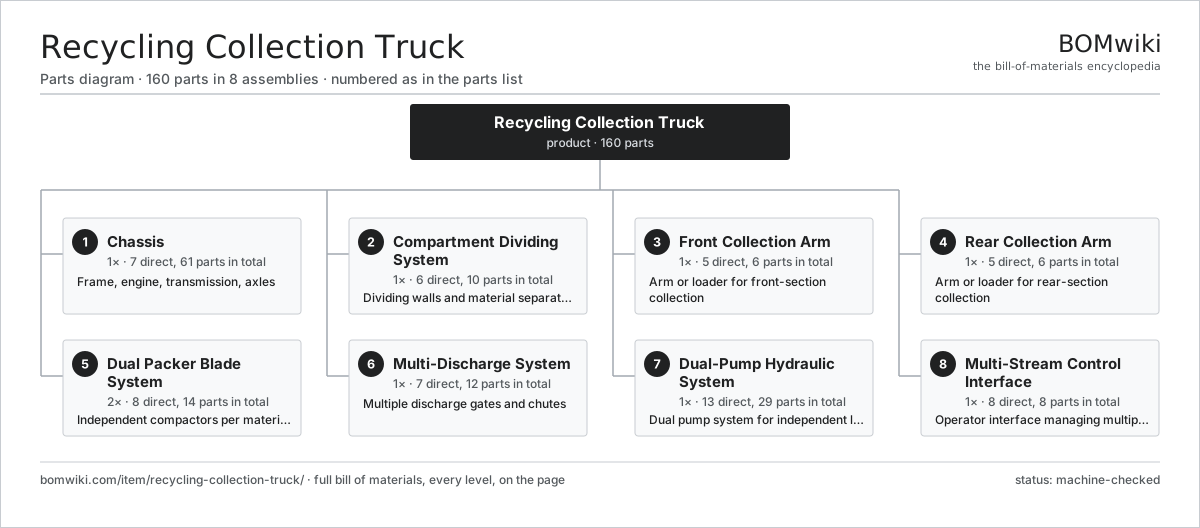
| # | Part | Qty | What it does |
|---|---|---|---|
| 1 | Chassis 7 parts | 1× | Frame, engine, transmission, axles |
| 2 | Compartment Dividing System 6 parts | 1× | Dividing walls and material separation |
| 3 | Front Collection Arm 5 parts | 1× | Arm or loader for front-section collection |
| 4 | Rear Collection Arm 5 parts | 1× | Arm or loader for rear-section collection |
| 5 | Dual Packer Blade System 8 parts | 2× | Independent compactors per material stream |
| 6 | Multi-Discharge System 7 parts | 1× | Multiple discharge gates and chutes |
| 7 | Dual-Pump Hydraulic System 13 parts | 1× | Dual pump system for independent lift control |
| 8 | Multi-Stream Control Interface 8 parts | 1× | Operator interface managing multiple streams |
3D model
No 3D model yet. Have a CAD file of this? Add a 3D model — STL renders right on this page; STEP, FreeCAD, and OpenSCAD sources are welcome too (openly licensed, like all 3D models on BOMwiki).
Build & assembly graph
expand / collapse · shared sub-assemblies converge · links to related products · est. labourTap an assembly to expand/collapse · tap a part to open it · use “Open page” for any node · drag to pan, scroll to zoom.
Bill of materials for Recycling Collection Truck
8 top-level lines · 72 rows shown · 160 parts total · indented to 3 levels| # | Item / sub-assembly | Part no. | Qty/assy | Ext. qty | Parts | Type |
|---|---|---|---|---|---|---|
| 1 | Chassis 7 parts | recycling-collection-truck-chassis | 1× | 1 | 61 | assembly |
| 1.1 | Extended Steel Frame | recycling-collection-truck-frame | 1× | 1 | · | part |
| 1.2 | Diesel Engine | recycling-collection-truck-engine | 1× | 1 | · | part |
| 1.3 | Transmission | recycling-collection-truck-transmission | 1× | 1 | · | part |
| 1.4 | Axles | recycling-collection-truck-axles | 2× | 2 | · | part |
| 1.5 | Operator Cabin | recycling-collection-truck-cab | 1× | 1 | · | part |
| 1.6 | Wheel Assembly 5 parts | wheel-assembly | 6× | 6 | 9 | assembly |
| 1.6.1 | Alloy Wheel | alloy-wheel | 1× | 6 | · | part |
| 1.6.2 | Tire | tire | 1× | 6 | · | part |
| 1.6.3 | TPMS Sensor | tpms-sensor | 1× | 6 | · | part |
| 1.6.4 | Lug Nut | lug-nut | 5× | 30 | · | part |
| 1.6.5 | Valve Stem | valve-stem | 1× | 6 | · | part |
| 1.7 | Fuel Tank | recycling-collection-truck-fuel-tank | 1× | 1 | · | part |
| 2 | Compartment Dividing System 6 parts | recycling-collection-truck-compartment-system | 1× | 1 | 10 | assembly |
| 2.1 | Front Partition Wall | recycling-collection-truck-partition-wall-front | 1× | 1 | · | part |
| 2.2 | Middle Partition Wall | recycling-collection-truck-partition-wall-middle | 1× | 1 | · | part |
| 2.3 | Rear Partition Wall | recycling-collection-truck-partition-wall-rear | 1× | 1 | · | part |
| 2.4 | Material Feed Chute | recycling-collection-truck-material-chute | 2× | 2 | · | part |
| 2.5 | Section Seal Gasket | recycling-collection-truck-section-seal | 2× | 2 | · | part |
| 2.6 | O-Ring Set | oring-set | 3× | 3 | · | part |
| 3 | Front Collection Arm 5 parts | recycling-collection-truck-lift-system-front | 1× | 1 | 6 | assembly |
| 3.1 | Front Boom Arm | recycling-collection-truck-boom-front | 1× | 1 | · | part |
| 3.2 | Front Claw | recycling-collection-truck-claw-front | 1× | 1 | · | part |
| 3.3 | Front Arm Cylinder | recycling-collection-truck-actuator-front | 2× | 2 | · | part |
| 3.4 | Front Arm Pivot | recycling-collection-truck-pivot-front | 1× | 1 | · | part |
| 3.5 | Pressure Sensor | pressure-sensor | 1× | 1 | · | part |
| 4 | Rear Collection Arm 5 parts | recycling-collection-truck-lift-system-rear | 1× | 1 | 6 | assembly |
| 4.1 | Rear Boom Arm | recycling-collection-truck-boom-rear | 1× | 1 | · | part |
| 4.2 | Rear Claw | recycling-collection-truck-claw-rear | 1× | 1 | · | part |
| 4.3 | Rear Arm Cylinder | recycling-collection-truck-actuator-rear | 2× | 2 | · | part |
| 4.4 | Rear Arm Pivot | recycling-collection-truck-pivot-rear | 1× | 1 | · | part |
| 4.5 | Pressure Sensor | pressure-sensor | 1× | 1 | · | part |
| 5 | Dual Packer Blade System 8 parts | recycling-collection-truck-packer-modules | 2× | 2 | 14 | assembly |
| 5.1 | Primary Packer Blade | recycling-collection-truck-packer-blade-primary | 1× | 2 | · | part |
| 5.2 | Secondary Packer Blade | recycling-collection-truck-packer-blade-secondary | 1× | 2 | · | part |
| 5.3 | Primary Packer Cylinders | recycling-collection-truck-packer-cylinders-primary | 2× | 4 | · | part |
| 5.4 | Secondary Packer Cylinders | recycling-collection-truck-packer-cylinders-secondary | 2× | 4 | · | part |
| 5.5 | Primary Blade Guide Rails | recycling-collection-truck-blade-guides-primary | 2× | 4 | · | part |
| 5.6 | Secondary Blade Guide Rails | recycling-collection-truck-blade-guides-secondary | 2× | 4 | · | part |
| 5.7 | Blade Seal Kit | recycling-collection-truck-blade-seals | 2× | 4 | · | part |
| 5.8 | Pressure Sensor | pressure-sensor | 2× | 4 | · | part |
| 6 | Multi-Discharge System 7 parts | recycling-collection-truck-discharge-system | 1× | 1 | 12 | assembly |
| 6.1 | Primary Tailgate | recycling-collection-truck-discharge-gate-primary | 1× | 1 | · | part |
| 6.2 | Secondary Discharge Gate | recycling-collection-truck-discharge-gate-secondary | 1× | 1 | · | part |
| 6.3 | Primary Discharge Chute | recycling-collection-truck-discharge-chute-primary | 1× | 1 | · | part |
| 6.4 | Secondary Discharge Chute | recycling-collection-truck-discharge-chute-secondary | 1× | 1 | · | part |
| 6.5 | Gate Latch | recycling-collection-truck-gate-latch | 2× | 2 | · | part |
| 6.6 | O-Ring Set | oring-set | 2× | 2 | · | part |
| 6.7 | Connector | connector | 4× | 4 | · | part |
| 7 | Dual-Pump Hydraulic System 13 parts | recycling-collection-truck-hydraulics | 1× | 1 | 29 | assembly |
| 7.1 | Primary Hydraulic Pump | recycling-collection-truck-pump-primary | 1× | 1 | · | part |
| 7.2 | Secondary Hydraulic Pump | recycling-collection-truck-pump-secondary | 1× | 1 | · | part |
| 7.3 | Primary Valve Manifold | recycling-collection-truck-manifold-primary | 1× | 1 | · | part |
| 7.4 | Secondary Valve Manifold | recycling-collection-truck-manifold-secondary | 1× | 1 | · | part |
| 7.5 | Primary Hydraulic Filter | recycling-collection-truck-filter-primary | 1× | 1 | · | part |
| 7.6 | Secondary Hydraulic Filter | recycling-collection-truck-filter-secondary | 1× | 1 | · | part |
| 7.7 | Primary Accumulator | recycling-collection-truck-accumulator-primary | 1× | 1 | · | part |
| 7.8 | Secondary Accumulator | recycling-collection-truck-accumulator-secondary | 1× | 1 | · | part |
| 7.9 | Primary Reservoir | recycling-collection-truck-tank-primary | 1× | 1 | · | part |
| 7.10 | Secondary Reservoir | recycling-collection-truck-tank-secondary | 1× | 1 | · | part |
| 7.11 | Pressure Sensor | pressure-sensor | 6× | 6 | · | part |
| 7.12 | Wire Bundle | wire-bundle | 3× | 3 | · | part |
| 7.13 | Connector | connector | 10× | 10 | · | part |
| 8 | Multi-Stream Control Interface 8 parts | recycling-collection-truck-controls | 1× | 1 | 8 | assembly |
| 8.1 | Front Control Panel | recycling-collection-truck-control-panel-front | 1× | 1 | · | part |
| 8.2 | Rear Control Panel | recycling-collection-truck-control-panel-rear | 1× | 1 | · | part |
| 8.3 | Packer Mode Selector | recycling-collection-truck-packer-selector | 1× | 1 | · | part |
| 8.4 | Discharge Mode Selector | recycling-collection-truck-discharge-selector | 1× | 1 | · | part |
| 8.5 | Load Monitor Display | recycling-collection-truck-load-display | 1× | 1 | · | part |
| 8.6 | Safety Interlock | recycling-collection-truck-safety-interlock | 1× | 1 | · | part |
| 8.7 | Warning System | recycling-collection-truck-audible-alarm | 1× | 1 | · | part |
| 8.8 | Microcontroller | mcu | 1× | 1 | · | part |
Related products
same domain, ranked by shared parts Coupe Car
1,617 parts · shares 8 with this page
Coupe Car
1,617 parts · shares 8 with this page
 Food Truck
197 parts · shares 8 with this page
Food Truck
197 parts · shares 8 with this page
 Food Waste Collection Truck
95 parts · shares 8 with this page
Food Waste Collection Truck
95 parts · shares 8 with this page
 Front Loader Refuse Truck
131 parts · shares 8 with this page
Front Loader Refuse Truck
131 parts · shares 8 with this page
 Grapple Truck
146 parts · shares 8 with this page
Litter Vacuum Truck
101 parts · shares 8 with this page
Grapple Truck
146 parts · shares 8 with this page
Litter Vacuum Truck
101 parts · shares 8 with this page
Sourcing: possible vendors
Prices, MOQ, and lead times are algorithmic estimates, not quotes, and not claims about these companies. Company mappings are curated by keyword; est. price band $8k–$90k. How estimates work| Vendor | HQ | Specialty | MOQ | Lead time |
|---|---|---|---|---|
|
🇯🇵Toyota
global.toyota ↗
|
Toyota City, JP | Automaker | made to order | 16–28 wks |
| volkswagen-group.com ↗ | Wolfsburg, DE | Automaker | made to order | 16–28 wks |
| gm.com ↗ | Detroit, US | Automaker | made to order | 16–28 wks |
| hyundai.com ↗ | Seoul, KR | Automaker | made to order | 16–28 wks |
|
🇨🇳BYD
byd.com ↗
|
Shenzhen, CN | EV & battery manufacturer | made to order | 16–28 wks |
1,459-word article