Refractor Telescope
ProductOverview
The refractor telescope is the oldest and most elegant optical design. A simple objective lens bends starlight toward a focal point, and an eyepiece magnifies the real image formed there. No mirrors to align, no obstruction of light: just glass and starlight. Refractors deliver crisp, high-contrast views, especially at high magnification, and their sealed tubes require no maintenance compared to open reflectors. They dominate planetary observation and continue to excel in deep-sky work.
The objective is the optical workhorse, a combination of lens elements designed to bring light of all colors to the same focus and minimize aberrations. Early refractors used only a single lens, which meant the red and blue wavelengths focused at different distances, a defect called chromatic aberration. Modern objectives use two or three elements made of different glasses (ED or APO designs) to bring most colors to the same point, yielding a sharp image across the field.
The Main Tube Assembly is a sealed tube housing the entire optical path. At the back, the Focuser Unit moves the diagonal mirror and eyepiece into precise focus. The Dew Shield Extension extends beyond the objective to prevent dew from condensing on the lens surface on cool nights, a frequent problem in refractors because the front lens is exposed to the open sky. The Finder Scope helps you locate targets before diving in with magnification.
How it works
Starlight enters as parallel rays and the objective lens group bends them to converge. A single lens would focus red light at one distance and blue light at another; multi-element objectives use carefully chosen glasses to bring most wavelengths into focus at the same point, yielding a sharp image. The converging light forms a real image inside the tube, small and inverted.
The Diagonal Mirror sits near the focal point and bounces this real image sideways toward the eyepiece, which acts as a magnifying glass. The magnification is simply the focal length of the objective divided by the focal length of the eyepiece: a 1000 mm objective with a 10 mm eyepiece yields 100×. Higher magnifications use shorter focal-length eyepieces, but the view gets dimmer because the light spreads over a larger area of your eye's retina.
Collimation is seldom needed in refractors because the objective is factory-aligned and sealed. Unlike reflectors, where you routinely align mirrors, a refractor's optical axis is set once and tends to stay true. Small screws on the objective cell allow collimation if necessary, but most observers never touch them.
The Focuser Unit moves the drawtube in and out, shifting the eyepiece distance to bring the image into sharp focus. Helical focusers (a threaded screw) offer smooth motion and fine control, while rack-and-pinion focusers (a gear and rack) move faster but with less precision. Either way, the goal is to position the eyepiece at the point where the objective's image forms.
The dew shield is a practical necessity in refractors. As the night cools, moisture condenses on cold glass surfaces. The objective, exposed to the sky, cools faster than the air around it and becomes a magnet for dew. The shield, a tube extension that sticks out beyond the objective, keeps humid air away from the lens, preventing condensation and maintaining optical performance all night.
Refractor Telescope parts and their functions
10 top-level parts · 43 parts in total · full bill of materials below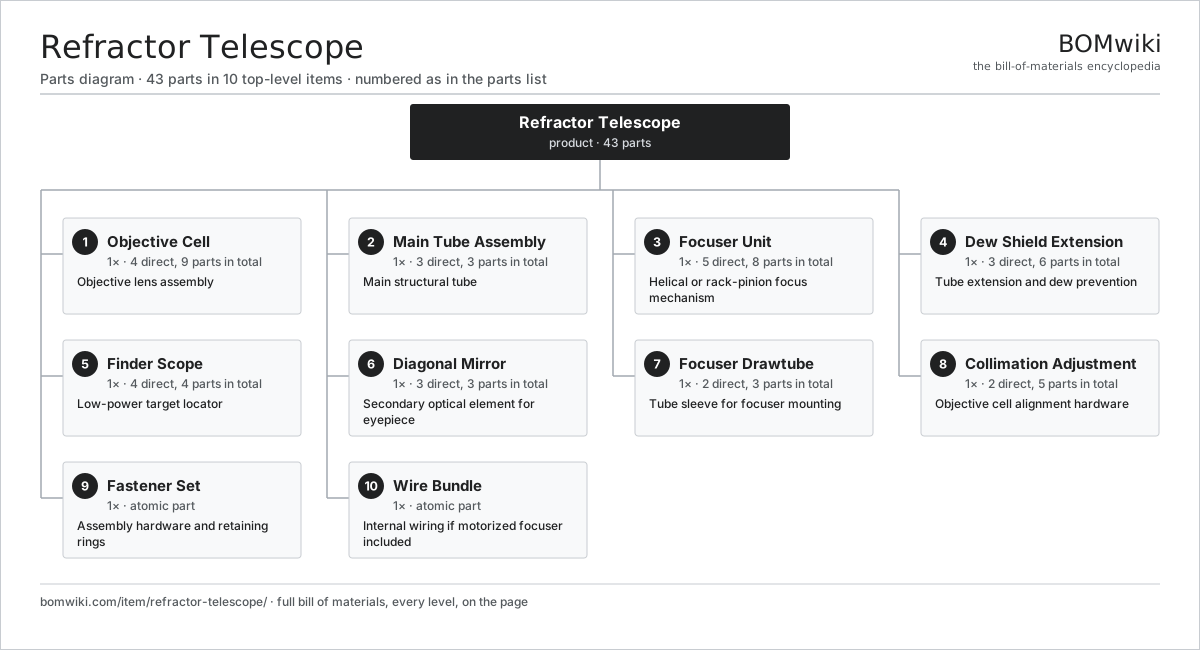
| # | Part | Qty | What it does |
|---|---|---|---|
| 1 | Objective Cell 4 parts | 1× | Objective lens assembly |
| 2 | Main Tube Assembly 3 parts | 1× | Main structural tube |
| 3 | Focuser Unit 5 parts | 1× | Helical or rack-pinion focus mechanism |
| 4 | Dew Shield Extension 3 parts | 1× | Tube extension and dew prevention |
| 5 | Finder Scope 4 parts | 1× | Low-power target locator |
| 6 | Diagonal Mirror 3 parts | 1× | Secondary optical element for eyepiece |
| 7 | Focuser Drawtube 2 parts | 1× | Tube sleeve for focuser mounting |
| 8 | Collimation Adjustment 2 parts | 1× | Objective cell alignment hardware |
| 9 | Fastener Set | 1× | Assembly hardware and retaining rings |
| 10 | Wire Bundle | 1× | Internal wiring if motorized focuser included |
3D model
No 3D model yet. Have a CAD file of this? Add a 3D model. STL renders right on this page; STEP, FreeCAD, and OpenSCAD sources are welcome too (openly licensed, like all 3D models on BOMwiki).
Build & assembly graph
expand / collapse · shared sub-assemblies converge · links to related products · est. labourTap an assembly to expand/collapse · tap a part to open it · use “Open page” for any node · drag to pan, scroll to zoom.
Bill of materials for Refractor Telescope
10 top-level lines · 38 rows shown · 43 parts total · indented to 3 levels| # | Item / sub-assembly | Part no. | Qty/assy | Ext. qty | Parts | Type |
|---|---|---|---|---|---|---|
| 1 | Objective Cell 4 parts | refractor-telescope-objective-cell | 1× | 1 | 9 | assembly |
| 1.1 | Objective Lens Group | refractor-telescope-objective-glass | 1× | 1 | · | part |
| 1.2 | Objective Holder Ring | refractor-telescope-objective-holder | 1× | 1 | · | part |
| 1.3 | Lens Spacing Ring | refractor-telescope-lens-spacing-rings | 4× | 4 | · | part |
| 1.4 | Cell Collimation Screw | refractor-telescope-cell-adjustment-screws | 3× | 3 | · | part |
| 2 | Main Tube Assembly 3 parts | refractor-telescope-optical-tube | 1× | 1 | 3 | assembly |
| 2.1 | Tube Body | refractor-telescope-tube-body | 1× | 1 | · | part |
| 2.2 | Mounting Rings | refractor-telescope-tube-rings | 1× | 1 | · | part |
| 2.3 | Internal Baffles | refractor-telescope-internal-baffles | 1× | 1 | · | part |
| 3 | Focuser Unit 5 parts | refractor-telescope-focuser-assembly | 1× | 1 | 8 | assembly |
| 3.1 | Focuser Drawtube 2 parts | refractor-telescope-focuser-tube | 1× | 1 | 3 | assembly |
| 3.1.1 | Drawtube Body | refractor-telescope-drawtube-body | 1× | 1 | · | part |
| 3.1.2 | Drawtube Stop Ring | refractor-telescope-drawtube-stops | 2× | 2 | · | part |
| 3.2 | Focuser Rack | refractor-telescope-focuser-rack | 1× | 1 | · | part |
| 3.3 | Focuser Pinion | refractor-telescope-focuser-pinion | 1× | 1 | · | part |
| 3.4 | Helical Focuser Screw | refractor-telescope-focuser-helical-screw | 1× | 1 | · | part |
| 3.5 | Focuser Knob | refractor-telescope-focuser-knobs | 2× | 2 | · | part |
| 4 | Dew Shield Extension 3 parts | refractor-telescope-dew-shield | 1× | 1 | 6 | assembly |
| 4.1 | Dew Shield Tube | refractor-telescope-dew-shield-tube | 1× | 1 | · | part |
| 4.2 | Extension Ring | refractor-telescope-dew-shield-extension | 1× | 1 | · | part |
| 4.3 | Dew Shield Fastener | refractor-telescope-dew-shield-fasteners | 4× | 4 | · | part |
| 5 | Finder Scope 4 parts | refractor-telescope-finder-scope | 1× | 1 | 4 | assembly |
| 5.1 | Finder Objective Lens | refractor-telescope-finder-objective | 1× | 1 | · | part |
| 5.2 | Finder Eyepiece | refractor-telescope-finder-eyepiece | 1× | 1 | · | part |
| 5.3 | Finder Tube | refractor-telescope-finder-body | 1× | 1 | · | part |
| 5.4 | Finder Mounting Bracket | refractor-telescope-finder-bracket | 1× | 1 | · | part |
| 6 | Diagonal Mirror 3 parts | refractor-telescope-diagonal-mirror | 1× | 1 | 3 | assembly |
| 6.1 | Mirror Glass | refractor-telescope-diagonal-glass | 1× | 1 | · | part |
| 6.2 | Mirror Holder | refractor-telescope-diagonal-holder | 1× | 1 | · | part |
| 6.3 | Secondary Cell | refractor-telescope-diagonal-secondary-cell | 1× | 1 | · | part |
| 7 | Focuser Drawtube 2 parts | refractor-telescope-focuser-tube | 1× | 1 | 3 | assembly |
| 7.1 | Drawtube Body | refractor-telescope-drawtube-body | 1× | 1 | · | part |
| 7.2 | Drawtube Stop Ring | refractor-telescope-drawtube-stops | 2× | 2 | · | part |
| 8 | Collimation Adjustment 2 parts | refractor-telescope-collimation-adjustment | 1× | 1 | 5 | assembly |
| 8.1 | Objective Cell Screw | refractor-telescope-objective-cell-screws | 3× | 3 | · | part |
| 8.2 | Diagonal Adjust Screw | refractor-telescope-diagonal-adjust-screws | 2× | 2 | · | part |
| 9 | Fastener Set | fastener-set | 1× | 1 | · | part |
| 10 | Wire Bundle | wire-bundle | 1× | 1 | · | part |
Something wrong in this list? Report a problem with this BOM.
Related products
same domain, ranked by shared parts 35mm Film SLR Camera
75 parts · shares 1 with this page
35mm Film SLR Camera
75 parts · shares 1 with this page
 Action Camera
271 parts · shares 1 with this page
Astro Camera
27 parts · shares 1 with this page
Action Camera
271 parts · shares 1 with this page
Astro Camera
27 parts · shares 1 with this page
 Autoguider
31 parts · shares 1 with this page
Autoguider
31 parts · shares 1 with this page
 Camera Gimbal Stabilizer
177 parts · shares 1 with this page
Camera Gimbal Stabilizer
177 parts · shares 1 with this page
 Camera Jib Crane
67 parts · shares 1 with this page
Camera Jib Crane
67 parts · shares 1 with this page
Sourcing: possible vendors
Browse the supplier directory → Prices, MOQ, and lead times are algorithmic estimates, not quotes, and not claims about these companies. Company mappings are curated by keyword; est. price band $100–$8k. How estimates work| Vendor | HQ | Specialty | MOQ | Lead time |
|---|---|---|---|---|
|
🇯🇵Canon
canon.com ↗
|
Tokyo, JP | Imaging & optics | 500 units | 10–16 wks |
|
🇯🇵Nikon
nikon.com ↗
|
Tokyo, JP | Imaging & optics | 500 units | 10–16 wks |
|
🇩🇪ZEISS
zeiss.com ↗
|
Oberkochen, DE | Optics & optoelectronics | 500 units | 10–16 wks |
| leica-camera.com ↗ | Wetzlar, DE | Cameras & optics | 500 units | 10–16 wks |
| flir.com ↗ | Wilsonville, US | Thermal imaging | 500 units | 10–16 wks |
592-word article