Remote Radio Head
ProductOverview
A remote radio head (RRH) is a distributed radio access network (RAN) architecture component that splits the base station into two physical units: a centralized baseband processing unit (BBU) located in a shelter or central office, and the RRH mounted at or near the antenna on the tower. The baseband processor (FPGA or ASIC) in the RRH performs Layer 1 modulation, demodulation, coding, and precoding, while the BBU in the shelter performs higher-layer functions (L2/L3). Baseband samples are exchanged between the two units over a fiber optic link using the Common Public Radio Interface (CPRI) protocol.
The key advantage of RRH architecture is elimination of long coaxial feeder cables. In a traditional base station, RF signals travel 100–300 feet from the antenna through a lossy feeder to the shelter. This cable loss introduces noise figure degradation and requires larger power amplifiers to compensate. With an RRH, only low-power baseband signals (millivolts amplitude) travel through the fiber, eliminating cable loss entirely. Fiber also provides immunity to electromagnetic interference and is weather-resistant, simplifying installation on exposed towers.
The Baseband Processor implements the 3GPP Layer 1 physical layer: FFT (for OFDM reception), channel equalization, turbo decoding (4G) or polar decoding (5G), and uplink processing (FFT, PAPR reduction). On transmit, it performs IFFT, modulation, coding, and precoding. The processor is typically an FPGA or vendor-specific ASIC, dissipating 30–50 W during peak load.
The RF Transceiver implements TX and RX signal chains. The RX path includes a RX Chain with a 0.5–0.8 dB noise-figure LNA, downconverter, and filtering, preparing RF signals for the Analog Frontend ADC. The TX path includes TX Chain upconverting baseband to RF, and a Power Amplifier delivering 20–46 dBm output.
Baseband samples (IQ pairs) are converted to optical format by a Fiber Interface, implementing the CPRI v7.0 protocol. CPRI multiplexes IQ samples, timing, and control over a 10.3 Gbps optical link, providing sufficient bandwidth for multiple carriers or wideband signals. The fiber carries timing information from the BBU to the RRH, maintaining bit-perfect synchronization across a 10+ km span.
Power is delivered from the shelter as 48V DC, stepped down by the Power Supply to multiple isolated rails for RF, baseband, and fiber circuits. The Cooling System dissipates 30–50 W via passive aluminum heatsinks, relying on natural convection and tower airflow.
The entire RRH is housed in an IP67-sealed Enclosure, protecting all components from rain, salt spray, and temperature extremes. Cable entry is via sealed M20/M25 glands, and the unit is mounted directly on the antenna platform or mast via Mounting Feet.
How It Works
The BBU (not shown in this product file, but the other half of the RRH system) encodes voice/data, performs HARQ feedback processing, and generates baseband IQ samples at a high data rate (gigabit-scale). These samples are serialized over the CPRI fiber link by the Fiber Interface, which also recovers timing from the link.
The RRH Baseband Processor deserializes the CPRI stream, recovers the IQ samples, and applies Layer 1 processing: modulation shaping, precoding for MIMO, and PAPR reduction. The resulting RF signal is generated by the TX Chain and amplified by the Power Amplifier, then passes through the TX/RX Duplexer and into the antenna.
Downlink reception is symmetric: RF signals arrive at the antenna, pass through the duplexer, and enter the RX Chain. The RX path amplifies the weak signal (–80 to –120 dBm), downconverts to baseband, and passes IQ samples to the Analog Frontend ADC. The Baseband Processor applies FFT, equalization, and decoding, recovering the data. The recovered IQ samples are serialized back over CPRI to the BBU, which performs higher-layer processing and sends user data to the core network.
Synchronization is critical: all RRHs on the same site must transmit on the same symbol timing (to within nanoseconds) to enable coherent combining and handover. The CPRI fiber carries timing information from the BBU's reference clock (typically locked to GPS), ensuring all RRHs remain synchronized.
Benefits and Tradeoffs
Benefits:
- No feeder cable loss: improved sensitivity and coverage range
- Fiber backhaul is immune to EMI and weather-resistant
- Simpler tower wiring and installation
- Easier capacity scaling: add BBU processing, not new towers
Tradeoffs:
- Fiber infrastructure required: CWDM/DWDM multiplexers, fiber runs, careful routing
- CPRI protocol overhead: 10.3 Gbps fronthaul for a 100 MHz carrier (10–20 Gbps per RRH)
- Latency: BBU-to-RRH round trip ~1 ms over 10 km fiber; must be accounted for in timing loops
- Higher cost per RRH (FPGA/ASIC, fiber transceiver, PA)
RRHs are popular in operator networks for large deployments and dense urban cells, where multiple RRHs on one shelf feed a shared BBU, reducing capital and power consumption compared to traditional distributed base stations.
Maintenance
RRHs are solid-state with no moving parts, providing high reliability. Key failure modes include:
Fiber Link Loss: Fiber cuts, connector contamination, or receiver/transmitter failure can black out the RRH. Continuous monitoring of CPRI link status is essential, with alarms for loss of signal.
Power Amplifier Degradation: The PA may lose efficiency or gain over years of operation, requiring recalibration or replacement.
Thermal Runaway: If heatsinks are blocked by dirt or ice, the die temperature may rise, reducing performance or causing thermal shutdown. Regular visual inspection and cleaning are recommended.
Most deployments include redundancy: two RRHs per sector with dual fiber links, allowing continued operation if one RRH or link fails.
Remote Radio Head parts and their functions
7 top-level parts · 26 parts in total · full bill of materials below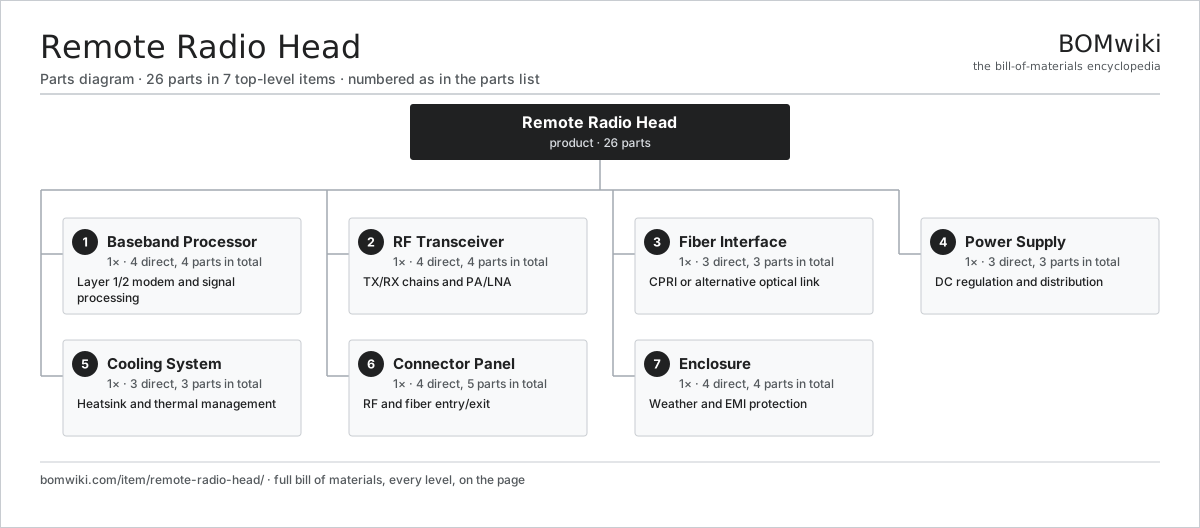
| # | Part | Qty | What it does |
|---|---|---|---|
| 1 | Baseband Processor 4 parts | 1× | Layer 1/2 modem and signal processing |
| 2 | RF Transceiver 4 parts | 1× | TX/RX chains and PA/LNA |
| 3 | Fiber Interface 3 parts | 1× | CPRI or alternative optical link |
| 4 | Power Supply 3 parts | 1× | DC regulation and distribution |
| 5 | Cooling System 3 parts | 1× | Heatsink and thermal management |
| 6 | Connector Panel 4 parts | 1× | RF and fiber entry/exit |
| 7 | Enclosure 4 parts | 1× | Weather and EMI protection |
3D model
No 3D model yet. Have a CAD file of this? Add a 3D model. STL renders right on this page; STEP, FreeCAD, and OpenSCAD sources are welcome too (openly licensed, like all 3D models on BOMwiki).
Build & assembly graph
expand / collapse · shared sub-assemblies converge · links to related products · est. labourTap an assembly to expand/collapse · tap a part to open it · use “Open page” for any node · drag to pan, scroll to zoom.
Bill of materials for Remote Radio Head
7 top-level lines · 32 rows shown · 26 parts total · indented to 3 levels| # | Item / sub-assembly | Part no. | Qty/assy | Ext. qty | Parts | Type |
|---|---|---|---|---|---|---|
| 1 | Baseband Processor 4 parts | remote-radio-head-baseband-processor | 1× | 1 | 4 | assembly |
| 1.1 | FPGA/ASIC | remote-radio-head-fpga-or-asic | 1× | 1 | · | part |
| 1.2 | Analog Frontend | remote-radio-head-analog-frontend | 1× | 1 | · | part |
| 1.3 | Memory Subsystem | remote-radio-head-memory-subsystem | 1× | 1 | · | part |
| 1.4 | Clock Recovery | remote-radio-head-clock-recovery | 1× | 1 | · | part |
| 2 | RF Transceiver 4 parts | remote-radio-head-rf-transceiver | 1× | 1 | 4 | assembly |
| 2.1 | Power Amplifier | remote-radio-head-power-amplifier | 1× | 1 | · | part |
| 2.2 | TX Chain | remote-radio-head-tx-chain | 1× | 1 | · | part |
| 2.3 | RX Chain | remote-radio-head-rx-chain | 1× | 1 | · | part |
| 2.4 | TX/RX Duplexer | remote-radio-head-tx-rx-duplexer | 1× | 1 | · | part |
| 3 | Fiber Interface 3 parts | remote-radio-head-fiber-interface | 1× | 1 | 3 | assembly |
| 3.1 | Optical Transceiver | remote-radio-head-optical-transceiver | 1× | 1 | · | part |
| 3.2 | CPRI Framing IC | remote-radio-head-cpri-framing | 1× | 1 | · | part |
| 3.3 | Fiber Connector | remote-radio-head-fiber-connector | 1× | 1 | · | part |
| 4 | Power Supply 3 parts | remote-radio-head-power-supply | 1× | 1 | 3 | assembly |
| 4.1 | Main DC-DC | remote-radio-head-main-dcdc | 1× | 1 | · | part |
| 4.2 | Isolated Rail Supply | remote-radio-head-isolated-ov-supply | 1× | 1 | · | part |
| 4.3 | Analog LDO | remote-radio-head-analog-ldo | 1× | 1 | · | part |
| 5 | Cooling System 3 parts | remote-radio-head-cooling-system | 1× | 1 | 3 | assembly |
| 5.1 | Baseband Heatsink | remote-radio-head-cpu-heatsink | 1× | 1 | · | part |
| 5.2 | PA Heatsink | remote-radio-head-pa-heatsink | 1× | 1 | · | part |
| 5.3 | Thermal Interface Material | remote-radio-head-thermal-interface | 1× | 1 | · | part |
| 6 | Connector Panel 4 parts | remote-radio-head-connector-panel | 1× | 1 | 5 | assembly |
| 6.1 | N-Type RF Connector | remote-radio-head-n-type-connector | 2× | 2 | · | part |
| 6.2 | Power Connector | remote-radio-head-power-connector | 1× | 1 | · | part |
| 6.3 | Fiber Bulkhead | remote-radio-head-fiber-bulkhead | 1× | 1 | · | part |
| 6.4 | Management Connector | remote-radio-head-mgmt-connector | 1× | 1 | · | part |
| 7 | Enclosure 4 parts | remote-radio-head-enclosure | 1× | 1 | 4 | assembly |
| 7.1 | Aluminum Body | remote-radio-head-cast-aluminum-body | 1× | 1 | · | part |
| 7.2 | Gasket | remote-radio-head-gasket-seal | 1× | 1 | · | part |
| 7.3 | Cable Gland | remote-radio-head-cable-gland | 1× | 1 | · | part |
| 7.4 | Mounting Feet | remote-radio-head-mounting-feet | 1× | 1 | · | part |
Something wrong in this list? Report a problem with this BOM.
Sourcing: possible vendors
Browse the supplier directory → Prices, MOQ, and lead times are algorithmic estimates, not quotes, and not claims about these companies. Company mappings are curated by keyword; est. price band $30–$50k. How estimates work| Vendor | HQ | Specialty | MOQ | Lead time |
|---|---|---|---|---|
|
🇺🇸Cisco
cisco.com ↗
|
San Jose, US | Networking | 500 units | 8–14 wks |
|
🇺🇸Juniper
juniper.net ↗
|
Sunnyvale, US | Networking | 500 units | 8–14 wks |
| arista.com ↗ | Santa Clara, US | Networking | 500 units | 8–14 wks |
|
🇫🇮Nokia
nokia.com ↗
|
Espoo, FI | Telecom equipment | 500 units | 8–14 wks |
|
🇨🇳Huawei
huawei.com ↗
|
Shenzhen, CN | Networking & telecom | 500 units | 8–14 wks |
970-word article