Rendering Cooker
ProductOverview
Rendering is the process of converting animal tissues, bone, meat, hide, offal, blood, and feathers, into two products: rendered fat (tallow, lard) and protein meal. The Rendering Cooker is a batch vessel where raw tissue is heated under steam to liquefy fat, denature and separate protein solids, and drive off water and volatile compounds.
Rendered fat is used in biodiesel feedstock, lubricants, soap, and specialty food applications. The protein cake is dried and used as animal feed. The process recovers economic value from waste streams in slaughterhouses and meat processing plants.
Chemistry of rendering
Animal tissue is 30–70% water, 10–35% fat, and 5–20% protein by weight. When heated above 55°C, fat begins to melt. At 100°C, water boils; steam provides stripping action and heat transfer. Protein denatures around 65–75°C, ceasing to hold emulsified fat. The fat separates as a continuous liquid phase, drains downward by gravity, and the solids settle at the vessel bottom.
The Cooking Vessel is heated by a Steam Supply and Injection, both indirect jacket heating and direct steam sparge injection. Temperature is tightly controlled at 100–120°C (or 5–10 bar hydrostatic in pressure cookers) to avoid fatty acid breakdown and minimize oxidative rancidity.
Batch cooking process
Raw tissue, a heterogeneous mix of meat, bone, hide, and offal from a slaughterhouse, is charged into the Cooking Vessel. The Steam Supply and Injection heats the mass to 100–120°C over 30–60 minutes.
Throughout cooking, the Agitator Assembly rotating at 5–15 rpm gently stirs to keep solids suspended and promote fat liberation. As fat melts, it drains toward the bottom; Discharge Screen prevents large solids from exiting the Discharge and Separation.
Cooking duration is 2–6 hours depending on tissue composition and desired dryness of the cake. Longer cooking drives more water off, yielding drier cake but increasing oxidation risk.
Vapor management
The Vapor and Smell Recovery captures steam and odor-bearing volatiles above the vessel. A Vapor Hood funnels vapors to a Vapor Condenser, which cools and condenses water and water-soluble compounds. A Exhaust Blower extracts non-condensable vapors to an odor control unit (scrubber or thermal oxidizer).
This closed system prevents odor release to the environment, critical in urban meat processing settings.
Fat discharge and recovery
When cooking is complete, the Fat Drain Valve, a large-orifice gate valve, is opened. Liquid fat drains into a Settling Tank where it separates from residual water. The fat settles and is drawn off to storage or refining; water collects at the tank bottom and is drained.
Simultaneously or sequentially, the Cake Discharge Chute is opened, and the hot, compact solids cake is discharged into a collection bin or conveyor for cooling and grinding.
Pressure cooking variant
Some installations operate at 5–10 bar hydrostatic pressure (using a closed lid and relief valve), raising cooking temperature to 130–150°C. This accelerates fat rendering by 3–4x and reduces batch time to 1–2 hours. The trade-off is higher equipment cost and complexity, plus greater oxidation risk. Pressure cookers are used for high-throughput facilities where energy cost and space are critical.
Control and safety
The Temperature and Pressure Control maintain temperature within ±5°C by modulating the Steam Supply and Injection. A Temperature Sensor probe monitors bulk temperature; a relay controls the thermostatic steam valve.
In pressure cookers, a relief valve prevents overpressure. All vessels are designed and inspected per ASME Boiler & Pressure Vessel Code.
Product quality
Rendered fat quality depends on:
- Free fatty acid (FFA): 2–5% in cooked fat (low-quality feedstock → higher FFA)
- Water content: target < 1% (residual moisture reduces oxidation stability)
- Oxidation (peroxide value): < 10 meq/kg is acceptable
- Color: light tan to brown depending on tissue source and cooking time
Low-temperature rendering (95–105°C) produces lighter, higher-grade tallow; high-temperature rendering (120–150°C) darkens the product but speeds processing.
The protein cake, after cooling and grinding, is analyzed for crude protein (typically 40–50%), ash (3–5%), and fat (3–8%). It is sold as animal feed or poultry meal.
Environmental and regulatory aspects
Rendering produces a condensate stream (water from cooking) rich in dissolved proteins and fat. This waste requires treatment, either biological (anaerobic digestion) or physical (centrifugal separation and incineration). Modern regulations in EU, USA, and Asia mandate odor control and wastewater pretreatment before discharge.
Integration in the value chain
Rendering facilities are typically collocated with slaughterhouses or positioned as standalone waste processors. Output, tallow and protein meal, are commodities with global markets. In integrated biodiesel production, rendered fat is a primary feedstock. In petfood manufacturing, rendered meal is a protein ingredient.
Rendering Cooker parts and their functions
7 top-level parts · 28 parts in total · full bill of materials below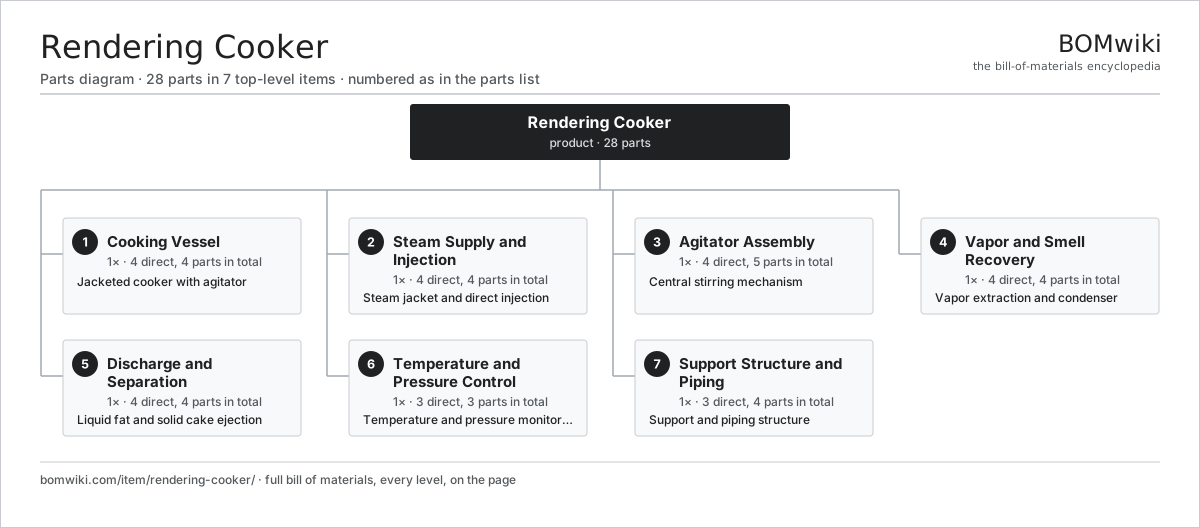
| # | Part | Qty | What it does |
|---|---|---|---|
| 1 | Cooking Vessel 4 parts | 1× | Jacketed cooker with agitator |
| 2 | Steam Supply and Injection 4 parts | 1× | Steam jacket and direct injection |
| 3 | Agitator Assembly 4 parts | 1× | Central stirring mechanism |
| 4 | Vapor and Smell Recovery 4 parts | 1× | Vapor extraction and condenser |
| 5 | Discharge and Separation 4 parts | 1× | Liquid fat and solid cake ejection |
| 6 | Temperature and Pressure Control 3 parts | 1× | Temperature and pressure monitoring |
| 7 | Support Structure and Piping 3 parts | 1× | Support and piping structure |
3D model
No 3D model yet. Have a CAD file of this? Add a 3D model. STL renders right on this page; STEP, FreeCAD, and OpenSCAD sources are welcome too (openly licensed, like all 3D models on BOMwiki).
Build & assembly graph
expand / collapse · shared sub-assemblies converge · links to related products · est. labourTap an assembly to expand/collapse · tap a part to open it · use “Open page” for any node · drag to pan, scroll to zoom.
Bill of materials for Rendering Cooker
7 top-level lines · 33 rows shown · 28 parts total · indented to 3 levels| # | Item / sub-assembly | Part no. | Qty/assy | Ext. qty | Parts | Type |
|---|---|---|---|---|---|---|
| 1 | Cooking Vessel 4 parts | rendering-cooker-vessel | 1× | 1 | 4 | assembly |
| 1.1 | Cooker Shell | rendering-cooker-vessel-shell | 1× | 1 | · | part |
| 1.2 | Steam Jacket | rendering-cooker-vessel-jacket | 1× | 1 | · | part |
| 1.3 | Discharge Screen | rendering-cooker-outlet-screen | 1× | 1 | · | part |
| 1.4 | Fastener Set | fastener-set | 1× | 1 | · | part |
| 2 | Steam Supply and Injection 4 parts | rendering-cooker-steam-system | 1× | 1 | 4 | assembly |
| 2.1 | Heating Element | heating-element | 1× | 1 | · | part |
| 2.2 | Steam Sparge Ring | rendering-cooker-steam-injector | 1× | 1 | · | part |
| 2.3 | Steam Trap | rendering-cooker-steam-trap | 1× | 1 | · | part |
| 2.4 | Pressure Sensor | pressure-sensor | 1× | 1 | · | part |
| 3 | Agitator Assembly 4 parts | rendering-cooker-agitator | 1× | 1 | 5 | assembly |
| 3.1 | Agitator Shaft | rendering-cooker-agitator-shaft | 1× | 1 | · | part |
| 3.2 | Ball Bearing | ball-bearing | 2× | 2 | · | part |
| 3.3 | Shaft Seal | rendering-cooker-seal-gland | 1× | 1 | · | part |
| 3.4 | Fastener Set | fastener-set | 1× | 1 | · | part |
| 4 | Vapor and Smell Recovery 4 parts | rendering-cooker-vapor-system | 1× | 1 | 4 | assembly |
| 4.1 | Vapor Hood | rendering-cooker-vapor-hood | 1× | 1 | · | part |
| 4.2 | Vapor Condenser | rendering-cooker-vapor-condenser | 1× | 1 | · | part |
| 4.3 | Exhaust Blower | rendering-cooker-blower | 1× | 1 | · | part |
| 4.4 | Pressure Sensor | pressure-sensor | 1× | 1 | · | part |
| 5 | Discharge and Separation 4 parts | rendering-cooker-discharge-system | 1× | 1 | 4 | assembly |
| 5.1 | Fat Drain Valve | rendering-cooker-discharge-valve | 1× | 1 | · | part |
| 5.2 | Settling Tank | rendering-cooker-settling-tank | 1× | 1 | · | part |
| 5.3 | Cake Discharge Chute | rendering-cooker-cake-chute | 1× | 1 | · | part |
| 5.4 | Fastener Set | fastener-set | 1× | 1 | · | part |
| 6 | Temperature and Pressure Control 3 parts | rendering-cooker-controls | 1× | 1 | 3 | assembly |
| 6.1 | Temperature Sensor | rendering-cooker-thermostat | 1× | 1 | · | part |
| 6.2 | Relay | relay | 1× | 1 | · | part |
| 6.3 | Pressure Sensor | pressure-sensor | 1× | 1 | · | part |
| 7 | Support Structure and Piping 3 parts | rendering-cooker-frame | 1× | 1 | 4 | assembly |
| 7.1 | Frame Steel | rendering-cooker-frame-steel | 1× | 1 | · | part |
| 7.2 | Sheet Metal Panel | sheet-panel | 1× | 1 | · | part |
| 7.3 | Fastener Set | fastener-set | 2× | 2 | · | part |
Something wrong in this list? Report a problem with this BOM.
Related products
same domain, ranked by shared parts Bakery Deck Oven
44 parts · shares 3 with this page
Blood Coagulator/Dryer
38 parts · shares 3 with this page
Continuous Frying System
118 parts · shares 3 with this page
Dough Rounding Machine
212 parts · shares 3 with this page
Bakery Deck Oven
44 parts · shares 3 with this page
Blood Coagulator/Dryer
38 parts · shares 3 with this page
Continuous Frying System
118 parts · shares 3 with this page
Dough Rounding Machine
212 parts · shares 3 with this page
 Edible Oil Refining Line
3,224 parts · shares 3 with this page
Edible Oil Refining Line
3,224 parts · shares 3 with this page
Sourcing: possible vendors
Browse the supplier directory → Prices, MOQ, and lead times are algorithmic estimates, not quotes, and not claims about these companies. Company mappings are curated by keyword; est. price band $1k–$500k. How estimates work| Vendor | HQ | Specialty | MOQ | Lead time |
|---|---|---|---|---|
| gea.com ↗ | Düsseldorf, DE | Process technology | 20 units | 12–20 wks |
| buhlergroup.com ↗ | Uzwil, CH | Food & materials processing | 20 units | 12–20 wks |
| tetrapak.com ↗ | Pully, CH | Food packaging & processing | 20 units | 12–20 wks |
| jbtc.com ↗ | Chicago, US | Food processing equipment | 20 units | 12–20 wks |
| alfalaval.com ↗ | Lund, SE | Heat transfer & separation | 20 units | 12–20 wks |
794-word article