Retort Autoclave
ProductOverview
Retort autoclaves are industrial pressure vessels that sterilize canned and bottled foods via saturated steam at 250–275 °F (121–135 °C) and 15–40 psia. The process destroys bacterial spores (Clostridium botulinum and thermophiles) that would otherwise proliferate during shelf storage, extending safe shelf life to 1–5 years or longer. A retort accepts a wheeled basket or cage of canned product, seals its door, introduces steam from an external boiler or integral electric element, maintains a precise time-temperature profile logged for regulatory traceability, and then cools the product back to safe handling temperature, typically 100–110 °F, before unloading.
The key physics is pasteurization kinetics: pathogens are killed following first-order exponential decay with temperature. The process is expressed as an Fo value (equivalent minutes of lethal time at 250 °F, 121.1 °C), with targets typically 2.4–12 Fo minutes depending on product acidity (low-acid canned goods require the highest lethality). Because thermal lags and product geometry mean the coldest point in a can takes longest to reach temperature, operators assume this "cold spot" temperature for all process calculations, ensuring safety margin.
Modern retorts are fully automated with PLC control, real-time temperature and pressure logging, and data archiving for FDA compliance (21 CFR Part 11). Pressurizing the steam-water mixture raises its saturation temperature, speeding thermal penetration into product. Cooling immediately after the hold phase minimizes damage to flavor, color, and texture, a critical value-add for premium products.
How it works
Loading: A wheeled basket or cage, loaded with cylindrical cans or bottles arranged in layers, is pushed into the vessel on rails. The basket must fit snugly to allow steam circulation but not restrict flow. The door is manually or hydraulically closed and locked with multiple toggle clamps that distribute load evenly and prevent gasket extrusion.
Come-Up Phase: Once the door is sealed, the PLC opens the steam inlet. Saturated steam from a 3–10 kW boiler (or external utility line) flows through a spray header above the basket, condensing and releasing latent heat. Condensate and non-condensable gases drain toward the vessel bottom via a thermostatic steam trap. Over 8–15 minutes, the air and cool condensate are displaced ("removed from the load"), and the vessel and all product surfaces reach the target temperature (e.g., 252 °F). Accurate pressure control is vital: too low, and heating is slow; too high, and product cooks too fast, damaging texture.
Hold Phase: Once the vessel reaches setpoint (verified by three redundant thermocouples, one at basket entry, one at center, one at exit, plus a pressure gauge), the controller closes the steam inlet and activates a proportional modulating valve that maintains precise temperature by small steam pulses. The PLC continuously logs temperature and pressure at 1–10 second intervals. The product core (the thermal center of the coldest can) receives the Fo value (e.g., 3 minutes equivalent lethal exposure at 250 °F), calculated by integrating the heating curve. This hold time depends on product, can geometry, and filler temperature; a #10 can of vegetables might require 45 minutes, while a broth might need 100 minutes.
Cool-Down Phase: After the hold, the steam inlet closes and the cooling water pump activates. Cool water (70–80 °F) sprays over the basket from nozzles overhead, or the basket is lowered into an immersion basin. Rapid cooling to 100–110 °F minimizes over-cooking and microbial re-growth risk. Cool-down typically takes 10–30 minutes. A thermostatic mixing valve modulates the cool-water temperature to avoid thermal shock that might crack glass containers.
Unload: Once the vessel pressure drops below 5 psia (checked by a safety interlock switch), the door unlock motor activates hydraulically or pneumatically, retracting the latch cylinders and allowing manual opening. The basket is pushed out on rails and moved to labeling or case-packing.
Subsystems
Pressure Vessel Chamber is the critical ASME-certified container; Steam Generation and Injection System provides heat; Basket Car Indexing System indexes product in and out; Temperature Monitoring and Control logs the sterilization lethality; Pressure Monitoring and Relief protects against overpressure; Post-Sterilization Cooling System minimizes thermal damage post-sterilization.
Common modes of operation
Still retort (atmospheric-steam/water spray): Simplest, often older machines, where steam and hot water together circulate. Non-condensable gases remain longer, prolonging come-up time but accepting longer cycles as routine.
Pressurized retort (saturated steam): Modern standard, where steam is compressed (15–40 psia) to reach higher temperatures (252–275 °F), shortening cycles and improving product quality. Requires rapid vent at come-up and effective steam traps.
Agitating retort: Basket rotates slowly during hold phase, improving heat distribution within can and reducing cold-spot temperature, thus reducing required processing time. Adds complexity and cost; best for slow-heating products like soups.
Continuous or tunnel retort: Cans move on conveyor through heating, hold, and cooling zones rather than batch-loading; used for very high throughput (hundreds cans/minute). Requires substantial capital and space.
Process validation and regulatory requirements
Each product must be validated: a small pilot run is conducted with thermocouples in dummy cans placed at slow-heating locations (typical cold-spot is the geometric center of the can). The heating curve is logged and the Fo value calculated. FDA 21 CFR Part 11 requires that process data (temperature, pressure, time) be recorded and archived for seven years. Any deviation, power failure, pressure drop, temperature fall, must trigger automatic shutdown and a hold on product release until investigation confirms safety.
The process authority or regulatory agency issues a formal process schedule (time, temperature, product formulation, container size). Operators must follow this schedule precisely; deviations require new validation. Pressure gauges and thermometers must be calibrated annually, and safety relief valves annually certified.
Heat transfer physics and cold-spot theory
The coldest point in a can is typically the geometric center if the can is vertical, or slightly off-center if the can is horizontal in a crowded basket. This point heats slowly due to the poor thermal conductivity of food (0.3–0.6 W/m·K, far lower than water). The warm-up curve follows the solution to the heat diffusion equation; for a slab or cylinder, surface temperature rises quickly (minutes) while the center lags (minutes to hours depending on size). The retort operator cannot simply raise steam temperature to 300 °F to speed the process, because at higher pressure, the hold time is calculated assuming a cooler vessel (higher Fo at lower temperatures), so the benefit is counterintuitive. Instead, shorter cycles favor smaller containers (6–10 oz jars) and filling product warm (180–200 °F, reducing thermal lag).
Failures and maintenance
Gasket hardening and extrusion (from 5–10 years of thermal cycling) allow steam leakage and pressure loss; gasket replacement is a major maintenance event ($2,000–$5,000 and 1–2 days downtime). Thermocouple drift (aging) can cause over- or under-processing; annual calibration against a precision reference is mandatory. Steam traps plug with mineral scale; descaling or replacement is required every 12–24 months if water hardness is high. Relief valve "chattering" (oscillating flow) indicates a worn poppet or seat; replacement or refurbishment is needed. Basket rails rust if exposed to condensate; stainless steel rail cladding or frequent corrosion treatment prevents jamming.
Energy and water consumption
A typical cycle consuming 45 minutes at full power consumes 11–23 kWh of electrical energy (for boiler and pumps) plus 100–300 gallons of cooling water, corresponding to $2–$5 in energy per load. For a facility running 50 loads per day, this is $100–$250/day, or $25,000–$60,000 annually. Heat recovery systems (using exiting steam to preheat incoming cool water or feed the boiler) can recover 30–50% of heat; such systems are economical on large, multi-ton retorts but marginal on small models.
Retort Autoclave parts and their functions
8 top-level parts · 42 parts in total · full bill of materials below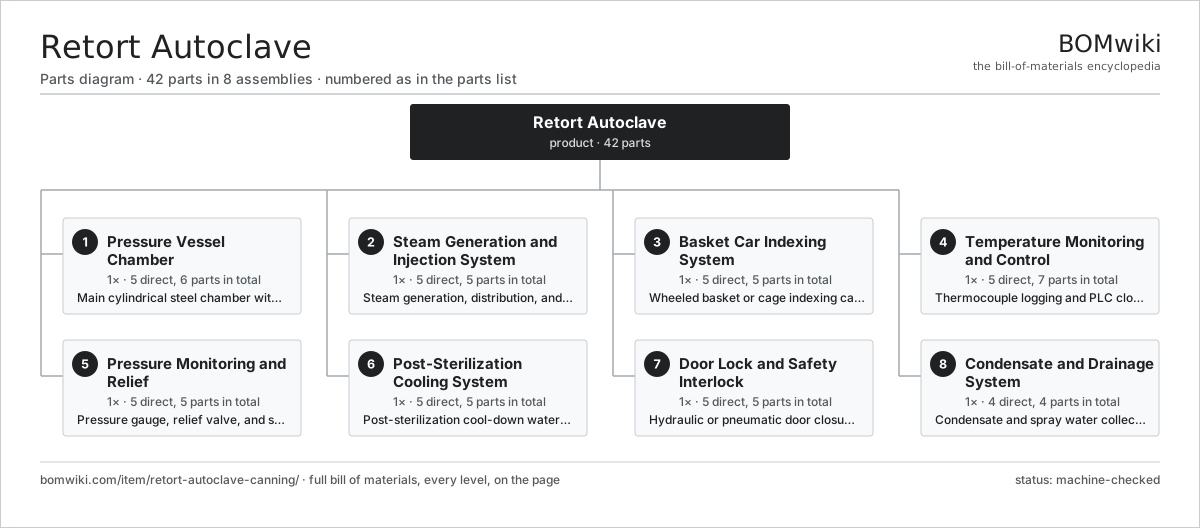
| # | Part | Qty | What it does |
|---|---|---|---|
| 1 | Pressure Vessel Chamber 5 parts | 1× | Main cylindrical steel chamber with hemispherical end caps |
| 2 | Steam Generation and Injection System 5 parts | 1× | Steam generation, distribution, and injection into chamber |
| 3 | Basket Car Indexing System 5 parts | 1× | Wheeled basket or cage indexing cans through vessel |
| 4 | Temperature Monitoring and Control 5 parts | 1× | Thermocouple logging and PLC closed-loop temperature regulation |
| 5 | Pressure Monitoring and Relief 5 parts | 1× | Pressure gauge, relief valve, and safety interlocks |
| 6 | Post-Sterilization Cooling System 5 parts | 1× | Post-sterilization cool-down water spray or immersion |
| 7 | Door Lock and Safety Interlock 5 parts | 1× | Hydraulic or pneumatic door closure and safety interlock |
| 8 | Condensate and Drainage System 4 parts | 1× | Condensate and spray water collection and drainage |
3D model
No 3D model yet. Have a CAD file of this? Add a 3D model — STL renders right on this page; STEP, FreeCAD, and OpenSCAD sources are welcome too (openly licensed, like all 3D models on BOMwiki).
Build & assembly graph
expand / collapse · shared sub-assemblies converge · links to related products · est. labourTap an assembly to expand/collapse · tap a part to open it · use “Open page” for any node · drag to pan, scroll to zoom.
Bill of materials for Retort Autoclave
8 top-level lines · 47 rows shown · 42 parts total · indented to 3 levels| # | Item / sub-assembly | Part no. | Qty/assy | Ext. qty | Parts | Type |
|---|---|---|---|---|---|---|
| 1 | Pressure Vessel Chamber 5 parts | retort-autoclave-canning-pressure-vessel | 1× | 1 | 6 | assembly |
| 1.1 | Outer Steel Shell | retort-autoclave-canning-outer-shell | 1× | 1 | · | part |
| 1.2 | Hemispherical End Caps | retort-autoclave-canning-end-caps | 2× | 2 | · | part |
| 1.3 | Stainless Internal Lining | retort-autoclave-canning-internal-lining | 1× | 1 | · | part |
| 1.4 | Thermal Insulation | retort-autoclave-canning-thermal-insulation | 1× | 1 | · | part |
| 1.5 | Base Frame | retort-autoclave-canning-frame-support | 1× | 1 | · | part |
| 2 | Steam Generation and Injection System 5 parts | retort-autoclave-canning-steam-system | 1× | 1 | 5 | assembly |
| 2.1 | Steam Boiler | retort-autoclave-canning-steam-boiler | 1× | 1 | · | part |
| 2.2 | Spray Header Assembly | retort-autoclave-canning-spray-header | 1× | 1 | · | part |
| 2.3 | Check Valve | retort-autoclave-canning-check-valve | 1× | 1 | · | part |
| 2.4 | Steam Trap | retort-autoclave-canning-steam-trap | 1× | 1 | · | part |
| 2.5 | Pressure Regulator | retort-autoclave-canning-pressure-regulator | 1× | 1 | · | part |
| 3 | Basket Car Indexing System 5 parts | retort-autoclave-canning-basket-car-system | 1× | 1 | 5 | assembly |
| 3.1 | Basket Cage | retort-autoclave-canning-basket-cage | 1× | 1 | · | part |
| 3.2 | Basket Rail Track | retort-autoclave-canning-rail-track | 1× | 1 | · | part |
| 3.3 | Basket Drive Motor | retort-autoclave-canning-drive-motor | 1× | 1 | · | part |
| 3.4 | Basket Position Sensor | retort-autoclave-canning-position-sensor | 1× | 1 | · | part |
| 3.5 | Hydraulic Basket Cylinder | retort-autoclave-canning-hydraulic-cylinder | 1× | 1 | · | part |
| 4 | Temperature Monitoring and Control 5 parts | retort-autoclave-canning-temperature-control | 1× | 1 | 7 | assembly |
| 4.1 | Type K Thermocouple | retort-autoclave-canning-thermocouple | 3× | 3 | · | part |
| 4.2 | PLC Controller | retort-autoclave-canning-plc-controller | 1× | 1 | · | part |
| 4.3 | Data Logger Module | retort-autoclave-canning-data-logger | 1× | 1 | · | part |
| 4.4 | Proportional Steam Valve | retort-autoclave-canning-modulating-valve | 1× | 1 | · | part |
| 4.5 | Electric Backup Heater | retort-autoclave-canning-resistance-heater | 1× | 1 | · | part |
| 5 | Pressure Monitoring and Relief 5 parts | retort-autoclave-canning-pressure-monitoring | 1× | 1 | 5 | assembly |
| 5.1 | Pressure Gauge | retort-autoclave-canning-pressure-gauge | 1× | 1 | · | part |
| 5.2 | Pressure Transmitter | retort-autoclave-canning-pressure-transmitter | 1× | 1 | · | part |
| 5.3 | Relief Valve | retort-autoclave-canning-relief-valve | 1× | 1 | · | part |
| 5.4 | Rupture Disc | retort-autoclave-canning-rupture-disc | 1× | 1 | · | part |
| 5.5 | Pressure Sensor | pressure-sensor | 1× | 1 | · | part |
| 6 | Post-Sterilization Cooling System 5 parts | retort-autoclave-canning-cooling-system | 1× | 1 | 5 | assembly |
| 6.1 | Cooling Water Pump | retort-autoclave-canning-cooling-pump | 1× | 1 | · | part |
| 6.2 | Spray Nozzles | retort-autoclave-canning-spray-nozzles-cooling | 1× | 1 | · | part |
| 6.3 | Drain Trough | retort-autoclave-canning-drain-trough | 1× | 1 | · | part |
| 6.4 | Thermostatic Mixing Valve | retort-autoclave-canning-thermostat-valve | 1× | 1 | · | part |
| 6.5 | Immersion Cooling Basin | retort-autoclave-canning-cooling-basin | 1× | 1 | · | part |
| 7 | Door Lock and Safety Interlock 5 parts | retort-autoclave-canning-door-lock | 1× | 1 | 5 | assembly |
| 7.1 | Door Frame and Gasket | retort-autoclave-canning-door-frame | 1× | 1 | · | part |
| 7.2 | Latch Mechanism | retort-autoclave-canning-latch-mechanism | 1× | 1 | · | part |
| 7.3 | Hydraulic Door Cylinder | retort-autoclave-canning-hydraulic-pull-latch | 1× | 1 | · | part |
| 7.4 | Pressure Interlock Switch | retort-autoclave-canning-pressure-interlock-switch | 1× | 1 | · | part |
| 7.5 | Door Handle | retort-autoclave-canning-handle-system | 1× | 1 | · | part |
| 8 | Condensate and Drainage System 4 parts | retort-autoclave-canning-drainage | 1× | 1 | 4 | assembly |
| 8.1 | Drain Sump | retort-autoclave-canning-drain-sump | 1× | 1 | · | part |
| 8.2 | Sump Pump | retort-autoclave-canning-sump-pump | 1× | 1 | · | part |
| 8.3 | Float Level Switch | retort-autoclave-canning-level-switch | 1× | 1 | · | part |
| 8.4 | Drain Strainer | retort-autoclave-canning-drain-strainer | 1× | 1 | · | part |
Used in 1 assembly
Related products
same domain, ranked by shared parts Automatic Espresso Tamper
45 parts · shares 1 with this page
Automatic Filleting Machine
73 parts · shares 1 with this page
Automatic Espresso Tamper
45 parts · shares 1 with this page
Automatic Filleting Machine
73 parts · shares 1 with this page
 Bakery Deck Oven
44 parts · shares 1 with this page
Batter and Breading Line
127 parts · shares 1 with this page
Bakery Deck Oven
44 parts · shares 1 with this page
Batter and Breading Line
127 parts · shares 1 with this page
Sourcing: possible vendors
Prices, MOQ, and lead times are algorithmic estimates, not quotes, and not claims about these companies. Company mappings are curated by keyword; est. price band $1k–$500k. How estimates work| Vendor | HQ | Specialty | MOQ | Lead time |
|---|---|---|---|---|
| gea.com ↗ | Düsseldorf, DE | Process technology | 20 units | 12–20 wks |
| buhlergroup.com ↗ | Uzwil, CH | Food & materials processing | 20 units | 12–20 wks |
| tetrapak.com ↗ | Pully, CH | Food packaging & processing | 20 units | 12–20 wks |
| jbtc.com ↗ | Chicago, US | Food processing equipment | 20 units | 12–20 wks |
| alfalaval.com ↗ | Lund, SE | Heat transfer & separation | 20 units | 12–20 wks |
1,316-word article