Riot Shield
ProductOverview
A riot shield is a transparent hand-held barrier used by police public-order units to absorb thrown objects, bottles, and strikes while leaving the officer's vision and weak hand free. The full-length pattern described here, roughly 1.7 m tall, cylindrically curved, about 3.5 kg, is the standard for static shield lines; smaller round and rectangular variants serve arrest teams and corrections officers. It is a blunt-impact device: standard public-order shields are not ballistic protection, and ballistic shields are a separate, far heavier product category.
Mechanically the shield is a simple system: a Panel Assembly does the protective work, the Edge Trim System keeps the panel's vulnerable edges intact, and the Handle Assembly and Arm Cuff Assembly couple it to the officer's arm through carefully load-spread Mounting Hardware.
The panel
The Polycarbonate Sheet is the entire protective concept. Polycarbonate is used because no other transparent material matches its toughness: around 250 times the impact resistance of float glass and 30 times that of acrylic, with the ability to absorb a baton or brick strike by flexing rather than shattering. The blank, typically 4 mm thick, is thermoformed into a cylindrical curve, curvature adds geometric stiffness and encourages projectiles to glance off rather than land square.
Polycarbonate's weaknesses drive the rest of the design. It scratches easily, so a siloxane Hardcoat Layer preserves optical clarity through repeated contact and cleaning. It loses toughness with UV exposure, so the resin is UV-stabilized and shields are lifed at about five years. Most importantly, it is notch-sensitive: cracks start at cut edges and drilled holes, which is why the perimeter and every fastener hole receive specific treatment. A reflective Marking Decal identifies the carrier at distance, and the Unit Label records serial number and the impact standard (BS 7971-9 is the common UK public-order benchmark).
Edge protection
The Edge Trim System presses an EPDM Trim Extrusion, a U-channel, over the full perimeter, bonded with a Trim Adhesive bead and closed with Trim Joint Plugs where ends meet. The trim does three jobs: it shields the cut edge where cracks initiate, it cushions the officer's own body from the panel rim during pushing, and it prevents an opponent from getting a fingernail or tool under a loose channel.
Arm interface
The officer holds the shield through two points in line: the fist on the Handle Grip and the mid-forearm in the Cuff Band. The two-point interface is what makes a 3.5 kg shield controllable, strike loads arrive as torque, and the cuff reacts the twisting moment the wrist alone could not. The vertical grip stands off the panel on the Handle Bracket with a foam Grip Sleeve; the cuff closes over any sleeve bulk with the Cuff Strap and a quick-release Strap Buckle, so the officer can shed the shield in one motion if it is grabbed, a trained response, since a held shield becomes a lever against its carrier.
All of this hardware passes through the panel, and every penetration is managed: wide-head Through Bolts present a smooth dome on the threat side, Rubber Washers on both faces isolate bolt stress from the hole edge, Backing Plates spread handle and cuff loads across a broad area, and Nylock Nuts hold torque through impact vibration. A bolt tightened metal- to-polycarbonate would crack the panel at the first hard strike.
Formation use and carriage
Shield lines work as walls, not individuals. The molded Interlock Edge Profile profile lets adjacent shields overlap into a continuous barrier, and the curve of each panel nests against its neighbor. For the march to a deployment line the Carry Kit provides a Shoulder Strap on quick-detach Strap Clips anchored to reinforced Hanger Eyelets, which double as vehicle rack stowage points.
Inspection and limits
Shields are inspected for crazing, networks of fine surface cracks that signal UV and chemical degradation, and withdrawn when found, as crazed polycarbonate can fail brittlely under an impact it would once have absorbed. Solvent contact (some riot-control agent formulations included) accelerates this, so units specify approved cleaners. The other hard limit is thermal: polycarbonate softens near 150 °C, so petrol-bomb exposure deforms a shield even when flame contact is brief, and fire-facing tactics rotate shields out of line for inspection afterward.
Riot Shield parts and their functions
6 top-level parts · 59 parts in total · full bill of materials below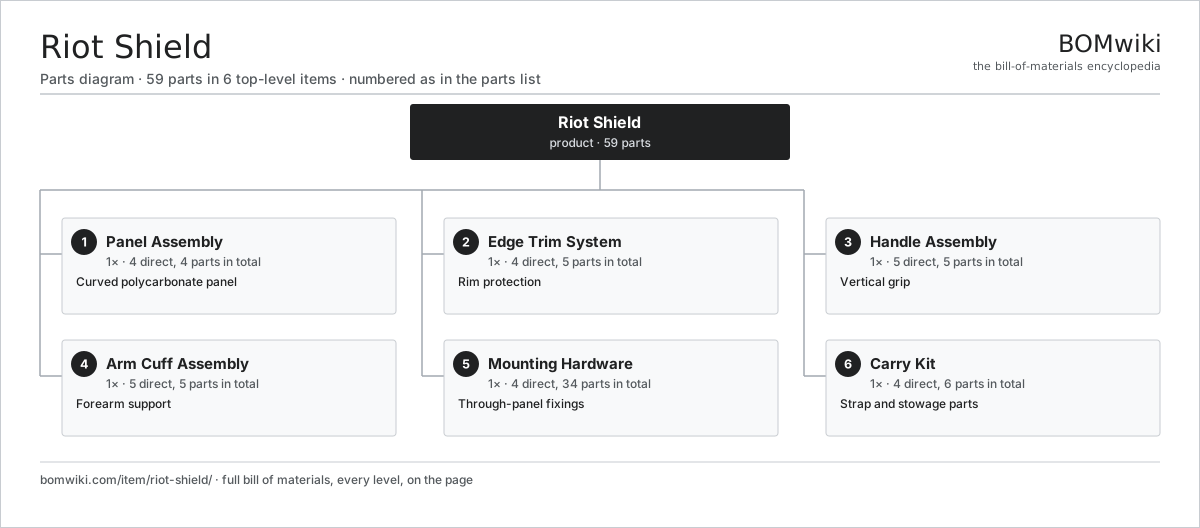
| # | Part | Qty | What it does |
|---|---|---|---|
| 1 | Panel Assembly 4 parts | 1× | Curved polycarbonate panel |
| 2 | Edge Trim System 4 parts | 1× | Rim protection |
| 3 | Handle Assembly 5 parts | 1× | Vertical grip |
| 4 | Arm Cuff Assembly 5 parts | 1× | Forearm support |
| 5 | Mounting Hardware 4 parts | 1× | Through-panel fixings |
| 6 | Carry Kit 4 parts | 1× | Strap and stowage parts |
3D model
No 3D model yet. Have a CAD file of this? Add a 3D model. STL renders right on this page; STEP, FreeCAD, and OpenSCAD sources are welcome too (openly licensed, like all 3D models on BOMwiki).
Build & assembly graph
expand / collapse · shared sub-assemblies converge · links to related products · est. labourTap an assembly to expand/collapse · tap a part to open it · use “Open page” for any node · drag to pan, scroll to zoom.
Bill of materials for Riot Shield
6 top-level lines · 32 rows shown · 59 parts total · indented to 3 levels| # | Item / sub-assembly | Part no. | Qty/assy | Ext. qty | Parts | Type |
|---|---|---|---|---|---|---|
| 1 | Panel Assembly 4 parts | riot-shield-panel-assembly | 1× | 1 | 4 | assembly |
| 1.1 | Polycarbonate Sheet | riot-shield-pc-sheet | 1× | 1 | · | part |
| 1.2 | Hardcoat Layer | riot-shield-hardcoat-layer | 1× | 1 | · | part |
| 1.3 | Marking Decal | riot-shield-marking-decal | 1× | 1 | · | part |
| 1.4 | Unit Label | riot-shield-unit-label | 1× | 1 | · | part |
| 2 | Edge Trim System 4 parts | riot-shield-edge-trim-system | 1× | 1 | 5 | assembly |
| 2.1 | Trim Extrusion | riot-shield-trim-extrusion | 1× | 1 | · | part |
| 2.2 | Trim Joint Plug | riot-shield-trim-joint-plug | 2× | 2 | · | part |
| 2.3 | Trim Adhesive | riot-shield-trim-adhesive | 1× | 1 | · | part |
| 2.4 | Fastener Set | fastener-set | 1× | 1 | · | part |
| 3 | Handle Assembly 5 parts | riot-shield-handle-assembly | 1× | 1 | 5 | assembly |
| 3.1 | Handle Grip | riot-shield-handle-grip | 1× | 1 | · | part |
| 3.2 | Handle Bracket | riot-shield-handle-bracket | 1× | 1 | · | part |
| 3.3 | Grip Sleeve | riot-shield-grip-sleeve | 1× | 1 | · | part |
| 3.4 | Handle Mount Plate | riot-shield-mount-plate | 1× | 1 | · | part |
| 3.5 | Fastener Set | fastener-set | 1× | 1 | · | part |
| 4 | Arm Cuff Assembly 5 parts | riot-shield-arm-cuff-assembly | 1× | 1 | 5 | assembly |
| 4.1 | Cuff Band | riot-shield-cuff-band | 1× | 1 | · | part |
| 4.2 | Cuff Padding | riot-shield-cuff-padding | 1× | 1 | · | part |
| 4.3 | Cuff Strap | riot-shield-cuff-strap | 1× | 1 | · | part |
| 4.4 | Strap Buckle | riot-shield-strap-buckle | 1× | 1 | · | part |
| 4.5 | Cuff Bracket | riot-shield-cuff-bracket | 1× | 1 | · | part |
| 5 | Mounting Hardware 4 parts | riot-shield-mounting-hardware | 1× | 1 | 34 | assembly |
| 5.1 | Through Bolt | riot-shield-through-bolt | 8× | 8 | · | part |
| 5.2 | Rubber Washer | riot-shield-rubber-washer | 16× | 16 | · | part |
| 5.3 | Nylock Nut | riot-shield-nylock-nut | 8× | 8 | · | part |
| 5.4 | Backing Plate | riot-shield-backing-plate | 2× | 2 | · | part |
| 6 | Carry Kit 4 parts | riot-shield-carry-kit | 1× | 1 | 6 | assembly |
| 6.1 | Shoulder Strap | riot-shield-shoulder-strap | 1× | 1 | · | part |
| 6.2 | Strap Clip | riot-shield-strap-clip | 2× | 2 | · | part |
| 6.3 | Hanger Eyelet | riot-shield-hanger-eyelet | 2× | 2 | · | part |
| 6.4 | Interlock Edge Profile | riot-shield-interlock-edge | 1× | 1 | · | part |
Something wrong in this list? Report a problem with this BOM.
Sourcing: possible vendors
Browse the supplier directory → Prices, MOQ, and lead times are algorithmic estimates, not quotes, and not claims about these companies. Company mappings are curated by keyword; est. price band $200–$100M. How estimates work| Vendor | HQ | Specialty | MOQ | Lead time |
|---|---|---|---|---|
| smithsdetection.com ↗ | London, GB | Security screening | made to order | 24–52 wks |
|
🇺🇸Leidos
leidos.com ↗
|
Reston, US | Security & screening | made to order | 24–52 wks |
|
🇺🇸Rapiscan
rapiscansystems.com ↗
|
Torrance, US | X-ray screening | made to order | 24–52 wks |
|
🇫🇷Thales
thalesgroup.com ↗
|
Paris, FR | Defense electronics | made to order | 24–52 wks |
| baesystems.com ↗ | London, GB | Defense | made to order | 24–52 wks |
793-word article