Ripple Tank
ProductOverview
The ripple tank is an indispensable tool in physics education for making water wave phenomena visible and measurable. By creating controlled surface waves in a shallow water layer and observing them directly or through projection, students and researchers can explore interference, diffraction, reflection, and refraction in real time. The apparatus typically consists of a transparent shallow basin, a vibrating source (point or bar), stroboscopic lighting to freeze the wave motion, and an optical projection system to magnify the wave pattern onto a large screen. The visual impact is immediate: students can see crests and troughs, watch two waves interfere and cancel, see diffraction patterns emerging from slits, and observe reflections off curved mirrors. These observations bridge the gap between abstract wave equations and tangible physical reality.
The physical principle is straightforward: a sinusoidal disturbance at the water surface launches waves that propagate radially (from a point source) or in parallel lines (from a bar source). The shallow-water approximation holds because the water depth (typically 1–3 cm) is much smaller than the wavelength (several centimeters at low frequencies), so waves propagate at a speed determined by the water depth and gravity, independent of frequency. As waves interact, encountering barriers, slits, or other waves, they exhibit classic phenomena like constructive and destructive interference, diffraction bending around obstacles, and reflection at boundaries. The strobe light "freezes" the motion by flashing in synchronization with the wave oscillation, allowing the eye to see a static interference pattern or to observe the wave motion frame-by-frame by adjusting the flash frequency slightly.
How it works
Wave generation: The Wave Generator Assembly oscillates vertically at a fixed or adjustable frequency, typically 1–50 Hz. A Point Source Rod creates concentric circular waves radiating outward; a Bar Wave Generator produces planar (straight) waves. The Amplitude Control controls the stroke amplitude (typically 1–10 mm), setting the wave height. As the rod or bar moves down, it displaces water, creating a downward-moving disturbance; as it moves up, it creates an upward bulge. The result is a sinusoidal wave traveling outward from the source.
Wave propagation: In shallow water, the wave speed v is governed by:
v = √(gh)
where g is gravitational acceleration (9.8 m/s²) and h is water depth. For typical depths of 2 cm, v ≈ 0.4 m/s. The wavelength λ is related to frequency f by:
λ = v/f
At 10 Hz and v = 0.4 m/s, λ = 4 cm, a wavelength easily observable in a 30 cm × 30 cm basin. As waves propagate, they slow slightly due to viscous damping and can interact with barriers or slits.
Visualization via stroboscopy: Direct observation of oscillating waves at 10+ Hz is impossible because the human eye cannot follow such rapid motion. The Stroboscopic Illumination solves this by producing brief, bright flashes synchronized to the wave frequency. If the flash occurs once per complete oscillation, the wave appears frozen at the same phase, creating an illusion of a static pattern. If the flash frequency is slightly higher than the wave frequency, the pattern appears to move slowly forward, a stroboscopic slow-motion effect useful for counting crests or measuring wave speed.
Projection and magnification: Many ripple tanks employ the Projection and Visualization to cast a shadow image of the water surface onto a large white screen. The Projection Light Source shines up through the water from below; wave crests (where the water is higher and denser) refract light downward and appear as dark bands on the screen, while troughs appear bright. This magnification (typically 5–20×) makes small ripples visible to a room full of students and enables precise measurement of wavelength and interference spacing.
Interference: When two wave sources (or a source and a reflected wave) create overlapping wavefronts, the waves add or cancel depending on phase. At locations where crests coincide with crests, constructive interference produces a doubled amplitude (a bright band on projection). Where crests meet troughs, destructive interference produces near-cancellation (a dark band with minimal wave height). The result is a pattern of parallel bright and dark bands, an interference fringes pattern identical to Young's double-slit experiment in optics.
Diffraction: When plane waves pass through a single narrow slit in a Slit Diffraction Insert, the slit acts as a point source, and waves spread out (diffract) into the geometrical shadow region behind the slit. The diffraction is most pronounced when the slit width is comparable to the wavelength. A ripple-tank-double-slit (typically two slits 1–2 wavelengths apart) produces two radiating point sources, creating a characteristic interference pattern of bright and dark arcs.
Reflection: When waves encounter a Straight Barrier Plate or Curved Reflector, they reflect according to the law of reflection: angle of incidence equals angle of reflection. A curved barrier can focus waves to a focal point (analogous to a parabolic mirror) or diverge them. These reflections create secondary wave sources that can interfere with incident waves, teaching students about wave superposition.
Design considerations
Basin depth and wave speed: Shallower basins (1 cm) produce slower waves (v ~ 0.3 m/s) and longer wavelengths, easier to observe but more prone to damping. Deeper basins (3 cm) produce faster waves (v ~ 0.5 m/s), requiring higher frequencies for comparable wavelengths. Typical designs compromise at 2 cm.
Motor frequency and synchronization: Early ripple tanks used AC synchronous motors fixed at 50 or 60 Hz. Modern designs employ variable-frequency function generators, allowing adjustment of frequency without changing the apparatus. Strobe synchronization requires a feedback signal from the frequency generator, critical for clean standing wave patterns.
Amplitude and damping: Large amplitudes (> 5 mm) create nonlinear wave effects and energy dissipation; small amplitudes (< 1 mm) are harder to visualize but more linear. Viscous damping of water (and energy radiated as heat and sound) limits observation time. After a few seconds, a wave pattern may deteriorate unless continuously driven. Some tanks include adjustable barriers at the perimeter to absorb and attenuate outgoing waves, preventing unwanted reflections from the basin walls.
Optical projection alternatives: Older designs used a bright incandescent lamp and manual inspection of shadows on a ground-glass screen. Modern kits often use LED projection for less heat generation and better control. Some designs also employ digital cameras and image processing to capture and analyze wave data.
Educational applications
The ripple tank is essential for teaching:
- Wave superposition and interference: Students directly see the bright and dark bands of constructive and destructive interference.
- Diffraction and Huygens' principle: Waves bending around slits demonstrate that each point on a wavefront acts as a secondary source.
- Resonance and standing waves: Enclosed basins create boundary reflections that can lock into standing wave modes at specific frequencies.
- Quantitative measurement: Wavelength, frequency, and wave speed can be measured directly from the tank or from projected images, allowing numerical problem-solving alongside qualitative observation.
- Analogy to light and sound: Water waves provide a tangible analogy to electromagnetic and acoustic waves, helping students build intuition for more abstract wave phenomena.
The ripple tank remains one of the few apparatus where students can see the actual wave (not merely its effects) and control all parameters in real time.
Ripple Tank parts and their functions
7 top-level parts · 36 parts in total · full bill of materials below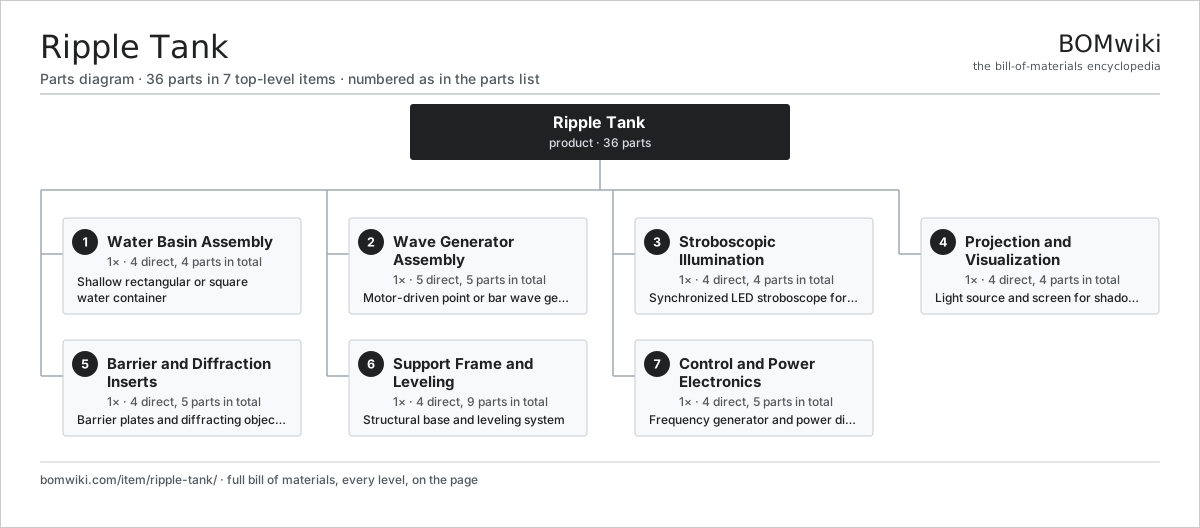
| # | Part | Qty | What it does |
|---|---|---|---|
| 1 | Water Basin Assembly 4 parts | 1× | Shallow rectangular or square water container |
| 2 | Wave Generator Assembly 5 parts | 1× | Motor-driven point or bar wave generator |
| 3 | Stroboscopic Illumination 4 parts | 1× | Synchronized LED stroboscope for wave visualization |
| 4 | Projection and Visualization 4 parts | 1× | Light source and screen for shadow projection |
| 5 | Barrier and Diffraction Inserts 4 parts | 1× | Barrier plates and diffracting objects |
| 6 | Support Frame and Leveling 4 parts | 1× | Structural base and leveling system |
| 7 | Control and Power Electronics 4 parts | 1× | Frequency generator and power distribution |
3D model
No 3D model yet. Have a CAD file of this? Add a 3D model. STL renders right on this page; STEP, FreeCAD, and OpenSCAD sources are welcome too (openly licensed, like all 3D models on BOMwiki).
Build & assembly graph
expand / collapse · shared sub-assemblies converge · links to related products · est. labourTap an assembly to expand/collapse · tap a part to open it · use “Open page” for any node · drag to pan, scroll to zoom.
Bill of materials for Ripple Tank
7 top-level lines · 36 rows shown · 36 parts total · indented to 3 levels| # | Item / sub-assembly | Part no. | Qty/assy | Ext. qty | Parts | Type |
|---|---|---|---|---|---|---|
| 1 | Water Basin Assembly 4 parts | ripple-tank-basin | 1× | 1 | 4 | assembly |
| 1.1 | Acrylic Basin Tray | ripple-tank-acrylic-tray | 1× | 1 | · | part |
| 1.2 | Basin Support Frame | ripple-tank-basin-frame | 1× | 1 | · | part |
| 1.3 | Basin Drain Valve | ripple-tank-basin-drain | 1× | 1 | · | part |
| 1.4 | Glass Bottom Insert | ripple-tank-glass-bottom | 1× | 1 | · | part |
| 2 | Wave Generator Assembly 5 parts | ripple-tank-vibration-source | 1× | 1 | 5 | assembly |
| 2.1 | AC Synchronous Vibration Motor | ripple-tank-vibration-motor | 1× | 1 | · | part |
| 2.2 | Point Source Rod | ripple-tank-point-source-rod | 1× | 1 | · | part |
| 2.3 | Bar Wave Generator | ripple-tank-bar-generator | 1× | 1 | · | part |
| 2.4 | Amplitude Control | ripple-tank-amplitude-dial | 1× | 1 | · | part |
| 2.5 | Generator Mounting Clamp | ripple-tank-generator-mount | 1× | 1 | · | part |
| 3 | Stroboscopic Illumination 4 parts | ripple-tank-strobe-lighting | 1× | 1 | 4 | assembly |
| 3.1 | Strobe LED Array | ripple-tank-strobe-led | 1× | 1 | · | part |
| 3.2 | Strobe Sync Controller | ripple-tank-strobe-controller | 1× | 1 | · | part |
| 3.3 | Strobe Light Mounting Arm | ripple-tank-strobe-bracket | 1× | 1 | · | part |
| 3.4 | Light Diffuser Lens | ripple-tank-light-diffuser | 1× | 1 | · | part |
| 4 | Projection and Visualization 4 parts | ripple-tank-projection-system | 1× | 1 | 4 | assembly |
| 4.1 | Projection Light Source | ripple-tank-projection-lamp | 1× | 1 | · | part |
| 4.2 | Projection Condenser Lens | ripple-tank-projection-lens | 1× | 1 | · | part |
| 4.3 | Projection Screen | ripple-tank-projection-screen | 1× | 1 | · | part |
| 4.4 | Projection Mirror | ripple-tank-mirror-optional | 1× | 1 | · | part |
| 5 | Barrier and Diffraction Inserts 4 parts | ripple-tank-wave-obstacles | 1× | 1 | 5 | assembly |
| 5.1 | Straight Barrier Plate | ripple-tank-straight-barrier | 2× | 2 | · | part |
| 5.2 | Curved Reflector | ripple-tank-curved-barrier | 1× | 1 | · | part |
| 5.3 | Slit Diffraction Insert | ripple-tank-slit-barrier | 1× | 1 | · | part |
| 5.4 | Obstacle Magnetic Base | ripple-tank-obstacle-base | 1× | 1 | · | part |
| 6 | Support Frame and Leveling 4 parts | ripple-tank-support-frame | 1× | 1 | 9 | assembly |
| 6.1 | Support Leg | ripple-tank-frame-legs | 4× | 4 | · | part |
| 6.2 | Horizontal Mounting Rail | ripple-tank-frame-rail | 2× | 2 | · | part |
| 6.3 | Vibration Isolation Pad | ripple-tank-vibration-damper | 1× | 1 | · | part |
| 6.4 | Fastener Set | fastener-set | 2× | 2 | · | part |
| 7 | Control and Power Electronics 4 parts | ripple-tank-electronics-control | 1× | 1 | 5 | assembly |
| 7.1 | Function Generator Module | ripple-tank-frequency-generator | 1× | 1 | · | part |
| 7.2 | Power Amplifier | ripple-tank-amplifier | 1× | 1 | · | part |
| 7.3 | Power Supply Adapter | ripple-tank-power-supply | 1× | 1 | · | part |
| 7.4 | Connector | connector | 2× | 2 | · | part |
Something wrong in this list? Report a problem with this BOM.
Sourcing: possible vendors
Browse the supplier directory → Prices, MOQ, and lead times are algorithmic estimates, not quotes, and not claims about these companies. Company mappings are curated by keyword; est. price band $1k–$500k. How estimates work| Vendor | HQ | Specialty | MOQ | Lead time |
|---|---|---|---|---|
| thermofisher.com ↗ | Waltham, US | Lab instruments | 100 units | 10–18 wks |
|
🇺🇸Agilent
agilent.com ↗
|
Santa Clara, US | Analytical instruments | 100 units | 10–18 wks |
|
🇺🇸Bruker
bruker.com ↗
|
Billerica, US | Scientific instruments | 100 units | 10–18 wks |
|
🇯🇵Shimadzu
shimadzu.com ↗
|
Kyoto, JP | Analytical instruments | 100 units | 10–18 wks |
|
🇺🇸Waters
waters.com ↗
|
Milford, US | Chromatography & MS | 100 units | 10–18 wks |
1,208-word article