River Fish Counter
ProductOverview
A riverine fish counter is a fixed monitoring station installed at a weir or dam that automatically counts and measures fish migrating upstream or downstream. The sensor array detects fish passages in real-time; the signal processor distinguishes fish from debris; and the data logger timestamps each detection. The weir is a low-head obstruction (1–3 feet) that forces all fish through a confined counting zone, ensuring complete capture of the population. Modern counters are solar-powered and remotely telemetered, allowing continuous unattended operation for years in remote rivers.
Weir Structure and Fish Passage
The weir is the structural centerpiece, a low-head dam that directs flow through a counting notch. A typical weir is 10 feet wide, creates a 1–3 foot head drop, and includes a rectangular fish passage notch 2 feet wide × 1 foot tall with smooth, sloped edges. Fish attempting to migrate upstream encounter the weir's main plate and naturally seek the lower-energy path through the notch. The notch is large enough to pass any native fish species (including 20+ lb salmon) without damage, but confined enough that all passage is concentrated in a narrow zone where sensors are placed.
The weir is anchored to the river bed with four legs extending 5–8 feet deep, resisting flood forces of up to 50,000 pounds per linear foot during high flows. A scour apron (concrete or riprap) extends 10 feet downstream, dissipating energy and preventing the weir from being undercut. The entire structure is sized for the 100-year flood event in the river.
Optical Sensor Array
Many fish counters employ infrared optical sensors. The system consists of six pairs of LED sources and photodiode receivers arranged vertically in a 4-foot column, with 6-inch spacing (0.5 inches between individual sensors when dual-redundancy is used). Each beam has a 4-inch diameter and is positioned to cross the fish notch horizontally.
As a fish swims through the notch, it progressively breaks each beam from top to bottom (or bottom to top, depending on orientation). The signal processor detects the beam-break pattern: a single downstroke signature is counted as one fish. The duration of each beam blockage (called pulse width) correlates with fish size: a 30 cm salmon blocks a beam for ~200 ms at a typical swim speed of 0.5 m/s, while a 10 cm trout blocks for ~67 ms.
Infrared sensors operate at 850 nm, a wavelength that penetrates turbid river water better than visible light. Lens correction compensates for water's refractive index (1.33), focusing infrared light precisely at the weir notch and minimizing false triggers from floating debris (which have much less regular shadows).
Resistivity Sensor Alternative
Some systems use a four-electrode resistivity probe as an alternative to optical detection. The probe measures the tissue conductivity of objects passing through the counting zone. Fish tissue, being electrically conductive (muscles and blood), exhibits 1000–5000 µS/cm conductivity; wood, bone, and most debris are insulators with <100 µS/cm. A brief high-conductivity pulse passing through the electrode array is classified as a fish.
Resistivity sensors excel in very turbid water (where optical beams fail) and measure fish mass more directly, but are sensitive to electrode fouling (algae, sediment buildup). Most modern systems use optical sensors as primary and resistivity as backup.
Signal Processing and Fish Identification
The signal processor is a real-time detection circuit that runs algorithms to distinguish fish from false triggers:
Threshold detection: The analog signal (photodetector voltage) is continuously compared to a threshold set 20% above ambient noise. When the signal dips below threshold, a "beam break" event is logged.
Pulse aggregation: All six beam breaks within a 1–2 second window are aggregated as a single fish passage event.
Signature validation: The pattern of beam breaks is checked against expected fish profiles:
- A descending pattern (top to bottom) indicates upstream migration.
- The duration of each beam break is recorded for size estimation.
- Irregular patterns (gaps, reversals) are flagged as debris or multiple fish.
Size estimation: Using empirical calibration (fish measured post-capture), pulse-width thresholds distinguish:
- Fry: <5 cm (very brief pulse, <50 ms)
- Juvenile: 5–15 cm (50–150 ms pulse)
- Adult: 15–30 cm (150–300 ms pulse)
- Large: >30 cm (>300 ms pulse)
Accuracy depends on calibration and water clarity. In clear, slow-moving water, detection accuracy exceeds 95% for fish >15 cm and 70–80% for fish <10 cm. In turbid water, accuracy drops 10–15%.
Data Logging and Real-Time Transmission
The data logger records each detected fish with microsecond timestamp precision, calculating statistics in real-time. A typical log entry occupies 20 bytes (timestamp, size class, direction). At 30 fish per minute (a high count), the system generates 864 KB per day, or 315 MB per year, easily accommodated by a 4 GB microSD card over 10+ years.
The real-time clock is synchronized daily via GPS (if a satellite is visible from the river location) or maintains ±1 second accuracy per year without it. This precision is crucial for correlating fish passages with environmental data (e.g., "Did the fish run coincide with high flow?").
Power Management and Solar Integration
The power system supplies 12V and 5V for continuous unattended operation. A 50W solar panel oriented south at 30° latitude provides 200–300 Wh per day on average (50W panel × 4–6 peak-sun-hours). The MPPT charge controller maximizes energy extraction by dynamically adjusting the load resistance to match the panel's peak power point as cloud cover and angle change throughout the day.
A LiFePO4 battery bank (10 Ah, 120 Wh) buffers the system through cloudy days and nighttime. The battery is oversized to tolerate winter conditions (shorter daylight, lower solar angles): a 10 Ah battery holds 5 days of autonomy at 10W average consumption, allowing the counter to survive a week of cloudy weather.
The DC-DC converter regulates the 12V battery voltage to stable 12V and 5V supplies, protecting sensitive electronics from voltage ripple and transient spikes during solar charging surges.
Remote Data Access and Telemetry
The communication module transmits detection data, battery status, and system health to a remote server daily or on-demand. A 4G LTE modem is primary; if cellular is unavailable (remote mountain river), a LoRaWAN module provides fallback through a local gateway up to 5 miles away.
Data transmission occurs once per day at a fixed time (e.g., midnight), minimizing power consumption. A daily transmission of 1 KB (24-hour summary: total count, fish size distribution, device status) consumes roughly 2 Wh of battery via cellular, sustainable on solar power.
Cloud-based dashboards allow researchers to monitor fish passage in real-time from an office, generating alerts if unusual patterns occur (e.g., sudden drop in count indicating sensor failure, or a spike indicating a migration event). Historical data is archived for trend analysis.
Installation and Maintenance
Installation requires:
Site selection: A river reach with stable flow, minimal debris load, and accessible weir location.
Weir construction: Heavy equipment (excavator, concrete trucks) placing and anchoring the weir structure (cost: $50,000–$200,000 depending on river width and depth).
Sensor setup: Mounting the optical sensors and electronics enclosure on the weir (cost: $20,000–$40,000 for equipment; labor: 1 week).
Calibration: Releasing test fish (known sizes) through the counting zone and adjusting signal thresholds (labor: 2–3 days).
Maintenance is minimal: quarterly cleaning of sensor optics (algae buildup degrades beam transmission), annual battery replacement (LiFePO4 lasts 10 years but should be proactively replaced), and biennial inspection of the weir structure for scour or cracks.
Data Interpretation and Population Monitoring
The counter's output is a time series of fish passage events. Researchers aggregate this into:
- Daily count: Total fish migrating past the counter per day.
- Size distribution: Histogram of fish sizes.
- Migration timing: Onset, peak, and cessation of migration events.
- Demographic trends: Year-to-year changes in abundance and size structure.
These metrics inform management decisions:
- Does the population meet recovery targets (e.g., "1,000 adult salmon per day")?
- Is fish passage working post-dam-removal?
- Are juvenile and adult migrations timing correctly?
A fish counter is the most cost-effective way to monitor spawning runs and juvenile outmigration in rivers, providing decades of uninterrupted data for population viability analysis.
River Fish Counter parts and their functions
7 top-level parts · 37 parts in total · full bill of materials below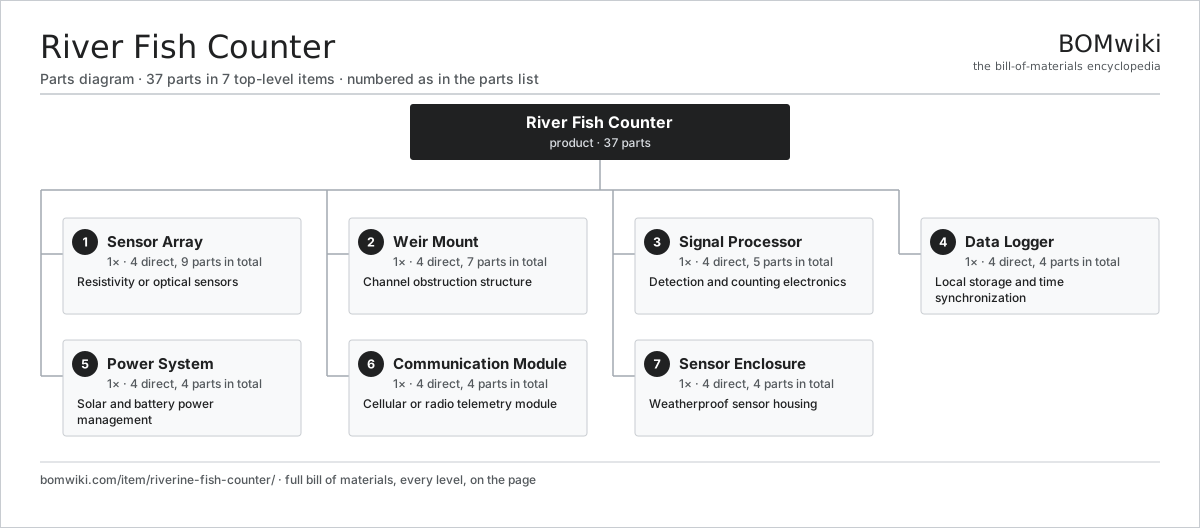
| # | Part | Qty | What it does |
|---|---|---|---|
| 1 | Sensor Array 4 parts | 1× | Resistivity or optical sensors |
| 2 | Weir Mount 4 parts | 1× | Channel obstruction structure |
| 3 | Signal Processor 4 parts | 1× | Detection and counting electronics |
| 4 | Data Logger 4 parts | 1× | Local storage and time synchronization |
| 5 | Power System 4 parts | 1× | Solar and battery power management |
| 6 | Communication Module 4 parts | 1× | Cellular or radio telemetry module |
| 7 | Sensor Enclosure 4 parts | 1× | Weatherproof sensor housing |
3D model
No 3D model yet. Have a CAD file of this? Add a 3D model. STL renders right on this page; STEP, FreeCAD, and OpenSCAD sources are welcome too (openly licensed, like all 3D models on BOMwiki).
Build & assembly graph
expand / collapse · shared sub-assemblies converge · links to related products · est. labourTap an assembly to expand/collapse · tap a part to open it · use “Open page” for any node · drag to pan, scroll to zoom.
Bill of materials for River Fish Counter
7 top-level lines · 35 rows shown · 37 parts total · indented to 3 levels| # | Item / sub-assembly | Part no. | Qty/assy | Ext. qty | Parts | Type |
|---|---|---|---|---|---|---|
| 1 | Sensor Array 4 parts | riverine-fish-counter-sensor-array | 1× | 1 | 9 | assembly |
| 1.1 | Optical Sensor | riverine-fish-counter-optical-sensor | 6× | 6 | · | part |
| 1.2 | Resistivity Probe | riverine-fish-counter-resistivity-sensor | 1× | 1 | · | part |
| 1.3 | Sensor Bracket | riverine-fish-counter-sensor-bracket | 1× | 1 | · | part |
| 1.4 | Lens Set | riverine-fish-counter-lens-set | 1× | 1 | · | part |
| 2 | Weir Mount 4 parts | riverine-fish-counter-weir-mount | 1× | 1 | 7 | assembly |
| 2.1 | Weir Plate | riverine-fish-counter-weir-plate | 1× | 1 | · | part |
| 2.2 | Fish Notch | riverine-fish-counter-weir-notch | 1× | 1 | · | part |
| 2.3 | Mounting Leg | riverine-fish-counter-mounting-legs | 4× | 4 | · | part |
| 2.4 | Scour Apron | riverine-fish-counter-anti-scour-apron | 1× | 1 | · | part |
| 3 | Signal Processor 4 parts | riverine-fish-counter-signal-processor | 1× | 1 | 5 | assembly |
| 3.1 | Photodetector Amplifier | riverine-fish-counter-photodetector-amp | 1× | 1 | · | part |
| 3.2 | Analog Filter | riverine-fish-counter-analog-conditioning | 1× | 1 | · | part |
| 3.3 | ADC & Processor | riverine-fish-counter-adc-processor | 1× | 1 | · | part |
| 3.4 | Relay Driver | riverine-fish-counter-relay-driver | 2× | 2 | · | part |
| 4 | Data Logger 4 parts | riverine-fish-counter-data-logger | 1× | 1 | 4 | assembly |
| 4.1 | Real-Time Clock | riverine-fish-counter-rtc-module | 1× | 1 | · | part |
| 4.2 | Flash Memory | riverine-fish-counter-flash-memory | 1× | 1 | · | part |
| 4.3 | Counter IC | riverine-fish-counter-counter-ic | 1× | 1 | · | part |
| 4.4 | Logger Processor | riverine-fish-counter-logger-processor | 1× | 1 | · | part |
| 5 | Power System 4 parts | riverine-fish-counter-power-system | 1× | 1 | 4 | assembly |
| 5.1 | Solar Panel | riverine-fish-counter-solar-panel | 1× | 1 | · | part |
| 5.2 | Charge Controller | riverine-fish-counter-charge-controller | 1× | 1 | · | part |
| 5.3 | Battery Bank | riverine-fish-counter-battery-bank | 1× | 1 | · | part |
| 5.4 | DC-DC Converter | riverine-fish-counter-dcdc-converter | 1× | 1 | · | part |
| 6 | Communication Module 4 parts | riverine-fish-counter-communication | 1× | 1 | 4 | assembly |
| 6.1 | Cellular Modem | riverine-fish-counter-cellular-modem | 1× | 1 | · | part |
| 6.2 | Cellular Antenna | riverine-fish-counter-antenna | 1× | 1 | · | part |
| 6.3 | IoT SIM Card | riverine-fish-counter-sim-card | 1× | 1 | · | part |
| 6.4 | Backup Radio | riverine-fish-counter-backup-radio | 1× | 1 | · | part |
| 7 | Sensor Enclosure 4 parts | riverine-fish-counter-enclosure | 1× | 1 | 4 | assembly |
| 7.1 | Enclosure Case | riverine-fish-counter-enclosure-case | 1× | 1 | · | part |
| 7.2 | Seal System | riverine-fish-counter-enclosure-seal | 1× | 1 | · | part |
| 7.3 | Enclosure Heater | riverine-fish-counter-enclosure-heater | 1× | 1 | · | part |
| 7.4 | Mounting Pole | riverine-fish-counter-mounting-pole | 1× | 1 | · | part |
Something wrong in this list? Report a problem with this BOM.
Sourcing: possible vendors
Browse the supplier directory → Prices, MOQ, and lead times are algorithmic estimates, not quotes, and not claims about these companies. Company mappings are curated by keyword; est. price band $20–$2k. How estimates work| Vendor | HQ | Specialty | MOQ | Lead time |
|---|---|---|---|---|
|
🇺🇸Coleman
coleman.com ↗
|
Chicago, US | Camping gear | 1,000 units | 6–10 wks |
| thenorthface.com ↗ | Denver, US | Outdoor apparel & gear | 1,000 units | 6–10 wks |
|
🇺🇸YETI
yeti.com ↗
|
Austin, US | Coolers & drinkware | 1,000 units | 6–10 wks |
| decathlon.com ↗ | Villeneuve-d'Ascq, FR | Sporting goods | 1,000 units | 6–10 wks |
|
🇺🇸Garmin
garmin.com ↗
|
Olathe, US | GPS & wearables | 1,000 units | 6–10 wks |
1,529-word article