Road Flight Case
ProductOverview
A road flight case is a professional protective transport container designed for touring musicians, audiovisual technicians, and equipment rental companies. Unlike soft luggage or hardside suitcases (consumer travel), road cases are engineered to survive:
- Repeated loading/unloading (50+ times per tour).
- Airline and freight handling (dropped, stacked under weight).
- Outdoor weather (rain, UV, temperature swings).
- Long-term storage (shipping containers, trucks).
The construction combines economic wood panels (birch plywood) with protective aluminum edges and corner fittings, creating a high-strength-to-weight ratio. Interior foam is custom-cut or moldable, cradling equipment in a shock-absorbing nest. Road cases are the industry standard for touring; a single case designed for a synthesizer, mixer, or camera rig can cost $1,000–3,000 and last 10–20 years.
Structural Design
The Case Enclosure is a six-panel box: top, bottom, front, back, left side, right side. Each panel is typically 0.5–0.75 inch (12–18 mm) birch or pine plywood with a laminate veneer (plastic film bonded to the surface).
Panel selection:
- Birch plywood: Strong, light (650 kg/m³), machines cleanly; expensive ($30–50 per sheet).
- Pine plywood: Weaker, heavier (700+ kg/m³), splinters; cheaper ($15–25 per sheet).
- Laminate veneer: Polyester or melamine film protects plywood from moisture and scuffing; comes in black, gray, or custom colors.
Edge protection:
- Aluminum extrusions (typically 1–1.5 inches wide, 0.25 inch thick) trim every seam where plywood meets another panel.
- Extrusions are anodized (oxidized to prevent corrosion) and mechanically attached (riveted or bolted) to the plywood.
- Purpose: Prevents delamination (the laminate veneer peeling away), protects plywood edges from moisture ingress, and provides a professional appearance.
Corner reinforcement:
- Ball corners are cast aluminum spheres (1.5–2 inches diameter) at all eight corners.
- Internally, the ball corner has a threaded pocket receiving bolts from the adjacent aluminum extrusions.
- Purpose: Distributes impact stress over a larger area; allows stacking (the rounded corner prevents the sharp edge from crushing another case below).
Internal bracing:
- Cross-braces (wooden or aluminum bars) run along the interior, perpendicular to long sides.
- Spacing: Typically one brace per 12–18 inches of length (larger cases need more).
- Purpose: Resists flexing under load, preventing the case from racking (twisting into a parallelogram) when lifted asymmetrically.
Stress analysis:
- A 40-pound payload + case weight (40 lbs) = 80 lbs total.
- Lifting via two top-side handles means each handle supports 40 lbs (180 newtons).
- Plywood tensile strength: ~50 MPa; a 1-inch-thick panel can withstand ~5,000 lbs tension before rupture, so the case is over-engineered for typical loading.
- Common failure: Not the structure, but latches shearing or hinges tearing out due to repeated stress.
Hinge System
The flight hinges are heavy-duty piano hinges running the full width (or length) of the case, enabling the lid to open 180° or beyond. Unlike furniture hinges (weak), flight hinges are sized for industrial loads.
Hinge specifications:
- Material: Steel or stainless steel (frequent touring requires corrosion resistance).
- Barrel diameter: 0.5–1 inch (12–25 mm).
- Leaf thickness: 0.125–0.25 inch (3–6 mm).
- Pin: Stainless or hardened steel, preventing flexing.
Mechanical advantage:
- The full-length hinge distributes lid weight across many bolts (typically 12–16 bolts per hinge).
- A single-hinge design would concentrate stress at two or three bolts, causing failure.
- Dual hinges (left and right) are redundant; if one hinge fractures, the case remains functional (though asymmetrically).
Common failure modes:
- Hinge bolt shear: Repeated opening/closing causes micro-fractures in bolt threads; eventually a bolt breaks, and the lid tilts.
- Hinge corrosion: Non-stainless steel corrodes in humid storage (tour buses, outdoor locations); rust weakens the pin and barrel.
- Hinge-to-plywood separation: Bolts pull through the plywood if the equipment inside exceeds design load (over-packing).
Latch System
Four butterfly latches (also called toggle latches) provide closure and cargo security:
Mechanism:
- Spring-loaded toggle arm flips down, engaging a catch plate on the opposite panel.
- Pushing the toggle upward releases the catch, allowing the lid to open.
- Each latch handles ~20 pounds of clamp force, so four latches can theoretically hold a 80-pound payload closed.
Design refinement:
- Latches are typically phenolic plastic (lightweight, non-corroding) with a stainless steel pin.
- Some road cases use redundant latches: if one fails, the others hold the case closed.
- Latch positioning: Symmetrically placed (e.g., two on the long sides, two on the short sides) ensures even closure.
Failure modes:
- Spring fatigue: After 500+ opening cycles, the spring weakens and the latch becomes loose (no longer clamps the lid).
- Catch wear: The catch plate edge rounds over, allowing the toggle to slip.
- Plastic creep: Phenolic latch arms deform over years, reducing clamp force.
Interior Foam System
The Interior Foam Packing is custom-cut or moldable to cradle the specific equipment being transported. Protection strategy:
Foam types:
- Closed-cell polyethylene (PE): Standard choice, ~2 pounds per cubic foot, ~50 mm sheets common.
- EVA (ethylene-vinyl acetate): Denser (4–6 lbs/cu.ft), better at shock absorption; expensive.
- Pluck-and-pick foam: Special foam with small cubes held loosely together; user can pluck out individual cubes to create custom shapes (no cutting required).
Thickness:
- Bottom: 2–3 inches (50–75 mm); thick enough to absorb road vibration and minor drops.
- Lid: 1–2 inches; protects contents from impacts on the interior of the lid.
- Compartment dividers: 0.5–1 inch; separate components but don't provide shock absorption.
Custom cutout strategy:
- For expensive equipment (radio transmitter, camera), the foam is measured and die-cut (laser or hot-wire) to fit the equipment exactly.
- The equipment nestles in the foam with 0.5–1 inch clearance on all sides, absorbing impacts without any internal movement.
- Budget cases use generic foam compartments; tour-grade cases are custom-tailored per shipment.
Protection performance:
- Drop test: A case with 2-inch foam can survive a 3-foot drop without damage to contents (assuming the equipment is not fragile electronics).
- Vibration isolation: Foam damps road vibration, protecting sensitive components (hard drives, microphones) from damage.
Hardware & Fastening
Fastening is critical in road cases; a single loose bolt can render the entire structure unsound.
Rivet vs. bolt comparison:
- Rivets: Permanent, lightweight; once set, they cannot loosen from vibration. Common in budget cases.
- Bolts: Repairable; if a bolt shears, it can be replaced. Required for high-reliability cases (rental inventory).
Hardware materials:
- Aluminum extrusions: Anodized (type II, typical 0.7–1.2 mils thickness) for corrosion resistance; silver, black, or bronze finishes.
- Ball corners: Cast aluminum, anodized or powdered-coated; stainless steel bolts.
- Fasteners: Grade 8 bolts (hardened steel) or stainless; threading prevents loosening (lock washers, thread-locking compound).
Locking & Security
Road flight cases do not include built-in locks; security is typically achieved via:
- Padlocks: Users add a lock through the latch toggles and catch plates.
- TSA-compatible padlocks: Required for touring in the United States (similar to hardside suitcases).
- Cable ties: Quick solution; prevents casual opening but not theft-proof.
Casters & Mobility
Many road cases include optional casters (wheels):
Caster design:
- Heavy-duty swivel casters (75–100 mm polyurethane wheels) mounted on a Caster Plate.
- Brake mechanism: Foot-activated lever locks the wheel in place.
- Plate thickness: Aluminum or steel, 0.25 inch minimum, resisting flexing under load.
Benefits:
- Enabling mobility for heavy cases (60+ kg) that would be difficult to carry.
- Allowing quick stage setup (wheel the case from truck to stage, unload on-site).
Trade-offs:
- Adds 10–15 pounds to case weight.
- Wheels add height, changing center of gravity; some cases become difficult to stack.
- Wheels require maintenance (dirt buildup, bearing replacement).
Alternative: Heavy cases often use side handles (reinforced grip points on the sides), allowing two-person carries without wheels.
Interior Compartment Organization
Road cases often include organizational features beyond foam:
- Base Foam Layer: Solid foam base layer 2–3 inches thick.
- Foam Divider: Foam walls creating sub-compartments (e.g., separate sections for electronics, cables, microphones).
- Pluck-and-Pick Foam: Optional pluck-and-pick foam allowing custom cutouts on-site.
Compartment strategy:
- Separate heavy items (amplifier, power supply) from delicate items (microphone, sensors).
- Arrange frequently accessed items (cables, connectors) in the top layer.
- Weight distribution: Heavier items near the case center to balance carrying.
Weather Resistance
Road cases encounter outdoor weather during touring:
Water ingress prevention:
- Laminate veneer resists moisture for short-term (rain, puddles); extended wetness can seep through.
- Aluminum extrusions and hardware resist corrosion if not scratched.
- Solution: Periodic sealing with automotive wax or polyurethane, especially seams and hinges.
Temperature resistance:
- Plywood and foam are temperature-sensitive:
- Extreme cold: Brittle, prone to cracking.
- Extreme heat: Glue in plywood lamination weakens, causing delamination.
- Typical touring: −10°C to +50°C (manageable for standard cases).
UV exposure:
- Laminate colors fade; black laminate is least resistant, fades to gray.
- Aluminum extrusions oxidize slightly; anodizing slows this.
- Solution: Store indoors between tours; cover during long-term outdoor storage.
Durability & Lifespan
A well-maintained road flight case lasts 10–20+ years:
| Component | Lifespan | Failure Mode |
|---|---|---|
| Plywood panels | 15+ years | Delamination, moisture damage |
| Aluminum extrusions | 15+ years | Corrosion (if anodizing compromised) |
| Hinges | 10–15 years | Bolt shear, corrosion, hinge seal failure |
| Latches | 5–10 years | Spring fatigue, plastic creep |
| Foam | 8–12 years | Compression, yellowing, deterioration |
| Casters (if equipped) | 3–5 years | Wheel wear, bearing failure |
Maintenance:
- Annual inspection: Check bolt torque, hinge operation, latch clamp force.
- Seal hinges: Apply silicone sealant annually to prevent moisture ingress.
- Replace worn latches: Spring-loaded latches ~$20 each, easy to replace.
- Inspect foam: Compressed or degraded foam reduces shock absorption; consider replacement if cracks appear.
Cost of ownership:
- Initial cost: $800–2,000 for a mid-size custom case.
- Maintenance (hinges, latches, sealing): ~$50–100 annually.
- 15-year total: $800 + ($75 × 15) = ~$1,925 (amortized ~$130/year).
Comparison: Road Case vs. Soft Cases
| Aspect | Road Case | Soft Case / Gig Bag |
|---|---|---|
| Protection | Excellent (rigid shell) | Good (padding only) |
| Weight | Heavy (40–80 lbs) | Light (5–15 lbs) |
| Cost | High ($800–3,000) | Low ($100–500) |
| Durability | 10–20 years | 3–8 years |
| Mobility | Difficult (wheels optional) | Easy (shoulder strap) |
| Interior organization | Excellent (custom foam) | Fair (generic pockets) |
Road cases dominate professional touring and rental fleets; soft cases suit gigging musicians and freelance technicians where cost and portability outweigh maximum protection.
Road Flight Case parts and their functions
4 top-level parts · 60 parts in total · full bill of materials below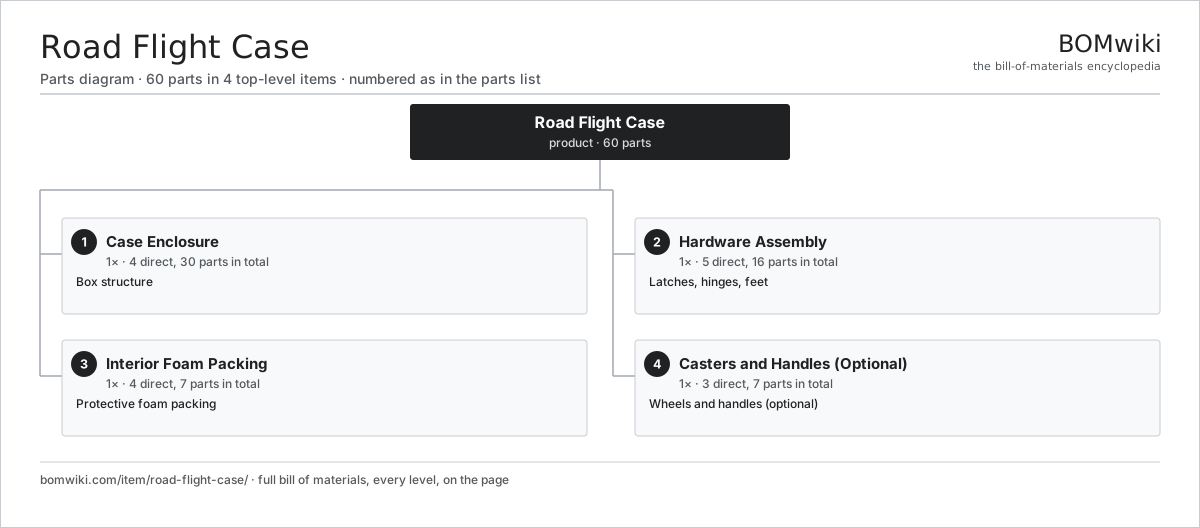
| # | Part | Qty | What it does |
|---|---|---|---|
| 1 | Case Enclosure 4 parts | 1× | Box structure |
| 2 | Hardware Assembly 5 parts | 1× | Latches, hinges, feet |
| 3 | Interior Foam Packing 4 parts | 1× | Protective foam packing |
| 4 | Casters and Handles (Optional) 3 parts | 1× | Wheels and handles (optional) |
3D model
No 3D model yet. Have a CAD file of this? Add a 3D model. STL renders right on this page; STEP, FreeCAD, and OpenSCAD sources are welcome too (openly licensed, like all 3D models on BOMwiki).
Build & assembly graph
expand / collapse · shared sub-assemblies converge · links to related products · est. labourTap an assembly to expand/collapse · tap a part to open it · use “Open page” for any node · drag to pan, scroll to zoom.
Bill of materials for Road Flight Case
4 top-level lines · 20 rows shown · 60 parts total · indented to 3 levels| # | Item / sub-assembly | Part no. | Qty/assy | Ext. qty | Parts | Type |
|---|---|---|---|---|---|---|
| 1 | Case Enclosure 4 parts | road-flight-case-enclosure | 1× | 1 | 30 | assembly |
| 1.1 | Plywood Panel | road-flight-case-plywood-panel | 6× | 6 | · | part |
| 1.2 | Aluminum Edge Extrusion | road-flight-case-aluminum-extrusion | 12× | 12 | · | part |
| 1.3 | Ball Corner | road-flight-case-corner-piece | 8× | 8 | · | part |
| 1.4 | Reinforcement Brace | road-flight-case-reinforcement-brace | 4× | 4 | · | part |
| 2 | Hardware Assembly 5 parts | road-flight-case-hardware-assembly | 1× | 1 | 16 | assembly |
| 2.1 | Butterfly Latch | road-flight-case-butterfly-latch | 4× | 4 | · | part |
| 2.2 | Flight Hinge | road-flight-case-flight-hinge | 2× | 2 | · | part |
| 2.3 | Foot Pad | road-flight-case-foot-pad | 4× | 4 | · | part |
| 2.4 | Handle | road-flight-case-handle-assembly | 2× | 2 | · | part |
| 2.5 | Latch Catch Plate | road-flight-case-latch-catch | 4× | 4 | · | part |
| 3 | Interior Foam Packing 4 parts | road-flight-case-interior-foam | 1× | 1 | 7 | assembly |
| 3.1 | Base Foam Layer | road-flight-case-foam-base | 1× | 1 | · | part |
| 3.2 | Lid Foam Padding | road-flight-case-foam-lid-padding | 1× | 1 | · | part |
| 3.3 | Foam Divider | road-flight-case-foam-compartment-dividers | 4× | 4 | · | part |
| 3.4 | Pluck-and-Pick Foam | road-flight-case-foam-pick-sheet | 1× | 1 | · | part |
| 4 | Casters and Handles (Optional) 3 parts | road-flight-case-casters-system | 1× | 1 | 7 | assembly |
| 4.1 | Locking Wheel Caster | road-flight-case-wheel-caster | 4× | 4 | · | part |
| 4.2 | Side Handle | road-flight-case-side-handle | 2× | 2 | · | part |
| 4.3 | Caster Plate | road-flight-case-caster-plate | 1× | 1 | · | part |
Something wrong in this list? Report a problem with this BOM.
Sourcing: possible vendors
Browse the supplier directory → Prices, MOQ, and lead times are algorithmic estimates, not quotes, and not claims about these companies. Company mappings are curated by keyword; est. price band $20–$2k. How estimates work| Vendor | HQ | Specialty | MOQ | Lead time |
|---|---|---|---|---|
|
🇺🇸Coleman
coleman.com ↗
|
Chicago, US | Camping gear | 1,000 units | 6–10 wks |
| thenorthface.com ↗ | Denver, US | Outdoor apparel & gear | 1,000 units | 6–10 wks |
|
🇺🇸YETI
yeti.com ↗
|
Austin, US | Coolers & drinkware | 1,000 units | 6–10 wks |
| decathlon.com ↗ | Villeneuve-d'Ascq, FR | Sporting goods | 1,000 units | 6–10 wks |
|
🇺🇸Garmin
garmin.com ↗
|
Olathe, US | GPS & wearables | 1,000 units | 6–10 wks |
1,768-word article