Road Marking Machine
ProductOverview
A road marking machine is a truck-mounted system for painting centerlines, edge lines, and symbols on highways and urban streets. The equipment simultaneously applies paint (solvent-based acrylic or thermoplastic) and glass beads (retroreflective spheres) in a single pass, creating a visible, reflective road line durable for 1–3 years depending on traffic.
Road authorities employ fleet marking machines for continuous network maintenance. A single operator and laborer can mark 20–40 km of centerline per 8-hour shift on a two-lane highway, covering in weeks what would take manual crews months. The machine's proportional system adjusts paint flow and bead rate on-the-fly based on vehicle speed, maintaining uniform appearance.
The Road Marking Machine combines three functions: (1) heating and pressurizing paint, (2) metering paint flow at constant rate per unit distance, and (3) dispensing glass beads synchronized with paint for immediate retroreflectivity. Modern machines employ GPS or odometer-based intermittent marking (dashed or broken lines) without operator manual intervention.
How it works
The operator pre-fills the paint tank with acrylic or thermoplastic paint (500–2000 L per full tank). The electric heater raises paint temperature to 80–120 °C (depending on paint type and ambient conditions). The bead hopper is charged with 1000–2000 kg of retroreflective glass beads (typical specification: 500–1000 µm spheres, 1.5 refractive index).
The operator drives the truck at a constant speed (5–30 km/h) along the road centerline or edge. The odometer (GPS or wheel-mounted encoder) measures distance traveled. The operator activates the marking via a console button; the proportional spray nozzles open, discharging paint at a pre-set rate (mL/m). Simultaneously, the glass bead dispenser opens, metering beads at a synchronized rate (100–300 kg/km).
Paint is applied from two spray guns (left and right lines) or a single central gun (centerline). The guns are positioned 150–300 mm above the pavement, producing a 100–400 mm wide line at variable paint flow depending on vehicle speed. The proportional controller receives speed input from the odometer and adjusts spray pressure in real-time: at higher speed, spray pressure increases to maintain constant paint volume per unit length; at lower speed, spray pressure decreases. This feedback keeps line appearance uniform despite varying road conditions and operator speed variations.
Glass beads are dispensed immediately after paint is laid, embedding in the wet paint film. As paint cures (10–60 minutes depending on solvent content), the beads become partially embedded, achieving retroreflectivity (headlight reflection toward the driver). Without beads, paint lines are non-reflective at night and invisible.
Dashed or broken lines are produced using the odometer to trigger intermittent on/off cycles: for example, 3 meters of paint followed by 3 meters of gap. The controller manages this without operator input, improving consistency and safety.
Paint types and properties
Acrylic water-based paint: Solvent: water + coalescent. Dry time 15–45 minutes at +20 °C. Durability: 12–18 months (moderate traffic). Cost: €3–5/L. Advantage: low VOC, easy cleanup. Disadvantage: poor weather resistance, fades quickly in sunlight.
Solvent-based acrylic: Solvent: xylene, toluene, acetone. Dry time 10–20 minutes. Durability: 18–24 months. Cost: €5–8/L. Advantage: better weather resistance and color stability. Disadvantage: VOC regulations in some regions, flammability.
Thermoplastic (hot-melt): Polymer-bitumen binder, applied at 180–220 °C. Dry time 5 minutes. Durability: 3–4 years (2–3x longer than acrylic). Cost: €8–12/L. Advantage: superior durability and skid resistance. Disadvantage: requires specialized heated tank and applicator, higher initial cost.
Most road authorities specify acrylic for cost-effectiveness; thermoplastic is reserved for high-traffic arterials and highways. A Road Marking Machine can apply either with tank temperature adjustment; thermoplastic machines are slightly larger due to higher heating demand.
Glass bead retroreflection
Glass beads (spheres, typically 500–1000 µm diameter, 1.5 refractive index) achieve retroreflection through internal refraction. A parallel beam of light (e.g., automobile headlights) enters a sphere, refracts through the opposite side, reflects off the back surface, and exits back through the entry surface, returning light toward the source. This creates the "cat's eye" effect visible at night.
Retroreflectivity is measured in candlepower units (cd/m²/lux): a standard line should achieve 200–400 cd/m²/lux when tested at 30 meters. Factors affecting performance:
- Bead size distribution: Smaller beads (< 500 µm) reflect less; larger beads (1000–1400 µm) reflect more but are less durable. Optimal grading includes mix of sizes.
- Bead embedment: Beads must sink halfway into the paint film, exposing the reflective hemisphere. Over-embedment (buried) or under-embedment (loose) reduces retroreflection.
- Paint thickness: Thin paint films allow better bead embedment; thick films (>0.5 mm) cover beads, reducing light return. Optimal film thickness 0.2–0.4 mm.
- Paint clarity: Opaque pigments (white titanium dioxide) carry light-absorbing additives; transparent or translucent base coats with minimal pigment allow better light transmission to beads.
Bead application rate of 100–300 kg/km is specified by road authorities; rates are country/region-specific and based on durability and safety testing. The metering auger and adjustable nozzles allow operators to fine-tune bead rate without stopping to manually adjust hoppers.
Proportional control and speed compensation
Modern road marking machines employ proportional solenoid control for spray pressure. As vehicle speed varies, the proportional regulator automatically adjusts spray nozzle pressure to maintain constant paint volume per unit distance traveled.
Example: A line specification calls for 50 mL/m paint at 1 m/s speed (equivalent to 180 mL at 1 second/meter). At 10 m/s (36 km/h), the target becomes 500 mL per second, requiring higher spray pressure. The odometer continuously measures speed; the controller adjusts proportional pressure upward to achieve 500 mL/s. If the operator slows to 5 m/s (18 km/h), pressure drops to maintain 250 mL/s.
This feedback system prevents over-application (waste and slippery lines) and under-application (faint, short-lived lines). Without speed compensation, lines painted at constant pressure vary in thickness and durability: slow sections are thick and blur, fast sections are thin and fade quickly.
Maintenance and durability
The heater is the most critical maintenance item. Paint residues polymerize at the heater surface, gradually reducing heat transfer. Annual heater cleaning (descaling with solvent) is required. Heater failure forces emergency equipment shutdown; spares are typically stocked.
The spray nozzles are prone to clogging from paint residue or dust ingestion. Operators flush nozzles at the end of each shift with solvent; neglected nozzles clog within days. Nozzle replacement (€200–400 per gun) is routine maintenance.
The bead hopper requires occasional draining and cleaning. Glass beads absorb moisture and can bridge (form arches) in the hopper if humidity is high. A pneumatic vibrator is activated before each marking run to break bridges and ensure smooth flow.
The insulated supply hose must withstand high temperature (up to 120 °C paint temperature) without degrading. Rubber hoses are rated for these temperatures but lose elasticity after 3–4 years. Hose failure causes paint discharge loss and requires field repair (carrying spare hoses and couplers is essential).
Operator skill and line quality
Line quality depends on operator experience. Poor technique produces:
- Wavering centerlines: Inconsistent steering, causing the line to meander.
- Bleed-through: Paint applied over wet paint from the previous pass, causing bleeding and fuzzy edges.
- Bead drop-off: Inadequate paint film, allowing beads to roll off early, reducing durability.
- Inconsistent width: Spray pressure variations, producing lines thicker in some sections.
Experienced operators maintain consistent speed, level acceleration/deceleration, and follow road geometry precisely. Training typically requires 40–80 hours of supervised operation before independent work.
Environmental and safety
Solvent-based paint emissions are subject to VOC (volatile organic compound) regulations. Many jurisdictions restrict solvent-based marking to night hours or low-traffic periods to minimize worker and public exposure. Water-based acrylics emit negligible VOC.
Operator inhalation of paint fumes during 8-hour shifts is a health concern; forced ventilation in the cab and respiratory protection are standard in developed markets. Some regions mandate electrostatic painting (charged paint particles) to improve application efficiency and reduce airborne losses.
Traffic safety during line painting is critical. Marked lanes must be temporarily closed or traffic slowed using police escorts or temporary signage. Paint application equipment extends 1–2 m beyond the truck width; operators must maintain awareness of parked cars, pedestrians, and bicycles.
Standards and specifications
Road marking is governed by ASTM D711 (paint properties), EN 1824 (European durability standards), and local road authorities' design guides. Lines must meet reflectance (typically 200–400 cd/m²/lux), durability (12–36 months), and skid resistance (depending on road type) standards. Periodic testing is required; failed lines are re-marked at no cost.
Road Marking Machine parts and their functions
7 top-level parts · 29 parts in total · full bill of materials below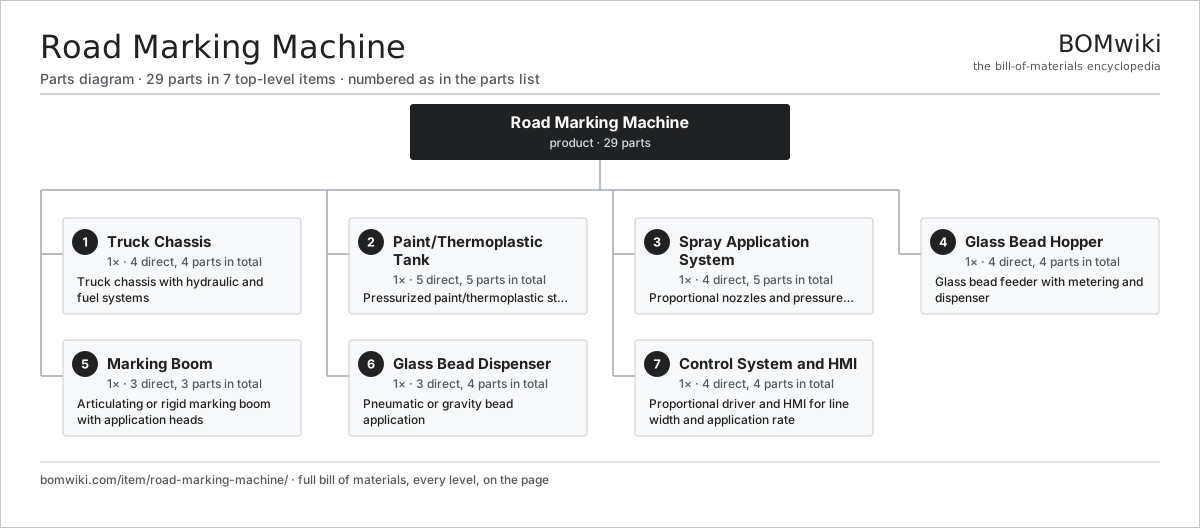
| # | Part | Qty | What it does |
|---|---|---|---|
| 1 | Truck Chassis 4 parts | 1× | Truck chassis with hydraulic and fuel systems |
| 2 | Paint/Thermoplastic Tank 5 parts | 1× | Pressurized paint/thermoplastic storage and heating |
| 3 | Spray Application System 4 parts | 1× | Proportional nozzles and pressure regulation |
| 4 | Glass Bead Hopper 4 parts | 1× | Glass bead feeder with metering and dispenser |
| 5 | Marking Boom 3 parts | 1× | Articulating or rigid marking boom with application heads |
| 6 | Glass Bead Dispenser 3 parts | 1× | Pneumatic or gravity bead application |
| 7 | Control System and HMI 4 parts | 1× | Proportional driver and HMI for line width and application rate |
3D model
No 3D model yet. Have a CAD file of this? Add a 3D model. STL renders right on this page; STEP, FreeCAD, and OpenSCAD sources are welcome too (openly licensed, like all 3D models on BOMwiki).
Build & assembly graph
expand / collapse · shared sub-assemblies converge · links to related products · est. labourTap an assembly to expand/collapse · tap a part to open it · use “Open page” for any node · drag to pan, scroll to zoom.
Bill of materials for Road Marking Machine
7 top-level lines · 34 rows shown · 29 parts total · indented to 3 levels| # | Item / sub-assembly | Part no. | Qty/assy | Ext. qty | Parts | Type |
|---|---|---|---|---|---|---|
| 1 | Truck Chassis 4 parts | road-marking-chassis | 1× | 1 | 4 | assembly |
| 1.1 | Truck Frame | road-marking-truck-body | 1× | 1 | · | part |
| 1.2 | Engine | road-marking-prime-engine | 1× | 1 | · | part |
| 1.3 | Hydraulic Pump | road-marking-hydraulic-pump | 1× | 1 | · | part |
| 1.4 | Proportional Valve Block | road-marking-proportional-valves | 1× | 1 | · | part |
| 2 | Paint/Thermoplastic Tank 5 parts | road-marking-paint-tank | 1× | 1 | 5 | assembly |
| 2.1 | Tank Vessel | road-marking-tank-vessel | 1× | 1 | · | part |
| 2.2 | Tank Heater | road-marking-heater | 1× | 1 | · | part |
| 2.3 | Circulation Pump | road-marking-circulation-pump | 1× | 1 | · | part |
| 2.4 | Tank Strainer | road-marking-tank-strainer | 1× | 1 | · | part |
| 2.5 | Pressure Gauge | road-marking-pressure-gauge | 1× | 1 | · | part |
| 3 | Spray Application System 4 parts | road-marking-spray-system | 1× | 1 | 5 | assembly |
| 3.1 | Pressure Regulator | road-marking-pressure-regulator | 1× | 1 | · | part |
| 3.2 | Spray Gun | road-marking-spray-gun | 2× | 2 | · | part |
| 3.3 | Nozzle Manifold | road-marking-nozzle-manifold | 1× | 1 | · | part |
| 3.4 | Supply Hose | road-marking-supply-hose | 1× | 1 | · | part |
| 4 | Glass Bead Hopper 4 parts | road-marking-glass-bead-hopper | 1× | 1 | 4 | assembly |
| 4.1 | Bead Hopper | road-marking-bead-hopper-shell | 1× | 1 | · | part |
| 4.2 | Bead Vibrator | road-marking-bead-vibrator | 1× | 1 | · | part |
| 4.3 | Bead Auger | road-marking-bead-auger | 1× | 1 | · | part |
| 4.4 | Bead Motor | road-marking-bead-auger-motor | 1× | 1 | · | part |
| 5 | Marking Boom 3 parts | road-marking-boom | 1× | 1 | 3 | assembly |
| 5.1 | Boom Arm | road-marking-boom-arm | 1× | 1 | · | part |
| 5.2 | Boom Suspension | road-marking-boom-suspension | 1× | 1 | · | part |
| 5.3 | Guidance System | road-marking-boom-guide | 1× | 1 | · | part |
| 6 | Glass Bead Dispenser 3 parts | road-marking-bead-system | 1× | 1 | 4 | assembly |
| 6.1 | Bead Manifold | road-marking-bead-manifold | 1× | 1 | · | part |
| 6.2 | Bead Nozzle | road-marking-bead-nozzle | 2× | 2 | · | part |
| 6.3 | Bead Blower | road-marking-bead-blower | 1× | 1 | · | part |
| 7 | Control System and HMI 4 parts | road-marking-controls | 1× | 1 | 4 | assembly |
| 7.1 | Marking Controller | road-marking-plc | 1× | 1 | · | part |
| 7.2 | HMI Console | road-marking-hmi-console | 1× | 1 | · | part |
| 7.3 | Odometer | road-marking-odometer | 1× | 1 | · | part |
| 7.4 | Proportional Amplifier | road-marking-proportional-amplifier | 1× | 1 | · | part |
Something wrong in this list? Report a problem with this BOM.
Sourcing: possible vendors
Browse the supplier directory → Prices, MOQ, and lead times are algorithmic estimates, not quotes, and not claims about these companies. Company mappings are curated by keyword; est. price band $15k–$2M. How estimates work| Vendor | HQ | Specialty | MOQ | Lead time |
|---|---|---|---|---|
| caterpillar.com ↗ | Irving, US | Construction & mining equipment | made to order | 16–28 wks |
|
🇯🇵Komatsu
komatsu.com ↗
|
Tokyo, JP | Construction & mining equipment | made to order | 16–28 wks |
|
🇸🇪Volvo CE
volvoce.com ↗
|
Gothenburg, SE | Construction equipment | made to order | 16–28 wks |
|
🇨🇭Liebherr
liebherr.com ↗
|
Bulle, CH | Cranes & heavy equipment | made to order | 16–28 wks |
|
🇨🇳XCMG
xcmg.com ↗
|
Xuzhou, CN | Construction machinery | made to order | 16–28 wks |
1,520-word article