Rock Bolter
ProductOverview
A rock bolter is a specialized support rig designed to install ground reinforcement bolts in underground mines and hard rock tunnels. These machines combine a long articulated boom, a precision drill head, and a bolt handling system to rapidly install roof support without stationary drilling stands. By automating bolt placement and tightening, rock bolters reduce the labor-intensive manual bolting process and improve worker safety by positioning personnel on an elevated basket rather than on scaling ladders. Bolters are essential in tunneling, longhole mining, and development headings where ground control directly determines production rate and safety.
How it works
The rock bolter is a compact, low-profile tracked platform optimized for confined underground spaces. Its diesel engine drives a hydrostatic transmission, allowing infinitely variable speed without mechanical gearing. The operator controls the entire machine from a pendant with proportional joysticks, either hardwired or wireless.
Boom Positioning and Drilling
The articulated boom is the machine's defining feature. It comprises three sections connected by hydraulic cylinders. As the operator manipulates dual proportional joysticks, the proportional valve block meters flow to each boom cylinder independently, allowing the boom to sweep across the roof and sidewalls in three dimensions. The boom extends 4–6 meters, reaching ceiling heights of 3–5 meters and sidewall locations 2–3 meters above floor.
Once positioned, the drill head, a compact pneumatic or electric spindle turning at 300–800 rpm, contacts the rock face. The operator engages feed pressure, and the drill quill travels down, driven by a solenoid-controlled pneumatic feed valve. As the bit penetrates, a mechanical depth stop prevents over-drilling. Hole depth is typically 1.5–5 meters, limited by bolt length and ground conditions.
The chuck holds the drill rod and any bolt-handling adapter. When the hole is complete, the boom-end gripper releases the bit, and the boom automatically retrieves a fresh tool from the personnel basket or changes bit via the integrated cartridge system.
Bolt Installation Methods
Bolting methods vary by ground support design:
Resin Cartridge (Most Common)
A capsule of two-part epoxy resin is inserted into the hole. The pneumatic nut runner rotates the bolt, and the rotating bolt threads through the capsule, shearing its membrane and mixing resin. As the operator spins the nut down, resin fills the hole space, bonding the bolt to the rock. Installation is fast, 30–60 seconds per bolt, and requires no curing time.
Split-Set Bolts
A wedge-action bolt with radial springs is inserted into the hole and driven with a pneumatic pusher until the springs expand against the hole wall. The nut runner then tightens the face washer. Installation is even faster but provides less load capacity than resin.
Mechanical Anchors
Expansion bolts require drilling to precise depth, inserting the bolt, then driving expansion wedges with a nut runner. More labor-intensive but preferred in weak ground.
Bolt Handling System
The bolt handling system automates bolt feeding. A magazine mounted on the basket holds 50–100 cartridges or loose bolts. A vibrator orients bolts and prevents jams. When the drill head is ready, the pusher cylinder advances the next bolt into the chuck. After installation, the bolt is released and the cycle repeats.
The entire system, drill, feed, grip, bolt push, nut run, is orchestrated by the proportional valve manifold and operator pendant. Experienced operators achieve installation rates of 15–25 bolts per hour in favorable ground.
Hydraulic and Pneumatic Integration
The main hydraulic system is a variable-displacement pump (80–150 cc/rev) supplying the boom, feed, and gripper circuits. The proportional valve block integrates all circuits; each solenoid section receives an electrical command from the operator joystick, modulating spool position and thus oil flow to its destination.
The pump is load-sensing: it measures pressure in the line leading to the highest-resistance circuit and automatically reduces displacement when that circuit is idle, saving fuel. An accumulator (0.5–1 liter) absorbs shock when the drill suddenly hits hard inclusions or when the nut runner stalls.
Pneumatic power for drill, feed, gripper, nut runner, and hopper vibrator comes from a separate compressor system (25–35 bar). The desiccant dryer removes moisture to prevent tool corrosion in wet underground environments. A main regulator steps down to the working pressure (6–8 bar) for all pneumatic accessories.
Personnel Platform and Safety
The elevated platform brings operators and bolt supplies 2–3 meters above ground. This eliminates the hazard of hand-scaling (climbing mine walls with pickaxes), a leading cause of mining injuries. The perimeter railing and ladder access meet mining safety standards. The tool rack keeps drills, nuts, and cartridges organized within arm's reach.
A battery backup system ensures that proportional valve control remains active even if the diesel engine stalls or dies. This is critical for safe boom retraction. A communication radio allows the operator to coordinate with ground personnel and production supervision.
Design Constraints in Underground Environments
Rock bolters operating in coal mines must be "gassy mine" certified: they use wet drilling to suppress coal dust, employ flame-arrestor fuel caps, and have sealed electrical systems to prevent ignition of methane. Diesel engines are often replaced with battery-electric drivetrains in the deepest coal mines.
Heading sizes vary globally. Asian coal mines average 3–4 meter tunnel heights, requiring track width and mast height below 2.5 meters. North American hard rock tunnels reach 5–7 meters, allowing larger machines. Manufacturers offer bolters with adjustable track widths and collapsible canopies to fit regional standards.
Ventilation in tunnels is often marginal. Bolters generate exhaust heat and require effective engine cooling. The cooler must handle both hydraulic and engine coolant loops in confined spaces. Muffler heat shields prevent ignition of exposed bolts or cartridges stored above the exhaust.
Durability and Maintenance
Underground bolters face extreme wear: abrasive rock dust penetrates seals, mine-water corrosion attacks cylinders, and high-cycle use stresses boom pivot pins. Expected service life is 5,000–8,000 operating hours.
Maintenance highlights:
- Boom pins and cylinders: Inspect every 1,000 hours for corrosion and free play.
- Drill chuck and spindle: Bearings wear rapidly; replace every 2,000 hours in high-production headings.
- Proportional solenoids: Dust damage is common; filter air supply and replace every 3,000 hours.
- Hydraulic hoses: Subject to sharp rock abrasion; replace annually or per visual inspection.
- Drill bits and cartridges: Consumables replaced per geological mapping of bolt locations.
Bolters are typically moved between headings monthly and undergo complete fluid flush and filter change every 500 operating hours to manage dust contamination.
Integration with Mining Operations
Rock bolting directly affects mine safety and production. Poor bolting design or misaligned bolts cause ground failures weeks or months later, halting production and injuring personnel. Bolters enable rapid support installation as development headings advance, maintaining tight production cycles in modern mines.
Digital bolters now integrate rig-mounted cameras and position sensors that log every bolt location, depth, and nut-runner torque. This data is centralized in mine planning software, creating a spatial record of ground support. Supervisors can verify that bolting design was followed and identify problem zones requiring remedial support.
Rock Bolter parts and their functions
9 top-level parts · 117 parts in total · full bill of materials below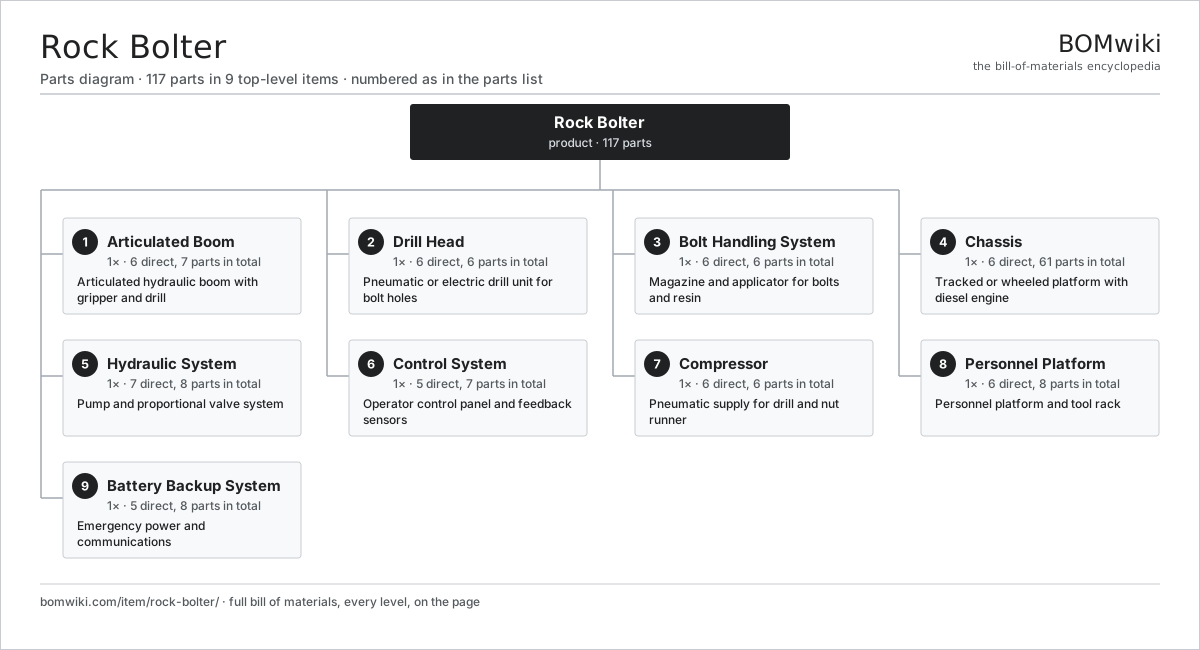
| # | Part | Qty | What it does |
|---|---|---|---|
| 1 | Articulated Boom 6 parts | 1× | Articulated hydraulic boom with gripper and drill |
| 2 | Drill Head 6 parts | 1× | Pneumatic or electric drill unit for bolt holes |
| 3 | Bolt Handling System 6 parts | 1× | Magazine and applicator for bolts and resin |
| 4 | Chassis 6 parts | 1× | Tracked or wheeled platform with diesel engine |
| 5 | Hydraulic System 7 parts | 1× | Pump and proportional valve system |
| 6 | Control System 5 parts | 1× | Operator control panel and feedback sensors |
| 7 | Compressor 6 parts | 1× | Pneumatic supply for drill and nut runner |
| 8 | Personnel Platform 6 parts | 1× | Personnel platform and tool rack |
| 9 | Battery Backup System 5 parts | 1× | Emergency power and communications |
3D model
No 3D model yet. Have a CAD file of this? Add a 3D model. STL renders right on this page; STEP, FreeCAD, and OpenSCAD sources are welcome too (openly licensed, like all 3D models on BOMwiki).
Build & assembly graph
expand / collapse · shared sub-assemblies converge · links to related products · est. labourTap an assembly to expand/collapse · tap a part to open it · use “Open page” for any node · drag to pan, scroll to zoom.
Bill of materials for Rock Bolter
9 top-level lines · 67 rows shown · 117 parts total · indented to 3 levels| # | Item / sub-assembly | Part no. | Qty/assy | Ext. qty | Parts | Type |
|---|---|---|---|---|---|---|
| 1 | Articulated Boom 6 parts | rock-bolter-boom | 1× | 1 | 7 | assembly |
| 1.1 | Main Boom Section | rock-bolter-boom-base | 1× | 1 | · | part |
| 1.2 | Mid Boom Section | rock-bolter-boom-mid | 1× | 1 | · | part |
| 1.3 | End Boom Section | rock-bolter-boom-end | 1× | 1 | · | part |
| 1.4 | Articulation Cylinder | rock-bolter-articulation-cylinder | 2× | 2 | · | part |
| 1.5 | Boom Pin | rock-bolter-boom-pin | 1× | 1 | · | part |
| 1.6 | Boom-End Gripper | rock-bolter-boom-gripper | 1× | 1 | · | part |
| 2 | Drill Head 6 parts | rock-bolter-drill-head | 1× | 1 | 6 | assembly |
| 2.1 | Drill Motor | rock-bolter-drill-motor | 1× | 1 | · | part |
| 2.2 | Drill Chuck | rock-bolter-drill-chuck | 1× | 1 | · | part |
| 2.3 | Feed Solenoid Valve | rock-bolter-feed-solenoid | 1× | 1 | · | part |
| 2.4 | Drill Quill | rock-bolter-quill | 1× | 1 | · | part |
| 2.5 | Depth Stop | rock-bolter-depth-stop | 1× | 1 | · | part |
| 2.6 | O-Ring Set | oring-set | 1× | 1 | · | part |
| 3 | Bolt Handling System 6 parts | rock-bolter-bolt-handling | 1× | 1 | 6 | assembly |
| 3.1 | Bolt Hopper | rock-bolter-hopper | 1× | 1 | · | part |
| 3.2 | Hopper Vibrator | rock-bolter-hopper-vibrator | 1× | 1 | · | part |
| 3.3 | Bolt Pusher | rock-bolter-bolt-pusher | 1× | 1 | · | part |
| 3.4 | Resin Injector | rock-bolter-resin-injector | 1× | 1 | · | part |
| 3.5 | Nut Runner | rock-bolter-nut-runner | 1× | 1 | · | part |
| 3.6 | Fastener Set | fastener-set | 1× | 1 | · | part |
| 4 | Chassis 6 parts | rock-bolter-chassis | 1× | 1 | 61 | assembly |
| 4.1 | Diesel Engine | rock-bolter-engine | 1× | 1 | · | part |
| 4.2 | Hydrostatic Transmission | rock-bolter-transmission | 1× | 1 | · | part |
| 4.3 | Track Unit | rock-bolter-track-unit | 2× | 2 | · | part |
| 4.4 | Track Motor | rock-bolter-track-motor | 2× | 2 | · | part |
| 4.5 | Fuel Tank | rock-bolter-fuel-tank | 1× | 1 | · | part |
| 4.6 | Wheel Assembly 5 parts | wheel-assembly | 6× | 6 | 9 | assembly |
| 4.6.1 | Alloy Wheel | alloy-wheel | 1× | 6 | · | part |
| 4.6.2 | Tire | tire | 1× | 6 | · | part |
| 4.6.3 | TPMS Sensor | tpms-sensor | 1× | 6 | · | part |
| 4.6.4 | Lug Nut | lug-nut | 5× | 30 | · | part |
| 4.6.5 | Valve Stem | valve-stem | 1× | 6 | · | part |
| 5 | Hydraulic System 7 parts | rock-bolter-hydraulics | 1× | 1 | 8 | assembly |
| 5.1 | Main Pump | rock-bolter-pump | 1× | 1 | · | part |
| 5.2 | Proportional Valve Block | rock-bolter-proportional-valve | 1× | 1 | · | part |
| 5.3 | Accumulator | rock-bolter-accumulator | 1× | 1 | · | part |
| 5.4 | Filter | rock-bolter-filter | 1× | 1 | · | part |
| 5.5 | Cooler | rock-bolter-cooler | 1× | 1 | · | part |
| 5.6 | Pressure Sensor | pressure-sensor | 2× | 2 | · | part |
| 5.7 | Hose Bundle | rock-bolter-hose-bundle | 1× | 1 | · | part |
| 6 | Control System 5 parts | rock-bolter-controls | 1× | 1 | 7 | assembly |
| 6.1 | Control Pendant | rock-bolter-pendant | 1× | 1 | · | part |
| 6.2 | Proportional Joystick | rock-bolter-proportional-joystick | 2× | 2 | · | part |
| 6.3 | Pressure Gauge | rock-bolter-pressure-gauge | 2× | 2 | · | part |
| 6.4 | Depth Counter | rock-bolter-depth-counter | 1× | 1 | · | part |
| 6.5 | LCD Panel | lcd-panel | 1× | 1 | · | part |
| 7 | Compressor 6 parts | rock-bolter-compressor | 1× | 1 | 6 | assembly |
| 7.1 | Compressor Head | rock-bolter-compressor-head | 1× | 1 | · | part |
| 7.2 | Compressor Motor | rock-bolter-compressor-motor | 1× | 1 | · | part |
| 7.3 | Air Receiver Tank | rock-bolter-air-tank | 1× | 1 | · | part |
| 7.4 | Pressure Regulator | rock-bolter-pressure-regulator | 1× | 1 | · | part |
| 7.5 | Air Dryer | rock-bolter-dryer | 1× | 1 | · | part |
| 7.6 | Air Hose | rock-bolter-air-hose | 1× | 1 | · | part |
| 8 | Personnel Platform 6 parts | rock-bolter-basket | 1× | 1 | 8 | assembly |
| 8.1 | Basket Frame | rock-bolter-basket-frame | 1× | 1 | · | part |
| 8.2 | Basket Floor | rock-bolter-basket-floor | 1× | 1 | · | part |
| 8.3 | Safety Railing | rock-bolter-railing | 2× | 2 | · | part |
| 8.4 | Step Ladder | rock-bolter-step-ladder | 1× | 1 | · | part |
| 8.5 | Tool Rack | rock-bolter-tool-rack | 1× | 1 | · | part |
| 8.6 | Sheet Metal Panel | sheet-panel | 2× | 2 | · | part |
| 9 | Battery Backup System 5 parts | rock-bolter-battery-backup | 1× | 1 | 8 | assembly |
| 9.1 | LiPo Cell | lipo-cell | 4× | 4 | · | part |
| 9.2 | BMS Board | bms-board | 1× | 1 | · | part |
| 9.3 | Battery Charger | rock-bolter-charger | 1× | 1 | · | part |
| 9.4 | Inverter | rock-bolter-inverter | 1× | 1 | · | part |
| 9.5 | Communication Radio | rock-bolter-radio | 1× | 1 | · | part |
Something wrong in this list? Report a problem with this BOM.
Related products
same domain, ranked by shared parts Underground Utility Vehicle
148 parts · shares 9 with this page
Underground Utility Vehicle
148 parts · shares 9 with this page
 Quarry Drill Rig
94 parts · shares 8 with this page
Quarry Drill Rig
94 parts · shares 8 with this page
 Drilling Jumbo
175 parts · shares 7 with this page
Drilling Jumbo
175 parts · shares 7 with this page
 Load-Haul-Dump (LHD)
164 parts · shares 7 with this page
Load-Haul-Dump (LHD)
164 parts · shares 7 with this page
 Mining Haul Truck
1,000 parts · shares 7 with this page
Mining Haul Truck
1,000 parts · shares 7 with this page
 Quarry Wheel Loader
227 parts · shares 7 with this page
Quarry Wheel Loader
227 parts · shares 7 with this page
Sourcing: possible vendors
Browse the supplier directory → Prices, MOQ, and lead times are algorithmic estimates, not quotes, and not claims about these companies. Company mappings are curated by keyword; est. price band $200k–$5M. How estimates work| Vendor | HQ | Specialty | MOQ | Lead time |
|---|---|---|---|---|
| caterpillar.com ↗ | Irving, US | Construction & mining equipment | made to order | 20–36 wks |
|
🇯🇵Komatsu
komatsu.com ↗
|
Tokyo, JP | Construction & mining equipment | made to order | 20–36 wks |
|
🇸🇪Sandvik
rocktechnology.sandvik ↗
|
Stockholm, SE | Mining & rock technology | made to order | 20–36 wks |
|
🇸🇪Epiroc
epiroc.com ↗
|
Stockholm, SE | Mining & drilling equipment | made to order | 20–36 wks |
|
🇫🇮Metso
metso.com ↗
|
Helsinki, FI | Crushing & minerals processing | made to order | 20–36 wks |
1,306-word article