Roe Extraction Machine
ProductOverview
Roe (fish eggs) is a valuable commodity in seafood processing, used as caviar, sushi toppings, and ingredient in Japanese furikake and other specialty foods. A spawning female fish (salmon, herring, pollock, capelin) contains 15–30% of body weight in roe sacs nested in the abdominal cavity. Extracting and processing roe requires specialized equipment: mechanical separation must break the connecting tissue without damaging individual eggs (roe). The roe extraction machine combines twin rotating drums with elastomer coverings (to cushion eggs) and a perforated screening deck (to size and dry the final product). The process is gentle but efficient: cavity material (fish innards with roe sacs) is fed into the drums, which compress and separate roe from tissue, blood, and waste. The roe then passes through a vibrating screen, where it drains free water and is sorted by size. A final dewatering drum reduces moisture, and the finished product (whole roe sacs, often called "ikura" for salmon or "kazunoko" for herring) is ready for curing, salting, or packaging.
Industrial roe extraction is critical for wild fisheries: salmon and herring processing plants rely on roe as a secondary revenue stream (25–40% of total revenue) to offset the cost of low-value fish meal produced from trim. Without efficient roe recovery, processing margins would be significantly impaired.
How it works
Raw abdominal cavity material (containing roe sacs, blood, connective tissue, and organ residue) is loaded into the hopper. A vibrating feeder meter the material onto the twin drum assembly at 20–50 kg/min. The two elastomer-covered drums rotate in opposite directions at 50–150 rpm, creating a compression zone between them. As the cavity material passes through, the soft eggs are suspended and mostly passed intact, while hard tissue, blood, and bone fragments are compressed against the elastomer surface and partially broken. The compression force is gentle enough to preserve egg integrity (cell wall tension resists breakage up to 150 kPa).
After passing through the drum compression zone, the partially separated roe (still mixed with tissue fragments, blood, and liquid) drops onto the inclined perforated screening deck. The screen has 0.5–2 mm apertures, and a rotating agitator arm vibrates the screen at 20–60 rpm. Liquid, blood, and small tissue fragments pass through the perforations and drain into the sump; larger roe and intact roe sacs remain on top of the screen. The screen is tilted at 20–30° so that separated roe slides toward a secondary dewatering drum.
The dewatering drum (a stainless steel cylinder with 3 mm perforations, rotating at 100–300 rpm) further removes water and tissue fragments. Roe tumbles inside the drum for 20–40 seconds, and residual moisture is flung outward through the perforations. The final roe product (70–85% of input weight, now at 50–60% moisture) discharges onto a collection chute for icing or further processing.
Key assemblies
Twin-drum press: The elastomer covering is critical for egg protection. A hardness of 60 Shore A (on the durometer scale) is a compromise: too soft (< 50 Shore A) and the drums become tacky and wear quickly; too hard (> 70 Shore A) and egg damage increases. The drums typically run at 50–150 rpm for herring/capelin (smaller, more delicate eggs) and up to 200 rpm for salmon (larger eggs with thicker shells). Drum covering lifespan is 500–1000 hours before replacement, costing $200–400 per pair.
Screening deck: The screen mesh is the primary size-selecting element. Herring roe (about 0.5 mm diameter) uses a 0.5 mm screen; salmon roe (about 5–7 mm) uses a 2 mm screen. Screen blinding (clogging with small tissue fragments) is the main operational issue; the rotating agitator arm with rubber fingers vibrates the screen to prevent sediment buildup and maintain flow rate. High-efficiency screens can process 500–800 kg/hour; poorly maintained screens clogged with debris drop to 100–200 kg/hour.
Dewatering centrifuge: This secondary stage is optional but valuable for premium products requiring very low moisture (< 50%). The 3 mm perforations allow roe to drop through but retain most tissue fragments. Centrifugal force at 100–300 rpm provides 5–10 g of acceleration, effectively squeezing water from roe surface and pores. Dewatering time is typically 20–30 seconds.
Drive system: The main motor (10–15 kW) powers the drum gearbox; separate VFDs drive the screen agitator and dewater drum independently. This decoupling allows operators to tune screen speed (for optimal separation without tissue damage) and dewater drum speed (for final moisture control) without changing mechanical gears. VFD soft-start also prevents mechanical shock during startup.
Controls: The PLC monitors drum motor current draw as a proxy for material load; if load spikes (indicating tissue accumulation or blockage), the PLC can reduce drum speed or trigger an alarm. Some advanced systems integrate moisture measurement via near-infrared or capacitive sensors, automatically adjusting dewater drum speed to hit a target moisture setpoint (e.g., 55% target).
Yield and quality factors
Roe recovery depends on cavity material content. Fresh spawning fish (in breeding season) yield 70–85% roe by weight of input cavity material; fish past their prime or with damaged roe sacs yield only 40–60%. Species matter: salmon roe is larger and more robust (90–95% recovery); herring roe is smaller and more fragile (70–80% recovery).
Egg damage (breakage) is the primary quality issue. Target damage rates are < 2% intact eggs remaining (98% whole roe sacs). High drum speed increases throughput but elevates damage; optimal speed balances yield and quality. Most processors operate at the sweet spot: 100 rpm for salmon, 80 rpm for herring.
Maintenance and consumables
The drum elastomer liner is the highest-wear component, lasting 500–1000 hours before replacement becomes economical. Replacement involves unbolting the old covering, slipping it off the mandrel, and sliding a new liner on; total downtime is 1–2 hours. Some facilities stock spare mandrels with liners pre-installed to minimize downtime.
The screen mesh typically lasts 2–4 months under continuous use before the nylon becomes brittle or stainless corrodes. Replacement cost is $100–300 per screen. High-protein, salt-rich roe and blood accelerate corrosion, so stainless 316L (higher corrosion resistance) is preferred over 304 for long service life.
The drum bearing (tapered roller bearing) should be inspected every 500 operating hours and regreased with NLGI 2 grease. Worn bearings introduce radial play that degrades compression zone performance. Full bearing replacement every 2000–3000 hours is typical.
Variants and integration
Small batch machines (100–200 kg/hour) use a single vibrating screen deck without secondary dewatering; more moisture remains in the product but capital cost is 40–50% less. Large-volume operations (1000+ kg/hour) employ dual-drum systems running in parallel or a single large-diameter drum (150–180 mm) running at lower speed to reduce egg damage.
Integrated caviar processing lines pair roe extraction with downstream salt curing (applying 8–12% salt for shelf life) and vacuum packaging. Cold storage (-18°C) preserves roe quality for 12–24 months.
Some premium processors add a gentle wash stage after the screen deck: recovered roe is rinsed in fresh 4°C water to remove residual blood and tissue, improving color and shelf appeal. This adds a secondary conveyor and spray system but does not significantly impact throughput.
Roe Extraction Machine parts and their functions
8 top-level parts · 63 parts in total · full bill of materials below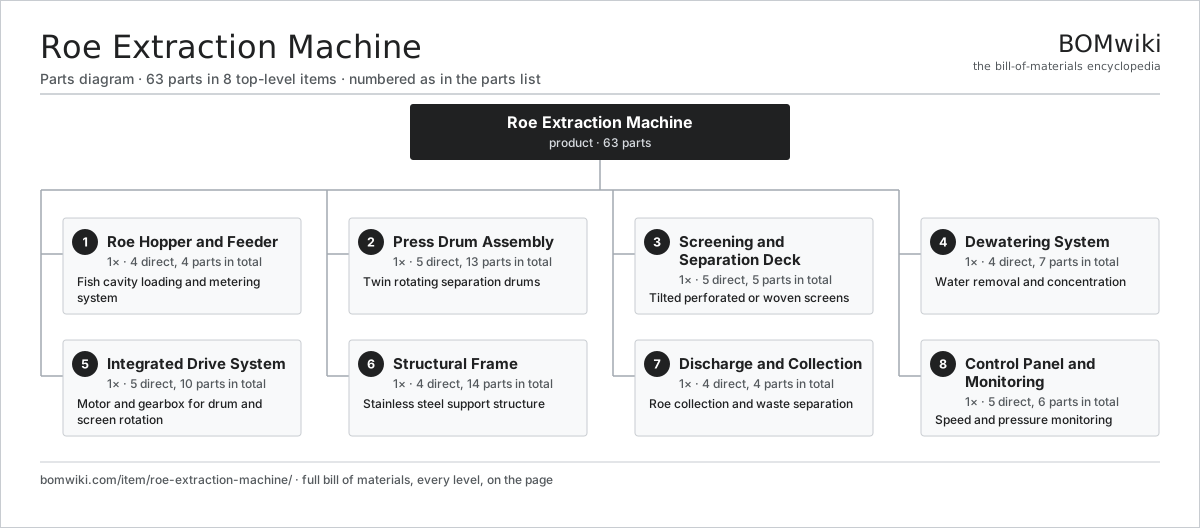
| # | Part | Qty | What it does |
|---|---|---|---|
| 1 | Roe Hopper and Feeder 4 parts | 1× | Fish cavity loading and metering system |
| 2 | Press Drum Assembly 5 parts | 1× | Twin rotating separation drums |
| 3 | Screening and Separation Deck 5 parts | 1× | Tilted perforated or woven screens |
| 4 | Dewatering System 4 parts | 1× | Water removal and concentration |
| 5 | Integrated Drive System 5 parts | 1× | Motor and gearbox for drum and screen rotation |
| 6 | Structural Frame 4 parts | 1× | Stainless steel support structure |
| 7 | Discharge and Collection 4 parts | 1× | Roe collection and waste separation |
| 8 | Control Panel and Monitoring 5 parts | 1× | Speed and pressure monitoring |
3D model
No 3D model yet. Have a CAD file of this? Add a 3D model. STL renders right on this page; STEP, FreeCAD, and OpenSCAD sources are welcome too (openly licensed, like all 3D models on BOMwiki).
Build & assembly graph
expand / collapse · shared sub-assemblies converge · links to related products · est. labourTap an assembly to expand/collapse · tap a part to open it · use “Open page” for any node · drag to pan, scroll to zoom.
Bill of materials for Roe Extraction Machine
8 top-level lines · 44 rows shown · 63 parts total · indented to 3 levels| # | Item / sub-assembly | Part no. | Qty/assy | Ext. qty | Parts | Type |
|---|---|---|---|---|---|---|
| 1 | Roe Hopper and Feeder 4 parts | roe-extraction-machine-hopper | 1× | 1 | 4 | assembly |
| 1.1 | Hopper Pan | roe-extraction-machine-hopper-pan | 1× | 1 | · | part |
| 1.2 | Vibratory Feeder Unit | roe-extraction-machine-vibrator | 1× | 1 | · | part |
| 1.3 | Flow Control Gate | roe-extraction-machine-slide-gate | 1× | 1 | · | part |
| 1.4 | Fastener Set | fastener-set | 1× | 1 | · | part |
| 2 | Press Drum Assembly 5 parts | roe-extraction-machine-press-drums | 1× | 1 | 13 | assembly |
| 2.1 | Drum Mandrel | roe-extraction-machine-drum-shaft | 2× | 2 | · | part |
| 2.2 | Drum Elastomer Liner | roe-extraction-machine-drum-covering | 2× | 2 | · | part |
| 2.3 | Tapered Roller Bearing | roe-extraction-machine-drum-bearing | 4× | 4 | · | part |
| 2.4 | Drum Drive Motor | roe-extraction-machine-drum-motor | 1× | 1 | · | part |
| 2.5 | Ball Bearing | ball-bearing | 4× | 4 | · | part |
| 3 | Screening and Separation Deck 5 parts | roe-extraction-machine-screening-deck | 1× | 1 | 5 | assembly |
| 3.1 | Screen Pan | roe-extraction-machine-screen-pan | 1× | 1 | · | part |
| 3.2 | Screen Mesh | roe-extraction-machine-screen-mesh | 1× | 1 | · | part |
| 3.3 | Screen Agitator | roe-extraction-machine-screen-agitator | 1× | 1 | · | part |
| 3.4 | Agitator Drive Motor | roe-extraction-machine-screen-motor | 1× | 1 | · | part |
| 3.5 | Fastener Set | fastener-set | 1× | 1 | · | part |
| 4 | Dewatering System 4 parts | roe-extraction-machine-dewatering | 1× | 1 | 7 | assembly |
| 4.1 | Dewatering Drum | roe-extraction-machine-dewater-drum | 1× | 1 | · | part |
| 4.2 | Dewater Motor | roe-extraction-machine-dewater-motor | 1× | 1 | · | part |
| 4.3 | Drain Sump Tank | roe-extraction-machine-drain-sump | 1× | 1 | · | part |
| 4.4 | Ball Bearing | ball-bearing | 4× | 4 | · | part |
| 5 | Integrated Drive System 5 parts | roe-extraction-machine-drive-system | 1× | 1 | 10 | assembly |
| 5.1 | Main Drive Motor | roe-extraction-machine-main-motor | 1× | 1 | · | part |
| 5.2 | Distribution Gearbox | roe-extraction-machine-gearbox | 1× | 1 | · | part |
| 5.3 | VFD Control Panel | roe-extraction-machine-vfd-panel | 1× | 1 | · | part |
| 5.4 | Ball Bearing | ball-bearing | 6× | 6 | · | part |
| 5.5 | Fastener Set | fastener-set | 1× | 1 | · | part |
| 6 | Structural Frame 4 parts | roe-extraction-machine-frame | 1× | 1 | 14 | assembly |
| 6.1 | Base Plate | roe-extraction-machine-base-plate | 1× | 1 | · | part |
| 6.2 | Support Column | roe-extraction-machine-uprights | 4× | 4 | · | part |
| 6.3 | Bracing Beam | roe-extraction-machine-beams | 6× | 6 | · | part |
| 6.4 | Fastener Set | fastener-set | 3× | 3 | · | part |
| 7 | Discharge and Collection 4 parts | roe-extraction-machine-discharge | 1× | 1 | 4 | assembly |
| 7.1 | Roe Collection Chute | roe-extraction-machine-roe-chute | 1× | 1 | · | part |
| 7.2 | Tissue Waste Basket | roe-extraction-machine-waste-bin | 1× | 1 | · | part |
| 7.3 | Water Discharge Line | roe-extraction-machine-water-discharge | 1× | 1 | · | part |
| 7.4 | Fastener Set | fastener-set | 1× | 1 | · | part |
| 8 | Control Panel and Monitoring 5 parts | roe-extraction-machine-controls | 1× | 1 | 6 | assembly |
| 8.1 | PLC Controller | roe-extraction-machine-plc | 1× | 1 | · | part |
| 8.2 | HMI Touchscreen | roe-extraction-machine-hmi | 1× | 1 | · | part |
| 8.3 | Encoder | encoder | 1× | 1 | · | part |
| 8.4 | Pressure Sensor | pressure-sensor | 1× | 1 | · | part |
| 8.5 | Relay | relay | 2× | 2 | · | part |
Something wrong in this list? Report a problem with this BOM.
Related products
same domain, ranked by shared parts Bottle Washing Machine
2,388 parts · shares 2 with this page
Brine Chilling System
239 parts · shares 2 with this page
Candy Depositing Line
223 parts · shares 2 with this page
Bottle Washing Machine
2,388 parts · shares 2 with this page
Brine Chilling System
239 parts · shares 2 with this page
Candy Depositing Line
223 parts · shares 2 with this page
Sourcing: possible vendors
Browse the supplier directory → Prices, MOQ, and lead times are algorithmic estimates, not quotes, and not claims about these companies. Company mappings are curated by keyword; est. price band $1k–$500k. How estimates work| Vendor | HQ | Specialty | MOQ | Lead time |
|---|---|---|---|---|
| gea.com ↗ | Düsseldorf, DE | Process technology | 20 units | 12–20 wks |
| buhlergroup.com ↗ | Uzwil, CH | Food & materials processing | 20 units | 12–20 wks |
| tetrapak.com ↗ | Pully, CH | Food packaging & processing | 20 units | 12–20 wks |
| jbtc.com ↗ | Chicago, US | Food processing equipment | 20 units | 12–20 wks |
| alfalaval.com ↗ | Lund, SE | Heat transfer & separation | 20 units | 12–20 wks |
1,217-word article