Roof Exhaust Fan
ProductOverview
A roof exhaust fan is the simplest and most direct way to expel air from a building: a centrifugal impeller mounted in a roof curb that draws air from the space below and throws it into the outside air. The fan is self-contained, integral with its own damper, hood, and vibration isolation, and requires only a ductwork connection to the building and electrical power. Roof exhaust fans are ubiquitous in commercial kitchens, warehouses, garages, locker rooms, and any application where the exhaust ductwork can rise vertically to the roof.
The unit consists of a Roof Curb & Base that sits on the roof deck with flashing, a Centrifugal Wheel driven by an Electric Motor, and a scroll Housing & Discharge Scroll that discharges to a Backdraft Damper and Discharge Hood & Birdscreen. Sizes range from a quiet 0.5 m³/s for residential exhaust to 20 m³/s (72,000 m³/h) for a large industrial facility. Electric motor controls are simple: a switch and thermostat, or integration into a BMS for variable-frequency drives.
Impeller and airflow
The Centrifugal Wheel is a forward-curved design: air enters the eye of the Blade Ring and is thrown both radially outward and tangentially, hitting the Discharge Scroll walls. A forward-curved wheel produces useful pressure at low speed and is inherently quiet, making it popular for indoor exhaust applications. The wheel is keyed to the Fan Shaft and bolted to the Impeller Hub; it is Wheel Balancing to Grade 6.3 ISO 20816 to minimize vibration. The motor shaft couples directly via the key, eliminating belt slip and belt noise.
The Housing & Discharge Scroll is a spiral casing that expands around the wheel, converting the velocity of the discharged air into static pressure that pushes air into the ductwork at 150–500 Pa. An Inlet Bell Mouth bell mouth at the intake minimizes inlet losses and guides air smoothly into the wheel eye.
Mounting and isolation
The fan sits in a Roof Curb & Base, a structural galvanized-steel frame sitting on the roof. The Roof Flashing seals the roof penetration with an aluminum boot that slopes away from the opening and is flashed into the membrane or shingled surface. The Vibration Isolator pads or spring mounts under the entire assembly decouple the centrifugal forces from the roof deck; without this isolation, the roof would transmit a constant low-frequency hum into the building below. The Access Cover Plate can be removed to slide the wheel and motor assembly off the shaft for cleaning or replacement.
Damper and weather protection
The Backdraft Damper is a critical passive safety feature: a hinged Damper Flapper that swings open on a few pascals of fan discharge pressure but closes under gravity or spring force when the fan stops. This backdraft damper prevents rain from entering the ductwork during heavy wind, and prevents outdoor air, sometimes cold, from flowing backward into the building at night. The damper is simple, maintenance-free, and has no moving parts that can jam.
The Discharge Hood & Birdscreen is a peaked aluminum or galvanized-steel shell that sheds rain and debris away from the discharge opening. An integral Birdscreen Mesh of 12 mm galvanized mesh prevents birds and large insects from nesting in the ductwork. The hood typically hinges open on a Hood Hinge for ductwork connection and periodic cleaning of the birdscreen.
Bearings and drive
The motor is directly coupled to the fan shaft; there are no belts, sheaves, or gearboxes. The Electric Motor is a standard induction machine, sized to the pressure and flow demand, rated for continuous duty. The non-motor end of the shaft runs in a Pillow Block Bearing assembly: a self-aligning ball bearing in a Pillow Block Housing cast-iron pedestal, with a Bearing Seal that keeps dust and rain out. Modern units often add a second bearing under the motor flange for very large high-speed wheels.
Ductwork connection
The Discharge Collar on the fan scroll is a flat flange that bolt-connects to the building's exhaust riser. A short Flexible Duct Connector of insulated spiral aluminum flex duct isolates the high-speed fan vibration from the rigid ductwork. Duct Vibration Hanger strap hangers with elastomer isolators support the duct run without coupling the vibration back to the building frame. The entire discharge path must be sealed to prevent leakage and maintain the fan's rated pressure capability.
Noise
Forward-curved wheels are inherently quieter than backward-curved designs at the same duty point, running typically at 75–90 dB(A) at 1 m depending on size and speed. The Vibration Isolation System system is critical to acoustic performance: without it, the vibration radiates through the roof and walls as structure-borne noise. Variable-frequency drives that slow the fan speed for part-load operation reduce noise further, since noise roughly tracks the eighth power of speed.
Roof Exhaust Fan parts and their functions
8 top-level parts · 82 parts in total · full bill of materials below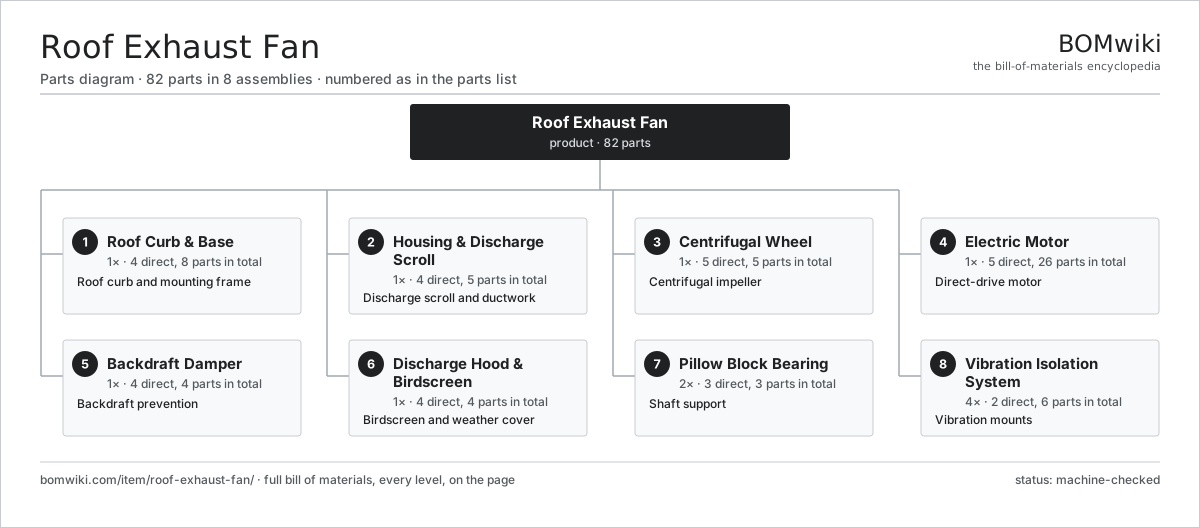
| # | Part | Qty | What it does |
|---|---|---|---|
| 1 | Roof Curb & Base 4 parts | 1× | Roof curb and mounting frame |
| 2 | Housing & Discharge Scroll 4 parts | 1× | Discharge scroll and ductwork |
| 3 | Centrifugal Wheel 5 parts | 1× | Centrifugal impeller |
| 4 | Electric Motor 5 parts | 1× | Direct-drive motor |
| 5 | Backdraft Damper 4 parts | 1× | Backdraft prevention |
| 6 | Discharge Hood & Birdscreen 4 parts | 1× | Birdscreen and weather cover |
| 7 | Pillow Block Bearing 3 parts | 2× | Shaft support |
| 8 | Vibration Isolation System 2 parts | 4× | Vibration mounts |
3D model
No 3D model yet. Have a CAD file of this? Add a 3D model — STL renders right on this page; STEP, FreeCAD, and OpenSCAD sources are welcome too (openly licensed, like all 3D models on BOMwiki).
Build & assembly graph
expand / collapse · shared sub-assemblies converge · links to related products · est. labourTap an assembly to expand/collapse · tap a part to open it · use “Open page” for any node · drag to pan, scroll to zoom.
Bill of materials for Roof Exhaust Fan
8 top-level lines · 46 rows shown · 82 parts total · indented to 3 levels| # | Item / sub-assembly | Part no. | Qty/assy | Ext. qty | Parts | Type |
|---|---|---|---|---|---|---|
| 1 | Roof Curb & Base 4 parts | roof-exhaust-fan-curb-base | 1× | 1 | 8 | assembly |
| 1.1 | Curb Frame | roof-exhaust-fan-curb-frame | 1× | 1 | · | part |
| 1.2 | Roof Flashing | roof-exhaust-fan-roof-flashing | 1× | 1 | · | part |
| 1.3 | Vibration Isolator | roof-exhaust-fan-vibration-isolator | 4× | 4 | · | part |
| 1.4 | Fastener Set | fastener-set | 2× | 2 | · | part |
| 2 | Housing & Discharge Scroll 4 parts | roof-exhaust-fan-housing | 1× | 1 | 5 | assembly |
| 2.1 | Discharge Scroll | roof-exhaust-fan-scroll | 1× | 1 | · | part |
| 2.2 | Inlet Bell Mouth | roof-exhaust-fan-inlet-ring | 1× | 1 | · | part |
| 2.3 | Access Cover Plate | roof-exhaust-fan-access-cover | 1× | 1 | · | part |
| 2.4 | Bearing Pedestal | roof-exhaust-fan-bearing-block | 2× | 2 | · | part |
| 3 | Centrifugal Wheel 5 parts | roof-exhaust-fan-wheel | 1× | 1 | 5 | assembly |
| 3.1 | Impeller Hub | roof-exhaust-fan-impeller-hub | 1× | 1 | · | part |
| 3.2 | Blade Ring | roof-exhaust-fan-blade-set | 1× | 1 | · | part |
| 3.3 | Fan Shaft | roof-exhaust-fan-shaft | 1× | 1 | · | part |
| 3.4 | Shaft Keyway | roof-exhaust-fan-shaft-key | 1× | 1 | · | part |
| 3.5 | Wheel Balancing | roof-exhaust-fan-wheel-balancing | 1× | 1 | · | part |
| 4 | Electric Motor 5 parts | roof-exhaust-fan-motor | 1× | 1 | 26 | assembly |
| 4.1 | Stator Assembly 3 parts | stator-assembly | 1× | 1 | 3 | assembly |
| 4.1.1 | Stator Core (laminations) | stator-core | 1× | 1 | · | part |
| 4.1.2 | Copper Winding | copper-winding | 1× | 1 | · | part |
| 4.1.3 | Slot Insulation | stator-insulation | 1× | 1 | · | part |
| 4.2 | Rotor Assembly 4 parts | rotor-assembly | 1× | 1 | 19 | assembly |
| 4.2.1 | Rotor Shaft | rotor-shaft | 1× | 1 | · | part |
| 4.2.2 | Rotor Core | rotor-core | 1× | 1 | · | part |
| 4.2.3 | Neodymium Magnet | neodymium-magnet | 16× | 16 | · | part |
| 4.2.4 | Ball Bearing | ball-bearing | 1× | 1 | · | part |
| 4.3 | Copper Winding | copper-winding | 1× | 1 | · | part |
| 4.4 | Motor Housing | motor-housing | 1× | 1 | · | part |
| 4.5 | Ball Bearing | ball-bearing | 2× | 2 | · | part |
| 5 | Backdraft Damper 4 parts | roof-exhaust-fan-damper | 1× | 1 | 4 | assembly |
| 5.1 | Damper Flapper | roof-exhaust-fan-damper-flapper | 1× | 1 | · | part |
| 5.2 | Damper Hinge | roof-exhaust-fan-damper-hinge | 1× | 1 | · | part |
| 5.3 | Balance Weight or Spring | roof-exhaust-fan-damper-counterweight | 1× | 1 | · | part |
| 5.4 | Damper Seat Frame | roof-exhaust-fan-damper-seat | 1× | 1 | · | part |
| 6 | Discharge Hood & Birdscreen 4 parts | roof-exhaust-fan-hood | 1× | 1 | 4 | assembly |
| 6.1 | Hood Shell | roof-exhaust-fan-hood-shell | 1× | 1 | · | part |
| 6.2 | Hood Hinge | roof-exhaust-fan-hood-hinge | 1× | 1 | · | part |
| 6.3 | Birdscreen Mesh | roof-exhaust-fan-birdscreen | 1× | 1 | · | part |
| 6.4 | Screen Holder Frame | roof-exhaust-fan-hood-frame | 1× | 1 | · | part |
| 7 | Pillow Block Bearing 3 parts | roof-exhaust-fan-motor-bearing | 2× | 2 | 3 | assembly |
| 7.1 | Ball Bearing | ball-bearing | 1× | 2 | · | part |
| 7.2 | Pillow Block Housing | roof-exhaust-fan-pillow-housing | 1× | 2 | · | part |
| 7.3 | Bearing Seal | roof-exhaust-fan-bearing-seal | 1× | 2 | · | part |
| 8 | Vibration Isolation System 2 parts | roof-exhaust-fan-isolation | 4× | 4 | 6 | assembly |
| 8.1 | Isolation Pad | roof-exhaust-fan-isolation-pad | 4× | 16 | · | part |
| 8.2 | Spring Isolator | roof-exhaust-fan-spring-isolator | 2× | 8 | · | part |
Related products
same domain, ranked by shared parts Air Curtain
115 parts · shares 11 with this page
Air Curtain
115 parts · shares 11 with this page
 Air Handling Unit
631 parts · shares 11 with this page
Air Handling Unit
631 parts · shares 11 with this page
 Air Purifier
331 parts · shares 11 with this page
Air Purifier
331 parts · shares 11 with this page
 Ceiling Cassette AC
395 parts · shares 11 with this page
Ceiling Cassette AC
395 parts · shares 11 with this page
 Centrifugal Chiller
340 parts · shares 11 with this page
Centrifugal Chiller
340 parts · shares 11 with this page
 Dehumidifier
217 parts · shares 11 with this page
Dehumidifier
217 parts · shares 11 with this page
Sourcing: possible vendors
Prices, MOQ, and lead times are algorithmic estimates, not quotes, and not claims about these companies. Company mappings are curated by keyword; est. price band $100–$20k. How estimates work| Vendor | HQ | Specialty | MOQ | Lead time |
|---|---|---|---|---|
|
🇺🇸Carrier
carrier.com ↗
|
Palm Beach Gardens, US | HVAC | 500 units | 8–14 wks |
| tranetechnologies.com ↗ | Davidson, US | HVAC | 500 units | 8–14 wks |
|
🇯🇵Daikin
daikin.com ↗
|
Osaka, JP | HVAC | 500 units | 8–14 wks |
|
🇺🇸Lennox
lennox.com ↗
|
Richardson, US | HVAC | 500 units | 8–14 wks |
| johnsoncontrols.com ↗ | Milwaukee, US | Building systems | 500 units | 8–14 wks |
880-word article