Vehicle Roof-Top Tent
ProductOverview
A roof-top tent moves the sleeping platform from the ground to the vehicle roof. The format originated in 1950s Italy (Autohome's ancestors) and matured in Australian and African overlanding, where sleeping above ground level avoids mud, water, and wildlife. The fold-out soft-shell type described here packs to half its floor area: one Floor Panel stays bolted over the roof rack while the other folds out on the Main Floor Hinge to cantilever over the side of the vehicle, doubling the floor to about 2.4 by 1.4 metres. The Telescoping Ladder is structural, not just access; it props the cantilevered half and carries a large share of the occupants' weight to the ground.
Unlike a ground tent, nothing is assembled at camp. The Canopy Fabric is permanently attached to both floor halves, the Mattress Assembly stays inside through the fold, and Spring-Steel Rod bows tension the fabric automatically as the floor opens. Setup is the time it takes to unzip the Travel Cover, swing the floor over, and extend the ladder, typically well under ten minutes.
Structure and loads
The floor is the defining structural problem. A ground tent floor carries nothing; this one is a bridge. Each panel is an aluminum-skinned honeycomb sandwich, the same construction logic as an aircraft floor: thin face sheets take bending tension and compression while the honeycomb core holds them apart and resists shear, giving high stiffness per kilogram. The Base Frame extrusion stiffens the perimeter and forms the T-slots for mounting. In the open position the outboard panel is supported at the hinge line and at the ladder, so occupant loads near the outer edge resolve mostly down the Ladder Section stack; the Locking Collar pins must therefore be fully engaged before anyone climbs in.
Mounting transfers two very different load cases into the vehicle. Static, the rack sees the tent plus occupants, commonly 270 kg or more, which most factory rails handle because the load path is straight down. Dynamic, while driving, the rack sees only the 50–65 kg tent but with vibration, aerodynamic lift, and braking loads, which is why rack makers publish a separate dynamic rating that must meet or exceed the tent weight. The Mounting Rail T-slots accept Clamp Plate hardware at any crossbar spread, with the M8 Mounting Bolt Set torqued to about 18–20 N·m and re-checked after the first drive.
Weather behavior
The poly-cotton canopy is a deliberate compromise. Pure polyester is lighter and dries faster, but cotton-blend fabric breathes, which matters in a tent whose occupants exhale roughly a litre of water overnight. The PU coating brings hydrostatic head to 2,000–3,000 mm, sufficient for sustained rain, while the Rainfly Assembly handles the roof, the most exposed surface: its Rainfly Fabric sheds water on an independent rod-supported layer with an air gap, so condensation forming under the fly drips onto the canopy exterior rather than the sleepers. Beneath the mattress, the Anti-Condensation Mat solves the corresponding cold-surface problem at the floor, holding the foam off the aluminum panel so vapor can escape instead of condensing into the foam.
Wind is the soft-shell format's weak point. The opened tent presents a tall fabric box on top of a vehicle, and spring-rod awnings start deforming audibly in gusts above roughly 50 km/h; standard practice in storms is to fold the tent and sleep in the vehicle. The two-layer Door Panel and Window Panel panels (storm fabric plus no-see-um mesh, independently zipped) let occupants trade ventilation against weather without leaving the sleeping bag.
Travel configuration
Folded, the tent must survive highway speeds. The Compression Strap set cinches the bundle so fabric cannot work loose and flutter, and the Cover Shell, a welded PVC-coated polyester skin closed by the Cover Zipper, takes the 120 km/h wind blast, rain, and UV that would destroy tent fabric in a season of exposure. Fuel-economy penalties of 5–15 % are typical from the added frontal area and the roughly 60 kg up high, which also raises the vehicle's center of gravity noticeably on off-camber trails. Gas Strut springs assist the fold in both directions, since the outboard panel with mattress and canopy is an awkward 25-plus kilograms swinging overhead. Hard-shell variants trade the fold-out's floor area for a clamshell or wedge that opens in seconds and carries less aerodynamic penalty, but the fold-out soft shell remains the dominant type by volume because it sleeps two adults over a footprint half its open size.
Vehicle Roof-Top Tent parts and their functions
8 top-level parts · 68 parts in total · full bill of materials below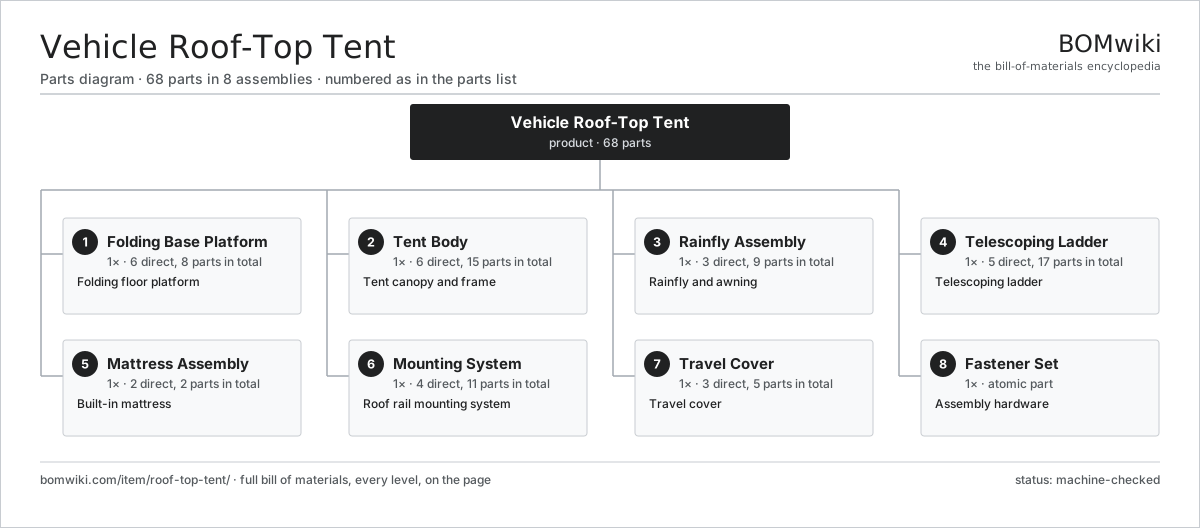
| # | Part | Qty | What it does |
|---|---|---|---|
| 1 | Folding Base Platform 6 parts | 1× | Folding floor platform |
| 2 | Tent Body 6 parts | 1× | Tent canopy and frame |
| 3 | Rainfly Assembly 3 parts | 1× | Rainfly and awning |
| 4 | Telescoping Ladder 5 parts | 1× | Telescoping ladder |
| 5 | Mattress Assembly 2 parts | 1× | Built-in mattress |
| 6 | Mounting System 4 parts | 1× | Roof rail mounting system |
| 7 | Travel Cover 3 parts | 1× | Travel cover |
| 8 | Fastener Set | 1× | Assembly hardware |
3D model
No 3D model yet. Have a CAD file of this? Add a 3D model — STL renders right on this page; STEP, FreeCAD, and OpenSCAD sources are welcome too (openly licensed, like all 3D models on BOMwiki).
Build & assembly graph
expand / collapse · shared sub-assemblies converge · links to related products · est. labourTap an assembly to expand/collapse · tap a part to open it · use “Open page” for any node · drag to pan, scroll to zoom.
Bill of materials for Vehicle Roof-Top Tent
8 top-level lines · 37 rows shown · 68 parts total · indented to 3 levels| # | Item / sub-assembly | Part no. | Qty/assy | Ext. qty | Parts | Type |
|---|---|---|---|---|---|---|
| 1 | Folding Base Platform 6 parts | roof-top-tent-base | 1× | 1 | 8 | assembly |
| 1.1 | Floor Panel | roof-top-tent-floor-panel | 2× | 2 | · | part |
| 1.2 | Main Floor Hinge | roof-top-tent-main-hinge | 1× | 1 | · | part |
| 1.3 | Base Frame | roof-top-tent-base-frame | 1× | 1 | · | part |
| 1.4 | Gas Strut | roof-top-tent-gas-strut | 2× | 2 | · | part |
| 1.5 | Anti-Condensation Mat | roof-top-tent-condensation-mat | 1× | 1 | · | part |
| 1.6 | Fastener Set | fastener-set | 1× | 1 | · | part |
| 2 | Tent Body 6 parts | roof-top-tent-body | 1× | 1 | 15 | assembly |
| 2.1 | Canopy Fabric | roof-top-tent-canopy | 1× | 1 | · | part |
| 2.2 | Spring-Steel Rod | roof-top-tent-spring-rod | 4× | 4 | · | part |
| 2.3 | Door Panel | roof-top-tent-door | 2× | 2 | · | part |
| 2.4 | Window Panel | roof-top-tent-window | 3× | 3 | · | part |
| 2.5 | Zipper Set | roof-top-tent-zipper-set | 1× | 1 | · | part |
| 2.6 | Internal Storage Pocket | roof-top-tent-internal-pocket | 4× | 4 | · | part |
| 3 | Rainfly Assembly 3 parts | roof-top-tent-rainfly | 1× | 1 | 9 | assembly |
| 3.1 | Rainfly Fabric | roof-top-tent-fly-fabric | 1× | 1 | · | part |
| 3.2 | Fly Support Rod | roof-top-tent-fly-rod | 2× | 2 | · | part |
| 3.3 | Fly Tension Buckle | roof-top-tent-fly-buckle | 6× | 6 | · | part |
| 4 | Telescoping Ladder 5 parts | roof-top-tent-ladder | 1× | 1 | 17 | assembly |
| 4.1 | Ladder Section | roof-top-tent-ladder-section | 3× | 3 | · | part |
| 4.2 | Ladder Rung | roof-top-tent-ladder-rung | 8× | 8 | · | part |
| 4.3 | Locking Collar | roof-top-tent-locking-collar | 2× | 2 | · | part |
| 4.4 | Ladder Mount Bracket | roof-top-tent-ladder-bracket | 2× | 2 | · | part |
| 4.5 | Ladder Foot | roof-top-tent-ladder-foot | 2× | 2 | · | part |
| 5 | Mattress Assembly 2 parts | roof-top-tent-mattress | 1× | 1 | 2 | assembly |
| 5.1 | Foam Core | roof-top-tent-foam-core | 1× | 1 | · | part |
| 5.2 | Mattress Cover | roof-top-tent-mattress-cover | 1× | 1 | · | part |
| 6 | Mounting System 4 parts | roof-top-tent-mounting | 1× | 1 | 11 | assembly |
| 6.1 | Mounting Rail | roof-top-tent-mounting-rail | 2× | 2 | · | part |
| 6.2 | Clamp Plate | roof-top-tent-clamp-plate | 4× | 4 | · | part |
| 6.3 | M8 Mounting Bolt Set | roof-top-tent-m8-bolt-set | 1× | 1 | · | part |
| 6.4 | Rail End Cap | roof-top-tent-rail-end-cap | 4× | 4 | · | part |
| 7 | Travel Cover 3 parts | roof-top-tent-cover | 1× | 1 | 5 | assembly |
| 7.1 | Cover Shell | roof-top-tent-cover-shell | 1× | 1 | · | part |
| 7.2 | Cover Zipper | roof-top-tent-cover-zipper | 1× | 1 | · | part |
| 7.3 | Compression Strap | roof-top-tent-compression-strap | 3× | 3 | · | part |
| 8 | Fastener Set | fastener-set | 1× | 1 | · | part |
Related products
same domain, ranked by shared parts Avalanche Transceiver
35 parts · shares 1 with this page
Avalanche Transceiver
35 parts · shares 1 with this page
 Backpacking Stove
32 parts · shares 1 with this page
Backpacking Stove
32 parts · shares 1 with this page
 Baitcasting Reel
51 parts · shares 1 with this page
Bow Press
17 parts · shares 1 with this page
Bow Sight
72 parts · shares 1 with this page
Baitcasting Reel
51 parts · shares 1 with this page
Bow Press
17 parts · shares 1 with this page
Bow Sight
72 parts · shares 1 with this page
Sourcing: possible vendors
Prices, MOQ, and lead times are algorithmic estimates, not quotes, and not claims about these companies. Company mappings are curated by keyword; est. price band $20–$2k. How estimates work| Vendor | HQ | Specialty | MOQ | Lead time |
|---|---|---|---|---|
|
🇺🇸Coleman
coleman.com ↗
|
Chicago, US | Camping gear | 1,000 units | 6–10 wks |
| thenorthface.com ↗ | Denver, US | Outdoor apparel & gear | 1,000 units | 6–10 wks |
|
🇺🇸YETI
yeti.com ↗
|
Austin, US | Coolers & drinkware | 1,000 units | 6–10 wks |
| decathlon.com ↗ | Villeneuve-d'Ascq, FR | Sporting goods | 1,000 units | 6–10 wks |
|
🇺🇸Garmin
garmin.com ↗
|
Olathe, US | GPS & wearables | 1,000 units | 6–10 wks |
832-word article