Rotary Water Well Rig
ProductOverview
The rotary water well rig is a truck-mounted drilling rig used to bore water supply wells into aquifers beneath overburden layers of soil and soft rock. The rig rotates a continuous drill string (kelly, drill pipe, heavy collars, and bit) while pumping mud down through the string and back up the borehole annulus. The mud serves multiple purposes: cooling and lubricating the bit, removing cuttings from the hole, and maintaining hydrostatic pressure to prevent collapse.
Rotary water well rigs typically drill holes 300–1500 meters deep depending on aquifer depth and formation hardness. They are workhorse machines across farming, municipalities, and remote areas where reliable groundwater is critical. The rig is highly adaptable: the same truck and power plant can accommodate different mast heights, pump capacities, and rotary speeds by swapping tooling modules.
How it works
The operator stands in the doghouse (a control cabin) and monitors depth, rotation speed, pump pressure, and torque from digital readouts. The main diesel engine (CAT C15, 250–400 kW) is the rig's heartbeat. It drives the Rotary Table via multi-output gearbox, and a separate power takeoff shaft drives the mud pump engine.
As the drill string rotates, the Drill Bit cuts through layers of clay, sand, gravel, and limestone. The operator applies vertical load by slowly lowering the hook, which hangs the drill string from the Drawworks via the Crown Block and drilling line. Too much load bends the string or breaks the bit; too little wastes time.
The Mud Circulation System is critical. Mud (a bentonite-water or polymer slurry) is pumped down the kelly at 200–500 GPM, exits the Drill Bit, and carries cuttings (loose rock chips) up the annulus (the gap between drill pipe and borehole wall) back to the Mud Tank. There, a Shale Shaker vibrates to separate solids, and the clean mud returns to the pump suction. This circulation cools the bit (which heats from friction), prevents the hole from collapsing, and suspends cuttings so they don't jam the string.
When the well reaches target depth, the operator trips the pipe out, slowly raising the string hand-over-hand, each 9 m joint unscrewed at the Rotary Table and racked back vertically in the mast's pipe rack. The final step is installing a Well Screen and Geothermal Loop Drilling Rig if required for production or monitoring.
Key systems
Mast and derrick: The Mast (25–35 m tall) is the rig's structural spine. It must handle three loads: the weight of suspended drill string (typically 50–100 tonnes), the bending moment from the rotating string's gyroscopic force, and wind loading. Lattice bracing keeps it rigid without excessive steel.
Rotary table: The Rotary Table grips the square Kelly through carbide-lined bushings and rotates it 60–300 RPM depending on bit type and formation. Higher speeds suit softer, shallow formations; lower speeds provide torque for harder layers. The table sits on a large roller bearing and is driven by a 50–150 kW electric or hydraulic motor through a gearbox.
Drawworks: The Drawworks is a drum winch spooled with 1–2 km of steel wire rope. As the operator engages the clutch, the Drawworks Drum turns, raising the hook and drill string. The Drawworks Brake is a friction band that arrests rotation and holds load when disengaged. Proper brake maintenance is essential, a runaway rig has caused fatalities.
Mud circulation: The mud system is a triumph of pragmatic engineering. The pump is a positive-displacement unit (triplex piston or screw pump) that maintains pressure even as flow resistance changes. Pressure gauges at the pump inlet and standpipe (the hose attached to the kelly) let the operator detect formation changes or blockages. Mud density is tailored to each hole section: denser mud is used in weak formations to prevent cave-in; lighter mud in hard rock reduces bit wear.
Power plant: A single heavy-duty diesel engine (250–400 kW, typically CAT C15 or Cummins QSL) drives the entire rig through a complex gearbox with multiple clutches and shafts. One output drives the rotary table at variable speed; another drives the drawworks (independently controlled); a third powers the mud pump engine. Ancillary functions (generator, mud agitators, cooling fans) take shaft power or electrical power from the alternator. This integrated design minimizes the number of engines and keeps the rig's center of gravity low.
Truck chassis: The Truck Frame & Suspension is typically a 6×4 or 8×4 heavy-duty chassis (Mercedes Actros, Volvo FH, Scania R-series, or equivalent) rated for 150–250 tonnes. Air suspension and power steering are mandatory for on-road transport and rig mobility. The mast is lowered onto saddles for travel and raised hydraulically once on-site.
Field operations
On-site, the rig is leveled with hydraulic jacks, and the pump unit is positioned upwind of the mud tank (dust control). The drill crew, operator, driller's helper, and casing driver, work in coordinated steps: drill ahead 5–10 meters, stop, raise the kelly to a safe height, add a joint of drill pipe, lower and screw it on, resume drilling. This repeat cycle dominates well drilling. Every 50–100 meters, a crew member inspects the Drill Bit for wear.
Once the aquifer is reached (confirmed by a rise in mud returns or a sudden drop in pressure), drilling stops. If a Well Screen is to be installed, the drill string is pulled and replaced with casing. Gravel pack material is lowered around the screen. The well is then developed by surging, pumping in and out to flush fine sediment and maximize production yield.
Maintenance is constant. The Drawworks Brake pads are checked daily. The mud pump pistons and liners wear (triplex pumps can do 1000–2000 hours before overhaul). The drill bit's cones become blunt and are replaced. Hoses fatigue and leak. The rig is a system in continuous stress, and downtime for repairs is a major cost driver.
Standards and regulations
Drilling fluids must be disposed of responsibly in accordance with local environmental law. Drilling reports, depth, bit type, formation description, core samples if taken, are filed with the water authority. Well completion certificates document screen depth, casing type, and gravel pack interval. These records are vital for aquifer management and future well remediation.
Water well drilling is often a build-to-order trade: the same rig, driver, and crew handle dozens of different aquifer geometries and formation types across a region. Success depends on the operator's experience in reading formations from mud color, returns rate, and pressure trends, and in adjusting bit speed and weight on the fly.
Rotary Water Well Rig parts and their functions
8 top-level parts · 218 parts in total · full bill of materials below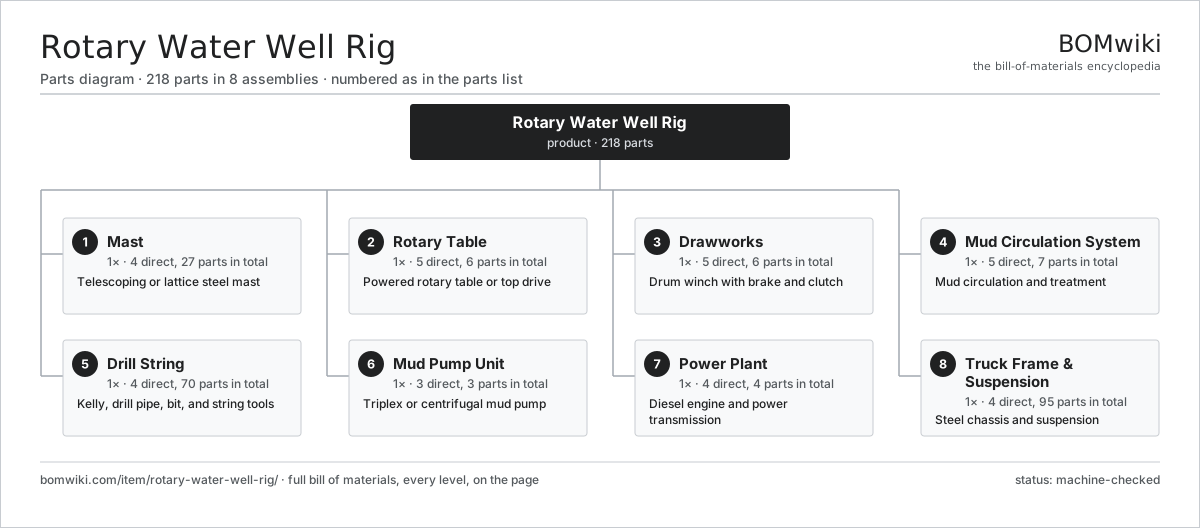
| # | Part | Qty | What it does |
|---|---|---|---|
| 1 | Mast 4 parts | 1× | Telescoping or lattice steel mast |
| 2 | Rotary Table 5 parts | 1× | Powered rotary table or top drive |
| 3 | Drawworks 5 parts | 1× | Drum winch with brake and clutch |
| 4 | Mud Circulation System 5 parts | 1× | Mud circulation and treatment |
| 5 | Drill String 4 parts | 1× | Kelly, drill pipe, bit, and string tools |
| 6 | Mud Pump Unit 3 parts | 1× | Triplex or centrifugal mud pump |
| 7 | Power Plant 4 parts | 1× | Diesel engine and power transmission |
| 8 | Truck Frame & Suspension 4 parts | 1× | Steel chassis and suspension |
3D model
No 3D model yet. Have a CAD file of this? Add a 3D model — STL renders right on this page; STEP, FreeCAD, and OpenSCAD sources are welcome too (openly licensed, like all 3D models on BOMwiki).
Build & assembly graph
expand / collapse · shared sub-assemblies converge · links to related products · est. labourTap an assembly to expand/collapse · tap a part to open it · use “Open page” for any node · drag to pan, scroll to zoom.
Bill of materials for Rotary Water Well Rig
8 top-level lines · 49 rows shown · 218 parts total · indented to 3 levels| # | Item / sub-assembly | Part no. | Qty/assy | Ext. qty | Parts | Type |
|---|---|---|---|---|---|---|
| 1 | Mast 4 parts | rotary-water-well-rig-mast | 1× | 1 | 27 | assembly |
| 1.1 | Mast Column | rotary-water-well-rig-mast-column | 4× | 4 | · | part |
| 1.2 | Mast Braces | rotary-water-well-rig-mast-braces | 12× | 12 | · | part |
| 1.3 | Crown Block 2 parts | rotary-water-well-rig-crown-block | 1× | 1 | 10 | assembly |
| 1.3.1 | Ball Bearing | ball-bearing | 8× | 8 | · | part |
| 1.3.2 | Sheet Metal Panel | sheet-panel | 2× | 2 | · | part |
| 1.4 | Fastener Set | fastener-set | 1× | 1 | · | part |
| 2 | Rotary Table 5 parts | rotary-water-well-rig-rotary-table | 1× | 1 | 6 | assembly |
| 2.1 | Rotary Bowl | rotary-water-well-rig-rotary-bowl | 1× | 1 | · | part |
| 2.2 | Rotary Drive Motor | rotary-water-well-rig-rotary-motor | 1× | 1 | · | part |
| 2.3 | Kelly Bushings | rotary-water-well-rig-kelly-bushings | 2× | 2 | · | part |
| 2.4 | Helical Gear Pair | gear-pair | 1× | 1 | · | part |
| 2.5 | Fastener Set | fastener-set | 1× | 1 | · | part |
| 3 | Drawworks 5 parts | rotary-water-well-rig-drawworks | 1× | 1 | 6 | assembly |
| 3.1 | Drawworks Drum | rotary-water-well-rig-drawworks-drum | 1× | 1 | · | part |
| 3.2 | Drawworks Brake | rotary-water-well-rig-drawworks-brake | 2× | 2 | · | part |
| 3.3 | Drawworks Clutch | rotary-water-well-rig-drawworks-clutch | 1× | 1 | · | part |
| 3.4 | Drawworks Motor | rotary-water-well-rig-drawworks-motor | 1× | 1 | · | part |
| 3.5 | Gearbox Housing | gearbox-housing | 1× | 1 | · | part |
| 4 | Mud Circulation System 5 parts | rotary-water-well-rig-mud-system | 1× | 1 | 7 | assembly |
| 4.1 | Mud Tank | rotary-water-well-rig-mud-tank | 1× | 1 | · | part |
| 4.2 | Mud Pump | rotary-water-well-rig-mud-pump | 1× | 1 | · | part |
| 4.3 | Shale Shaker | rotary-water-well-rig-shale-shaker | 1× | 1 | · | part |
| 4.4 | Mud Lines & Piping | rotary-water-well-rig-mud-lines | 1× | 1 | · | part |
| 4.5 | Pressure Sensor | pressure-sensor | 3× | 3 | · | part |
| 5 | Drill String 4 parts | rotary-water-well-rig-drill-string | 1× | 1 | 70 | assembly |
| 5.1 | Kelly | rotary-water-well-rig-kelly | 1× | 1 | · | part |
| 5.2 | Drill Pipe | rotary-water-well-rig-drill-pipe | 60× | 60 | · | part |
| 5.3 | Heavy-Wall Collars | rotary-water-well-rig-collars | 8× | 8 | · | part |
| 5.4 | Drill Bit | rotary-water-well-rig-drill-bit | 1× | 1 | · | part |
| 6 | Mud Pump Unit 3 parts | rotary-water-well-rig-pump-unit | 1× | 1 | 3 | assembly |
| 6.1 | Pump Drive Engine | rotary-water-well-rig-pump-motor | 1× | 1 | · | part |
| 6.2 | Pump Head | rotary-water-well-rig-pump-head | 1× | 1 | · | part |
| 6.3 | Pump Intake System | rotary-water-well-rig-pump-intake | 1× | 1 | · | part |
| 7 | Power Plant 4 parts | rotary-water-well-rig-power-plant | 1× | 1 | 4 | assembly |
| 7.1 | Main Diesel Engine | rotary-water-well-rig-main-engine | 1× | 1 | · | part |
| 7.2 | Power Transmission Gearbox | rotary-water-well-rig-transmission | 1× | 1 | · | part |
| 7.3 | Electrical System | rotary-water-well-rig-electrical | 1× | 1 | · | part |
| 7.4 | Radiator | radiator | 1× | 1 | · | part |
| 8 | Truck Frame & Suspension 4 parts | rotary-water-well-rig-truck-frame | 1× | 1 | 95 | assembly |
| 8.1 | Truck Chassis | rotary-water-well-rig-chassis | 1× | 1 | · | part |
| 8.2 | Suspension System | rotary-water-well-rig-suspension | 1× | 1 | · | part |
| 8.3 | Axles | rotary-water-well-rig-axles | 3× | 3 | · | part |
| 8.4 | Wheel Assembly 5 parts | wheel-assembly | 10× | 10 | 9 | assembly |
| 8.4.1 | Alloy Wheel | alloy-wheel | 1× | 10 | · | part |
| 8.4.2 | Tire | tire | 1× | 10 | · | part |
| 8.4.3 | TPMS Sensor | tpms-sensor | 1× | 10 | · | part |
| 8.4.4 | Lug Nut | lug-nut | 5× | 50 | · | part |
| 8.4.5 | Valve Stem | valve-stem | 1× | 10 | · | part |
Related products
same domain, ranked by shared parts Backhoe Loader
278 parts · shares 9 with this page
Backhoe Loader
278 parts · shares 9 with this page
 Concrete Mixer Truck
286 parts · shares 9 with this page
Concrete Mixer Truck
286 parts · shares 9 with this page
 Concrete Pump Truck
282 parts · shares 9 with this page
Concrete Pump Truck
282 parts · shares 9 with this page
 Dump Truck
331 parts · shares 9 with this page
Dump Truck
331 parts · shares 9 with this page
 Motor Grader
224 parts · shares 9 with this page
Motor Grader
224 parts · shares 9 with this page
 Motor Scraper
170 parts · shares 9 with this page
Motor Scraper
170 parts · shares 9 with this page
Sourcing: possible vendors
Prices, MOQ, and lead times are algorithmic estimates, not quotes, and not claims about these companies. Company mappings are curated by keyword; est. price band $15k–$2M. How estimates work| Vendor | HQ | Specialty | MOQ | Lead time |
|---|---|---|---|---|
| caterpillar.com ↗ | Irving, US | Construction & mining equipment | made to order | 16–28 wks |
|
🇯🇵Komatsu
komatsu.com ↗
|
Tokyo, JP | Construction & mining equipment | made to order | 16–28 wks |
|
🇸🇪Volvo CE
volvoce.com ↗
|
Gothenburg, SE | Construction equipment | made to order | 16–28 wks |
|
🇨🇭Liebherr
liebherr.com ↗
|
Bulle, CH | Cranes & heavy equipment | made to order | 16–28 wks |
|
🇨🇳XCMG
xcmg.com ↗
|
Xuzhou, CN | Construction machinery | made to order | 16–28 wks |
1,178-word article