Running Shoe
ProductOverview
Running shoes balance cushioning, responsiveness, and durability for repetitive ground impact and propulsion. A modern road running shoe absorbs 1.5–3× bodyweight impact force with each foot strike and must distribute pressure across the entire plantar surface while minimizing energy loss.
The midsole is the functional core: thick foam (typically EVA or polyurethane) compresses under load, storing elastic energy that helps propel the runner forward. High-end models add a carbon composite plate that stiffens the forefoot and acts as a mechanical spring, returning stored energy more efficiently than foam alone. This reduces muscular effort and allows faster running speeds at lower lactate accumulation.
The upper must balance breathability (minimizing heat buildup during 45+ minute runs) with structural support to prevent excessive foot motion. Modern uppers use engineered knit fabrics tailored for specific zones: loose weave on lateral sides for flexibility, tighter knit on medial arch for support, mesh windows on forefoot and throat for peak ventilation.
The outsole tread pattern is zone-specific: small dense studs on the forefoot and lateral edge provide grip and steering control during turns; larger heel studs absorb the impact transient when the heel strikes the ground first. Rubber compound hardness balances grip (soft rubber) against wear resistance (hard rubber); typical racing shoes use durometer 55–60 Shore A, sacrificing longevity for lowest weight.
Biomechanics & Cushioning Design
Impact Loading & Absorption
A 70 kg runner moving at 3 min/km (5.6 m/s) generates ground reaction forces (GRF) of ~2.2× bodyweight at heel strike, approximately 1540 N hitting the heel counter within 50 ms. This force is transmitted through:
Heel strike phase (0–50 ms): Heel strike transient; the outsole and heel stack decelerate the lower leg and compress maximally. During this window, the runner is passively absorbing energy; high cushioning is critical to reduce shock transmission to bones and joints.
Midstance (50–200 ms): Foot fully loaded; body weight distributed across midfoot and forefoot. The midfoot shank resists pronation (inward roll); the arch support prevents medial collapse. Energy absorption transitions to elastic recoil, the foam begins returning stored energy.
Propulsion (200–300 ms): Calf and forefoot extensors fire; the runner pushes off the ground. The carbon plate (if present) stiffens the forefoot, reducing bending moments and improving mechanical efficiency by 1–3%.
Foam Formulations & Energy Return
EVA (ethylene-vinyl acetate): Industry standard for running shoes. EVA is soft (low modulus), cushioning but prone to creep (permanent deformation after thousands of impacts). Most shoes use EVA with 0.25–0.30 g/cm³ density. A foam core starting at 12 mm forefoot thickness and 20 mm heel thickness provides balanced load distribution.
Polyurethane (PU): More durable than EVA, retains shape longer. PU-based midsoles cost 15–20% more and are used in premium or trail shoes where durability is prioritized.
Dual-density stacks: High-end racing shoes layer soft foam (0.22 g/cm³) on top of denser foam (0.30 g/cm³). Soft foam provides initial compliance and comfort; dense foam below is stiffer, providing rebound and limiting maximum compression.
Energy return in running shoes is measured by coefficient of restitution (COR). A shoe with COR = 0.70 returns 70% of the energy imparted by foot strike; the remaining 30% is dissipated as heat, sound, and deformation. Modern racing shoes achieve COR = 0.75–0.80 with carbon plates; conventional trainers achieve 0.65–0.70.
Fit & Sizing
Running shoes are sized by upper length and midfoot circumference. Sizing typically runs true-to-street shoe size in most brands, though some runners (particularly marathon distance) upsize by half to account for foot swelling over 2+ hours of running.
Widths: Men's shoes are sized B (regular), 2E (wide), 4E (extra-wide). Women's shoes are sized A, B, C. Heel pitch (drop) of 10 mm is standard; minimalist shoes use 0–4 mm drop for more ground feel but require calf adaptation.
Materials & Sustainability
Upper materials are predominantly synthetic (nylon knits, polyester mesh) for durability and washability. Some premium models use wool blends or recycled ocean plastic yarn. Total virgin material per shoe averages 180–220 g.
Midsole foams are not biodegradable; end-of-life shoes typically enter landfill, though some brands (Nike Grind, Adidas Parley) operate take-back programs shredding used shoes into rubberized playground or track surfaces.
Manufacturing footprint: ~15 kg CO₂ emissions per shoe pair from raw materials, molding, and air freight to regional distribution hubs.
Running Shoe parts and their functions
8 top-level parts · 27 parts in total · full bill of materials below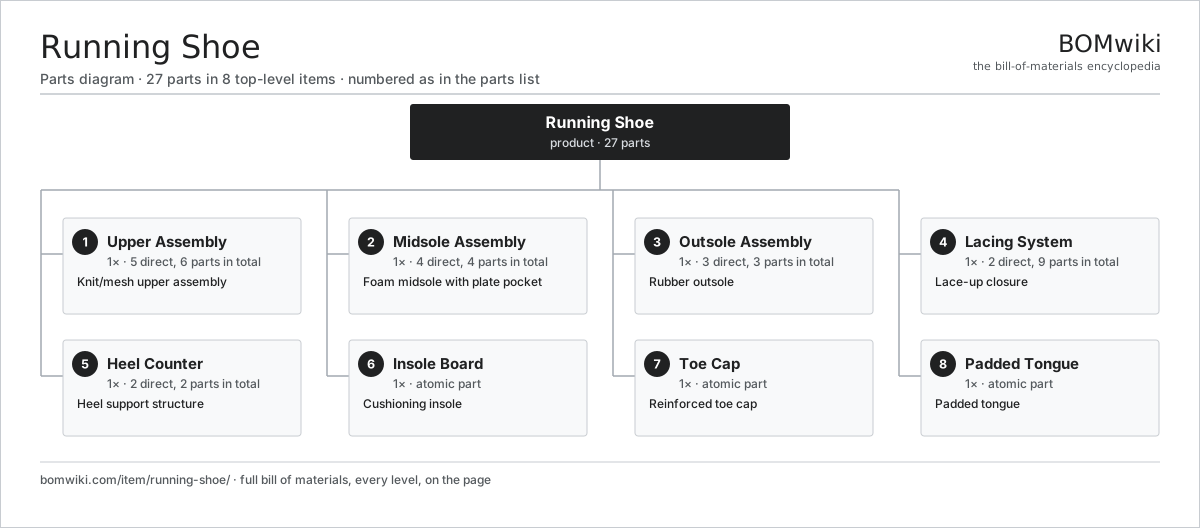
| # | Part | Qty | What it does |
|---|---|---|---|
| 1 | Upper Assembly 5 parts | 1× | Knit/mesh upper assembly |
| 2 | Midsole Assembly 4 parts | 1× | Foam midsole with plate pocket |
| 3 | Outsole Assembly 3 parts | 1× | Rubber outsole |
| 4 | Lacing System 2 parts | 1× | Lace-up closure |
| 5 | Heel Counter 2 parts | 1× | Heel support structure |
| 6 | Insole Board | 1× | Cushioning insole |
| 7 | Toe Cap | 1× | Reinforced toe cap |
| 8 | Padded Tongue | 1× | Padded tongue |
3D model
No 3D model yet. Have a CAD file of this? Add a 3D model. STL renders right on this page; STEP, FreeCAD, and OpenSCAD sources are welcome too (openly licensed, like all 3D models on BOMwiki).
Build & assembly graph
expand / collapse · shared sub-assemblies converge · links to related products · est. labourTap an assembly to expand/collapse · tap a part to open it · use “Open page” for any node · drag to pan, scroll to zoom.
Bill of materials for Running Shoe
8 top-level lines · 24 rows shown · 27 parts total · indented to 3 levels| # | Item / sub-assembly | Part no. | Qty/assy | Ext. qty | Parts | Type |
|---|---|---|---|---|---|---|
| 1 | Upper Assembly 5 parts | running-shoe-upper | 1× | 1 | 6 | assembly |
| 1.1 | Knit/Mesh Fabric Panel | running-shoe-knit-mesh | 2× | 2 | · | part |
| 1.2 | Vamp Board | running-shoe-vamp-board | 1× | 1 | · | part |
| 1.3 | Collar Padding | running-shoe-collar-padding | 1× | 1 | · | part |
| 1.4 | Heel Pull Tab | running-shoe-heel-tab | 1× | 1 | · | part |
| 1.5 | Fastener Set | fastener-set | 1× | 1 | · | part |
| 2 | Midsole Assembly 4 parts | running-shoe-midsole | 1× | 1 | 4 | assembly |
| 2.1 | Foam Core | running-shoe-foam-core | 1× | 1 | · | part |
| 2.2 | Carbon Plate | running-shoe-carbon-plate | 1× | 1 | · | part |
| 2.3 | Heel Stack | running-shoe-foam-heel | 1× | 1 | · | part |
| 2.4 | Midsole Shank | running-shoe-midsole-shank | 1× | 1 | · | part |
| 3 | Outsole Assembly 3 parts | running-shoe-outsole | 1× | 1 | 3 | assembly |
| 3.1 | Rubber Tread | running-shoe-rubber-tread | 1× | 1 | · | part |
| 3.2 | Forefoot Stud Cluster | running-shoe-forefoot-studs | 1× | 1 | · | part |
| 3.3 | Heel Stud Wedge | running-shoe-heel-wedge | 1× | 1 | · | part |
| 4 | Lacing System 2 parts | running-shoe-lacing-system | 1× | 1 | 9 | assembly |
| 4.1 | Lace Eyelet | running-shoe-eyelet | 8× | 8 | · | part |
| 4.2 | Shoelace | running-shoe-lace | 1× | 1 | · | part |
| 5 | Heel Counter 2 parts | running-shoe-heel-counter | 1× | 1 | 2 | assembly |
| 5.1 | Counter Shell | running-shoe-counter-shell | 1× | 1 | · | part |
| 5.2 | Counter Lining | running-shoe-counter-liner | 1× | 1 | · | part |
| 6 | Insole Board | running-shoe-insole | 1× | 1 | · | part |
| 7 | Toe Cap | running-shoe-toe-cap | 1× | 1 | · | part |
| 8 | Padded Tongue | running-shoe-tongue | 1× | 1 | · | part |
Something wrong in this list? Report a problem with this BOM.
Related products
same domain, ranked by shared parts Avalanche Transceiver
35 parts · shares 1 with this page
Avalanche Transceiver
35 parts · shares 1 with this page
 Backpacking Stove
32 parts · shares 1 with this page
Backpacking Stove
32 parts · shares 1 with this page
 Baitcasting Reel
51 parts · shares 1 with this page
Bow Press
17 parts · shares 1 with this page
Bow Sight
72 parts · shares 1 with this page
Baitcasting Reel
51 parts · shares 1 with this page
Bow Press
17 parts · shares 1 with this page
Bow Sight
72 parts · shares 1 with this page
Sourcing: possible vendors
Browse the supplier directory → Prices, MOQ, and lead times are algorithmic estimates, not quotes, and not claims about these companies. Company mappings are curated by keyword; est. price band $20–$2k. How estimates work| Vendor | HQ | Specialty | MOQ | Lead time |
|---|---|---|---|---|
|
🇺🇸Coleman
coleman.com ↗
|
Chicago, US | Camping gear | 1,000 units | 6–10 wks |
| thenorthface.com ↗ | Denver, US | Outdoor apparel & gear | 1,000 units | 6–10 wks |
|
🇺🇸YETI
yeti.com ↗
|
Austin, US | Coolers & drinkware | 1,000 units | 6–10 wks |
| decathlon.com ↗ | Villeneuve-d'Ascq, FR | Sporting goods | 1,000 units | 6–10 wks |
|
🇺🇸Garmin
garmin.com ↗
|
Olathe, US | GPS & wearables | 1,000 units | 6–10 wks |
789-word article