Runway Sweeper Blower
ProductOverview
A runway sweeper blower is a specialized airport ground-support vehicle that combines a rotating broom cassette and high-velocity centrifugal blower to remove snow, water, sand, and rubber particles from runways and taxiways. Unlike street-sweeping equipment, which uses bins and dust collection, the runway sweeper relies on blower pressure to expel debris laterally out of traffic lanes. The machine is compact and all-wheel-drive to operate on snow and ice without losing traction, and it must clear runways in minutes between aircraft movements.
The design separates cleaning from collection. The Broom Cassette Assembly scrubs and lifts debris, the Debris Collection Hood deflects the material into an intake, and the Blower and Suction System accelerates it to discharge it laterally. A rotating brush drum maintains bristle-pavement contact even over surface irregularities, while the blower's suction keeps debris airborne through the system without settling.
Broom cassette and sweep action
The Broom Cassette Assembly is a removable assembly that can be swapped in minutes. The Brush Drum is a rotating cylinder carrying synthetic or natural bristles (most commonly polypropylene or boar hair) arranged in a pattern that provides overlap coverage as the drum rotates. The Brush Motor drives the drum at 100–200 rpm; the slower the drum, the more aggressive the bristle scrub (good for thick, wet snow) and the higher the bristle wear.
As the machine moves forward slowly (2–5 km/h), the rotating brush sweeps loose particles toward the suction inlet. The drum shaft is supported by two Brush Bearing pillow blocks that can handle both rotating load and the side thrust from bristles dragging on pavement. The Cassette Mount frame allows the entire cassette to be removed without tools, so operators can swap cassettes for different snow types or bristle replacement.
The broom works best on loose snow and compacted ice; on deep slush, the machine may need to make multiple passes or use the optional Optional Plow Blade to pre-clear. The bristles are replaceable and cost about 20–30% of cassette cost; a full replacement is typical every 400–600 operating hours.
Blower and suction system
The Blower and Suction System is the heart of the system. Its Blower Motor is often a separate electric motor (25–40 kW) or independent diesel engine, independent of the traction engine, so the blower can run at constant optimal RPM regardless of forward speed. The Centrifugal Impeller is a multi-blade centrifugal fan that accelerates swept air and debris into a discharge chute.
The Suction Tube connects the broom area to the blower inlet. Suction in this duct is typically 8–12 kPa (1.2–1.7 psi), enough to keep debris airborne but low enough to avoid clogging or stalling the brush. The suction pulls swept material from under the broom into the intake, where the Debris Collection Hood shields it from wind scatter.
The Discharge Chute at the blower exit can be aimed left, right, or forward to direct expelled debris onto the grass or taxiway shoulder, away from active traffic lanes. Modern machines include a Filter (cartridge or baghouse) that separates larger particles before exhaust discharge, reducing dust and compliance with EPA air-quality rules.
Hydraulic system and control
The Hydraulic Drive System system feeds power to the broom motor and plow lift via a Hydraulic Pump driven from the Engine PTO. The Valve Manifold contains proportional directional valves for smooth, operator-controlled speed modulation. The Broom Control Valve throttles flow to the broom motor; the Plow Control Valve is a simple solenoid-directional valve for on/off plow raise-lower.
Hydraulic flow is typically 60–100 L/min at 210 bar. The Hose Bundle is routed with careful attention to pressure rating (hoses must handle 250 bar burst rating for safety). The Hydraulic Tank is sized for continuous high-load operation and includes an oil cooler because sustained sweeping generates heat; an undersized tank can overheat and degrade hydraulic fluid.
Chassis and traction
The Carrier Chassis is all-wheel-drive (AWD) or all-wheel-steer (AWS) to maintain traction and maneuverability on ice-covered runways. The Chassis Frame is heavily reinforced to absorb broom vibration and lateral blower thrust without deflecting. The Drive Axles usually include selectable locking differentials; on slippery runways, the driver locks all differentials for maximum traction.
The Engine is a diesel in the 60–100 kW range, powerful enough to overcome broom drag and maintain steady forward speed in heavy snow. Acceleration is slow (5–15 km/h normal operating speed) because the engine must also power the hydraulic system and, on some designs, the broom motor directly. The Wheel Assembly are heavy-duty pneumatic tires, typically lower-pressure to distribute weight on soft snow and reduce slipping.
Most runway sweepers are small and compact to fit between taxiway markings (about 3 m wide) and to navigate the tight geometry of runway intersections. Some larger airports use multiple smaller units to work multiple runways in parallel rather than deploying one large machine that occupies a runway longer.
Operator control and ergonomics
The Operator Cab and Controls is a heated, air-conditioned enclosed cabin that protects the operator from cold and wind. The Joystick Control is a multi-axis proportional control that commands vehicle steering, broom speed, and plow lift simultaneously from one hand. The Button Panel includes start buttons for the hydraulic pump, blower motor, and auxiliary systems.
The Instruments displays engine oil pressure, hydraulic pressure, coolant temperature, and ground speed. A low-hydraulic-pressure alarm warns of pump slippage or fluid loss. Some modern units include GPS for autonomous route programming, the machine can sweep a programmed taxiway corridor repeatedly without continuous operator input, useful for night operations or storm recovery.
The Lighting includes powerful LED work lights on the broom to illuminate the sweep area during night operations, and strobe warning lights to alert aircraft and ground personnel of the equipment's presence.
Optional plow blade
Many runway sweepers include an optional Optional Plow Blade, a fixed or lift-able cutting blade that can be lowered 5–15 cm to cut through compacted snow before the broom engages. The Plow Blade is carbide-tipped or hardened steel, and the Plow Lift Cylinder raises and lowers it hydraulically from the cab. The plow is most useful in heavy accumulation (15+ cm) where a broom alone would compact rather than clear; it adds 200–300 kg to the machine but saves multiple passes.
Dust suppression and environmental control
The Dust Suppression system applies a fine water mist at the broom to wet debris and prevent it from becoming airborne as dust. This is critical at airports because dust on the runway reduces aircraft braking grip. The system uses a low-pressure pump (5–10 bar) and 4–8 small spray nozzles positioned around the broom. Water supply comes from the airport's pressurized service water system or an on-board 200 L tank.
A Filter in the blower discharge captures particles and prevents them from being expelled into the atmosphere, meeting EPA PM10 and PM2.5 limits. The filter is typically a pleated cartridge cleaned automatically by backflush air or manually during maintenance.
Runway Sweeper Blower parts and their functions
7 top-level parts · 88 parts in total · full bill of materials below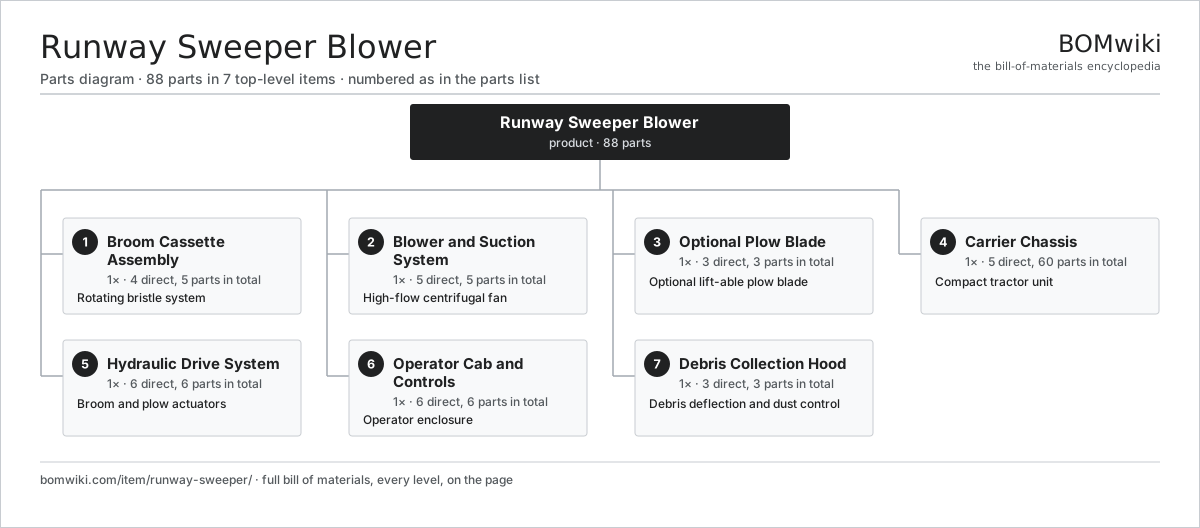
| # | Part | Qty | What it does |
|---|---|---|---|
| 1 | Broom Cassette Assembly 4 parts | 1× | Rotating bristle system |
| 2 | Blower and Suction System 5 parts | 1× | High-flow centrifugal fan |
| 3 | Optional Plow Blade 3 parts | 1× | Optional lift-able plow blade |
| 4 | Carrier Chassis 5 parts | 1× | Compact tractor unit |
| 5 | Hydraulic Drive System 6 parts | 1× | Broom and plow actuators |
| 6 | Operator Cab and Controls 6 parts | 1× | Operator enclosure |
| 7 | Debris Collection Hood 3 parts | 1× | Debris deflection and dust control |
3D model
No 3D model yet. Have a CAD file of this? Add a 3D model. STL renders right on this page; STEP, FreeCAD, and OpenSCAD sources are welcome too (openly licensed, like all 3D models on BOMwiki).
Build & assembly graph
expand / collapse · shared sub-assemblies converge · links to related products · est. labourTap an assembly to expand/collapse · tap a part to open it · use “Open page” for any node · drag to pan, scroll to zoom.
Bill of materials for Runway Sweeper Blower
7 top-level lines · 44 rows shown · 88 parts total · indented to 3 levels| # | Item / sub-assembly | Part no. | Qty/assy | Ext. qty | Parts | Type |
|---|---|---|---|---|---|---|
| 1 | Broom Cassette Assembly 4 parts | runway-sweeper-broom-cassette | 1× | 1 | 5 | assembly |
| 1.1 | Brush Drum | runway-sweeper-brush-drum | 1× | 1 | · | part |
| 1.2 | Brush Motor | runway-sweeper-brush-motor | 1× | 1 | · | part |
| 1.3 | Brush Bearing | runway-sweeper-brush-bearing | 2× | 2 | · | part |
| 1.4 | Cassette Mount | runway-sweeper-brush-mounting | 1× | 1 | · | part |
| 2 | Blower and Suction System 5 parts | runway-sweeper-blower-unit | 1× | 1 | 5 | assembly |
| 2.1 | Blower Motor | runway-sweeper-blower-motor | 1× | 1 | · | part |
| 2.2 | Centrifugal Impeller | runway-sweeper-blower-impeller | 1× | 1 | · | part |
| 2.3 | Suction Tube | runway-sweeper-suction-duct | 1× | 1 | · | part |
| 2.4 | Discharge Chute | runway-sweeper-discharge-chute | 1× | 1 | · | part |
| 2.5 | Filter | runway-sweeper-filter-element | 1× | 1 | · | part |
| 3 | Optional Plow Blade 3 parts | runway-sweeper-plow-front | 1× | 1 | 3 | assembly |
| 3.1 | Plow Blade | runway-sweeper-plow-blade | 1× | 1 | · | part |
| 3.2 | Plow Lift Cylinder | runway-sweeper-plow-cylinder | 1× | 1 | · | part |
| 3.3 | Plow Frame | runway-sweeper-plow-bracket | 1× | 1 | · | part |
| 4 | Carrier Chassis 5 parts | runway-sweeper-chassis | 1× | 1 | 60 | assembly |
| 4.1 | Chassis Frame | runway-sweeper-main-frame | 1× | 1 | · | part |
| 4.2 | Drive Axles | runway-sweeper-drive-axles | 2× | 2 | · | part |
| 4.3 | Wheel Assembly 5 parts | wheel-assembly | 6× | 6 | 9 | assembly |
| 4.3.1 | Alloy Wheel | alloy-wheel | 1× | 6 | · | part |
| 4.3.2 | Tire | tire | 1× | 6 | · | part |
| 4.3.3 | TPMS Sensor | tpms-sensor | 1× | 6 | · | part |
| 4.3.4 | Lug Nut | lug-nut | 5× | 30 | · | part |
| 4.3.5 | Valve Stem | valve-stem | 1× | 6 | · | part |
| 4.4 | Engine | runway-sweeper-engine | 1× | 1 | · | part |
| 4.5 | 12 V Battery | lv-battery | 2× | 2 | · | part |
| 5 | Hydraulic Drive System 6 parts | runway-sweeper-hydraulic-drive | 1× | 1 | 6 | assembly |
| 5.1 | Hydraulic Pump | runway-sweeper-hydraulic-pump | 1× | 1 | · | part |
| 5.2 | Valve Manifold | runway-sweeper-valve-manifold | 1× | 1 | · | part |
| 5.3 | Broom Control Valve | runway-sweeper-broom-actuator | 1× | 1 | · | part |
| 5.4 | Plow Control Valve | runway-sweeper-plow-actuator | 1× | 1 | · | part |
| 5.5 | Hose Bundle | runway-sweeper-hose-bundle | 1× | 1 | · | part |
| 5.6 | Hydraulic Tank | runway-sweeper-oil-reservoir | 1× | 1 | · | part |
| 6 | Operator Cab and Controls 6 parts | runway-sweeper-cab | 1× | 1 | 6 | assembly |
| 6.1 | Cab Shell | runway-sweeper-cab-shell | 1× | 1 | · | part |
| 6.2 | Joystick Control | runway-sweeper-joystick-console | 1× | 1 | · | part |
| 6.3 | Button Panel | runway-sweeper-button-panel | 1× | 1 | · | part |
| 6.4 | Instruments | runway-sweeper-instrument-cluster | 1× | 1 | · | part |
| 6.5 | Climate Control | runway-sweeper-heating-ac | 1× | 1 | · | part |
| 6.6 | Lighting | runway-sweeper-lighting | 1× | 1 | · | part |
| 7 | Debris Collection Hood 3 parts | runway-sweeper-collection-hood | 1× | 1 | 3 | assembly |
| 7.1 | Hood Panels | runway-sweeper-hood-panels | 1× | 1 | · | part |
| 7.2 | Hood Frame | runway-sweeper-hood-brackets | 1× | 1 | · | part |
| 7.3 | Dust Suppression | runway-sweeper-dust-suppression | 1× | 1 | · | part |
Something wrong in this list? Report a problem with this BOM.
Related products
same domain, ranked by shared parts

Sourcing: possible vendors
Browse the supplier directory → Prices, MOQ, and lead times are algorithmic estimates, not quotes, and not claims about these companies. Company mappings are curated by keyword; est. price band $30k–$1.5M. How estimates work| Vendor | HQ | Specialty | MOQ | Lead time |
|---|---|---|---|---|
| oshkoshaerotech.com ↗ | Orlando, US | Airport ground support | made to order | 16–30 wks |
| tld-group.com ↗ | Paris, FR | Ground support equipment | made to order | 16–30 wks |
| textrongse.txtsv.com ↗ | Augusta, US | Ground support equipment | made to order | 16–30 wks |
| vestergaardcompany.com ↗ | Skanderborg, DK | De-icers & GSE | made to order | 16–30 wks |
| mallaghangse.com ↗ | Dungannon, GB | Ground support equipment | made to order | 16–30 wks |
1,259-word article