Safe Combination Lock
ProductOverview
Safe combination locks are mechanical devices that use rotating wheels with precisely cut gates to control a locking bolt. When the correct sequence of numbers is dialed, the wheel gates align within a lever notch, permitting the bolt to retract. The mechanical elegance lies in the cumulative rotation principle: the user performs a series of dial turns (right-left-right for a 3-number combination), and only when all wheels are perfectly aligned does the lock release.
These locks are the standard on filing cabinets, gun safes, bank vaults, and security containers. Unlike pin-tumbler locks (which rely on springs and discrete pins), dial locks have no moving internal springs after the wheels are aligned, the gates themselves are the primary security feature. This makes them highly reliable, resistant to vibration, and serviceable by trained technicians.
Mechanical principle
The Dial Assembly is the user-facing interface: a numbered ring (0–99 or 0–39) attached to a spindle shaft via a friction collar. When the user rotates the dial, the friction collar causes the Spindle Shaft to rotate inside the lock housing. The shaft is coupled to the Wheel Pack via Drive Pin elements, typically small pins or cams on the spindle that engage slots or holes in each wheel.
For a 3-number combination (e.g., 12-34-07), the protocol is:
- Right (clockwise) at least 3 full turns, passing 12 once, stopping at 12 the second time.
- Left (counterclockwise) at least 1 full turn, passing 34 once, stopping at 34 the second time.
- Right (clockwise) directly to 07 without passing it.
This rotation sequence positions each Wheel 1, Wheel 2, and Wheel 3 so their Fence Notch (cut gates) align vertically. Once all three wheels are aligned, the Lever and Fence arm drops into the aligned notches and can move, permitting the Bolt Assembly to release.
Wheel pack and gates
The Wheel Pack is the heart of the lock: typically three wheels (or two, in U-lock designs) stacked on the spindle shaft. Each wheel is a brass or steel disk roughly 30–40 mm in diameter and 3–5 mm thick. A gate, a cut or notch, is machined into the outer edge of each wheel. The gates are not simple rectangular cuts but usually V-notched or specially shaped to engage a matching notch on the Lever and Fence.
The depth and width of each gate is under 0.05 mm tolerance. A worn or corroded gate (less than 0.05 mm rounding) will prevent proper lock operation. Each wheel is independently rotatable on the shaft via Drive Pin coupling; rotating the spindle causes only the wheel(s) currently engaged by the drive pin(s) to rotate. This enables the stepwise protocol.
The wheels are separated by Wheel Spacer bushings, maintaining exact spacing (typically 2–3 mm apart) so the gates align vertically and catch the single lever notch simultaneously.
Spindle and bearings
The Spindle Shaft is a hardened steel rod, typically 10–12 mm diameter, running the length of the lock. The front end terminates in the Drive Cam, which rotates past a stationary Lever and Fence arm as the dial is turned. The rear end is fixed to the Dial Assembly via the friction collar.
Two Shaft Bearing elements (ball bearings or needle roller bearings) support the shaft at front and rear, allowing smooth, low-friction rotation even under heavy use. A Shaft Seal (typically an O-ring or felt washer) prevents dust and debris from entering the wheel chamber.
The friction collar connecting the dial to the spindle is the critical interface. It is a loose-fitting sleeve with a rubber or elastomer insert. When the user rotates the dial, friction between the collar's inner surface and the spindle causes the spindle to rotate. However, if the spindle is held stationary (e.g., when the wheels are locked against a stop), the collar can slip, allowing the dial to continue rotating without turning the wheels. This "dial slip" is intentional, it prevents the user from accidentally misaligning the wheels if the dial is rotated too far.
Lever and fence mechanism
The Lever and Fence is a rigid steel arm, typically 50–80 mm long, pivoting on a Pivot Pin at one end. The other end has a precisely machined V-notch or rectangular notch, cut to the exact profile of the wheel gates. When the wheels are properly aligned, all three gates form a vertical line, and the lever notch drops into this line.
A Leaf Spring biases the lever downward (or inward, depending on orientation) with consistent pressure, typically 5–20 N. This ensures that once the gates are aligned, the lever settles smoothly into place without bouncing or jamming.
A Stop Pin limits the lever's travel, preventing it from being pushed too far and damaging the gate-alignment calibration. When the lever is fully engaged in the aligned gates, it physically connects the wheels, and any rotation of the spindle will cause the lever to lift out of alignment, this is the security mechanism.
The Drive Cam at the spindle's front end is a rotating lobe that passes adjacent to the lever as the dial is turned. In many designs, the cam intentionally raises the lever slightly at certain dial positions (e.g., when the user first begins the combination sequence) to ensure the lever is fully disengaged from the wheels. This prevents jamming if the user starts dialing before releasing the dial from the previous attempt.
Bolt release
Once the lever is fully seated in the aligned wheel gates, the Bolt Assembly can be manipulated. The bolt is a hardened steel bar or composite linkage connected to the lever by a mechanical link. In safe-door applications, the bolt extends 12–25 mm through the lock housing and engages a corresponding slot or catch in the safe's door and frame.
When the lever is out of alignment (lock is "locked"), the bolt is held in the extended position by the Return Spring, preventing the door from opening. Once the lever fully engages the aligned wheels, the mechanical connection is established, and the user can pull or push the door. The combined load (user pulling + safe mechanism friction) typically requires 15–50 kg of force to overcome the return spring, lift the lever, and retract the bolt.
No separate key or solenoid is needed, the mechanical arrangement is self-contained.
Anti-manipulation features
Modern high-security safe locks include hardened elements to resist drilling or physical penetration. The Anti-Drilling Pin is a hardened steel rod or insert positioned to prevent a drill bit from reaching the wheels or spindle. If an attacker attempts to drill straight through the center of the lock, the drill bit breaks or bounces off the hardened pin.
Additionally, the wheels themselves are often made from hardened brass or steel, and their gate edges are beveled or rounded (not sharp right angles), making it difficult for a manipulator (an external probe) to sense the gates by touch. The lever notch is also enclosed within the housing, invisible and unreachable from outside.
Professional safe-opening specialists can sometimes manipulate a standard dial lock by listening carefully for gate alignment clicks as the dial is turned, but modern locks include Leaf Spring tension calibration and design variations specifically to eliminate audible feedback.
Installation and maintenance
A safe combination lock is typically mounted to the interior of the safe door via the Mounting Bracket, which bolts to the door. The bolt projection extends through a hole in the door frame and engages a hardened strike.
Maintenance is minimal if the lock is kept clean and dry. The main failure modes are:
- Worn gates: Long-term use or corrosion can round or enlarge the gate notches, preventing the lever from engaging smoothly.
- Seized wheels: Moisture or debris can cause wheels to stick; the spindle rotation may jam.
- Broken drive pins: The pins coupling spindle to wheels can shear under excessive force or corrosion.
Professional locksmiths can partially disassemble the lock to clean, polish, and lubricate the wheels without disrupting the combination. Full overhauls are rarely necessary; most safes retain their original locks for 50+ years.
Standards and ratings
Safe locks are rated by organizations like UL (Underwriters Laboratories) and BHMA (Builders Hardware Manufacturers Association). A UL TL-15 rating indicates the lock is resistant to manipulation, drilling, and mechanical attack for 15 minutes with common tools. UL TL-30 requires 30 minutes of protection. These ratings depend on both the lock design and the surrounding safe construction.
A Wheel Pack with precisely cut hardened-steel gates, anti-drilling pins, and an enclosed housing provides foundation-level security; the safe's outer body, hinges, and bolts provide the secondary layer.
Safe Combination Lock parts and their functions
8 top-level parts · 38 parts in total · full bill of materials below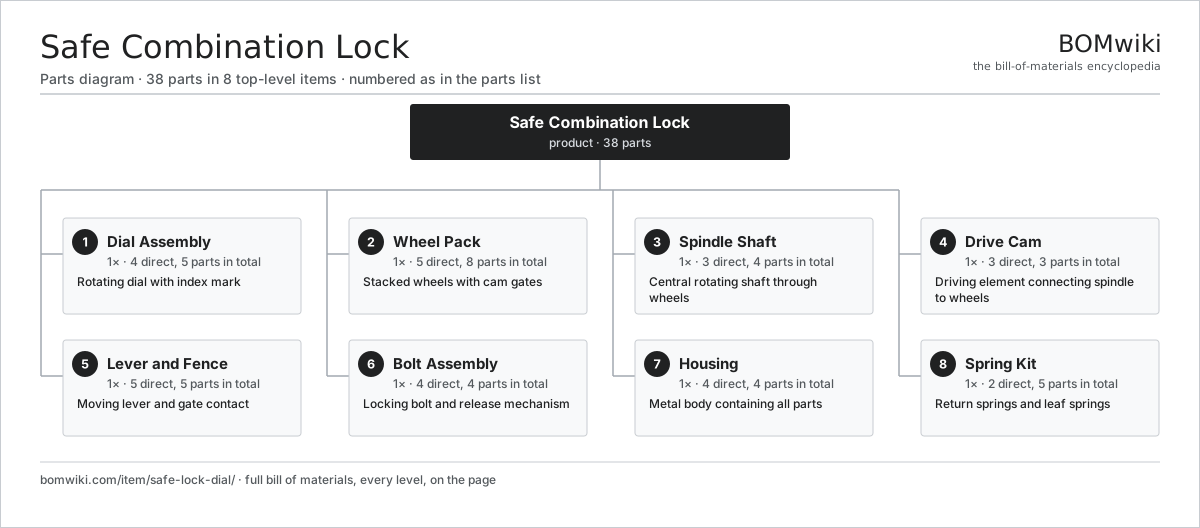
| # | Part | Qty | What it does |
|---|---|---|---|
| 1 | Dial Assembly 4 parts | 1× | Rotating dial with index mark |
| 2 | Wheel Pack 5 parts | 1× | Stacked wheels with cam gates |
| 3 | Spindle Shaft 3 parts | 1× | Central rotating shaft through wheels |
| 4 | Drive Cam 3 parts | 1× | Driving element connecting spindle to wheels |
| 5 | Lever and Fence 5 parts | 1× | Moving lever and gate contact |
| 6 | Bolt Assembly 4 parts | 1× | Locking bolt and release mechanism |
| 7 | Housing 4 parts | 1× | Metal body containing all parts |
| 8 | Spring Kit 2 parts | 1× | Return springs and leaf springs |
3D model
No 3D model yet. Have a CAD file of this? Add a 3D model. STL renders right on this page; STEP, FreeCAD, and OpenSCAD sources are welcome too (openly licensed, like all 3D models on BOMwiki).
Build & assembly graph
expand / collapse · shared sub-assemblies converge · links to related products · est. labourTap an assembly to expand/collapse · tap a part to open it · use “Open page” for any node · drag to pan, scroll to zoom.
Bill of materials for Safe Combination Lock
8 top-level lines · 38 rows shown · 38 parts total · indented to 3 levels| # | Item / sub-assembly | Part no. | Qty/assy | Ext. qty | Parts | Type |
|---|---|---|---|---|---|---|
| 1 | Dial Assembly 4 parts | safe-lock-dial-dial-assembly | 1× | 1 | 5 | assembly |
| 1.1 | Dial Ring | safe-lock-dial-dial-ring | 1× | 1 | · | part |
| 1.2 | Friction Collar | safe-lock-dial-friction-collar | 1× | 1 | · | part |
| 1.3 | Index Mark | safe-lock-dial-index-mark | 1× | 1 | · | part |
| 1.4 | Bearing Washer | safe-lock-dial-bearing-washer | 2× | 2 | · | part |
| 2 | Wheel Pack 5 parts | safe-lock-dial-wheel-pack | 1× | 1 | 8 | assembly |
| 2.1 | Wheel 1 | safe-lock-dial-wheel-1 | 1× | 1 | · | part |
| 2.2 | Wheel 2 | safe-lock-dial-wheel-2 | 1× | 1 | · | part |
| 2.3 | Wheel 3 | safe-lock-dial-wheel-3 | 1× | 1 | · | part |
| 2.4 | Drive Pin | safe-lock-dial-drive-pin | 3× | 3 | · | part |
| 2.5 | Wheel Spacer | safe-lock-dial-wheel-spacer | 2× | 2 | · | part |
| 3 | Spindle Shaft 3 parts | safe-lock-dial-spindle-shaft | 1× | 1 | 4 | assembly |
| 3.1 | Shaft Body | safe-lock-dial-shaft-body | 1× | 1 | · | part |
| 3.2 | Shaft Bearing | safe-lock-dial-shaft-bearing | 2× | 2 | · | part |
| 3.3 | Shaft Seal | safe-lock-dial-shaft-seal | 1× | 1 | · | part |
| 4 | Drive Cam 3 parts | safe-lock-dial-drive-cam | 1× | 1 | 3 | assembly |
| 4.1 | Cam Body | safe-lock-dial-cam-body | 1× | 1 | · | part |
| 4.2 | Cam Pin | safe-lock-dial-cam-pin | 1× | 1 | · | part |
| 4.3 | Cam Profile | safe-lock-dial-cam-follower-surface | 1× | 1 | · | part |
| 5 | Lever and Fence 5 parts | safe-lock-dial-lever-fence | 1× | 1 | 5 | assembly |
| 5.1 | Lever Arm | safe-lock-dial-lever-arm | 1× | 1 | · | part |
| 5.2 | Fence Notch | safe-lock-dial-fence-notch | 1× | 1 | · | part |
| 5.3 | Pivot Pin | safe-lock-dial-pivot-pin | 1× | 1 | · | part |
| 5.4 | Leaf Spring | safe-lock-dial-leaf-spring | 1× | 1 | · | part |
| 5.5 | Stop Pin | safe-lock-dial-stop-pin | 1× | 1 | · | part |
| 6 | Bolt Assembly 4 parts | safe-lock-dial-bolt-assembly | 1× | 1 | 4 | assembly |
| 6.1 | Bolt Bar | safe-lock-dial-bolt-bar | 1× | 1 | · | part |
| 6.2 | Bolt Projection | safe-lock-dial-bolt-projection | 1× | 1 | · | part |
| 6.3 | Return Spring | safe-lock-dial-return-spring | 1× | 1 | · | part |
| 6.4 | Anti-Drilling Pin | safe-lock-dial-anti-drilling-pin | 1× | 1 | · | part |
| 7 | Housing 4 parts | safe-lock-dial-housing | 1× | 1 | 4 | assembly |
| 7.1 | Housing Body | safe-lock-dial-housing-body | 1× | 1 | · | part |
| 7.2 | Bezel Ring | safe-lock-dial-bezel-ring | 1× | 1 | · | part |
| 7.3 | Mounting Bracket | safe-lock-dial-mounting-bracket | 1× | 1 | · | part |
| 7.4 | Fastener Set | fastener-set | 1× | 1 | · | part |
| 8 | Spring Kit 2 parts | safe-lock-dial-spring-kit | 1× | 1 | 5 | assembly |
| 8.1 | Coil Spring | coil-spring | 3× | 3 | · | part |
| 8.2 | Leaf Spring | safe-lock-dial-leaf-spring | 2× | 2 | · | part |
Something wrong in this list? Report a problem with this BOM.
Related products
same domain, ranked by shared parts Access Control Panel
52 parts · shares 1 with this page
Automatic Smoke Vent
60 parts · shares 1 with this page
Access Control Panel
52 parts · shares 1 with this page
Automatic Smoke Vent
60 parts · shares 1 with this page
 Automatic Swing Door Operator
43 parts · shares 1 with this page
Automatic Swing Door Operator
43 parts · shares 1 with this page
 Clay Brick Extruder
154 parts · shares 1 with this page
Concrete Pipe Making Machine
154 parts · shares 1 with this page
Clay Brick Extruder
154 parts · shares 1 with this page
Concrete Pipe Making Machine
154 parts · shares 1 with this page
 Deadbolt Assembly
41 parts · shares 1 with this page
Deadbolt Assembly
41 parts · shares 1 with this page
Sourcing: possible vendors
Browse the supplier directory → Prices, MOQ, and lead times are algorithmic estimates, not quotes, and not claims about these companies. Company mappings are curated by keyword; est. price band $50–$10k. How estimates work| Vendor | HQ | Specialty | MOQ | Lead time |
|---|---|---|---|---|
| assaabloy.com ↗ | Stockholm, SE | Locks & access | 1,000 units | 8–12 wks |
|
🇺🇸Allegion
allegion.com ↗
|
Dublin, US | Security products (Schlage) | 1,000 units | 8–12 wks |
| dormakaba.com ↗ | Rümlang, CH | Access & door systems | 1,000 units | 8–12 wks |
| honeywell.com ↗ | Charlotte, US | Building & safety tech | 1,000 units | 8–12 wks |
| hikvision.com ↗ | Hangzhou, CN | Surveillance & security | 1,000 units | 8–12 wks |
1,556-word article