Safety Boot
ProductOverview
Safety boots are personal protective equipment (PPE) designed to protect workers' feet in industrial environments from crushing injuries (falling objects, machinery), puncture wounds (nails, metal shards), chemical exposure, and slip hazards. Unlike casual footwear, safety boots are engineered to ANSI/ASTM standards and tested to quantified impact and puncture thresholds.
The toe cap is the primary protective feature: a rigid shell (typically steel or composite) covers the entire toe box, meeting or exceeding ANSI Z41 Class 75 rating (200 J impact energy). For context, a 20 kg toolbox dropped 1 meter delivers approximately 200 J of kinetic energy, a certified toe cap can withstand this impact with deformation <6 mm, preventing foot fracture.
The puncture-resistant plate is equally critical in environments where sharp objects litter the ground (construction sites, warehouses, roofing work). A steel or aramid plate spanning the full foot width prevents nails and metal shards from penetrating the sole and impaling the foot. A 3 mm nail driven into the plate at 1100 N force should not penetrate the insole.
Toe Cap Engineering
Impact Absorption & Force Distribution
The toe cap is a hollow shell, typically 0.7–1.0 mm thick pressed steel or molded composite (fiberglass-reinforced polypropylene, polyurethane). The shell design prioritizes:
Load spreading: When a 20 kg toolbox hits the toe at one point, the curved shell distributes the impact force across the entire toe box surface, preventing point-loading that could crush the foot underneath.
Deformation limits: The ANSI Z41 test measures toe box deformation at 200 J impact; acceptable deformation is <6 mm. Beyond 6 mm, the toe cap contacts the foot bones and causes injury. A well-designed shell provides elastic deflection (springback) rather than plastic deformation (permanent shape change).
Clearance: There is typically 12–15 mm clearance between the inside of the toe cap shell and the outermost toe bones, allowing some deformation without contact.
The inner foam padding (5–8 mm) absorbs impact energy through compression, reducing peak force transmitted to toes.
Material Selection
Steel toe caps (traditional):
- Material: Cold-rolled steel, 0.7–1.0 mm thickness
- Weight: Heavy (180–250 g per cap)
- Cost: $5–15 per boot
- Durability: Excellent; does not degrade over time
- Disadvantage: Thermal conductivity, in extreme cold (<-20 °C), steel conducts foot heat away; workers report toe numbness.
Composite toe caps (modern):
- Material: Fiberglass-reinforced polypropylene, polyurethane, or aramid (Kevlar)
- Weight: Light (100–150 g per cap)
- Cost: $10–30 per boot
- Durability: Good; slight degradation under UV exposure over 5+ years
- Advantage: Lower thermal conductivity; feet stay warmer
- Trade-off: Slightly lower impact energy absorption; requires 10–15% thicker shell
Modern safety boots increasingly use composite toe caps, especially in cold climates and for workers who operate near electrical equipment (steel toe caps can concentrate electrical currents; composite caps are non-conductive).
Puncture Resistance
The midsole puncture plate is the second line of defense. Placed between the foam midsole and the outsole, the plate is flexible (allowing the boot to flex naturally) but stiff enough to resist penetration.
Plate Material & Testing
Steel puncture plates:
- Material: Spring steel (0.5–0.7 mm), hardness 50–55 HRC
- Testing: ASTM F1679 specifies a 3 mm diameter test nail driven vertically into the plate at 1100 N force; acceptable result is no penetration of the nail point through the plate.
- Durability: Indefinite; steel does not fatigue under normal wear conditions.
Aramid (Kevlar) composite plates:
- Material: Woven Kevlar 29 fabric embedded in nylon or polyurethane matrix (1.5–2.0 mm total thickness)
- Advantage: Lighter and more flexible than steel
- Trade-off: Can degrade under prolonged UV exposure; replaced every 5–7 years
The ASTM F1679 puncture test simulates a nail stepping through the sole. In the worst-case scenario, a worker is walking across a construction site, steps on an exposed 3 mm nail at an angle, and the nail penetrates through the sole. A certified puncture plate prevents this; the nail mushrooms or bends rather than penetrating the foot.
Most industrial environments require steel plates; roofing and construction sites mandate this. Aramid plates are acceptable in electrical utilities and general warehousing.
Slip Resistance & Outsole Design
The slip-resistant outsole is the first point of contact with wet or oily industrial floors. ASTM F489 measures static coefficient of friction (CoF) by sliding a weighted test slab across wet ceramic tile and polished steel. Acceptable CoF for safety boots is >0.50 on both surfaces.
The rubber compound must be oil-resistant, meaning exposure to mineral oils, hydraulic fluids, and synthetic lubricants does not cause the rubber to swell or lose durability. Standard rubber (natural or SBR alone) swells 5–10% when exposed to mineral oil; this causes the sole to sponge up, losing stiffness and creating a feeling of "sliding" on the floor. Oil-resistant formulations use:
- Nitrile rubber (NBR): Synthetic rubber with aromatic backbone, resistant to mineral oils. Used in seals, hoses, and safety boot soles.
- Butyl rubber: Secondary component improving oil barrier properties.
The tread pattern is aggressive: 6–8 mm height blocks with narrow slots (1–2 mm) that shed water and oil, preventing liquid pooling. A simple pattern (wide, deep lugs) clogs with liquid; a complex pattern (many thin blocks) does not shed well. The optimal pattern is a balance: medium-sized blocks with drainage channels.
The heel section is thickened (8–10 mm extra) to absorb impact on concrete floors. Repeated striking of heel on hard industrial floors over 8+ hour shifts creates cumulative impact; the heel pad absorbs this, preventing pain and stress fractures in the calcaneus.
Fit & Extended Wear
Safety boots are worn for 8–10 hour shifts in industrial environments, sometimes 5 days per week. The insole is therefore critical for fatigue prevention. Modern safety boots include gel or EVA insoles with arch support, reducing plantar fascia strain and flat foot fatigue.
The heel counter is stiffer than running shoe heel counters, preventing heel slip in the boot during repeated movement on a production line.
Break-in period is longer than casual boots (3–5 days) because the upper leather is thicker and stiffer. Workers often apply leather conditioner and use boot stretchers to accelerate break-in.
Maintenance & Lifespan
A safety boot used daily in an industrial setting has a lifespan of 1–2 years before the puncture plate or outsole tread is worn. At that point, the boot should be replaced, not resoled, because:
- The puncture plate degrades; re-evaluating puncture resistance requires testing.
- Tread wear is significant (>30% loss); slip resistance drops below ASTM F489 minimum.
Regular maintenance extends usable life:
- Daily: Remove insoles; air-dry boots overnight.
- Weekly: Clean with stiff brush; apply leather conditioner every 3–4 weeks.
- Monthly: Inspect toe cap for dents (cosmetic only) and midsole for cracks (safety risk).
Replacement schedule: Inspection at 12 months; replacement by 18–24 months of daily use.
Safety Boot parts and their functions
8 top-level parts · 22 parts in total · full bill of materials below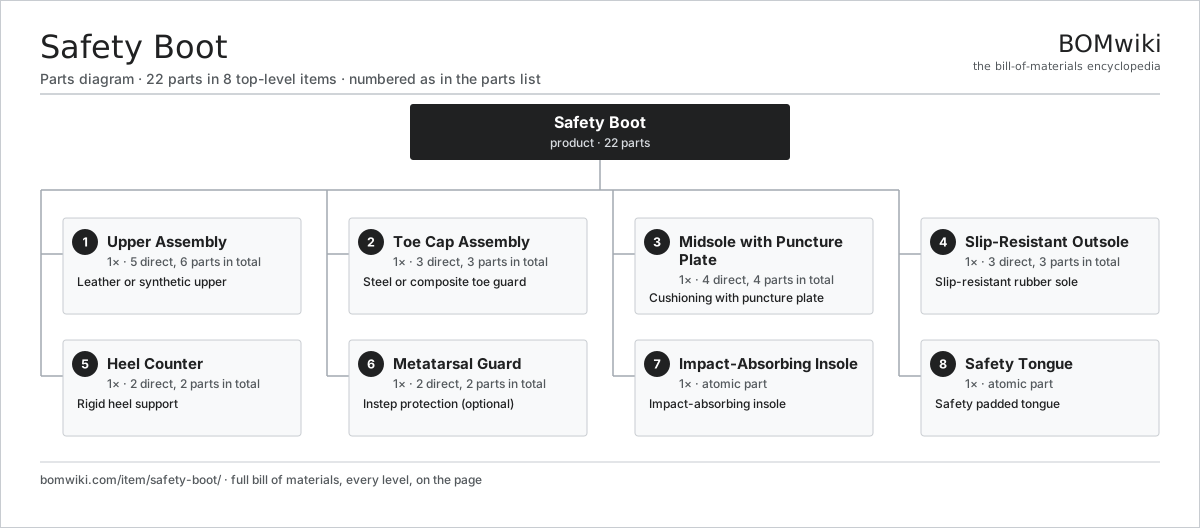
| # | Part | Qty | What it does |
|---|---|---|---|
| 1 | Upper Assembly 5 parts | 1× | Leather or synthetic upper |
| 2 | Toe Cap Assembly 3 parts | 1× | Steel or composite toe guard |
| 3 | Midsole with Puncture Plate 4 parts | 1× | Cushioning with puncture plate |
| 4 | Slip-Resistant Outsole 3 parts | 1× | Slip-resistant rubber sole |
| 5 | Heel Counter 2 parts | 1× | Rigid heel support |
| 6 | Metatarsal Guard 2 parts | 1× | Instep protection (optional) |
| 7 | Impact-Absorbing Insole | 1× | Impact-absorbing insole |
| 8 | Safety Tongue | 1× | Safety padded tongue |
3D model
No 3D model yet. Have a CAD file of this? Add a 3D model. STL renders right on this page; STEP, FreeCAD, and OpenSCAD sources are welcome too (openly licensed, like all 3D models on BOMwiki).
Build & assembly graph
expand / collapse · shared sub-assemblies converge · links to related products · est. labourTap an assembly to expand/collapse · tap a part to open it · use “Open page” for any node · drag to pan, scroll to zoom.
Bill of materials for Safety Boot
8 top-level lines · 27 rows shown · 22 parts total · indented to 3 levels| # | Item / sub-assembly | Part no. | Qty/assy | Ext. qty | Parts | Type |
|---|---|---|---|---|---|---|
| 1 | Upper Assembly 5 parts | safety-boot-upper | 1× | 1 | 6 | assembly |
| 1.1 | Leather Upper | safety-boot-leather-main | 1× | 1 | · | part |
| 1.2 | Reinforced Stitching | safety-boot-reinforced-stitching | 1× | 1 | · | part |
| 1.3 | Side Reinforcement | safety-boot-side-reinforcement | 2× | 2 | · | part |
| 1.4 | Collar Padding | safety-boot-collar-padding | 1× | 1 | · | part |
| 1.5 | Pull-Up Tab | safety-boot-pull-loop | 1× | 1 | · | part |
| 2 | Toe Cap Assembly 3 parts | safety-boot-toe-cap | 1× | 1 | 3 | assembly |
| 2.1 | Toe Cap Shell | safety-boot-toe-cap-shell | 1× | 1 | · | part |
| 2.2 | Toe Cap Lining | safety-boot-toe-cap-lining | 1× | 1 | · | part |
| 2.3 | Edge Trim | safety-boot-toe-cap-edge-trim | 1× | 1 | · | part |
| 3 | Midsole with Puncture Plate 4 parts | safety-boot-midsole | 1× | 1 | 4 | assembly |
| 3.1 | Foam Core | safety-boot-foam-core | 1× | 1 | · | part |
| 3.2 | Puncture Plate | safety-boot-puncture-plate | 1× | 1 | · | part |
| 3.3 | Heel Stack | safety-boot-heel-cushion | 1× | 1 | · | part |
| 3.4 | Arch Stiffener | safety-boot-arch-support | 1× | 1 | · | part |
| 4 | Slip-Resistant Outsole 3 parts | safety-boot-outsole | 1× | 1 | 3 | assembly |
| 4.1 | Oil-Resistant Rubber | safety-boot-rubber-compound | 1× | 1 | · | part |
| 4.2 | Slip-Resistant Tread | safety-boot-tread-pattern | 1× | 1 | · | part |
| 4.3 | Heel Pad | safety-boot-heel-block | 1× | 1 | · | part |
| 5 | Heel Counter 2 parts | safety-boot-heel-counter | 1× | 1 | 2 | assembly |
| 5.1 | Counter Shell | safety-boot-counter-shell | 1× | 1 | · | part |
| 5.2 | Counter Padding | safety-boot-counter-padding | 1× | 1 | · | part |
| 6 | Metatarsal Guard 2 parts | safety-boot-metatarsal-guard | 1× | 1 | 2 | assembly |
| 6.1 | Metatarsal Shield | safety-boot-metatarsal-shield | 1× | 1 | · | part |
| 6.2 | Attachment Strap | safety-boot-metatarsal-strap | 1× | 1 | · | part |
| 7 | Impact-Absorbing Insole | safety-boot-insole | 1× | 1 | · | part |
| 8 | Safety Tongue | safety-boot-tongue | 1× | 1 | · | part |
Something wrong in this list? Report a problem with this BOM.
Sourcing: possible vendors
Browse the supplier directory → Prices, MOQ, and lead times are algorithmic estimates, not quotes, and not claims about these companies. Company mappings are curated by keyword; est. price band $20–$2k. How estimates work| Vendor | HQ | Specialty | MOQ | Lead time |
|---|---|---|---|---|
|
🇺🇸Coleman
coleman.com ↗
|
Chicago, US | Camping gear | 1,000 units | 6–10 wks |
| thenorthface.com ↗ | Denver, US | Outdoor apparel & gear | 1,000 units | 6–10 wks |
|
🇺🇸YETI
yeti.com ↗
|
Austin, US | Coolers & drinkware | 1,000 units | 6–10 wks |
| decathlon.com ↗ | Villeneuve-d'Ascq, FR | Sporting goods | 1,000 units | 6–10 wks |
|
🇺🇸Garmin
garmin.com ↗
|
Olathe, US | GPS & wearables | 1,000 units | 6–10 wks |
1,219-word article