SAG Mill
ProductOverview
A semi-autogenous mill (SAG mill) is a large rotating cylindrical drum that grinds ore using a combination of ore-on-ore impact (autogenous grinding) and impact from steel balls. Unlike ball mills, which rely entirely on steel balls for comminution, a SAG mill carries fewer balls, typically 6–10% of the mill volume, and allows large ore pieces to tumble and fracture against each other. This hybrid approach makes SAG mills economical for grinding coarse primary mill products (−200 to +10 mm) to intermediate sizes (−100 to −75 μm), preparing the ore for flotation, leaching, or final ball mill grinding.
SAG mills dominate the primary grinding stage in modern metal mining. A typical installation handles 50–500 t/h, with the largest units exceeding 10 MW of installed power. The technology is applied to copper, gold, iron, molybdenum, and nickel ores, as well as industrial minerals.
How it works
Crushed ore is delivered from a primary crushes (jaw or gyratory) into a feed hopper holding 50–200 tonnes. A feed gate meters the ore into the rotating mill shell at a controlled rate. Inside the drum, the ore tumbles in a slurry of water, smaller ore particles, and steel balls. As the shell rotates at 10–14 rpm, the ore near the periphery is carried upward by the lifter bars, steel or composite bars molded to the shell liners. When the ore reaches a critical angle (typically 50–60° from vertical), it cascades down through the mill interior, striking other ore particles, the lifter bars, and steel balls, causing fracture and size reduction through impact and abrasion.
The more frequently a particle is lifted and dropped, the more energy it absorbs. A particle may make hundreds of passes through the mill before exiting; smaller pieces exit faster. This selective action, large pieces circulate many times, fines exit on their first pass, creates a natural size distribution optimized for downstream flotation or leaching circuits.
As grinding progresses, the ore and water form a slurry. The mill is typically operated at 65–75% of its volume filled with solids and water (''mill load''). The slurry flows to the discharge system, where an internal grate partitions the mill. Only particles small enough to fall through the grate apertures (typically 6–12 mm) exit; larger particles continue to tumble in the mill, recirculating.
Ground slurry overflows a weir lip at the discharge end and spills out through a chute to a pump that delivers the slurry to a hydroclassifier or thickener for separation.
Mill Shell and Liners
The mill shell is a welded mild steel cylinder, 6–12 m in diameter and 2.5–4.5 m long, with walls 30–50 mm thick. The shell must withstand impact loads from tumbling ore and centrifugal forces at rotation. Large end flanges at each end are reinforced to carry the ring gear and to support the trunnion pins that hold the mill aloft.
Inside, the shell is protected by replaceable liners, rubber or composite segments 50–150 mm thick, bolted in circumferential rings. These liners absorb impact and are worn away by ore abrasion; they are replaced every 12–24 months depending on ore type and throughput. The lifter bars are molded to or bolted on the liners and shape the cascade path. At the discharge end, grate liners protect the grate bars from erosion.
Drive and Rotation
The mill shell is rotated by a drive system comprising a large AC motor (2–10 MW), a multi-stage helical gearbox, and a pinion gear. The motor runs at 1500–1800 rpm; the gearbox reduces this to 60–120 rpm, which is then reduced further by the pinion meshing with the ring gear to achieve 10–14 rpm at the mill shell.
Modern mills use soft-starters or variable frequency drives (VFDs) to ramp the motor up smoothly, reducing inrush current and mechanical shock during start-up. Without soft-starting, the inertia of a 500-tonne drum accelerating from rest can cause damage to the gearbox or motor.
The ring gear is typically forged or fabricated as segments and bolted around the mill shell flange. Teeth engage the pinion continuously, transmitting torque to rotate the shell.
Bearings and Support
The rotating mill shell is supported by large trunnion bearings at the front and rear. These may be rolling-element bearings (tapered or cylindrical rollers) or hydrostatic (oil-film) bearings. The trunnion pins are conical hardened steel pins projecting from the stationary mill frame; they sit in the rotating bearing assemblies. A centralized grease pump supplies the bearings continuously, essential for managing the intense pressure and heat from a 500-tonne rotating load.
Discharge and Control
Product exits the mill through a grate partition inside the shell. Steel grate bars are parallel and spaced 6–12 mm apart; particles larger than this aperture size remain in the mill and continue circulating until they are small enough to pass. An overflow weir, a rubber lip, controls the static slurry level inside the mill. A chute conveys the discharged slurry to a pump that delivers it to a secondary ball mill or to separation plant (cyclones, flotation cells, gravity concentrators).
Operational Control
Modern SAG mills are highly instrumented. A mill level sensor (radar or capacitive) continuously measures the internal ore level. If the level is too high, the mill is overloaded, risking stalling or grinding to a halt, called "mill jam.'' If too low, the balls and ore cannot cascade effectively, and grinding power is wasted. A motor current sensor measures real-time power draw, which correlates to mill load and grinding efficiency.
A programmable logic controller reads these sensors and automatically adjusts the feed gate and water addition to maintain optimal conditions. If mill current spikes (indicating jam), the PLC may trigger an alarm, reduce feed rate, or activate a mill ''unload'' procedure to temporarily increase water and reduce solids, allowing ore to re-flow.
SAG Mill vs. Ball Mill
A SAG mill is more energy-efficient than a ball mill at grinding coarse ore but requires larger capital investment and more sophisticated automation. Ball mills are simpler and more robust, but cannot economically process coarse (+10 mm) material. In modern circuits, a SAG mill typically precedes one or more ball mills in a ''grinding train,'' each stage progressively fine-tuning product size.
Typical Applications
SAG mills are the workhorse of hard-rock mining. In copper flotation, a SAG mill feeds a pebble mill and regrind ball mill, producing −75 μm slurry for flotation cells. In gold leaching, SAG mill product feeds agitated tanks. In iron ore concentrates, SAG mills prepare feed for magnetic separation or flotation. The flexibility to vary ball load (6–10%) allows operators to tune the mill for soft ores (higher autogenous content) or hard ores (higher ball load).
SAG Mill parts and their functions
8 top-level parts · 27 parts in total · full bill of materials below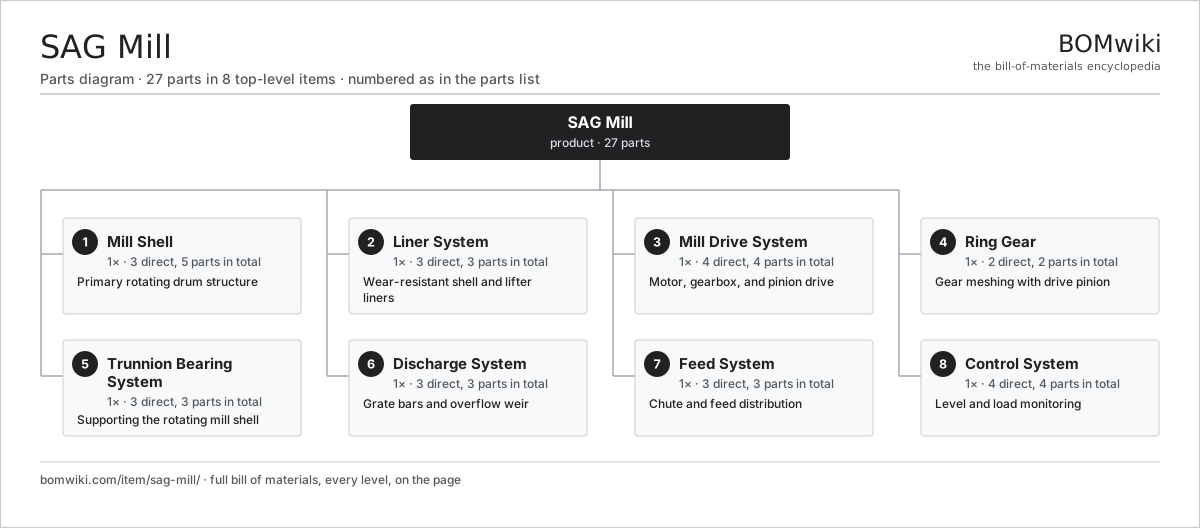
| # | Part | Qty | What it does |
|---|---|---|---|
| 1 | Mill Shell 3 parts | 1× | Primary rotating drum structure |
| 2 | Liner System 3 parts | 1× | Wear-resistant shell and lifter liners |
| 3 | Mill Drive System 4 parts | 1× | Motor, gearbox, and pinion drive |
| 4 | Ring Gear 2 parts | 1× | Gear meshing with drive pinion |
| 5 | Trunnion Bearing System 3 parts | 1× | Supporting the rotating mill shell |
| 6 | Discharge System 3 parts | 1× | Grate bars and overflow weir |
| 7 | Feed System 3 parts | 1× | Chute and feed distribution |
| 8 | Control System 4 parts | 1× | Level and load monitoring |
3D model
No 3D model yet. Have a CAD file of this? Add a 3D model. STL renders right on this page; STEP, FreeCAD, and OpenSCAD sources are welcome too (openly licensed, like all 3D models on BOMwiki).
Build & assembly graph
expand / collapse · shared sub-assemblies converge · links to related products · est. labourTap an assembly to expand/collapse · tap a part to open it · use “Open page” for any node · drag to pan, scroll to zoom.
Bill of materials for SAG Mill
8 top-level lines · 33 rows shown · 27 parts total · indented to 3 levels| # | Item / sub-assembly | Part no. | Qty/assy | Ext. qty | Parts | Type |
|---|---|---|---|---|---|---|
| 1 | Mill Shell 3 parts | sag-mill-mill-shell | 1× | 1 | 5 | assembly |
| 1.1 | Mill Shell Cylinder | sag-mill-shell-body | 1× | 1 | · | part |
| 1.2 | End Flanges | sag-mill-shell-flanges | 2× | 2 | · | part |
| 1.3 | Trunnion Pins | sag-mill-trunnion-pins | 2× | 2 | · | part |
| 2 | Liner System 3 parts | sag-mill-liners | 1× | 1 | 3 | assembly |
| 2.1 | Shell Liners | sag-mill-shell-liners | 1× | 1 | · | part |
| 2.2 | Lifter Bars | sag-mill-lifter-bars | 1× | 1 | · | part |
| 2.3 | Grate Discharge Liners | sag-mill-grate-liners | 1× | 1 | · | part |
| 3 | Mill Drive System 4 parts | sag-mill-mill-drive | 1× | 1 | 4 | assembly |
| 3.1 | Drive Motor | sag-mill-drive-motor | 1× | 1 | · | part |
| 3.2 | Main Gearbox | sag-mill-main-gearbox | 1× | 1 | · | part |
| 3.3 | Pinion Gear | sag-mill-pinion | 1× | 1 | · | part |
| 3.4 | Motor Coupling | sag-mill-motor-coupling | 1× | 1 | · | part |
| 4 | Ring Gear 2 parts | sag-mill-ring-gear | 1× | 1 | 2 | assembly |
| 4.1 | Ring Gear Segment | sag-mill-ring-gear-segment | 1× | 1 | · | part |
| 4.2 | Ring Gear Fastening | sag-mill-ring-gear-bolts | 1× | 1 | · | part |
| 5 | Trunnion Bearing System 3 parts | sag-mill-trunnion-bearings | 1× | 1 | 3 | assembly |
| 5.1 | Front Bearing | sag-mill-mill-bearing-front | 1× | 1 | · | part |
| 5.2 | Rear Bearing | sag-mill-mill-bearing-rear | 1× | 1 | · | part |
| 5.3 | Bearing Lubrication | sag-mill-bearing-lubrication | 1× | 1 | · | part |
| 6 | Discharge System 3 parts | sag-mill-discharge-system | 1× | 1 | 3 | assembly |
| 6.1 | Grate Bars | sag-mill-grate-bars | 1× | 1 | · | part |
| 6.2 | Overflow Weir | sag-mill-overflow-weir | 1× | 1 | · | part |
| 6.3 | Discharge Chute | sag-mill-discharge-chute | 1× | 1 | · | part |
| 7 | Feed System 3 parts | sag-mill-feed-system | 1× | 1 | 3 | assembly |
| 7.1 | Feed Hopper | sag-mill-feed-hopper | 1× | 1 | · | part |
| 7.2 | Feed Chute | sag-mill-feed-chute | 1× | 1 | · | part |
| 7.3 | Feed Gate | sag-mill-feed-gate | 1× | 1 | · | part |
| 8 | Control System 4 parts | sag-mill-control-system | 1× | 1 | 4 | assembly |
| 8.1 | Mill Level Sensor | sag-mill-level-sensor | 1× | 1 | · | part |
| 8.2 | Motor Load Monitor | sag-mill-motor-current-sensor | 1× | 1 | · | part |
| 8.3 | Discharge Density Meter | sag-mill-discharge-density-sensor | 1× | 1 | · | part |
| 8.4 | Mill Controller | sag-mill-plc | 1× | 1 | · | part |
Something wrong in this list? Report a problem with this BOM.
Sourcing: possible vendors
Browse the supplier directory → Prices, MOQ, and lead times are algorithmic estimates, not quotes, and not claims about these companies. Company mappings are curated by keyword; est. price band $200k–$5M. How estimates work| Vendor | HQ | Specialty | MOQ | Lead time |
|---|---|---|---|---|
| caterpillar.com ↗ | Irving, US | Construction & mining equipment | made to order | 20–36 wks |
|
🇯🇵Komatsu
komatsu.com ↗
|
Tokyo, JP | Construction & mining equipment | made to order | 20–36 wks |
|
🇸🇪Sandvik
rocktechnology.sandvik ↗
|
Stockholm, SE | Mining & rock technology | made to order | 20–36 wks |
|
🇸🇪Epiroc
epiroc.com ↗
|
Stockholm, SE | Mining & drilling equipment | made to order | 20–36 wks |
|
🇫🇮Metso
metso.com ↗
|
Helsinki, FI | Crushing & minerals processing | made to order | 20–36 wks |
1,275-word article