Sand Classifying Tank
ProductOverview
A sand classifying tank, also called a settling tank or clarifier, is a large basin that removes fine sand and clay from slurry produced by wash plant cyclones or spiral classifiers. The tank works on gravity settling: incoming slurry is distributed across the basin, velocity reduces, and sand particles gradually sink. A rotating rake arm slowly sweeps settled sand toward a central collection flume, where it is discharged as a concentrated underflow (70–80% solids). Clarified water exits as overflow at the basin perimeter, recycled back to the wash plant or sent to final disposal.
Classifying tanks are essential in aggregate processing because they:
- Allow fine settling in calm conditions, achieving 5–15 second residence per particle
- Separate sand (>0.074 mm) from clay and ultra-fine silts via differential settling
- Concentrate sand into a dewatering-ready slurry with minimal dilution
- Recirculate clear water indefinitely without disposal, lowering freshwater consumption
- Handle high fluctuations in feed rate without washing away settled material
Tanks range from 4 to 12 meters in diameter and hold 100–500 m³. In large quarries processing 100+ tonnes per hour, multiple tanks are installed in parallel, each handling 20–30 tonnes per hour of cyclone underflow.
Settling Theory and Design
Gravity settling efficiency depends on five variables:
Retention Time: Residence time in the tank. Most fine sand (100–200 microns) settles within 2–4 hours, while clay (1–10 microns) requires 8–24 hours. Most tanks are designed for 4–8 hour retention to balance settling completeness against tank size cost.
Settling Velocity: The speed at which particles sink due to gravity. Sand (density 2.65 g/cm³) settles at 0.5–2 m/hour depending on particle size. Stokes' law governs settling: fine particles settle slower (proportional to diameter squared). A 100-micron sand particle settles 100 times faster than a 10-micron clay particle.
Basin Geometry: Circular basins with gentle sloping floors and baffles are preferred. The baffle redirects inlet turbulence and prevents short-circuiting (some slurry flowing straight through without settling). Most tanks are 2–3 meters deep, balancing settling distance against cost.
Feed Distribution: The inlet hopper reduces inlet velocity from 1–2 m/second in the feed pipe to <0.1 m/second in the basin. This sharp velocity reduction allows particles to begin settling immediately rather than being swept across the tank.
Underflow Concentration: As the rotating rake collects settled sand, it compacts the bed, raising solids concentration. At 75–80% solids, friction between particles prevents further thickening; additional water is removed in the central flume. Solids concentration is critical: too low (60% solids), and the discharge valve wastes water; too high (>85% solids), and the sand becomes sticky and prone to jamming.
Tank Operation and Material Flow
Feed Entry
Slurry from the wash plant cyclones or spiral classifier arrives at the inlet hopper at 50–70% solids. The hopper is submerged at the tank center or perimeter, designed to distribute flow uniformly across the basin floor. This dissipation chamber reduces velocity from 1–2 m/second to <0.1 m/second, critical for allowing particles to settle.
Settling Zone
As slurry spreads across the basin floor, sand particles immediately begin settling. The baffle, a weir or internal wall, reduces turbulence and prevents short-circuiting. Particles settle according to Stokes' law:
- Sand (100–200 microns): Settles to basin floor in 1–2 hours
- Fine sand (50–100 microns): Settles in 2–4 hours
- Silt (10–50 microns): Settles in 4–24 hours
- Clay (<10 microns): May not settle; carries in overflow
Most operating tanks are designed for 4–8 hour retention, ensuring 100–50 micron sand settles completely while much clay remains suspended.
Rake Action
The rotating rake arm, a slow-turning device at 1–5 rpm, continuously sweeps settled sand toward the central collection flume. The rake consists of two or more radial blades carrying replaceable wear strips of hardened steel or urethane. As the rake rotates, these blades scrape the settled sand layer, moving it radially inward.
The rake speed is deliberately slow to minimize resuspension. A fast rake might stir settled sand back into the slurry, reversing the settling work. Instead, the gentle rake speed (1–5 rpm) allows settled sand to move compactly toward the center without liquefaction.
The rake drive consists of a small electric motor (0.75–3 kW) coupled through a heavy-duty gearbox (100:1 to 300:1) to reduce 1500 rpm to 5–15 rpm at the gearbox output, then further reduced via chain or belt drive to the rake shaft at 1–5 rpm. This massive speed reduction ensures torque is available to move compacted sand against friction.
Central Collection and Discharge
Settled sand and compacted slurry slide into the central flume, a V or U-shaped trough at the tank bottom center. The sand-water mixture flows through a vertical standpipe into the discharge valve, which is manually controlled or solenoid-operated. Operators adjust valve opening to control discharge rate, balancing settled sand removal against discharge line capacity.
The underflow discharged is typically 70–80% solids (sand) and 20–30% water. This concentrated slurry flows to a downstream dewatering screen or dewatering unit for final moisture removal before stockpiling.
Overflow and Recirculation
Clear water (or slurry with <3% solids) exits the basin perimeter at a weir level height, flowing to an overflow pipe that routes to either a secondary settling pond or directly back to the wash plant water circulation pump. If overflow turbidity exceeds 50 NTU (nephelometric turbidity units), it indicates that clay-sized particles are short-circuiting; operators may slow feed rate or increase tank retention time to allow more time for settling.
Instrumentation and Control
Level Monitoring
The level control system includes two sensors:
High-Level Alarm: A float or capacitive sensor at the overflow weir detects if slurry level rises above the design limit. If triggered, the sensor signals the feed pump to reduce speed or stops the pump entirely, preventing overflow.
Low-Level Alarm: An underflow sensor at the flume detects if the sand bed level drops too low. This indicates either excessive discharge or insufficient feed, risking air entrainment in the discharge line. If triggered, the sensor closes the discharge valve or raises an alarm.
Pressure Monitoring
Pressure gauges on inlet and outlet headers monitor slurry density and flow conditions. High inlet pressure combined with low overflow turbidity indicates good separation. High outlet pressure with low discharge rate suggests sand buildup in the flume or discharge line blockage.
Maintenance Needs
Classifying tanks are relatively simple machines but require regular attention:
- Rake blade wear: Blades are replaceable and wear 2–4 mm per month in heavy-duty service. Worn blades are less effective at moving settled sand; replacement intervals vary from 3–12 months depending on incoming fines content.
- Rake bearing seals: Water infiltration can cause corrosion. Bearings are sealed with o-rings and should be replaced annually.
- Shaft seal: The mechanical seal preventing water from entering the motor is the single most maintenance-intensive component. Leakage indicates seal wear; replacement every 12–24 months is normal.
- Discharge valve erosion: Slurry flow gradually wears the valve seat, causing leakage. Valve trim is replaced every 2–5 years.
- Tank cleaning: Settled sludge builds up slowly if very fine clays are present. Annual draining and cleaning prevents hardened sludge buildup that can jam the rake.
Applications in Processing Circuits
Sand classifying tanks are typically installed in two configurations:
Single Cyclone + Single Tank
A single cyclone feeds a 6–8 meter diameter tank sized for 4–8 hour retention. This is common in smaller quarries processing 20–30 tonnes per hour of slurry.
Multiple Cyclones + Multiple Tanks (or Large Single Tank)
Large wash plants with 4–6 cyclones may feed a single 10–12 meter tank or multiple 6–8 meter tanks in parallel. Each tank handles 10–20 tonnes per hour and is independently controlled.
In some modern plants, tanks are replaced by thickeners (larger-diameter, shallower settling tanks with mechanical rakes), which can achieve higher underflow density (80–90% solids) but occupy more footprint. Thickeners are economical in high-tonnage operations (>100 t/h) where saving on subsequent dewatering energy and chemicals justifies the large footprint.
Waste Disposal and Environmental Compliance
In environmentally sensitive regions, tank overflow cannot be discharged directly to streams. Instead, overflow is sent to a secondary settling pond or lagoon where further settling occurs over days to weeks. Solids eventually settle, and only clear water is permitted to exit the site.
Some operators recirculate tank overflow back to the cyclone for re-treatment, effectively using the tank as both a settling and recycling system. This eliminates external water discharge entirely, reducing freshwater consumption to <1 liter per tonne processed, among the lowest in the industry.
Tank sludge (accumulated clay and ultra-fine material) is periodically removed by draining and trucking to a licensed disposal site or using it as landfill daily cover in nearby operations.
Sand Classifying Tank parts and their functions
9 top-level parts · 56 parts in total · full bill of materials below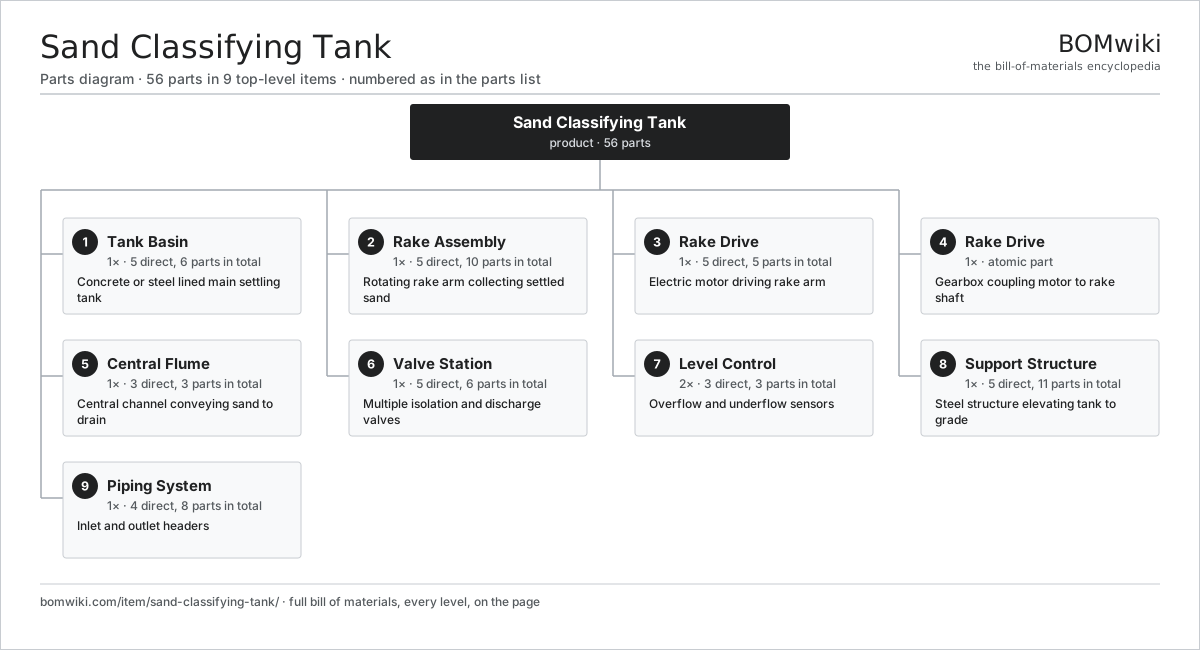
| # | Part | Qty | What it does |
|---|---|---|---|
| 1 | Tank Basin 5 parts | 1× | Concrete or steel lined main settling tank |
| 2 | Rake Assembly 5 parts | 1× | Rotating rake arm collecting settled sand |
| 3 | Rake Drive 5 parts | 1× | Electric motor driving rake arm |
| 4 | Rake Drive | 1× | Gearbox coupling motor to rake shaft |
| 5 | Central Flume 3 parts | 1× | Central channel conveying sand to drain |
| 6 | Valve Station 5 parts | 1× | Multiple isolation and discharge valves |
| 7 | Level Control 3 parts | 2× | Overflow and underflow sensors |
| 8 | Support Structure 5 parts | 1× | Steel structure elevating tank to grade |
| 9 | Piping System 4 parts | 1× | Inlet and outlet headers |
3D model
No 3D model yet. Have a CAD file of this? Add a 3D model. STL renders right on this page; STEP, FreeCAD, and OpenSCAD sources are welcome too (openly licensed, like all 3D models on BOMwiki).
Build & assembly graph
expand / collapse · shared sub-assemblies converge · links to related products · est. labourTap an assembly to expand/collapse · tap a part to open it · use “Open page” for any node · drag to pan, scroll to zoom.
Bill of materials for Sand Classifying Tank
9 top-level lines · 44 rows shown · 56 parts total · indented to 3 levels| # | Item / sub-assembly | Part no. | Qty/assy | Ext. qty | Parts | Type |
|---|---|---|---|---|---|---|
| 1 | Tank Basin 5 parts | sand-classifying-tank-basin | 1× | 1 | 6 | assembly |
| 1.1 | Tank Walls | sand-classifying-tank-basin-wall | 1× | 1 | · | part |
| 1.2 | Tank Floor | sand-classifying-tank-basin-floor | 1× | 1 | · | part |
| 1.3 | Inlet Hopper | sand-classifying-tank-inlet-hopper | 1× | 1 | · | part |
| 1.4 | Internal Baffle | sand-classifying-tank-baffle | 1× | 1 | · | part |
| 1.5 | Sheet Metal Panel | sheet-panel | 2× | 2 | · | part |
| 2 | Rake Assembly 5 parts | sand-classifying-tank-rake | 1× | 1 | 10 | assembly |
| 2.1 | Rake Shaft | sand-classifying-tank-rake-shaft | 1× | 1 | · | part |
| 2.2 | Rake Arm | sand-classifying-tank-rake-arm | 2× | 2 | · | part |
| 2.3 | Rake Blade | sand-classifying-tank-rake-blade | 4× | 4 | · | part |
| 2.4 | Rake Bearing | sand-classifying-tank-rake-bearing | 2× | 2 | · | part |
| 2.5 | Shaft Seal | sand-classifying-tank-rake-seal | 1× | 1 | · | part |
| 3 | Rake Drive 5 parts | sand-classifying-tank-rake-motor | 1× | 1 | 5 | assembly |
| 3.1 | Motor | sand-classifying-tank-motor | 1× | 1 | · | part |
| 3.2 | Gearbox | sand-classifying-tank-gearbox | 1× | 1 | · | part |
| 3.3 | Coupling | sand-classifying-tank-coupling | 1× | 1 | · | part |
| 3.4 | Drive Chain | sand-classifying-tank-drive-chain | 1× | 1 | · | part |
| 3.5 | Motor Mount | sand-classifying-tank-motor-support | 1× | 1 | · | part |
| 4 | Rake Drive | sand-classifying-tank-rake-drive | 1× | 1 | · | part |
| 5 | Central Flume 3 parts | sand-classifying-tank-collecting-flume | 1× | 1 | 3 | assembly |
| 5.1 | Flume Channel | sand-classifying-tank-flume-channel | 1× | 1 | · | part |
| 5.2 | Flume Standpipe | sand-classifying-tank-flume-connection | 1× | 1 | · | part |
| 5.3 | Flume Baffle | sand-classifying-tank-flume-baffle | 1× | 1 | · | part |
| 6 | Valve Station 5 parts | sand-classifying-tank-valve-station | 1× | 1 | 6 | assembly |
| 6.1 | Isolation Valve | sand-classifying-tank-isolation-valve | 2× | 2 | · | part |
| 6.2 | Discharge Valve | sand-classifying-tank-discharge-valve | 1× | 1 | · | part |
| 6.3 | Overflow Pipe | sand-classifying-tank-overflow-pipe | 1× | 1 | · | part |
| 6.4 | Valve Manifold | sand-classifying-tank-manifold | 1× | 1 | · | part |
| 6.5 | Discharge Hose | sand-classifying-tank-hose | 1× | 1 | · | part |
| 7 | Level Control 3 parts | sand-classifying-tank-level-sensor | 2× | 2 | 3 | assembly |
| 7.1 | Overflow Sensor | sand-classifying-tank-overflow-sensor | 1× | 2 | · | part |
| 7.2 | Underflow Sensor | sand-classifying-tank-underflow-sensor | 1× | 2 | · | part |
| 7.3 | Level Controller | sand-classifying-tank-sensor-controller | 1× | 2 | · | part |
| 8 | Support Structure 5 parts | sand-classifying-tank-support-frame | 1× | 1 | 11 | assembly |
| 8.1 | Support Column | sand-classifying-tank-column | 2× | 2 | · | part |
| 8.2 | Cross Brace | sand-classifying-tank-cross-brace | 4× | 4 | · | part |
| 8.3 | Foundation Pad | sand-classifying-tank-foundation-pad | 2× | 2 | · | part |
| 8.4 | Access Ladder | sand-classifying-tank-access-ladder | 1× | 1 | · | part |
| 8.5 | Sheet Metal Panel | sheet-panel | 2× | 2 | · | part |
| 9 | Piping System 4 parts | sand-classifying-tank-piping | 1× | 1 | 8 | assembly |
| 9.1 | Inlet Header | sand-classifying-tank-inlet-header | 1× | 1 | · | part |
| 9.2 | Outlet Header | sand-classifying-tank-outlet-header | 1× | 1 | · | part |
| 9.3 | Pressure Gauge | sand-classifying-tank-pressure-gauge | 2× | 2 | · | part |
| 9.4 | Hose Clamp | sand-classifying-tank-hose-clamp | 4× | 4 | · | part |
Something wrong in this list? Report a problem with this BOM.
Related products
same domain, ranked by shared parts Aggregate Wash Plant
115 parts · shares 1 with this page
Aggregate Wash Plant
115 parts · shares 1 with this page
 Baghouse Dust Collector
246 parts · shares 1 with this page
Baghouse Dust Collector
246 parts · shares 1 with this page
 Diamond Core Drill Rig
107 parts · shares 1 with this page
Double Roll Crusher
214 parts · shares 1 with this page
Diamond Core Drill Rig
107 parts · shares 1 with this page
Double Roll Crusher
214 parts · shares 1 with this page
 Gravity Concentrating Table
184 parts · shares 1 with this page
Gyratory Crusher
86 parts · shares 1 with this page
Gravity Concentrating Table
184 parts · shares 1 with this page
Gyratory Crusher
86 parts · shares 1 with this page
Sourcing: possible vendors
Browse the supplier directory → Prices, MOQ, and lead times are algorithmic estimates, not quotes, and not claims about these companies. Company mappings are curated by keyword; est. price band $200k–$5M. How estimates work| Vendor | HQ | Specialty | MOQ | Lead time |
|---|---|---|---|---|
| caterpillar.com ↗ | Irving, US | Construction & mining equipment | made to order | 20–36 wks |
|
🇯🇵Komatsu
komatsu.com ↗
|
Tokyo, JP | Construction & mining equipment | made to order | 20–36 wks |
|
🇸🇪Sandvik
rocktechnology.sandvik ↗
|
Stockholm, SE | Mining & rock technology | made to order | 20–36 wks |
|
🇸🇪Epiroc
epiroc.com ↗
|
Stockholm, SE | Mining & drilling equipment | made to order | 20–36 wks |
|
🇫🇮Metso
metso.com ↗
|
Helsinki, FI | Crushing & minerals processing | made to order | 20–36 wks |
1,650-word article