Sanforizing Machine
ProductOverview
A sanforizing machine is a shrink-proofing machine that mechanically compresses fabric to control residual shrinkage. The process involves dampening fabric, wrapping it around a large heated cylinder called a palmer cylinder, and pressing it against the cylinder with an elastomeric rubber belt. This controlled compression shrinks the fabric in a predictable way, reducing the shrinkage that would otherwise occur in washing or wearing.
Cotton fabrics naturally shrink 5–7% when washed because fibers relax and contract; sanforizing removes 80–90% of this potential shrinkage pre-finishing, guaranteeing stable garment dimensions. The process is called sanforizing after the original process by Sanford (1930s), though modern variants exist.
How It Works
Fabric from the unwind stand is first dampened with controlled moisture (typically 10–15% water by weight). Moisture plasticizes the fiber, making it more compressible. A dampening roller covered in wet felt applies an even water film; alternatively, spray nozzles mist the fabric.
The dampened fabric then enters the feed nip and is drawn into the narrow gap between a large heated palmer cylinder and an elastomeric rubber belt. The fabric wraps partway around the palmer (typically 180–270 degrees) and is pressed firmly. The combination of heat (100–150°C), moisture, and pressure causes permanent molecular relaxation: fibers shorten and contract.
As the fabric exits the nip and moves forward, the moisture begins to evaporate. A cooling section with chilled rollers and air circulation removes residual moisture and cools the fabric, "locking in" the shrunken dimension. The fabric is then rewound.
Result: the fabric has undergone 4–5% permanent shrinkage (mechanical), reducing residual shrinkage from 5–7% to <1% for lengthwise, or <2% for widthwise.
Palmer Cylinder
The palmer cylinder is the heart of the machine. A large steel drum 500–1000 mm diameter, it rotates at 30–100 rpm and is heated internally to 100–150°C via electric heating elements or steam circulation. The cylinder's surface is smooth and rounded; fabric wraps around it following its curvature.
The rubber belt (typically 5–20 mm thick synthetic rubber or elastomer) is pressed against the palmer by spring or pneumatic tension, creating a narrow nip. The belt's elasticity allows it to conform to fabric surface irregularities, distributing pressure evenly.
Dampening and Moisture Control
Moisture is critical to the sanforizing process. Dry fabric does not compress easily; over-dampened fabric becomes sticky and may wrinkle. The moisture sensor monitors fabric moisture content and adjusts spray nozzle flow or dampening roller pressure to maintain the target 10–15% moisture add-on.
Water type: soft water is preferred to avoid mineral deposits on the palmer. Some mills add small amounts of lubricants or surfactants to water to improve fiber relaxation.
Nip Pressure and Compression
Nip pressure (150–500 kN depending on fabric width and desired shrinkage) determines shrinkage depth. Higher pressure increases shrinkage but risks over-crushing fibers or creating harsh handle. Lower pressure produces less shrinkage and softer fabric.
Fabric wrapping angle affects compression time. Wrapping 180 degrees around the palmer gives ~1 second dwell time at 50 m/minute; 270 degrees gives ~1.5 seconds. Longer dwell allows more complete fiber relaxation but requires slower speeds.
Cooling and Stabilization
The cooling zone is critical for fixing the shrunken dimension. If fabric cools too slowly, fibers can gradually re-relax as residual moisture remains. The cooled roller and air circulation fan rapidly remove moisture and lower fabric temperature to below 40°C before winding.
Some machines include an extra drying stage with infrared heat or hot air to remove moisture completely.
Residual Shrinkage Specifications
After sanforizing:
- Warp shrinkage (lengthwise): Typically <0.5–1% in subsequent washing.
- Weft shrinkage (widthwise): Typically <1–2% (slightly higher due to mechanical structure).
- Standards: ISO 5077, ASTM D1276, JIS L0105.
Most mills conduct post-treatment shrinkage testing by washing samples (typically 5 cycles at 40°C) and measuring dimension change.
Fabric Types and Sanforizing
Sanforizing is most common on cotton and cotton-blend woven fabrics:
- Shirting fabrics: 90–150 g/m² requiring <1% shrinkage guarantee.
- Denim: Heavy 400–600 g/m² requiring <3–5% shrinkage allowance.
- Canvas and twill: Medium-weight requiring <2–3% shrinkage.
- Fine cotton:100–120 g/m² requiring tight (<1%) shrinkage control.
Synthetic-rich blends (polyester/cotton) have lower shrinkage potential and may not require sanforizing. Wool fabrics are seldom sanforized mechanically; chemical or thermal shrink-proofing is preferred.
Machine Variants
- Classic Sanford sanforizer: Large palmer cylinder with rubber belt (described above).
- Double-palmer sanforizer: Two palmer cylinders for increased compression.
- Combination sanforizer-curing machine: Sanforizing followed by heat curing in one pass.
- Flat-bed sanforizer: Horizontal fabric bed with heated roller pressing down; used for special fabrics or pile fabrics.
Most mills use the classical palmer-belt design for high-speed production. Flat-bed machines are used for delicate or specialized fabrics.
Integration in Production Lines
Sanforizing is typically done:
- After scouring and before dyeing: Shrinkage before color application ensures uniform dye uptake.
- After singeing: Fuzz is removed before sanforizing.
- After bleaching: Often combined with sanforizing for efficiency.
Some mills delay sanforizing to post-dyeing to avoid dye migration during compression. This is less common due to efficiency loss.
Sustainability Considerations
Sanforizing requires significant water and energy (heating to 100–150°C, cooling, moisture application). Some mills are investigating gentler shrink-proofing methods (enzyme or chemical treatments). However, mechanical sanforizing remains the gold standard for guaranteed shrinkage reduction in cotton apparel.
Wastewater from sanforizing is low-contamination (mostly water) and can be reused or discharged with minimal treatment.
Sanforizing Machine parts and their functions
8 top-level parts · 53 parts in total · full bill of materials below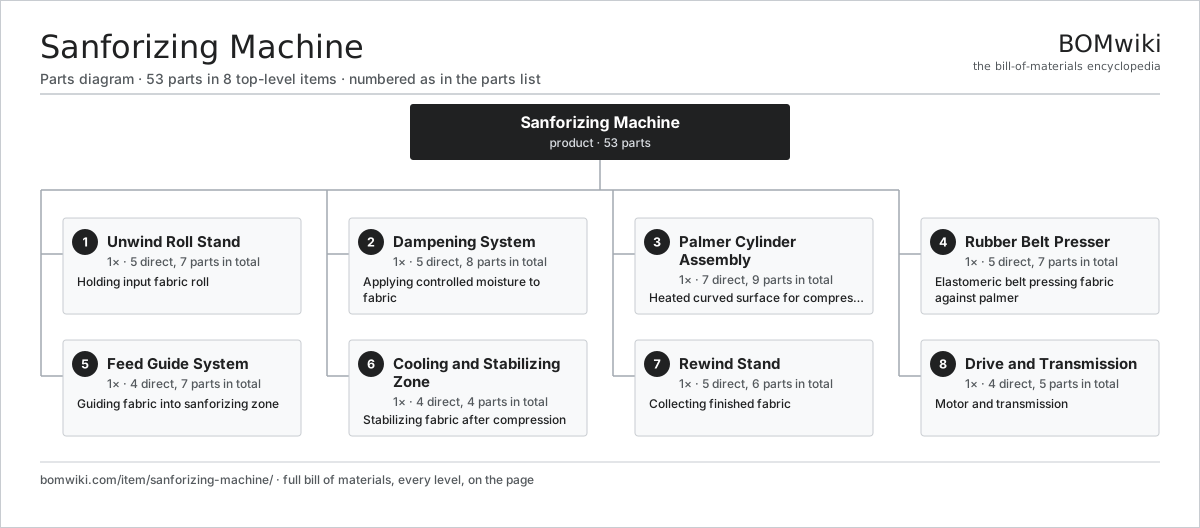
| # | Part | Qty | What it does |
|---|---|---|---|
| 1 | Unwind Roll Stand 5 parts | 1× | Holding input fabric roll |
| 2 | Dampening System 5 parts | 1× | Applying controlled moisture to fabric |
| 3 | Palmer Cylinder Assembly 7 parts | 1× | Heated curved surface for compression |
| 4 | Rubber Belt Presser 5 parts | 1× | Elastomeric belt pressing fabric against palmer |
| 5 | Feed Guide System 4 parts | 1× | Guiding fabric into sanforizing zone |
| 6 | Cooling and Stabilizing Zone 4 parts | 1× | Stabilizing fabric after compression |
| 7 | Rewind Stand 5 parts | 1× | Collecting finished fabric |
| 8 | Drive and Transmission 4 parts | 1× | Motor and transmission |
3D model
No 3D model yet. Have a CAD file of this? Add a 3D model. STL renders right on this page; STEP, FreeCAD, and OpenSCAD sources are welcome too (openly licensed, like all 3D models on BOMwiki).
Build & assembly graph
expand / collapse · shared sub-assemblies converge · links to related products · est. labourTap an assembly to expand/collapse · tap a part to open it · use “Open page” for any node · drag to pan, scroll to zoom.
Bill of materials for Sanforizing Machine
8 top-level lines · 47 rows shown · 53 parts total · indented to 3 levels| # | Item / sub-assembly | Part no. | Qty/assy | Ext. qty | Parts | Type |
|---|---|---|---|---|---|---|
| 1 | Unwind Roll Stand 5 parts | sanforizing-machine-unwind-stand | 1× | 1 | 7 | assembly |
| 1.1 | Input Roll Shaft | sanforizing-machine-roll-shaft | 1× | 1 | · | part |
| 1.2 | Bearing Block | sanforizing-machine-bearing-block | 2× | 2 | · | part |
| 1.3 | Unwind Tension Brake | sanforizing-machine-unwind-tension-brake | 1× | 1 | · | part |
| 1.4 | Dancer Tension Arm | sanforizing-machine-dancer-arm | 1× | 1 | · | part |
| 1.5 | Ball Bearing | ball-bearing | 2× | 2 | · | part |
| 2 | Dampening System 5 parts | sanforizing-machine-dampening-system | 1× | 1 | 8 | assembly |
| 2.1 | Dampening Roller | sanforizing-machine-dampening-roller | 1× | 1 | · | part |
| 2.2 | Spray Nozzle | sanforizing-machine-spray-nozzles | 4× | 4 | · | part |
| 2.3 | Dampening Water Pump | sanforizing-machine-water-pump | 1× | 1 | · | part |
| 2.4 | Dampening Water Tank | sanforizing-machine-water-tank | 1× | 1 | · | part |
| 2.5 | Moisture Sensor | sanforizing-machine-moisture-sensor | 1× | 1 | · | part |
| 3 | Palmer Cylinder Assembly 7 parts | sanforizing-machine-palmer-cylinder | 1× | 1 | 9 | assembly |
| 3.1 | Palmer Cylinder | sanforizing-machine-palmer-cylinder-drum | 1× | 1 | · | part |
| 3.2 | Palmer Heater Element | sanforizing-machine-palmer-heating-element | 1× | 1 | · | part |
| 3.3 | Palmer Water Jacket | sanforizing-machine-palmer-jacket-water | 1× | 1 | · | part |
| 3.4 | Palmer Shaft | sanforizing-machine-palmer-shaft | 1× | 1 | · | part |
| 3.5 | Palmer Bearing Block | sanforizing-machine-palmer-bearing-block | 2× | 2 | · | part |
| 3.6 | Palmer Drive Motor | sanforizing-machine-palmer-drive-motor | 1× | 1 | · | part |
| 3.7 | Ball Bearing | ball-bearing | 2× | 2 | · | part |
| 4 | Rubber Belt Presser 5 parts | sanforizing-machine-rubber-belt | 1× | 1 | 7 | assembly |
| 4.1 | Rubber Belt | sanforizing-machine-rubber-belt-element | 1× | 1 | · | part |
| 4.2 | Belt Drive Pulley | sanforizing-machine-belt-pulley-drive | 1× | 1 | · | part |
| 4.3 | Belt Tension Adjuster | sanforizing-machine-belt-tension-adjuster | 1× | 1 | · | part |
| 4.4 | Belt Idler Roller | sanforizing-machine-belt-idler-roller | 2× | 2 | · | part |
| 4.5 | Ball Bearing | ball-bearing | 2× | 2 | · | part |
| 5 | Feed Guide System 4 parts | sanforizing-machine-feed-rollers | 1× | 1 | 7 | assembly |
| 5.1 | Top Feed Roller | sanforizing-machine-feed-roller-top | 1× | 1 | · | part |
| 5.2 | Bottom Feed Roller | sanforizing-machine-feed-roller-bottom | 1× | 1 | · | part |
| 5.3 | Feed Nip Spring | sanforizing-machine-feed-nip-pressure-spring | 1× | 1 | · | part |
| 5.4 | Ball Bearing | ball-bearing | 4× | 4 | · | part |
| 6 | Cooling and Stabilizing Zone 4 parts | sanforizing-machine-cooling-section | 1× | 1 | 4 | assembly |
| 6.1 | Cooling Roller | sanforizing-machine-cool-roller | 1× | 1 | · | part |
| 6.2 | Cooling Fan | sanforizing-machine-cooling-fan | 1× | 1 | · | part |
| 6.3 | Chiller Unit | sanforizing-machine-cooling-water-circulation | 1× | 1 | · | part |
| 6.4 | Cooling Zone Sensor | sanforizing-machine-cool-temperature-sensor | 1× | 1 | · | part |
| 7 | Rewind Stand 5 parts | sanforizing-machine-rewind-stand | 1× | 1 | 6 | assembly |
| 7.1 | Rewind Motor | sanforizing-machine-rewind-motor | 1× | 1 | · | part |
| 7.2 | Rewind Shaft | sanforizing-machine-rewind-shaft | 1× | 1 | · | part |
| 7.3 | Rewind Nip Roller | sanforizing-machine-rewind-nip-roller | 1× | 1 | · | part |
| 7.4 | Rewind Tension Arm | sanforizing-machine-rewind-tension-arm | 1× | 1 | · | part |
| 7.5 | Ball Bearing | ball-bearing | 2× | 2 | · | part |
| 8 | Drive and Transmission 4 parts | sanforizing-machine-drive-system | 1× | 1 | 5 | assembly |
| 8.1 | Main Drive Motor | sanforizing-machine-main-motor | 1× | 1 | · | part |
| 8.2 | Variable Frequency Drive | sanforizing-machine-frequency-converter | 1× | 1 | · | part |
| 8.3 | Power Transmission | sanforizing-machine-transmission-belts | 1× | 1 | · | part |
| 8.4 | Relay | relay | 2× | 2 | · | part |
Something wrong in this list? Report a problem with this BOM.
Sourcing: possible vendors
Browse the supplier directory → Prices, MOQ, and lead times are algorithmic estimates, not quotes, and not claims about these companies. Company mappings are curated by keyword; est. price band $10k–$1M. How estimates work| Vendor | HQ | Specialty | MOQ | Lead time |
|---|---|---|---|---|
|
🇨🇭Rieter
rieter.com ↗
|
Winterthur, CH | Spinning machinery | 10 units | 14–24 wks |
| truetzschler.com ↗ | Mönchengladbach, DE | Textile machinery | 10 units | 14–24 wks |
|
🇧🇪Picanol
picanol.be ↗
|
Ypres, BE | Weaving machines | 10 units | 14–24 wks |
| karlmayer.com ↗ | Obertshausen, DE | Warp knitting machines | 10 units | 14–24 wks |
|
🇨🇭Saurer
saurer.com ↗
|
Arbon, CH | Spinning & embroidery | 10 units | 14–24 wks |
1,007-word article